Showing posts with label Mark. Show all posts
Showing posts with label Mark. Show all posts
Tuesday, March 15, 2022


Thursday, July 19, 2012
FacePlant of the Day - Debunking Christianity: One of the worst Christian argument I have ever had the displeasure to argue against

Recently, I posted a piece on biblical contradictions and how Christians harness cognitive dissonance tohelp them find desperate ways in which to defend ideas of inerrancy. I looked to show that they use a circular approach without realising it:
1) The Bible never makes contradictions
2) All alleged contradictions can be harmonised
3) Since the Bible never makes contradictions, all harmonisations are inherently more probable than the idea that there are contradictions
4) All harmonisations stand
C) Therefore, there are no contradictions in the Bible.
Here is one example of where Pearce goes off the rails. I have been studying the Bible for years. I have come to the conclusion that the Bible has no contradictions because I haven't found any. A harmonization is not enough. Either there is an explanation or there isn't. I keep finding out that when I don't understand a discrepancy in the text the problem is me - not the text.
The example of contradiction I gave in the original post was this:
Mark 5:1-2
They came to the other side of the sea, into the country of the Gerasenes. 2 When He got out of the boat, immediately a man from the tombs with an unclean spirit met Him,
Matt 8:28
When He came to the other side into the country of the Gadarenes, two men who were demon-possessed met Him as they were coming out of the tombs. They were so extremely violent that no one could pass by that way.
Luke 8:26-7
Then they sailed to the country of the Gerasenes, which is opposite Galilee. 27 And when He came out onto the land, He was met by a man from the city who was possessed with demons;
Now for this post i am not interested in the contradiction of place, which seems fairly cut and dry as explained in the previous post.
Not cut or dry. But I have written on this and gone back and forth with Pearce on it. You can find it here: http://mmcelhaney.blogspot.com/2012/07/bible-contradiction-where-did-jesus.html and there: http://mmcelhaney.blogspot.com/2012/07/responding-to-jonathan-pearce-on-divine.html
I would like to concentrate on the number problem:
When He came to the other side into the country of the Gadarenes, two men who were demon-possessed met Him as they were coming out of the tombs.
He was met by a man from the city who was possessed with demons;
So let us move on to this rather obtuse defence (and that is being generous). It comes in the form of a blog post from Marcus McElhaney who was, as far as I can make out, once banned from this site. Since then, he has taken it upon himself to devote most of his blogging to attempting to debunk DC, so to speak. Except he monumentally fails. And he does so with aplomb here. As ever, he continually illustrates Danth's Law, defined here:
States: “If you have to insist that you've won an internet argument, you've probably lost badly.” Named after a user on the role-playing gamers’ forum RPG.net. Danth’s Law was most famously declared in “The Lenski Affair”, between microbiologist Richard Lenski and the editor of Conservapedia.com, Andrew Schlafly, who cast doubt upon Prof Lenski’s elegant experimental demonstration of evolution. After what is widely held to be one of the greatest and most comprehensive put-downs in scientific argument from Prof Lenski, Mr Schlafly declared himself the winner.So, Pearce does not think he won? Neither do I. Also, I was not banned from Debunking Christianity. I left when GearHedED admitted to being a pig and not worth talking to because I'd be casting my pearls before swine. Not worth the time. Vocal people at DC are only interested in pontificating about how much they hate Christianity and not really interested in discussion. Don't bother them with the facts, they're "minds" are already made up. Just like John Loftus. Since then I haven't made a single comment on the DC blog. But I have made the comments I wanted to make here. Just like Pearce did today although I have enough class to read and disagree with him on my blog no matter how stupid his ideas are!
The exchanges we have are heavy on the rhetoric due to the long and annoying history we have of arguing stuff. Marcus plays a numbers game, as follows, to circumvent the problem that one Gospel claims there was one demoniac whilst the other claims there were two:
As for the number of men Jesus met and healed. Mark and Luke definitely says that there was one one guy while Matthew says there were two. The thing is how is this a contradiction? A contradiction would be if Mark and Luke had said that there was only one man. They don't. Each of the Gospel contains details that are not in the others. But none of those details contradicts the details in the others. If I tell you that Jack and Jill went to the mall and bought a DVD, but I tell another person that Jill went to Walmart and bought a DVD, did I contradict myself? Nope. I just didn't give the same detail. A contradiction would be if the mall did not have a Walmart. You don't have such a thing in this case.
To which I replied, somewhat rhetorically:
This is the funniest defence I have seen. This was the JP Holding defence I warned you not to use. This is ridiculous because no two claimed numbers that are different can ever be a contradiction because one number is always smaller than the other, and is thus claimed to be a subset of another.
If I said i played football against a team of 10 men the other day (when there should be eleven), you would claim, "that's OK, you obviously meant 11 men since 11 men includes 10 men. Just because you said 10 doesn't mean there weren't 11!"
Ridiculous, silly. You would only see this from someone who can't bear for the accounts to differ. This is so ad hoc and improbable as to literally be laughed at. I laughed at this.
So, as mentioned, you reasons are incredibly improbable and would require redefining language into being used in ways it is not...
Your Jack and Jill analogy is simply a false analogy. it is not numerical.
If I say yesterday in a news report "1 person was shot at a bank robbery" that does not leave the possibility that I could mean "2 people were shot yesterday in a bank robbery".
I would simply be wrong in my first claim.
To which Marcus opined:
I would have said the football team must be 11. You don't know how many men Jesus met unlike you know how many people there should be on a football team. You have to go on what the text says. Again they don't conflict because neither tells you there was only one man. Just because Mark and Luke does not tell us about both of them does not mean they didn't know about him.
I chipped in:
Wow. I can't believe you really believe your own shit. You were unable to rebut my football analogy. In order for you to claim you understanding you would have to qualify. This is absolutely empirically true. If you claim what you do in all seriousness (I honestly don't think you really believe that) you would have to, and I now expect you to, when told any number in any context, ask the commentator to qualify themselves.Marcus is claiming that whenever someone is in a pickle (in danger of contradiction) and they make a numeric claim, then that number can be interpreted as being of any value higher than the actual number quoted. The problem with this is as follows:
Jim: Hey Marcus, I just ate 2 donuts.
Marcus: That's great Jim, but i was having this argument about inerrancy and now I have to ask you whether by 2, you mean 3...or 4... or 5... or 5001...
Jane: Hey Marcus. I just stayed in Vancouver for 6 nights.
Marcus: That's lovely. but by 6 nights, did you actually mean 7... 8... 9... 2546...
Marcus' mum: Marcus, can you go and buy me 2 chairs?
Marcus: Sure.... Here you are.
Mum: Why have you bought me 56 chairs?
Marcus: Well, 56 includes 2 right? So I am technically not wrong.
Mum: Marcus, did I teach you to be such an idiot?
Etc Etc
1) With the language used, there is no precedent for this happening in normal conversations.
2) There is no reason to believe, and no evidence to believe, that this would be the case in this instance, unless one was desperate enough to want it to be true.
3) This would make no sense, would invalidate, any conversation involving number that people have had and do have.
4) No two numbers can contradict unless, as Marcus claims, the word "only" is utilised.
Go back and read the exchange and better yet the text.Neither Mark or Luke tells us there was only one man. These books existed individually and isolated from one another for years. There are generations of Christians who only had Mark. Or who only had Matthew. Or who only had Luke. Or only had John.And that means that they would not have known about the second man if they only had Mark or Luke. A discrepancy or a difference in details does not a contradiction make nor a difference in detail a necessary error. The answer I gave is the same answer that has been given for centuries. In order to reject it you have to show that Mark and Luke did not know that there was a second man and/or that they were saying that there was no second man.
Marcus:
I am not arguing against numerical contradiction. I am arguing that Matthew chose to include then number of the demon possessed men Jesus healed on this occasion and Mark and Luke only talks about one of them, I don't know why but this not the only occasion that the gospels differ in details. Different details do not equal a contradiction. I know people like you will disagree but this makes sense. Of the three, which one would be most likely be an eyewitness of the event? Matthew. Notice he was one of the twelve and most likely would have been present and seen the two men with his own eyes. Mark and Luke were not eyewitness to the event and they only spotlighted...
Different details do not make a contradiction if those details do not contradidict. Omitting one man form the account is not a coNtadiction because neither Mark or Luke says that there was only one man there. Don 't like it? Too bad.
Prove that the apostle named Matthew is not the author of the Gospel that bears his name. I dare you.
I am not saying Mark or Luke got anything wrong. You are and nothing to show for it.
Notice a slight move away towards now defending it in the context of Matthean priority. What Marcus is pleading is that one of the Gospel writers had no need to mention two demoniacs since it must be that only one of them was doing interesting enough stuff to warrant being mentioned.
Um no. I'm not arguing that Matthew was written first or that it supersedes Mark, Luke, or John. I'm saying that Mark and Luke or not obligated to talk about the second man just because Matthew did. We don't know how much either knew about what details Matthew gave or not given that each was writing to a different audience.
However, given that the other Gospel writer mentioned him, it looks like both warranted mention.
And just where do Mark and John mention the other man? Keep in mind that the above text wasn't even written to Pearce. It was directed to another commentator who agree with Pearce. However he neglects to mention that there was another commentator. Does that mean that Pearce and I are in contradiction and that his account should not be considered because he did not mention the second commentator? Nope. There are several other reasons to discount his arguments.
I STILL can't believe you believe that stuff. I think you are merely paying lip service to your own cognitive dissonance.
Your numerical defence is so shoddy it makes me laugh.
If , in a court of law, I claimed I was assaulted by 3 men, and then the defence claimed, or a witness claimed, there were two men who assaulted me, this would be a contradiction that called into question at least one of the accounts. They would NOT SAY "well, three includes the number 2!"
When skeptics deny AGW (sadly misrepresenting science), they use different numbers than the climate scientists. This is to contradict the scientists. You DON'T hear people claiming "well the larger number includes the smaller number!"
I could go on with these analogies which you have failed to defend.
THEY ARE NOT DIFFERENT DETAILS such that one claimed he was wearing sandals and another witness claimed he had blonde hair such that the two pieces of information could be pieced together. There are two claims of the same subject - the numerical value of the demoniacs. If you don't get this, and keep making your rather embarrassing defences, then there is no hope for you... you need to give me concrete examples where people writing history say one thing but mean another, numerically speaking. Tell me where a quote when someone says "the army was 10,000 strong" actually meant something like "the army was 150,000 strong" because 10,000 is a subset of 150,000! You are utterly bastardising the English language. I have illustrated this with many analogies which you have simply ignored.
You are using understanding of the language that is not only not used, but highly improbable, and you don't even have the gall to admit it.
Marcus again:
Neither would a court of law conclude that no assault happened or that either witness is a liar. This is the kind of thing you would expect from eyewitness testimony. Of the three accounts Matthew gives less information about the even than the others - Mark and Luke. The only detail given in Matthew that isn't in Mark or Luke was that there was a second man who was healed. The man who is detailed in Mark and Luke is quite busy in the story and maybe he was only mentioned because he wanted to go with Jesus and the other man didn't ask to go with Jesus. Here is an important point that might help you
"In any case, no contradiction exists. A contradiction occurs only if one statement makes the other impossible and there is absolutely no way for them to be reconciled. For example, let's say we put two apples on a table. Statement 1: There are two apples on the table. Statement 2: There is only one apple on the table. These two statements contradict each other. Now read these two statements: Statement 1: There are two apples on the table. Statement 2: There is an apple on the table. These two statements do not contradict each other. In the same way, the biblical accounts do not represent a contradiction. All three accounts describe demon possession and the power that Jesus has over the spirit world. All three tell us that He made a point to cross the sea to save someone from the demons. All three affirm that there was at least one man who was plagued by demons. The fact that the three accounts differ in some minor details only proves that they were written by three different authors, each of whom chose to focus on a different aspect of the account."
And me again:
Look how you change the frame of the conversation here. I am NOT denying the event happened. I am claiming that one account contradicts the other. In the court case, this would be hugely important, because in one case (3) we have one more person than the other case (2) such that if we believed the 2, and 3 was true, there would be a guilty person walking free. If we believed the 3, and 2 was true, then we would have incarcerated an innocent person.
The point about the biblical accounts is to get someone like you to admit that some of the details might be wrong. They may or may not be important details (this one isn't). But if one can show that unimportant details could be wrong, how can we be sure that important ones are correct?
You are literally defining an ad hoc hypothesis (http://en.wikipedia.org/wiki/Ad_hoc_hypothesis) and you don't seem to understand this.
The problem is, and your next point clearly proves this, is that you depend on the fallacy of equivocation in order to sustain your argument. Your are conflating "immediately a man from the tombs with an unclean spirit met Him" with meaning "at least one". If he meant that, he would have said that. I have shown rather conclusively that by utilising that logic, you would not be able to have sensible conversations normally. I have clearly shown above where equivocation gets you.
You elucidate a pragmatic contradiction similar to a zen koan.
Taken with a traditional and sensible understanding of the words used, it is contradictory. Your attempts to get yourself out of this position is fairly amusing, but it doesn't cut the mustard.
Do you ever, in you everyday life, use this understanding of language? Because you could never have a sensible conversation involving numbers, and you certainly couldn't do maths.
But if it makes you happy that to think this allows you to still hold that Mark 5 and Matthew8 don't contradict each other, then go for it. You are only deluding yourself.
Marcus then starts to get even more ridiculous, claiming that early Christians would have had a different understanding of number. Of course, he does this whilst providing no supporting evidence:
As for how this plays out in how we talk to one another today. We don't. But for centuries, this was not a problem. Because in that culture it would not have been looked at the way we see it today. The bottom line neither Matthew, Luke, or Mark tells us anything about the event that makes either account false...Um nope. I'm not saying that they did not understand the difference between one and two. I'm saying that they would not balk at Matthew saying that there were two men, while Mark and Luke give a great deal of detail of only one of them plus all the information that Matthew gives except for the total number of men Jesus healed in the incident.
You haven't shown that either Matthew, Mark, or Luke are wrong. All you have managed to prove is that they tell the story with different details. The details do not conflict, but taken together you get a complete picture about what happened. What part of Matthew saying that there were two men, make anything that Mark or Luke said impossible to have happened? Nothing. Ont top of that for there to be something wrong in either account you would have to show that Mark and Luke did not know about the second man. You can't. Sorry, but going against the Word of God invites failure.
Notice the complete lack of any supporting evidence for his claims. And finally, for this post, though it goes on, me again:
"As for how this plays out in how we talk to one another today. We don't. But for centuries, this was not a problem. Because in that culture it would not have been looked at the way we see it today. "It's all so obviously petty. I realise it has no great consequence. What is fascinating is the cognitive dissonance on show. You really get a feel, in a conversation like this, for how the Christian mind works. The answer is irrationally, a priori siding with the non-contradictory theory even if it is inherently far less plausible (and arguably impossible) than the theory that the bible may well be errant.
What a load of ad hoc BS. Please provide evidence of this. By the way, I ran a little experiment the other day. I heard, in conversation, numbers used about 47 times throughout the day. Of them, not a single conversation would have made sense with your understanding of the language.
Not 1.
0%.
I have never before seen such flagrant flailing. It's dishonest, to be honest.
I actually used this thread in teaching someone about logical fallacies. I copied and pasted the replies. He sent me back emails saying how much he laughed at your answers. That they define ad hoc.
Dude, you are so far out on this, it's not funny. You have 0% evidence that people use language like this and then try to assert they do.
Maths depends on numbers having different and discrete numerical value.
Language depends on it.
You don't realise that in order to claim that a number is a subset of another number, you HAVE to talk about the set to begin with.
eg:
15 hooligans were hanging around the football ground. One of the hooligans...
or
a hooligan...
walked up to the policeman.
The second option is still stretching it. YOU CANNOT without any context at all simply say:
A hooligan walked up to the policeman...
When another account says:
2 hooligans walked up to the policeman...
and expect people not to see a contradiction. This is how language works. You are SPECIAL PLEADING your case for a use of language for which you are providing no proof of it being probable (or even possible without equivocation).
Rather than accept that one and two are contradictory in any normal understanding of the sentences, Marcus' dissonance makes it far more plausible that:
1) Any use of a number can actually mean any number higher than the quoted number
I never said that. The Language Mark and Luke use does not tell us that there was only one man.
2) This is the case irrespective of surrounding grammatical constructions (or lack thereof)
"When He got out of the boat, immediately a man from the tombs with an unclean spirit met Him, "
So what part of this phrase means that there was not another man. Let us check Luke,
"And when He came out onto the land, He was met by a man from the city who was possessed with demons;"
3) That this wouldn't cause undue conversational confusion, even though we can clearly see it does
For centuries a lot of Christians were not confused.
4) That people actually do this, even though I have anecdotally shown that they don't
I'm not arguing that Matthew, Mark, or Luke were confused about how many demoniacs there were. I'm arguing that Pearce is when there is no reason to be.
5) That early Christians had a different numeric understanding than modern ones
I never said that. Pearce did.
6) Matthew priority
Nothing I said means categorically that Matthew was written first. We don't really know which one is written first. Many people believe they have really good reasons they think Mark was written first but they can't really prove that there was a "Q" source or that Mark or Luke copied from Mark. There are many hypothesis-es and opinions but I see no reason to think that these accounts disagree in the slightest.
7) That there were two demoniacs, but one was just not doing a lot
Fits what the text actually says.
8) That Christians who did not have access to both accounts would still have an accurate understanding of what went on
I never said that all Christians would know that there were two men. I don't think it's even really necessary to know that there were two men to get the point of the story.
So on and so forth. He HAS to believe all of the above is more plausible than:
This is exactly what I mean about Pearce misrepresenting me. He claims that there are eight people that seem implausible. I don't believe any of these things as being true. Pearce understand what I have written no better than he understands the Bible.
1) The two accounts are contradictory in that claim.
Whoah, bring in good ole Ockham for a shave with his Razor, please. What an elegantly simple hypothesis I just brewed up! It is sad to see potentially rational beings be so evidently irrational. Just remember, if anyone uses a number in conversation of writing tomorrow, that according to Marcus, they could be inferring any number higher than the one provided. Who needs accuracy!
Pearce would have a point if there was indeed a contradiction. Let again requote something Pearce interesting left out:
A contradiction occurs only when one statement makes the other
impossible. If Mark or Luke said that only one demoniac came to Jesus
while Matthew says that two came out, that would be a contradiction. If
there are two demoniacs, there is certainly at least one; therefore,
there is no contradiction.
Debunking Christianity: One of the worst Christian argument I have ever had the displeasure to argue against

Thursday, July 12, 2012
Bible Contradiction - Where Did Jesus Drive the Demons into Pigs?
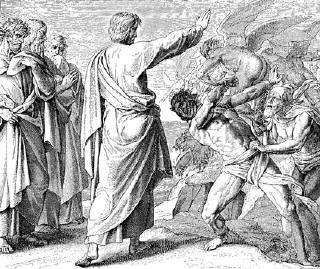
I will humour you.
Mark 5:1-2
They came to the other side of the sea, into the country of the Gerasenes. 2 When He got out of the boat, immediately a man from the tombs with an unclean spirit met Him,
Matt 8:
When He came to the other side into the country of the Gadarenes, two men who were demon-possessed met Him as they were coming out of the tombs. They were so extremely violent that no one could pass by that way.
Luke 8:
Then they sailed to the country of the Gerasenes, which is opposite Galilee. 27 And when He came out onto the land, He was met by a man from the city who was possessed with demons;
Now the standard reply is that they are two towns in the same general region so there is no contradiction. However, this is silly. The contradiction is plain. All accounts use the time connective 'when' which implies in all cases immediacy. When this happened, this happened. Thus, no traveling can be done. Looking at any map, the use of Gerasa is nonsensical (at least 12 miles from Gadara - ie further from the lake) - it is inland and too far for the sense to be made. Here is the hilariously bad bad harmonisation from Barne's noted on the bible:
"Country of the Gergesenes - Mark Mar 5:1 says that he came into the country of the "Gadarenes." This difference is only apparent.
"Gadara" was a city not far from the Lake Gennesareth, one of the ten cities that were called "Decapolis." See the notes at Matthew 4:25. "Gergesa" was a city about 12 miles to the southeast of Gadara, and about 20 miles to the east of the Jordan. There is no contradiction, therefore, in the evangelists. He came into the region in which the two cities were situated, and one evangelist mentioned one, and the other another. It shows that the writers had not agreed to impose on the world; for if they had, they would have mentioned the same city; and it shows. also, they were familiar with the country. No men would have written in this manner but those who were acquainted with the facts. Impostors do not mention places or homes if they can avoid it."
So bad it's funny.
Then there is the problem that Matthew clearly states two demons, not one.
You will have an answer, no doubt. It's just that to think it is plausible takes some wild gerrymandering.
Yes, indeed there are answers that don't require punting to the conclusion that the Bible is contradicting itself. Pearce recognizes that the passages are referring to two cities: Gerasa and Gadara. What I don't get why he think Mark and Luke think Jesus went to one city and that Matthew says that he went to the other? The texts do not say that it. They say that he went to the region containing those cities. The miracle that happened did not occur in a city or town. Pigs weren't kept in towns, as far as I can tell. The pigs are also an important point because it shows that the area was primarily populated by Gentiles - which is what Archaeology and extra Biblical sources tells us. Had the people been Jews, they would have neither cared about loosing a heard of pigs nor owned pigs.
As for the number of men Jesus met and healed. Mark and Luke definitely says that there was one one guy while Matthew says there were two. The thing is how is this a contradiction? A contradiction would be if Mark and Luke had said that there was only one man. They don't. Each of the Gospel contains details that are not in the others. But none of those details contradicts the details in the others. If I tell you that Jack and Jill went to the mall and bought a DVD, but I tell another person that Jill went to Walmart and bought a DVD, did I contradict myself? Nope. I just didn't give the same detail. A contradiction would be if the mall did not have a Walmart. You don't have such a thing in this case. We know that Jesus went to an area containing two cities, Gerasa and Gadara, and while he was there he cast demons out of two men that met Him as he came ashore and they knew who Jesus is. The demons drove some pigs mad and they drove themselves off a cliff into the Lake and drowned. No need to bring up phantom contradictions. If Pearce or anyone disagrees, I'd love to know what is so bad or false about understanding the text this way.
Tuesday, February 21, 2012
Nor the Son: Matthew 24:36 and Mark 13:32 - YouTube

Nor the Son: Matthew 24:36 and Mark 13:32 - YouTube
Saturday, February 11, 2012
Earliest Manuscript of the New Testament Discovered?

On 1 February 2012, I debated Bart Ehrman at UNC Chapel Hill on whether we have the wording of the original New Testament today. This was our third such debate, and it was before a crowd of more than 1000 people. I mentioned that seven New Testament papyri had recently been discovered—six of them probably from the second century and one of them probably from the first. These fragments will be published in about a year.
These manuscripts now increase our holdings as follows: we have as many as eighteen New Testament manuscripts (all fragmentary, more or less) from the second century and one from the first. Altogether, more than 40% of all New Testament verses are found in these manuscripts. But the most interesting thing is the first-century fragment.
Now this is exciting news, but like Dr James White said about it on last Thursday's Dividing Line, I do think that we should wait for the more information before we hang arguments and debates on it. However, Dr Wallace seems pretty excited but he is also cautious. Wallace explained why this is important:
But, if this Mark fragment is confirmed as from the first century, what a thrill it will be to have a manuscript that is dated within the lifetime of many of the original followers of Jesus! Not only this, but this manuscript would have been written before the New Testament was completed.
My favorite things about this is that if it pans out that the fragment is from the mid first century, it takes away one more excuse people raise to accepting that the Gospel of Mark is historical and written by one who would have had first-hand knowledge.
Wallace even gives a link for purchase of the debate with Ehrman from February 1st:
Purchase U.S. DVDs of the second debate or international DVDs
Home Page - Earliest Manuscript of the New Testament Discovered?

Friday, December 30, 2011
Biblical Condemnation of Rape and other Acts of Misogyny Part 2

Atheism and Rape - YouTube
Biblical Condemnation of Rape and other Acts of Misogyny
I appreciate the time and effort you’ve put into your answer, even though I disagree with much. Like an Eskimo meeting a Zulu, it may be hard to appreciate each other’s position, but hey, a culture clash is always mutually educational.
I agree that such exchanges are very educational and helpful. I especially appreciate Mark's attitude.
I appreciate the conversation and the way Mark has conducted himself. No ad hominem to be found. I can appreciate that he does not toss insults instead of why he disagrees. A lot of people could learn a lot from him, although I too disagree with much of what he has written. I think that in order to say that FGM is objectively immoral (as opposed to subjectively immoral), you have to unambiguously show that God prohibits it. Other wise you’re just saying that if God is silent on an issue that I disapprove of, then he forbids it, and if he is silent on an issue that I approve of, then he approves it. In other words; subjective morality!. Like you say pointing out that God does not mention FGM does not equate with saying it is right - it just means that you have no objective basis for saying that is wrong.
I disagree that we don't have any way of knowing what God thinks of female circumcision (aka FGM) because the Bible tells us that only males were supposed to circumcised. I'm dismayed that during the course of his follow-up comments, Mark did not explain why Genesis 18 and Romans 4 do not address the purpose of circumcision. I argued that it has no way of condoning female circumcision and excludes it as a way to honor God - no, more than that. It's against God's character making it immoral.
The background is this: Apologist William Lane Craig stated that atheists don’t have objective morals, which is quite a ballsy claim.
That's not what he argues. He argues that they can't consistently explain where those moral values come from. Please listen the following lecture so that you can hear what Dr Craig actually says:
Is God Necessary for Morality? by William Lane Craig - Apologetics 315
He reasons that “objective morals are morals that are valid and binding independent of human opinion” and “god’s moral nature is expressed in relation to us in form of divine commandments which constitute moral duties”. So in other words, there is no role at all for human interpretation of the bible, because then it is not “independent of human opinion”.
I disagree. If we don't understand what the Bible is saying then we don't know what the divine commandments are. For example, how do your children follow the rules you set, if they do not understand those rules. We know what the Bible says. It's clear. It's when you want to apply your own opinions and not just obey what you know it says is when we have issues. For example, how many ways can you interpret "Do not steal."? How does your opinion affect the meaning of that commandment? There is no reason why it should. We choose to obey God or we choose to sin. I don't think the Bible requires opinion to understand what God means. If you get stopped by a police officer for speeding, does your opinion matter as to whether or not you get the ticket? Nope. Why should divine commandments be different.
So, like me, you may feel strongly that FGM should be immoral. However, by WLC’s reasoning, you need “a divine commandment” that is “independent of human opinion” to say that FGM is immoral, and the bible doesn’t give you that.
Yes it does. If you are not a male descendant of Abraham, you don't have to be circumcised. If you are forced to be circumcised and told that it's in service to God, then you have been lied to. Immoral! End of story.
By WLC’s definition, nothing that is not explicitly permitted or forbidden in the bible has an objective moral basis.
I would like to see Mark or anyone provide such a statement from Dr, William Lane Craig.
So your reasoning that FGM is immoral becomes as subjective as an atheist’s, no matter how strongly you feel it. And it’s not just FGM that has no “biblical” objective basis, but also environmental protection, organ transplantation, IVF and age of sexual consent.
So Mark admits that an atheist has not objective basis for condemning female circumcision other than his own subjective opinion. Right? As for the Christian Theist, I managed to demonstrate that the Bible does condemn female circumcision. And as for environmental protection, who says it's immoral? As for what God thinks about it, read Genesis 1:28
28 God blessed them and said to them, “Be fruitful and increase in number; fill the earth and subdue it. Rule over the fish in the sea and the birds in the sky and over every living creature that moves on the ground.”
"Rule" includes to protecting and taking care of the earth. Who says organs transplantation is immoral? The Bible doesn't. And as for the age of sexual consent, the Bible tells us that a person should not be having sex until they are married. Our society has flipped that and has tried to change that and that is one reason why western ciivilization is in the state it is in. Imagine what would the world would be like if people stuck to their own spouse and married with the intent of raising any children that resulted? No need for abortions or divorce or any of the unpleasantness dragging our world.down straight to hell.
In my opinion, the value of a moral system is determined by its aim. The aim of biblical objective morality is to maximize obedience.
Who says that? Where in the Bible does it say that? I mean I agree that many churches are ran that way, but that's not what the Bible says.
40 Keep his decrees and commands, which I am giving you today, so that it may go well with you and your children after you and that you may live long in the land the LORD your God gives you for all time.- Deuteronomy 4:40
11 For I know the plans I have for you,” declares the LORD, “plans to prosper you and not to harm you, plans to give you hope and a future.- Jeremiah 29:11
The thief cometh not, but for to steal, and to kill, and to destroy: I am come that they might have life, and that they might have it more abundantly.- John 10:10
However, the aim of secular humanism’s morality is to maximize community health and happiness. Now that’s a moral system that is useful!
Just to go through the examples of misogyny that I quoted, I think you are using special pleading to avoid their nasty implications. I feel like the guy in that Monty Python skit trying to return a dead parrot – what’s in plain view is not being recognized.
I disagree. Since Mark has been kind enough to defend his examples of misogyny - and not just assert it, let's jump in.
1) Calling a woman unclean for a normal bodily function is certainly misogynistic. Did the men have to be kept isolated if they cut themselves and bled? There’s a vicious double standard at work. Telling women that their periods make them impure and unclean, and ostracizing them for weeks would damage anyone’s self-esteem. Have a moment’s pity for the poor girls with menorrhagia, whose periods can last up to three weeks. They would have spent almost all their adult life alone
I wonder if Mark is aware of all laws regarding how men can become ceremonially unclean? Just read Leviticus. Ceremonial uncleanness is about the right to take part in religious ceremonies. The reason for putting menstruating women outside the camp (and not into the wilderness) was for sanitation. They didn't have the same level of cleanliness we do today. I also don't think that we can say that this applied to when they lived in cities but when they were wandering around for 40 years. I also would ask if Mark, or anyone, could show the rate of menorrhagia among Hebrew women during that time? I mean if God keep their shoes from wearing out, and miraculously feed them manna and quail, I think keeping the women from getting menorrhagia would be minor thing.
2) I’m sure that Isaiah 3:16 doesn’t refer to all women – just the ones whose spirit hasn’t been beaten down. A woman with self-confidence? Who, God forbid, dares to flirt? Or wear accessories? Burn her, I say!! (In this case God was merciful, and gave them scalp lesions. He must have been in a good mood that day).
Isaiah was not saying anything of the sort. The women were not being punished for flirting. Why couldn't they just flirt with their husbands? No where are women told not to love themselves but are told to put their confidence in God, just like men are supposed to do. Sorry, Mark, the passage just doesn't say what you said it does.
3) You seem fond of defending bible verses by saying that economical realities of the time made what seemed cruel an act of mercy. Let’s overlook the fact that economic realities could have easily been changing laws by say, giving women the right to work and to own their own property. Let’s also overlook the fact that even if it was a mercy, women were never given a choice or a say in the matter. No, my issue is that your claim that these were economic realities of the time is false.
I don't know why God didn't just give women the right to vote and own property. It's not what he chose to do. I think you may forgetting that at the time this law was given, Israel was living in a nomadic existence. No one owned land or property.
Let’s look at Egypt in the biblical times. Only several hundred kilometers away from Israel, but centuries ahead in terms of treatment of women. Things weren’t perfect, but women could own property, borrow and lend money, attend markets, ask for divorce and make wills. Some women became craftswomen, and received pay equal to men (the Western world still hasn’t caught up to this). They even created female teachers and philosophers (if you want to know what the early Christians thought of female Egyptian philosophers, Google Hypatia of Alexandria).
Hypatia was not even contemporaneous to the laws we are discussing here. I'm not sure why Mark brings her up. As for the status of women in Alexandria, did slave women have the same rights? Nope only women who were royalty had that kind of privilege. Only less than the "1%". While the laws God gave Israel were applicable to everyone! Don't romanticize the ancient Egyptians so much.
So the fact that women could have their vows annulled by men had nothing to do with economic realities and everything to do with the fact that the bible was written by Galilean hillbillies. Even by the standards of their own time, they were rednecks.
Um, at the time Israel had gotten this Numbers, Israel had not reached the land of Israel, not even Galilee. And if you are one of those who think that most of the Torah was written in Babylon during the Exile, saying that numbers was written by Galileans is still wrong (anachronistic at best). I think the reason for the law also goes back to the roles men and women are supposed to have...such that men are the head of household - and that makes them responsible and accountable. Economic realities is part of it, but not the whole story.
4) On 1 Timothy 2:12, I’ll just point out that the Quiverfull movement today uses this verse to deny women education and the right to control their own destiny.
5) I’m sure that the Bible approves of monogamous, heterosexual sex in a marriage, but that is only a small slice of the phenomenon that is human sexuality. Everyone’s sexuality is unique, and we all have differing sexual needs. If someone approved of vanilla ice cream, but banned all of the other 300 flavors, wouldn’t it be reasonable to say he was anti-ice-cream?
Since God created sex and gave sex to humanity as a gift, don't you think God would know the best way to enjoy that gift? And no, I would not think that banning 300 flavor of ice cream but one mean that one has to hate ice cream - especially if other 299 flavors were poisonous and ultimately harmful no matter how good they taste. God is looking out for us and wants what is best for us.
I agree that Oholah is an allegory for Samaria, but it’s still a sexist allegory. There certainly were women who were like Oholah in biblical times. They achieved financial dependence without giving themselves in marriage, and controlled their own destinies. They had a healthy sexual appetite, and were liberated enough to follow it. They dared to enjoy material possessions. All without harming anyone else. They were the first feminists of biblical times. If Oholah really existed, I would have liked to [have met] her. I’m sure she would have been an amazing woman.
Why does having "healthy sexual appetite" mean having sex with anyone would have sex with you instead of enjoying sex with your spouse only? Ezekiel 23 does not describe women who are just liberated and happily determining their own destinies, it's telling us about women who are destroying themselves.
And like what all patriarchal men would like to do to feminists, she was abandoned, humiliated, mutilated, raped and murdered. I imagine the crowds of men were cheering when they heard the end of that story. After all, if Ezekiel didn’t think he could rely on misogyny to make his point, why tell the story?
You say Oholah deserved punishment for prostitution. But nowhere does Ezekiel suggest that money was her motivation. However, in several lines he says that she was motivated by lust “for mounted horsemen, all handsome young men….whose genitals were like donkeys and emissions were like horses(!)”. Fair enough, sounds like a confident girl with a healthy libido. I interpret Oholah to be a mistress of multiple men rather than a street-prostitute.
How is being the mistress of multiple men better than being a street-prostitute? Which one would you want your daughter to choose to be? Personally, I don't want my daughter to be neither.
Anyone, the reasons Ezekiel uses to demonize Oholah is that she dared to be lusty. Oh the horror! Solomon can have 1000 wives, but god forbid a woman enjoy sex with more than one man.
Men are also forbidden from enjoying sex with more than one women. There is no problem with that.Solomon was condemned for doing that. It was the start of his down fall.
1) You’re right; the Bible doesn’t suggest that the Benjamites were righteous men. But the plan to carry off the dancers of Shiloh wasn’t hatched by the Benjamites, but by the elders of all the tribes of Israel. I think the bible usually implies they were God’s favored.
The elders of Israel were not congratulated on their action. The Bible merely records it.
And when the fathers of the kidnapped girls came to the Israel tribal elders, the elders told them “Do us a kindness by helping the Benjamites out, so that all that pussy can be put to good use” (I may be paraphrasing that last line a bit).
Again the Bible does not tell us: This pleased God, go and do likewise.
Of course, the Benjamites were never punished for taking the dancers of Shiloh, and all the men lived happily ever after.
How do you know that the men involved were never punished? Just because the Bible does not record what happened to these men - the Benjamites nor the other elders of the tribes - does not mean that they did not pay for their sins. I see a lot of people take this line of reasoning. Jesus said something we should remember:
22 Jesus answered, “If I want him to remain alive until I return, what is that to you? You must follow me.” - John 21:22
2) I think that by the time the Midianite virgins were rationed out like cattle, the war was already over.
Are cattle allowed to mourn for their dead relatives? No? The Midianite captives were. I think that Mark is reading a lot of his own presuppositions into the accounts as to how these women thought and felt.
3) Perhaps your ‘re right, and David’s wives were given to his son rather than his neighbor. I’m sure that makes all the difference. It must have been all a big hoot for the lucky girls.
The part that’s missing from that verse is where the women were asked their opinion or permission. Evidently the biblical authors didn’t think they should have a say in whom they slept with.
They were wives of the King. In that day a woman expected to sleep with her husband. The point of the story was that David was getting payback for what he did to Bathsheba and her husband. When we do evil there are always consequences. Sometimes God takes those away when we get forgiven and sometimes we still have to live with them.
To finally wrap up:
Immoral behavior needs to be taught as much as moral behavior. If you don't think children need to be taught how to steal, just read Oliver Twist. Children develop their own personalities, with personal proclivities towards moral and immoral behavior varying from child to child.
In Oliver Twist, he had to learn to steal without being caught - not how to steal. Besides that is a fictional story. I would love for someone to point to a child who has never had to be corrected for lying or stealing. Every person has immoral proclivities. And unless someone tells you, you have no idea what is right and wrong in many respects.
Once again, this variation provides a survival advantage for our species. A book called "Nothing To Envy" described life during the famine in North Korea. One haunting statement by a defector was:
"the kind and generous, the ones that shared, the ones that wouldn't steal.......they were the first to die".
Evolution has bequeathed impulses that we describe has right and wrong, but both give survival advantages in different situations. In times of plenty, like what we live in, stealing is considered wrong, and not needed for survival. In times of famine, only the thieves survived.
Crediting evolution for the impulses to know right and wrong is a tricky thing. What do you do with people who don't see right and wrong the way you do? Is something wrong with them? Why can't they see it? Are they less evolved than the rest of us? Is someone who would steal cable less evolved than someone who would not? Why should those who don't see anything wrong with lying to certain people, murder certain people, or steal from certain people be allowed to live and procreate to pass on their messed up genes? Why? Why not?
What had happen' was.....: Biblical Condemnation of Rape and other Acts of Misogyny

Thursday, December 29, 2011
Biblical Condemnation of Rape and other Acts of Misogyny

I'm going to break my response into two parts; one to examin the notion that the Bible provides a workable moral system that prohibits rape and FGM, and a second to examine wether secular haumanism provides a system.
Fair enough.
I've challenged many apologists to provide a biblical basis for why rape/FGM should be considered wrong, and so far none have done so. The most common replies have been evasive responses like yours, i.e the "biblical-silence-equals-prohibition" response or the "against-the-vibe-of-the-
I'm going to just assume that Mark has simply not been exposed to such evidence for how we know that the Bible condemns and does not condone rape and just provide some helpful resources. I wrote a summary post of resources called Does the Bible Condone Rape? and one of the links on it that I must point out is Mariano Grinbank's parsed essay, Atheism, the Bible, Rape, EvilBible.com and Dan Barker. Mark has brought up specific scriptures and although Mariano addresses these, I will address them here too.
Firstly the "no passages saying it is a good idea" defence. I agree nowhere does the bible state a position on FGM (although, as seen below, in many verses the bible gives a thumbs-up to rape). However, neither does the bible say that it's a good idea to shave, drive a car, exercise, get an education or wash your hands after defecating. Because there are no passages saying it's a bad idea, would you say they are wrong.
Pointing out that God does not mention Female Genital Mutilation does not equate with saying it is right. The Bible also doesn't say "Don't stand underneath a tree when it falls", but I am confident that we shouldn't. Instead of looking at what the Bible does not say about FGM or what the Bible records what happened to women, why not look at what it says about how women should be treated!
Ultimately, you are making a claim that Christianity provides a framework for superior objective values. To back that up, you need to show that show that the bible provides unambiguous guidance in cases of rape/FGM, otherwise you are just using your subjective moral opinion. Where do you get these subjective opinions from. From secular hyumanism, which is informed by principles of the Enlightenment.
Before Mark goes as far as saying that the Bible does not provide a framework for repudiating rape, Female Genital Mutilation, or misogyny, let's look at the scriptures he uses and I will later give the reasons why I know the Bible is against such behavior and attitudes.
Secondly, it is not at all obvious from biblical teachings on the treatment of women that rape is wrong. To put it mildly, the bible is a cesspit of nauseating misogyny.
Actually, I think that was quite blunt..
Briefly, the bible describes women as unclean (Lev 15:19),
Does it really? In context?
19 “‘When a woman has her regular flow of blood, the impurity of her monthly period will last seven days, and anyone who touches her will be unclean till evening.- Lev 15:19
"Unclean" in this context is talking about ceremonial uncleanness - not worthless or bad.
haughty (Isiah 3:16)
Is Mark, thinking that Isaiah is saying that all women are haughty?
16 The LORD says,
“The women of Zion are haughty,
walking along with outstretched necks,
flirting with their eyes,
strutting along with swaying hips,
with ornaments jingling on their ankles. - Isaiah 3:16
and untrustworthy (Numbers 30:1),
1 Moses said to the heads of the tribes of Israel: “This is what the LORD commands: 2 When a man makes a vow to the LORD or takes an oath to obligate himself by a pledge, he must not break his word but must do everything he said.So is there anything in the text that says women can't make a vow or an oath because women can't be trusted? No - not one word. So why is it possible for a husband to nullify an oath made by his wife or for a father for her daughter? Simple. Because of verse 1. The man is responsible. His wife is his responsibility and his unmarried daughter living in his household is his responsibility.. This was how the society at the time - in theocratic Israel - was set up. Most women did not have the economic resources or means to fulfill the type of vows in view here - it was up to the man who was responsible for her. This had nothing to do with her moral purity nor cognitive powers.
3 “When a young woman still living in her father’s household makes a vow to the LORD or obligates herself by a pledge 4 and her father hears about her vow or pledge but says nothing to her, then all her vows and every pledge by which she obligated herself will stand. 5 But if her father forbids her when he hears about it, none of her vows or the pledges by which she obligated herself will stand; the LORD will release her because her father has forbidden her.
6 “If she marries after she makes a vow or after her lips utter a rash promise by which she obligates herself 7 and her husband hears about it but says nothing to her, then her vows or the pledges by which she obligated herself will stand. 8 But if her husband forbids her when he hears about it, he nullifies the vow that obligates her or the rash promise by which she obligates herself, and the LORD will release her.
9 “Any vow or obligation taken by a widow or divorced woman will be binding on her.
10 “If a woman living with her husband makes a vow or obligates herself by a pledge under oath 11 and her husband hears about it but says nothing to her and does not forbid her, then all her vows or the pledges by which she obligated herself will stand. 12 But if her husband nullifies them when he hears about them, then none of the vows or pledges that came from her lips will stand. Her husband has nullified them, and the LORD will release her. 13 Her husband may confirm or nullify any vow she makes or any sworn pledge to deny herself. 14 But if her husband says nothing to her about it from day to day, then he confirms all her vows or the pledges binding on her. He confirms them by saying nothing to her when he hears about them. 15 If, however, he nullifies them some time after he hears about them, then he must bear the consequences of her wrongdoing.”
16 These are the regulations the LORD gave Moses concerning relationships between a man and his wife, and between a father and his young daughter still living at home.- Numbers 30
and should aim to be submissive (1 Tim 2:12)
12 I do not permit a woman to teach or to assume authority over a man; she must be quiet.- 1 Timothy 2:12
I find it amazing that Mark would use this verse to discuss women and the command to submit. If you look up the other passages about women submitting you would find that it is in context to submitting to her husband and that male and female children should submit their mother and father (such as Ephesians 5:21-33). As for 1 Timothy 2:12 it is context of a church organizational structure - not on a job or in all interaction. I've written quite a bit on this at An "Evil of Christianity.
and hate sex (Ezekiel 23).
What?!!!!!
Most rapists share these views of women. Incidentally, I felt like I needed a showed after fact-checking those referecnes.

So, once again I'm going to ask you to provide bible-based reasoning on why rape and FGM is wrong.
In return, I'll provide secular-based reasoning on why rape/FGM is wrong. Keeping in mind that I've provided detailed multi-paragraph reasoning on why stance, perhaps you could provide more than the cursory two lines above.
Fair enough. I look forward to Mark providing a secular-based reasoning for why rape and Female Gentile Mutilation (FMG) is wrong.
A suggestion: Perhaps you could provide the answer as a response to the following hypothetical:
You have two new co-workers, called Bob and Cindy. Over lunchbreak, you find that you are all christians, and start to bond. then Bob offhandedly mentions that he raped his promiscious neighbour the night before.
"Bob, that's terrible" you say. What a wrong, immoral thing to do!"
Bob replies "Mr. McElhaney, you have no right to say such a thing. I am a godly man, and as such am following his laws. If god wanted women to have a say in sex, then he would not have let righteous men rape the women dancers of Shiloh (Judges 21:10), or given Midianite virgins to Moses soldiers, given Oholah to the Syrians or given David's wifes to his neighbours for sex (2 Samuel 12:11)"
Challenge 1: Use bible-based reasoning to show Bob why his actions are immoral.
"Bob, where does the Bible say that the Benjamites in Judges 21 are "righteous" men? Hint: It doesn't. Oholah being given to the Syrians in Ezekiel 23 mirrors the way God allowed Israel and Judah to fall to their enemies. Oholah deserved punishment for her prostitution and so did Israel and Judah. We deserve hell for our sins. The Midianite virgins does not apply to what you did. Were you in a war? No. You just said she wasn't a virgin. And no where does the text say they were raped and forced to do anything. As for David, his wives were not given to his son in public not his neighbors. And why did this come on David - because he committed adultery and tried to cover it up by murdering her husband. What you have done is no better than what David did or any of the reference to rape you mentioned. It also does not matter what evils and sins the woman you raped was guilty of. Not only were you wrong to rape her but even if she wanted it - that makes you a fornicator. Remember what 1 Corinthians 6:18 says. Brother, you need to beg God for mercy and forgiveness and repent of this horrible sin. You can start with the police. I'll call them for you. . You are being just like the people described in Judges 21:25
25In those days there was no king in Israel: every man did that which was right in his own eyes.

Then Cindy says that she is taking her 12 year old daughter back to Africa next week for genital circumcision. You reply "Cindy, how immoral! You can't do that to a young girl!"
"But Mr. McElhaney, such is our custom. And the bible does not say it is immoral, so who are you to say it is immoral?"
Challenge 2 : Use Bible based reasoning to show Cindy why FGM is wrong.
Cindy, I know western culture has labeled such practices as Female Genital Mutilation, but I am aware that many cultures that practice it refer to it as "female circumcision". There is not a single case or example of God requiring a woman to be circumcised. For what God glorifying purpose would you circumcise a female? Set aside for a moment the cultural reasons - like discouraging adultery, and the medical risks, and even the fact that it must have been horrible and painful for you personally and let's look at why God commanded circumcision in the first place. Here, get your Bible. When God gave Abraham the sign of circumcison he said:
9 Then God said to Abraham, “As for you, you must keep my covenant, you and your descendants after you for the generations to come. 10 This is my covenant with you and your descendants after you, the covenant you are to keep: Every male among you shall be circumcised. 11 You are to undergo circumcision, and it will be the sign of the covenant between me and you. 12 For the generations to come every male among you who is eight days old must be circumcised, including those born in your household or bought with money from a foreigner—those who are not your offspring. 13 Whether born in your household or bought with your money, they must be circumcised. My covenant in your flesh is to be an everlasting covenant. 14 Any uncircumcised male, who has not been circumcised in the flesh, will be cut off from his people; he has broken my covenant.”- Genesis 17:9-14
Do you see anything even resembling female circumcision? No. Only males. And it is to be sign between God and Abraham (and his descendants). And before you start thinking that I am arguing that only the circumcised can be righteous, you need to remember what Paul wrote in Romans.
9 Is this blessedness only for the circumcised, or also for the uncircumcised? We have been saying that Abraham’s faith was credited to him as righteousness. 10 Under what circumstances was it credited? Was it after he was circumcised, or before? It was not after, but before! 11 And he received circumcision as a sign, a seal of the righteousness that he had by faith while he was still uncircumcised. So then, he is the father of all who believe but have not been circumcised, in order that righteousness might be credited to them. 12 And he is then also the father of the circumcised who not only are circumcised but who also follow in the footsteps of the faith that our father Abraham had before he was circumcised.
13 It was not through the law that Abraham and his offspring received the promise that he would be heir of the world, but through the righteousness that comes by faith. 14 For if those who depend on the law are heirs, faith means nothing and the promise is worthless, 15 because the law brings wrath. And where there is no law there is no transgression.- Romans 4:9-15
What had happen' was.....: Atheism and Rape - YouTube

Subscribe to:
Posts (Atom)