Showing posts with label Hell. Show all posts

Tuesday, November 11, 2025

NT Wright's Thoughts on Hell


Wednesday, January 3, 2018

God Sends Non-Christians to Hell??? (Dr John Lennox)

Check out the following video clip from an interview with John Lennox where he tackles the question about if its correct that unbelievers go to hell. He uses a similar argument that CS Lewis used when he answered the same question.


I don't fully agree with the argument because I think it falls on the fact each one of us can only choose hell aside from the grace of God.

Saturday, July 28, 2012

FacePlant of the Day - Debunking Christianity: According to the Bible: Christians and Atheists Will Rot In Their Graves

Harry McCall continues to try and fails to use the Bible to demonstrate that the Bible makes Christianity wrong.The problem is that he fails to correctly understand what the Bible says in favor of his conclusions that the Bible does not support the idea of an afterlife in general or heaven and hell in particular. He even pretends that he can support his claims with the Bible. It'd be cute if it wasn't an utter failure. The Bible does not support him.


“for God is not a God of confusion but of peace, as in all the churches of the saints>.” 1 Corinthians 14:33

I totally agree with this scripture. McCall attempts to use this scripture to show that there is confusions as to what Christians and Jews have believed about the afterlife.


Some Modern Christian Afterlife Myths:

1. Last week a Christian woman who - had just lost her year old daughter (her first and only child) - was interviewed on TV. She said that at the time of her daughter’s death, she begged God to kill her so she could go to Heaven and be with her daughter.


So what myth does McCall think is being believed here? Is he saying that  the woman's daughter is not in heaven? If he wants to show that she believes a myth you would have to prove that either the baby didn't go to heaven or that there is no heaven.  Let's see if he can do that.

2. Southern Gospel songs such as “When We All Get To Heaven”, “I Won’t Have To Cross Jordan Alone”, “I’ll Fly Away” as well as the Carter Family’s favorite, “Will the Circle Be Unbroken” were written and sung based on the belief that at death, the righteous human soul goes immediately into the presence of the Lord (God / Jesus) in Heaven to be joined for eternity with loved ones.


Again, McCall would have to show that there is no heaven or that people are not really going to be present with God upon death.


3. Christian testimonial stories abound were the newly departed human soul either hovers above their body or is “ascended to Heaven or descended to Hell” only to be called back to the body doing resuscitation as a testimonial. This legend is then peddled to promote “proof” that an afterlife does exist and usually nets the claimant thousands of dollars as they travel the Christian circuit giving hope and inspirational talks on the Near Death Experience .


The Bible in no way tells us that this is how things really happen. So I'm going to ignore this one.  I see no reason to try to explain or defend this one - it's not about the Bible. As for whether it is true or not, I find it amazing that atheists almost never discuss the fact that unbelievers also have near-death experiences where they experience hell.


4. Based on two of the largest Christian denominations (Roman Catholic and LDS Mormon), one is given the theological legend that Christian dead go immediately to Heaven being reunited with their loved ones (though at just what age and state of metal maturity is open to question, that is; will dad be a child, young man or an elderly person as he was known before he died which begs the question as to how Christian dead will know one another?).


LDS Mormons one of the largest Christian denominations? LOL!!!!!!! I'll ignore such a stupid mistake for now but not having answers to such questions does not mean that heaven is not true.
 

5. On the other hand, I’ve also heard believers project an afterlife in order to get justice on corrupt politicians or evil people with statements such as; “They got away with it here, but they won’t get away from the judgment of God.”; thus again vindicating an afterlife. With the theme of Heaven being the largest selling points of Christianity, it is little wonder that pop Christian culture keeps this theological myth alive.
Again in order to show this as a myth, McCall would have to show that the Bible does not tell us that corrupt politicians or evil people are not punished in Hell or that there is no hell or heaven. 


6. Finally, the common Christian statement on the death of a loved one: “They are in a better place now.”


McCall would have to show that there is no heaven or that heaven is not better than here.
 

For the purpose of this post and for the sake of argument, let’s assume the Bible is an inspired book from God that contains revelations on the State of the Dead. As such, I’ll list a Biblical timeline on how the popular view of an afterlife evolved followed by some major Christian dogmas on the subject.\


Yes, let us agree to that. The Bible tells us about the state of the dead. The problem is that the Bible does not always agree with dogmas of churches.


A Chronology of the Evolution of the Christian Afterlife

A. Pre-Exilic Israel (9 – 8 century BCE to 586 BCE): Like all her neighbors, Israel (a term used by the Northern Kingdom (exiled 722 BCE) and taken over by the Southern Kingdom of Judah (exiled 586)), or the Hebrews believed the souls of all people (both good and bad) continued to exist in Sheol - a place darkness and loneliness under the earth and opposite from the gods who lived on top of a sacred mountains (such as Sinai).


What part of the Bible tells us that sheol is "a place darkness and loneliness under the earth and opposite from the gods who lived on top of a sacred mountains (such as Sinai)."? Sinai isn't even in Israel. Also the Bible never describes Sinai as the place YHWH lives. Projecting the beliefs and practices of ancient Israelites is truly an epic fail when there is no Biblical basis aside from the fact that the Old Testament records continually admonishes Israel to reject them. Fail number one.
 
B. Exilic / Post-Exilic Israel 586 BCE to the Hellenistic Period 332 BCE: Theological monotheism theism (Yahweh only party) suppresses Pre-Exilic theology’s polytheism and human sacrifice. Ancestral cult worship (divinatory and magical practices with the dead) are prohibited in both the Torah and the Deuteronomistic History. Persian theological influence began to shape the ideas of good and evil and an afterlife. Now at death, there is no consciousness in Sheol nor is there any contact there with this world and God (Psalms 6:5, 30: 8 – 10, 88: 3-12, Job 3: 11-19, 14: 10 – 14, 21: 19 – 21; and Ecclesiastes 9: 3-10).


Israel's Canaanite neighbors surely practiced polytheism and human sacrifices and divination and magic, but Israel wasn't supposed to and there is not enough evidence to conclude that this only began after 586 BC. McCall references several scriptures the he claims shows that there "is no consciousness in Sheol nor is there any contact there with this world and God ". Is he right? Take a look for yourself: link. These scriptures do not expressly tell us that there is no consciousness in Sheol. They are about the finality of death and how once you die, it is not normative that you are coming back to the life you knew. I agree that these scriptures do not give as much revelation about the state of the dead as other scriptures in the Bible. These writers wrote down the parts of the revelation that they had and they didn't have the whole revelation. For example: why isn't there a discussion about heaven or being in the presence of God? Simple. The Bible doesn't really address that question. We can't say that the Old Testament righteous was not in the presence of God before Jesus' death, burial and Resurrection. I mean Elijah and Enoch were taken into heaven not Sheol. I think the vast majority of people went to Sheol before Jesus completed his mission. Fail number two.

C. Hellenistic Period 332 BCE to the Roman Period 63 BCE): The view that the righteous Jew will be either rewarded while the unrighteous Jew will be punished is made 
theologically orthodox in such forged texts as the book of Daniel (especially Daniel 12: 2 “Many of those who sleep in the dust of the ground will awake, these to everlasting life, but the others to disgrace and everlasting contempt.”) Theologically, this verse in Daniel was in direct conflict with the afterlife position of the Testament of Abraham which teaches that immediately at death, Jewish souls receive judgment before Abel (Adam’s son) for either salvation or fiery torments (Test. Abraham 12 -13). Text such as Trito-Isaiah 66: 24 ("Then they will go forth and look on the corpses of the men Who have transgressed against Me. For their worm will not die and their fire will not be quenched; and they will be an abhorrence to all mankind.") will influence the writer of the Gospel Mark to have Jesus state in “Where their worm dieth not, and the fire is not quenched.” (Mark 9: 48) Also Paul uses the theology of the Hellenistic book of the Wisdom of Solomon to paint the human race with Original Sin.


I'd like to see McCall demonstrate that the Book of Daniel is a forgery. And so what if Daniel is in direct conflict with the Testament of Abraham? The Testament of Abraham is not just non-canonical for Christians but for Jews too. Why would you think Daniel is a forgery but the Testimonial of Abraham is not a forgery? Paul did not need the book the Wisdom of Solomon to get that Original Sin is a teaching. It is all over the Jewish canon.  Fail number 3.

D. The Roman Period 63 CE to the Council of Nicaea 325 CE: The conflict and tension of the theology of the so-called “Intertestamental Period” with its forge texts in the names of famous Israelite Patriarchs continued the confusion of an afterlife for Christianity with Paul view of an End Time bodily resurrection by stating in his final theological work of Romans 8: 10- 12 “But if the Spirit of Him who raised Jesus from the dead dwells in you, He who raised Christ Jesus from the dead will also give life to your mortal bodies through His Spirit who dwells in you. So then, brethren, we are under obligation, not to the flesh, to live according to the flesh” now contrast with that of the late Gospel of John having Jesus state that the Christian’s soul has eternal life immediately ““Truly, truly, I say to you, he who hears My word, and believes Him who sent Me, has eternal life, and does not come into judgment, but has passed out of death into life.” (John 5: 24). However, Christian eschatology remains in contradictory tension in that if the righteous soul is ALREADY with God in Heaven, then why would there ever need to be a resurrection of the body? Thus, Christians must face the fact that the majority of the New Testament (likely 99%), especially Paul’s letters and the Book of Revelation both teach that all souls (both good and evil) sleep in the earth (much like the Israelite dead did in Sheol) until the general resurrection and Final Judgment when Jesus returns. Soul Sleep is also the theme of other the Nicaea Creed and other Christian Creeds. Finally, the Bible never tells us how a place under the earth where all the dead go (Sheol) becomes modern Hell or how Christians go up into the sky to live with God (proof positive that a the theology of an afterlife is “subject to change without notice!).


So many errors...so little time. The "intertestamental period" can't be between the years he gives because "intertestamental" means between the old and new testaments. And the New Testament was completed during the first century but the Council of Nicea was in the fourth century. One of the Epistles of Paul, 1st Corinthians,  tells us that some in the early church did not think that there was a need for a physical resurrection but Paul and the other Apostles made it clear that there is and the quote from John also points that Jesus did teach a Physical resurrection. In the New Testament it is pointed out that the body does go into the ground - not the soul. When evaluating Creeds, you should ask yourself "Does the Bible agree with the creed?" In many cases it doesn't. Hell and Sheol are not that dissimilar. McCall seems to forget how Jesus described the state of the dead in Sheol. Read Luke 16:19-31. I realize that some might think that does not mean that Solomon understood Sheol this way when he wrote Ecclesiastes, but I think its the most complete description of Sheol in the Bible. I leave it to those who disagree to show that it's not.

E. Beginning with Cyprian of Carthage (died 258 CE) some theologians came to view Heaven as a place where people will meet their relatives and friends forming an eternal society with them.


So what? Bible doesn't talk about that. The Bible refers to the full relationship we will know God for all eternity.


F. Purgatory: This Catholic dogma as founded by Pope Gregory the Great (540 – 604) and is an afterlife place where all souls of the faithful must be purified before being allowed into Heaven.


Purgatory is not in the Bible. Does not matter if its wrong and it is. Fail number 5.


G. Limbo: To counteract the claim of St. Augustine that all unbaptized infant are damned, a state of both none suffering and no Heaven was invented. This place for unbaptized babies has basically been discontinued since 1950 when Catholic dogmas on non-baptized babies were changed.


Limbo is not in the Bible. I think that Augustine was wrong about all unbaptized infants going to hell, but it's moot. The Bible does not tells us that Limbo exists and just because the Catholic church changed it's position does not mean the Bible is wrong about hell or heaven.  Fail number 6.
 

H. The Peal of Great Price: The Latter Day Saint Books of Moses and especially Abraham (as “translated” by Joseph Smith) that states that all faithful Temple Mormons can become gods in the afterlife and populate other planets with “Spirit Children” just like the Christian God is doing now on earth.


One of the many reasons I reject Mormonism. There is nothing absolutely nothing in the Bible supports this. Failure number 7.


Though the Bible tells us that in Hebrews 13: 8 “Jesus Christ is the same yesterday and today and forever.” apparently the doctrine of an afterlife never was!


Dude, Jesus did not change. Biblical teaching on the afterlife never changed. Pointing out how men has changed their beliefs about the  life, even to comical extremes (I'm looking at you, Mormons), does not show confusion or contradiction with what God has revealed about the afterlife.
 

So as an atheist, I must say: Welcome to the grave Christian . . . you’re not alone! 

Harry McCall


So, to the atheist, I must reply: "Thanks for the welcome to the grave, but I'm passing through." So what are we left with? I know: A failed attempt to show that the Bible conflicts with itself regarding what happens when you die. 

Let's look at what the Bible says:


We are confident, I say, and would prefer to be away from the body and at home with the Lord.- 2 Corinthians 5:8


And I think its sheer and utter nonsense to claim that the Old Testament says nothing about Resurrection.  Job is one of the oldest books in the Bible and many think Job's story took place before or during Abraham's time.


23 “Oh, that my words were recorded,
    that they were written on a scroll,
24 that they were inscribed with an iron tool on[b] lead,
    or engraved in rock forever!
25 I know that my redeemer[c] lives,
    and that in the end he will stand on the earth.[d]
26 And after my skin has been destroyed,
    yet[e] in[f] my flesh I will see God;
27 I myself will see him
    with my own eyes —I, and not another.
    How my heart yearns within me! - Job 19:23-27

Debunking Christianity: According to the Bible: Christians and Atheists Will Rot In Their Graves
Enhanced by Zemanta

Saturday, February 18, 2012

Debunking Christianity: Is Whitney Houston in Heaven?

John Loftus, posted some uncharacteristically insightful thoughts about Whitney Houston's Funeral.

Kevin Costner gave a wonderful eulogy at Whitney's funeral today. He and others all claim Whitney Houston is in heaven. Is she? Whitney was a wonderful singer and actress. I loved her. I listened to her songs all of the time. But why is it that people we like are all going to heaven? Jesus said the road is narrow and few find it (Matthew 7:13-14). I understand about eulogies. Who in their right mind would question whether someone is in heaven in front of believing loved ones? Not me that's for sure, and I did funerals for people I doubted were in heaven as a former minister. That would be insensitive to the max. But again, why is it believers think they're all going to heaven? Why is it that any deceased person associated with the church is believed to have gone to heaven? According to Jesus even believers should not have this hope. According to him most people who have this hope are deluded.

While I disagree with his conclusions, Loftus has a point. Telling people that their recently died loved ones are in hell doesn't help anyone. In my experience when pastors and ministers find themselves preaching at a funeral for someone that, at worst, reject Christ, or at best, no one knows whether they were believers or no, they don't focus on whether or not the person went to heaven or hell, but instead use the occasion to make a plea to those who are not believers so that they would know who Jesus is. Loftus said: According to him most people who have this hope are deluded. Jesus never said anything of the kind. When Jesus gave the parable about turning away people who think that they were working for Him, he wasn't talking about people who really believe. He was talking about people who only outwardly act like they believe and love Him.

Instead I offer two scriptures that show what Jesus actually said about why we should believe that we will be with Him when this life is over. There are more, but let's look at these"

10 “You are Israel’s teacher,” said Jesus, “and do you not understand these things? 11 Very truly I tell you, we speak of what we know, and we testify to what we have seen, but still you people do not accept our testimony. 12 I have spoken to you of earthly things and you do not believe; how then will you believe if I speak of heavenly things? 13 No one has ever gone into heaven except the one who came from heaven—the Son of Man. 14 Just as Moses lifted up the snake in the wilderness, so the Son of Man must be lifted up, 15 that everyone who believes may have eternal life in him.”
 16 For God so loved the world that he gave his one and only Son, that whoever believes in him shall not perish but have eternal life. 17 For God did not send his Son into the world to condemn the world, but to save the world through him. 18 Whoever believes in him is not condemned, but whoever does not believe stands condemned already because they have not believed in the name of God’s one and only Son. 19 This is the verdict: Light has come into the world, but people loved darkness instead of light because their deeds were evil. 20 Everyone who does evil hates the light, and will not come into the light for fear that their deeds will be exposed. 21 But whoever lives by the truth comes into the light, so that it may be seen plainly that what they have done has been done in the sight of God.- John 3:10
And

 21 Once more Jesus said to them, “I am going away, and you will look for me, and you will die in your sin. Where I go, you cannot come.”
 22 This made the Jews ask, “Will he kill himself? Is that why he says, ‘Where I go, you cannot come’?”
 23 But he continued, “You are from below; I am from above. You are of this world; I am not of this world. 24 I told you that you would die in your sins; if you do not believe that I am he, you will indeed die in your sins.”
 25 “Who are you?” they asked.
   “Just what I have been telling you from the beginning,” Jesus replied. 26 “I have much to say in judgment of you. But he who sent me is trustworthy, and what I have heard from him I tell the world.” - John 8: 21-25


Believing in God's existence is not enough.

18 But someone will say, “You have faith; I have deeds.”
   Show me your faith without deeds, and I will show you my faith by my deeds. 19 You believe that there is one God. Good! Even the demons believe that—and shudder.
 20 You foolish person, do you want evidence that faith without deeds is useless?- James 2:18-20


Debunking Christianity: Is Whitney Houston in Heaven?

Wednesday, December 21, 2011

THE APOLOGETIC FRONT: Debate on "hell" now available!

Mike Felker posted the following on his blog

From the Theopologetics Blog

The Theopologetics Podcast is now available! Debate topic: "The punishment of the damned will actually be torment forever and ever." Hiram Diaz, creator of the Involuted Speculations blog and contributor at Grassroots Apologetics, affirms. Chris Date, host of the Theopologetics Podcast, denies. Moderated by Mike Felker of The Apologetic Front.

Important stuff! I hope everyone listens to it because "hell" is one of the emotional reasons masquerading as logic people use to deny God.

THE APOLOGETIC FRONT: Debate on "hell" now available!
Enhanced by Zemanta

Sunday, August 28, 2011

Faithful Thinkers: Video: Loved Ones in Hell

Norman Geisler answers a question that many atheist/skeptics brings up: How will a believer feel about a loved one who goes to hell.


I liked Dr. Geisler's answer. However I think that he could have spent more time on the point he raised about God's absolute justice. I don't want anyone to go hell, especially someone I've known, loved, and/or interacted with. IT really comes down to the following question for a believer: "How much do you really trust God?" Do you trust him to go as far as believe that He is doing everything for the best -  that he never makes a mistake or misstep? If you believe that then you don't have to worry about your loved ones. All we have to do is obey God and witness to everyone who we come into contact with - and if necessary use words! I would feel far worse realizing that I could have told someone about Jesus and they ended up going to hell without hearing about Jesus from me.

Faithful Thinkers: Video: Loved Ones in Hell
Enhanced by Zemanta

Saturday, August 27, 2011

Faithful Thinkers: Is Heaven Eternal?

Luke Nix has posted an interesting article summarizing answers to two of the most common questions regarding Hell:

Is Hell Eternal?
a. Is Annihilation a possibility?
b. Is Salvation after punishment an option?

He lays these out very well and compare what people are choosing to believe with what Scripture says.

Faithful Thinkers: Is Heaven Eternal?
Enhanced by Zemanta

Thursday, August 25, 2011

Faithful Thinkers: Video: More People in Heaven or Hell?

Last week, Luke Nix posted the following video of Dr Norman Geisler asking a question about the number of people who will end up in heaven verses the number in hell.


Faithful Thinkers: Video: More People in Heaven or Hell?
Enhanced by Zemanta

Friday, July 1, 2011

Saturday, June 25, 2011

Free Will - Comparison; Will A Man Rob God?

This graphic shows considerable ignorance as to what the Bible teaches us about God's character and how God relates to people. Equating a robber robing someone of material wealth that the robber does not deserve or own to God demanding worship is simply stupid. When we are commanded to worship God, it's a matter of God getting from us what He deserves and owed from us. When we worship God we fulfill the purpose for which we were brought into existence. There are as many different ways to worship God as there are people.

I think "Free Will"  is confused here with "Free Choice". They are not synonymous. While we can and do choose to obey God or disobey, we cannot choose to submit ourselves to God on our own. We are enslaved to sin. No matter how much you try you are unable to be sinless on your own without the Holy Spirit empowering you and even then its still a struggle. Without God, there is no struggle because we have no reason struggle against our natures.

5 Those who live according to the flesh have their minds set on what the flesh desires; but those who live in accordance with the Spirit have their minds set on what the Spirit desires. 6 The mind governed by the flesh is death, but the mind governed by the Spirit is life and peace. 7 The mind governed by the flesh is hostile to God; it does not submit to God’s law, nor can it do so. 8 Those who are in the realm of the flesh cannot please God.- Romans 8:5-8

God doesn't send people to hell because we all go to hell by default. It is a gift of God  to submit to His will and repent of our sins. We are unable to do it for ourselves.All you have to do is respond to the offer God is offering us and you will be saved. No one gets saved without making a conscious choice.

40 For my Father’s will is that everyone who looks to the Son and believes in him shall have eternal life, and I will raise them up at the last day.”
 41 At this the Jews there began to grumble about him because he said, “I am the bread that came down from heaven.” 42 They said, “Is this not Jesus, the son of Joseph, whose father and mother we know? How can he now say, ‘I came down from heaven’?”
   43 “Stop grumbling among yourselves,” Jesus answered. 44 “No one can come to me unless the Father who sent me draws them, and I will raise them up at the last day. 45 It is written in the Prophets: ‘They will all be taught by God.’ Everyone who has heard the Father and learned from him comes to me. 46 No one has seen the Father except the one who is from God; only he has seen the Father. - John 6:40-46
 8 For it is by grace you have been saved, through faith—and this is not from yourselves, it is the gift of God— 9 not by works, so that no one can boast. 10 For we are God’s handiwork, created in Christ Jesus to do good works, which God prepared in advance for us to do.- Ephesians 2:8-10


irReligion.org » Free Will
Enhanced by Zemanta

Faithful Thinkers: Video: Free Choice and Hell

Here is an interesting video of Norman Geisler from an episode of the John Ankerberg show. In the clip, Dr. Geisler talks about how people end up in hell.


I find myself in sharp disagree. Notice what he says: God tries to save as many people who let God save them. What? The argument put forth here is pretty much the same as what he wrote in his book on the same subject,Chosen But Free. Rather than rehash all the ways this view just doesn't stand up from Scripture as Geisler contends, I want anyone who wants to delve into this to read Chosen But Free and then read Dr. James White's response The Potter's Freedom. In the meantime, check out this video it sums up the other side perfectly!


Faithful Thinkers: Video: Free Choice and Hell
Enhanced by Zemanta

Friday, June 17, 2011

Faithful Thinkers: Video: Choose To Be In Hell?


Do People choose hell? Here is a video posted at Faithful Thinkers in which Dr Norman Geislergives his opinions. I don't agree with him completely but worth giving it a listen to.


Faithful Thinkers: Video: Choose To Be In Hell?

Friday, June 10, 2011

Faithful Thinkers: Video: Purpose of Hell

Here is a very interesting video of Dr Norman Geisler explaining the purpose of hell. Take a look.


Faithful Thinkers: Video: Purpose of Hell
Enhanced by Zemanta

Thursday, March 17, 2011

Interview: The Problem of Hell - Apologetics 315

Brian Auten has posted an interview of Dr. Jeremy Evans by Michael Licona. The subject was about hell - what the Bible teaches about it and what it means. He deals with many of the objections people raise about hell also. Unfortunately, many Christians shy away from the subject and even try to deny the reality of hell altogether. "There is a heaven to gain and a hell to shun."

Interview: The Problem of Hell - Apologetics 315
Enhanced by Zemanta

Tuesday, September 21, 2010

Debunking Christianity: Quote of the Day, by Erkki

John Loftus re-posted the comments from one of the comments made by one of his readers who goes by the name Erkki. Obviously, Loftus thinks that this is a well-reasoned argument.
Punishment has to serve a purpose, other than satisfying the punisher's lust for vengeance, in order to be of use. However, the Biblegod's version of punishment means that if you don't believe, your punishment never stops. It's pure vengeance. Unconditional love means that you use punishment only to correct and reform the wrongdoer. It's still tough love enough, for punishment is always tough to go through, but of course temporary, corrective punishment for sins is "too vanilla" or "too soft on sin" to please the conservative/fundamentalist segment of Christianity, heh. There's that lust for violence in the believers who adamantly preach that anyone who doesn't believe as they believe go to hell. It's a perversion, really.
I'm an atheist and I'm opposed to any religion that teaches the monstrosity of everlasting hell. So revolting is this concept that I can't see why any rational human being could accept this fear-mongering nonsense. But I'm sure if God exists, he's much nicer than the religious fanatics portray him to be. And more willing to correct even the worst villain ever and punish him only to cleanse him of his sins altogether. Because this is true love: to redeem even the worst among humans. Otherwise Satan or whoever is responsible for making humans sin is more powerful than God himself.
There are several points here I think are missed by people who holds Erkki's view of God's nature, character, and what hell is.
1. Hell is not just about punishment. No one goes to hell for what they did but because of what they are - sinners. We all deserve to go to hell. We all have earned God's wrath because we are not holy.
2. Think about what Erkki is saying: Unconditional love means that you use punishment only to correct and reform the wrongdoer. It's still tough love enough, for punishment is always tough to go through, but of course temporary, corrective punishment for sins is "too vanilla" or "too soft on sin" to please the conservative/fundamentalist segment of Christianity, heh. Who said? How was this conclusion reached? We have a characterization of "unconditional love" given without any proof that it's correct. I would argue that God has provided the means so that we can be cleansed of sin and be with Him forever - Jesus' atoning sacrifice and resurrection. Why should God allow you to avoid hell if you reject his grace and demand that you do it your own way?
3. How is this fear-mongering? How is this nonsense? Do you let people come in your house and do whatever they want no matter what you think? Nope. We live in God's universe. Why would God not have the right to enforce His will and standards regardless of what you think of those standards? He has every right.
4. What is there to fear if you obey God? In Jesus there is no condemnation. If hell frightens you, just put your faith in Christ. Simple.
Debunking Christianity: Quote of the Day, by Erkki
Enhanced by Zemanta

Tuesday, August 24, 2010

Debunking Christianity: Bishop Spong: "Hell is the Invention of the Church"

John Lofuts posted a video of John Shelby Spong explaining that "hell" was invented by the church. He doesn't think that there is any warrant for Christians to believe in Hell. Loftus wrote:
Evangelicals you are wrong, listen to Spong. ;-)
I've seen evangelicals change what they believe during my lifetime and I predict they will embrace Spong's views in 30-40 more years. Evangelicals are already embracing annihilationism, so why not? Watch him below:


The problem is that Jesus spoke about Hell more than He spoke about Heaven. Loftus is right that there are some people who call themselves "Christians" who have embraced annihilationism - meaning that people who die in their sins simply cease to exist and that there is no hell. This is not what the Bible says. Spong is wrong. Pure and simple. It's a heretical position and not something that Christians have believed over the past 2000 years ago. I don't really care what Spong thinks if he is going to contradict Jesus. Spong didn't die for me and take my sins away. Jesus did. What Jesus says carries more weight. Listen to Spong instead of Jesus and you will see just how wrong he is.

Debunking Christianity: Bishop Spong: "Hell is the Invention of the Church"
Enhanced by Zemanta

Wednesday, February 17, 2010

Ebon Musings: Infinite Punishment for Finite Sins

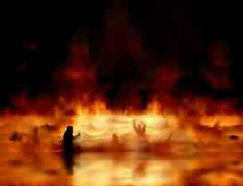
Fallen angels in HellImage via Wikipedia
Here is a  an article   I found in a tweet from godlessgirl. She suggests that this is a ninteresting article about hell. I think it would be fun to interact with it. My comments will be red.

The doctrine of Hell

"So shall it be at the end of the world: the angels shall come forth, and sever the wicked from among the just, and shall cast them into the furnace of fire: there shall be wailing and gnashing of teeth."
--The Bible, Matthew 13:40-50 (KJV)

"The same shall drink of the wine of the wrath of God, which is poured out without mixture into the cup of his indignation; and he shall be tormented with fire and brimstone in the presence of the holy angels, and in the presence of the Lamb: and the smoke of their torment ascendeth up for ever and ever: and they have no rest day nor night..."
--The Bible, Revelation 14:10-11 (KJV)

"But as for those who disbelieve, garments of fire will be cut out for them; boiling fluid will be poured down on their heads, whereby that which is in their bellies, and their skins too, will be melted; and for them are hooked rods of iron. Whenever, in their anguish, they would go forth from thence they are driven back therein and (it is said unto them): Taste the doom of burning."
--The Qur'an, sura 22:19-22

"Those who disbelieve Our revelations, We shall expose them to the Fire. As often as their skins are consumed We shall exchange them for fresh skins that they may taste the torment."
--The Qur'an, sura 4:56

"O the greatness of the mercy of our God, the Holy One of Israel! For he delivereth his saints from that awful monster the devil, and death, and hell, and that lake of fire and brimstone, which is endless torment."
--The Book of Mormon, 2 Nephi 9:19

"Depart, ye cursed, to whom everlasting wrath and ruin belong, who are by your own wickedness prepared for nothing else, but to be firebrands of hell, who are the fit objects and vessels of the vengeance and fury of the Almighty, into fire. He will not send them away merely into a loathsome prison, the receptacle of the filth and rubbish of the universe, but into a furnace of fire. That must be their dwelling-place, there they must be tormented with the most racking pain and anguish. It is everlasting fire. There is eternity in the sentence, which infinitely aggravates the doom, and will make every word of it immensely more dreadful, sinking, and amazing to the souls that receive it."
--Jonathan Edwards, "The Final Judgment"

"You are going to see again the child about which you read in the Terrible Judgement, that it was condemned to hell. See! It is a pitiful sight. The little child is in this red hot oven. Hear how it screams to come out. See how it turns and twists itself about in the fire. It beats its head against the roof of the oven. It stamps its little feet on the floor of the oven. You can see on the face of this little child what you see on the faces of all in hell - despair, desperate and horrible!"
--John Furniss, "The Sight of Hell"

"At certain revolutions all the damned
Are brought; and feel by turns the bitter change
Of fierce extremes, extremes by change more fierce,
From beds of raging fire to starve in ice
Their soft ethereal warmth, and there to pine
Immovable, infixed, and frozen round
Periods of time, - thence hurried back to fire."
--John Milton, Paradise Lost, book 2

At least the author of the article is trying to cover Christianity, Mormons, and the thoughts of people concerning hell,.

Before the advent of Christianity, Judaism was vague on the notion of what awaited us after death. Some verses in the Old Testament seem to teach annihilation, non-existence for good and evil alike. Others imply that we will all experience temporary oblivion, but the righteous will be resurrected by God on Judgment Day, while everyone else will stay dead. Yet others point to the existence of some shadowy realm called Sheol from which the spirits of the dead could be summoned and contacted. The doctrine of Hell first began to arise near the end of the Old Testament era, but it took Jesus Christ to fully codify and formalize it as a part of Christian doctrine, from which it migrated into monotheistic religions in general. As this great moral teacher explained it, Hell is a dreadful lake of fire where all those who disobey God will go when they die, to suffer and be tormented eternally with no hope of escape.

I think the article could have been strengthened if the author had given scriptural references of the Old Testament references that imply all these various notions, but since he seems to want to focus on the New Testament, I will too.

It is difficult to keep a clear head and not get angry when discussing this doctrine. Hell is by far the worst religious idea that human beings have ever invented; certainly, in terms of the sheer amount of cruelty one person can wish inflicted on another, it is by definition unsurpassed. Nor are the effects of this belief limited to theists passively wishing this fate upon their enemies regardless of what happens in this world. As Thomas Paine said, belief in a cruel god makes a cruel man, and many religious atrocities committed through the centuries can, directly or indirectly, be traced to belief in Hell. (For examples, see this post from Positive Liberty.) Thus, it is for the sake of this life - the only one anyone can ever know for certain that they have - that it is important to expose this vicious falsehood for what it is. By accepting this doctrine for the sake of argument, this essay will show that it collapses under the weight of its own absurdity.

What amazes me is the anger the idea of hell brings. I mean why get angry? Disagree all you want, but why should you get angry about it? I'll save my answer for this for later.

Before going any further, it should be pointed out that this essay will only address the conception of Hell as eternal torment. Views of Hell which depict it as a temporary state will not be addressed here. This is not unfair or a straw man for the simple reason that a great many believers in multiple religious traditions specifically do claim that Hell is eternal, and are supported by their own sacred texts in this. This is shown by several of the quotes above. The Christian Bible depicts the damned as having "no rest day or night". The Islamic Qur'an says that inhabitants of Hell are driven back into the fire whenever they would seek reprieve, and further reinforces this with verses such as 2:162 and 2:167, which specifically deny that Hell is temporary. The Book of Mormon describes Hell as "endless torment". In light of these verses, adherents of these traditions who deny that Hell is eternal must first deal with the evidence from their own holy scriptures. Conversely, theists who do not believe that there is a Hell, or that God would send anyone there permanently if there was, are encouraged to read "God Is Love" rather than this essay.

I agree that the Bible teaches that hell is eternal. So at least we can agree on that. I am going to further restrict myself to only Biblical Christianity for my comments.

The first argument against the existence of Hell is the simplest and most effective: Where is the proof that there is such a place? Until theists produce the evidence, there is no reason whatsoever to believe anyone who claims it exists. The mere fact that a large number of people believe in such a place proves precisely nothing if those people cannot point to the empirical evidence that convinced them in the first place, nor do hallucinations occasionally experienced by people in near-death states indicate the existence of anything outside the mind. In addition, there is positive evidence against the existence of such a place: as neurological evidence suggests, the best explanation for the functioning of the mind requires only the physical structure of the brain. It is highly unlikely that the source of consciousness is an immaterial soul, and thus it is highly unlikely that there is any part of us that survives our physical death and goes on to an afterlife, hellish or otherwise. Until theists who believe in such a state can supply the hard evidence to back up their claims, we can and should feel free to dismiss them as utterly without foundation.

What about the assertion that "It is highly unlikely that the source of consciousness is an immaterial soul, and thus it is highly unlikely that there is any part of us that survives our physical death and goes on to an afterlife, hellish or otherwise." Where is the proof? It's just stuck out there. My point is that the structure of the brain does not tell us why a human is conscious. We are not even really sure what consciousness or self-awareness really is aside from the fact that merely posing the question means we have it. Does one really want to argue that human personality and consciousness are just a function of neural chemical processes? How? Why? Therefore denying the existence of the human spirit/soul seems silly. As for asking for proof that hell exists as a physical place, let's assume it does exist for the purpose of continuing the discussion. A more formal proof will require arguing for the validity of the Bible as a trustworthy source, and I'll save that for later.

Although there is absolutely no evidence to support the existence of such a place as Hell, that has not stopped fundamentalists from appealing to it in an attempt to frighten people into converting. In fact, rather than present a reasoned argument, they often go to great lengths to describe it in terms as horrible and terrifying as possible, in an attempt to provoke an emotional response rather than a rational one - to override reason with unreasoning fear. Fire-and-brimstone sermonizing such as the passages quoted at the beginning of this essay has been used for this purpose since the inception of the doctrine of Hell, as religious fanatics throughout history have delighted in imagining ever more grotesque and horrible tortures for those they view as God's enemies. While the Bible only alludes to furnaces of fire, outer darkness, undying worms and wailing and gnashing of teeth, the Qur'an adds many gruesome details to its much more explicit depiction of Hell. In the Islamic conception of the underworld, the damned are forced to wear garments of fire, boiling water as hot as molten brass is poured on their heads, their skin is melted and burned off, and they are beaten with iron hooks. Not to be outdone, Christian poets such as Dante Alighieri (author of the Inferno) pictured a Hell where the condemned are boiled in excrement or blood, where demons continually hack their bodies into pieces, where they are imprisoned in blazing sepulchres or frozen up to their necks in ice gnawing on each other's skulls. An English clergyman named John Furniss penned an even more horribly graphic pamphlet, quoted above, in which he depicted even children and unbaptized infants as suffering every manner of agonizing torture. Across the Atlantic, American evangelists such as Jonathan Edwards terrified audiences with vivid descriptions of the torments of hellfire.

All these gory descriptions of the suffering of the damned lead to an obvious question: Why would God ever create such a place? What purpose does it serve? How can Hell possibly be compatible with God's attributes, which all the major monotheistic religions insist on, of benevolence, justice and mercy?

I think that here is were the crux of the disconnect is. The argument is that a benevolent, just, and merciful God would not send people to such a terrible place as hell. The thought is that I, nor anyone is that bad as to deserve to be punished for eternity. The thought is that every human being is basically "good"...we just sometimes do bad things.

Imagine how much hatred you would have to have for another person to take his hand and press it against a hot stove, and hold it there while he struggles and screams in pain. Now imagine, not just burning a person's hand, but setting his entire body on fire; and now imagine doing it not just for a few moments, not for hours or days or years or millennia, but forever; and now imagine tormenting not just one, but thousands, millions, billions of people like this, inflicting on each and every one of them a suffering beyond imagination or description, for every single instant without rest or relief throughout all the endless span of eternity. And this is the work of a good god?

This is a poor analogy to hell. To make it more like what Christianity actually holds what should have been written is that a person - of his own free will - is given the choice to not step in the fire but just submit to God and serve him or walk into the fire. Those who go to hell chose to walk into the fire.

Some theists say that God loves us and cares about us more deeply than we can imagine; and then turn around and say that he is ready at a moment's notice to hurl into endless agony anyone who did not worship him exactly as he directed. This is a hopelessly self-contradictory set of beliefs. If there is such a place as Hell, it could not possibly be the creation of any being worthy of the appellations "loving" or "caring"; it could only be the work of an evil, sadistic monster. Theists who are unwilling to grant that there could be such a being are therefore faced with a choice: give up belief in Hell, or give up belief in God altogether.

Huge problem with this thought. God has a standard. You can't be on the fence.  You are either in His will or out of his will. If you are out of his will you are going to hell. If you are in his will you are going to heaven. It's an absolute. How is it self-contradictory that if you don't meet the standard? How is that unfair? It's like gravity on a certain level. If you step off a cliff  is it gravity's fault when you fall off the cliff?  No it's not. However God loves us so much that he has given us a way to avoid walking off that cliff and because we can't fly he will carry us to safety. This is what salvation is about. No one can meet that standard on his/her own. This is why Jesus came and died in our place..

There is another problem with the doctrine of Hell, which is as follows: No deed that a human being could possibly commit merits such a punishment. It is stressed by virtually all religions that God is just, but it is a fundamental part of justice that the punishment must be proportionate to the crime, and Hell is, by definition, infinitely disproportionate when compared to any human act. No matter how monstrous a person was in life, no matter how evil their crimes, they can only have inflicted a finite amount of harm, and no finite sin can deserve an infinite amount of punishment. Even when a damned soul has suffered as much pain as they inflicted on others during their life, we are told, the torture continues. Even when that soul has been paid back, pain for pain, a hundred times over, or a thousand times, or a million, they continue to suffer. Every damned soul will eventually suffer as much pain as every innocent victim of every evil act in the entire history of the Earth combined, and still their punishment will continue without end. This is not fair - this is an outrageous injustice. Again, believers in a just and fair god cannot hold this belief alongside belief in an afterlife of eternal torment, not without contradicting themselves. The only intellectually consistent route is to deny that there is such a realm, or such a being, or both.

Actually that article is being intellectually inconsistent. The argument is made that our sins are finite therefore we don't deserve infinite punishment. Only a mind who does not understand how truly horrific sin is contrasted with God's holiness could possibly make such an argument. The Biblical position holds that you and I deserve to go to hell. We sin continually. We sin constantly sometimes without even realizing. Forget the times we sin  on purpose. Therefore an infinite punishment is deserved should we find ourselves in hell. Also why would you think that sins stop in hell? Does it make sense that everyone in hell will stop being evil just because they are in hell? I don't think  so. Hell will be full of people eternally quarantined from God and His people. The people in hell did not want God and then they will get their desire fulfilled.

Some apologists have put forth a defense against this argument, claiming that because God is infinitely good, a person who chooses to defy him is committing an "infinite crime" and therefore deserves an infinity of suffering as punishment. But consider: What does it mean to commit a crime against someone? Does the essence of a crime not lie in harm? Not all harm done to a person rises to the standard of a crime, but it cannot be said that you have committed a crime against someone if they have not been harmed in any way. But God, by his nature, can never be harmed. According to the monotheistic religions, God is omniscient, omnipotent, and perfect; he lacks nothing, he needs nothing, and certainly he cannot be injured or diminished in any way by anything a human being could ever do. Therefore, it is impossible to commit any crime against him at all, much less an infinite one. We may harm ourselves, or other people, but we can never harm God, and it defies justice to pay back an act that causes zero harm with an act that causes infinite harm.

The Bible teaches that all sin is against God. It's not about harming God it's about disobeying and disrespecting him. Sinners going to hell is not pay back for sins against God it's justice because it is an affront to His nature. It's like how light encroaches and vanquishes darkness. They cannot coexist forever. Light will overwhelm the darkness.

The apologist argument of disbelief as an infinite crime can be refuted in another way. For justice to be served, the punishment for a crime should be set not only by considering the consequences of the act, but also by considering the intent and level of understanding of the person who commits it. This is why, for example, most societies punish minors less harshly than they would adults who committed the same crime, or why they generally treat rather than punish people who commit a crime while operating under a sense of diminished capacity that makes them less able to tell right from wrong.

The relevance is this. In God's sight, compared to God's mind, are we adults or are we minors? Do theists believe that people who reject God understand exactly what they are doing? Is it possible for anyone with a finite mind to fully comprehend the repercussions of such an act? It is said that rejection of God is an infinite crime, but can a human being really commit a crime that great even if they want to, even if they think they mean it at the time? While Hell-believing theists will undoubtedly answer "yes" to these latter three questions, I suggest that those answers arise from their a priori beliefs rather than a rational and objective evaluation of the situation. Such an evaluation is far more likely to come to the opposite answer.

There are degrees of punishments in hell. Someone who sinned in ignorance and did not know as much as another will not experience that same torment as one who knew and understood better.

 47"That servant who knows his master's will and does not get ready or does not do what his master wants will be beaten with many blows. 48But the one who does not know and does things deserving punishment will be beaten with few blows. From everyone who has been given much, much will be demanded; and from the one who has been entrusted with much, much more will be asked. - :Luke 12: 47-48

Fair enough? Good!

This becomes even more acute when one considers that the length of the afterlife, in most major religious traditions, is believed to be eternity. The human mind is finite and thus, by definition, cannot fully comprehend such a span of time. How can it be fair to force beings as limited as us to make decisions that will influence our fate for an infinity thereafter and only allow us an infinitesimally short length of time to choose? This would be analogous to parents deciding how they will relate to their child for the rest of his life based on his behavior up until the age of two years old. If at some point during those first two years the child threw a tantrum and screamed "I hate you" at his parents, would the appropriate response be for them to throw him out of the house, disown him completely and never speak to him again for the rest of his life? Just as no two-year-old child could possibly be expected to have the perspective to make decisions that would be best for the rest of his finite life, so too could no finite human being be fairly expected to be able to make the best decisions for the rest of an infinite life. The conclusion remains the same: only an infinite being can commit an infinite crime.

Again a bad analogy. God does not write you off after one sin but you don't know how much time you have before you run out of opportunities to accept God'a offer of salvation.

Even assuming none of the preceding holds true, another question remains to be answered: Why can't you repent in Hell and be released? What happens if one of the damned says, "I can't take this anymore. I understand now that I sinned and I'm sorry. God, please forgive me and let me out of here"? Will this work? If not, why not? If there's a rule that says it's too late to repent once you're in Hell, who made that rule and why?

God made that rule and by definition no one in hell would repent and worship God even if they could get out. They wouldn't do it before they went to hell why would they change. If you end up in hell it is because you rejected God.  Now that you have what you want why belly ache? Yes, you could argue that you didn't understand the repercussions of the decisions they made in life, but does that matter? Anyone reading this has made up their minds. They understand that the Bible teaches that rejecting Jesus means they are going to hell. They have no excuse. Believe or don't believe. The consequences are on your head. I hope you choose to believe and put your faith in Jesus that way you don't have to worry about going to hell because then you can repair your relationship with God.

Some theists might say that God does not allow this because, in this case, people would be repenting just to escape further punishment, not because they were genuinely sorry. If this is the case, then shouldn't he also condemn people who repented on Earth only because they were afraid of Hell? Shouldn't he also condemn people who repented on Earth because of some personal tragedy or catastrophe that befell them? Yet no religions I am aware of teach that God will do this; if anything, most monotheistic religions teach that such occurrences are very salutary in bringing people closer to God and making them realize their dependence on him. If God wants everyone to be saved, if he accepts repentance motivated by personal catastrophe on Earth, and if he accepts repentance motivated by fear of Hell while on Earth, then a declaration that God will not forgive anyone once they are in Hell cannot be seen as anything other than arbitrary and irrational. Such a declaration would be motivated not by any real reason or logical necessity, but by the desire of that religion to secure earthly power by coercing and frightening people into allegiance.

People who repent and follow Christ only to escape hell may never develop a true heart and love for God. These people become apostates and never really were saved. Given enough time no one remains a Christian just because they are afraid of going to hell.

In the preceding paragraphs of this essay, I have argued that the doctrine of Hell is, in multiple aspects, starkly incompatible with the attributes of benevolence, justice, love, mercy and rationality attributed to God by mainstream monotheistic religions. It cannot logically be a part of a system that includes belief in such a god. This will, of course, not affect those theists who believe in an irrational or evil god; to these, I simply reiterate my argument that there is no evidence whatsoever for the existence of either such a place or such a being. In either case, the doctrine of Hell must be rejected.

The author's definitions for "benevolence, justice, love, mercy and rationality" are not consistent given what the Bible says about  God's benevolence, justice, love, mercy and rationality.

In light of these arguments, I will again raise the question asked earlier. Since the doctrine of Hell, as it is formulated in monotheistic religions, defies so many of God's attributes, one must ask why these religions believe in it at all. Why is there any need for such a place?

The most common apologist reply to this is that God has "no choice". To refuse to worship him is to sin, and loving though he may be he cannot allow sin into Heaven; therefore, he had no choice but to create a Hell where he could send those who die in their sins. This argument, however, is plainly ridiculous. Of course God, if there is such a being, would have a choice - he is all-powerful, is he not? He can do anything he wants. If he wanted to, he could choose to forgive all people of sin unconditionally and let everyone into Heaven. He could reincarnate people until they get it right, so no one has to be condemned. He could make the people who refuse to worship him cease to exist. Even assuming he could not do any of these things and there must be such a place as Hell where nonbelievers go, there is no reason why it has to be a pit of torture - it could just be a limbo, or a realm basically like Earth, where unbelievers could simply go their own way. But, if we are to believe many theists, despite having all these other options God chose none of them, and instead decreed that those who die without believing in him are condemned, with no forgiveness and no second chance, and made a place of endless torture for them to go to. This idea is such a grotesque absurdity it hardly needs refutation; it is in blatant contradiction to everything else we are supposed to believe about God. Again, if there was such a place as Hell, it could never be the creation of a merciful, loving or just deity, but only of an evil sadist. Only a god who enjoys the torment and suffering of others would create such a place or allow it to exist, yet both atheists and monotheists agree that there is no such god.

I agree that it's a silly argument that God had no choice but to make hell. But it is equally silly to assert that God could not be loving or merciful because Hell exists. The Bible says that God's plan for everything glorifies Himself. If there was no hell we would not be able to observe God's justice in punishing sin or his mercy in saving some of us from hell. The bottom line is if you don't wanna go to hell you don't have to go. All you have to do is submit to Jesus as Lord and Savior -  believe the Word of God and live that way. 

When all the arguments are considered, the true purpose of the doctrine of Hell becomes clear, and it is not a theological but rather a thoroughly practical and earthly one. Hell is, and has never been anything other than, a fiction invented by religions in an attempt to gain power and followers by bludgeoning people into line through threats and fear. As an atheist, I reject this tactic; it is nothing but empty words. Without evidence to back it up, the tattered specter of eternal torment should not sway a rational mind in the least. No one has anything to fear from this myth. The doctrine of Hell is constructed to appeal to the emotions, but collapses when examined by simple conscience or logic.

The doctrine hell is based on pure logic not emotion. If you are not born-again you are going to hell. Pure and simple. Everyone is hellbound from the moment we exist. God provided for us a gift - payment for the debt of sin that we can't pay. Jesus picked up our bill on his tab. The question becomes do you want stand before God on your own merits -  with a heart full of lust and greed -  or to be judged in light of the sinless perfection of  Jesus Christ. Personally, I'll choose the later.

Ebon Musings: Infinite Punishment for Finite Sins
Reblog this post [with Zemanta]