Showing posts with label Lee Strobel. Show all posts
Showing posts with label Lee Strobel. Show all posts
Tuesday, April 26, 2022


Thursday, July 26, 2012
"If God is All-Powerful, Why does Evil Exist?"

Greg Koukl
Truthbomb Apologetics: Video: Greg Koukl- "If God is All-Powerful, Why does Evil Exist?"
Ravi Zacharias
Lee Strobel
http://www.apologetics315.com/2012/07/why-does-god-allow-tragedy-and-suffering.html
Norman Geisler
Bill Honsberger

http://www.havenministry.com/A%20letter%20on%20the%20problem%20of%20evil.htm
Walter Martin

Evil and Human Suffering, part 1 and part 2
William Lane Craig

Tuesday, May 22, 2012
Confident Christianity: Lee Strobel Interviews Mary Jo Sharp

Confident Christianity: Lee Strobel Interviews Mary Jo Sharp
Saturday, April 23, 2011
The Dunamis Word: Lee Strobel, The Resurrection Took Me From Atheist To Apologist

The Dunamis Word: Lee Strobel, The Resurrection Took Me From Atheist To Apologist

Tuesday, April 19, 2011
Apologist Interview: Lee Strobel - Apologetics 315
 Image via WikipediaBrian Auten has posted his interview with Lee Strobel. It was great! I really enjoyed it. I especially enjoyed Strobel talking about how the his own work has affected himself.
Apologist Interview: Lee Strobel - Apologetics 315

Wednesday, March 9, 2011
FacePalm of the Day #66 - Debunking Christianity: The Ten Marks of a Deluded Person

Below in no particular order are what I consider the ten marks (or characteristics) of a deluded person. I think even educated Christians will agree with most of them. You might want to consider from this checklist how many of them apply to you. To the degree that more of them apply then the more likely you are deluded by your faith. Now it's quite possible that Christians can be deluded and yet their faith is true, in the same sense that a person might be brainwashed or indoctrinated into believing the truth. But the point is that if you're deluded then you have no reason to believe.
The thing is I think that many of these can apply to atheists. Let's see if his list makes sense.
A deluded person is more likely than not one who...
1) Was born and raised into his or her religious faith. Just taking the odds at face value this is non-controversial and undeniable given the number of religions propagated around the globe and adhered to with utter and complete confidence as the one true faith.
Not all Christians accepts odds at face value nor deny that there are things we don't know. The things all of the various religions Loftus refers cannot, in no way or shape or form, can be true simultaneously. Christianity is either true or it isn't. If any of the other religions are true then Christianity cannot be true. This is the bottom line. The other possibility is that none of them is wrong. I don't think that there is enough evidence pointing to Christianity being wrong. Better minds than John Loftus have tried to prove the Bible wrong and failed.
2) As an adult never adopts nor cultivates the adult attitude of doubt. All adults must revisit the religious faith taught to them by their parents since #1 above is undeniably true. That means they must doubt. Doubt is the adult attitude.
#1 is not true. Loftus cannot prove it to be true either. I'd like to know why he does not apply the "adult attitude" to his conclusions in #1? The Bible invites us to test our faith - to check it out. If you don't examine your presuppositions and your beliefs than you are disobeying the commands given by God through the Bible. If you don't believe that the Bible is the word of God, I sure would like to see you prove it.
3) Never reads widely or is exposed to other points of view in the media. I'm talking about non-fiction works about the sciences, different cultures, different faiths, and those written by skeptics or non-believers. To escape from being deluded, believers should read books that are written by people within different cultures and faith communities, and watch programs on the History Channel, National Geographic Channel, Discovery Channel, PBS, 60 Minutes, Dateline, and yes, YouTube.
I'd like to know why Loftus thinks that if one exposes themselves to other viewpoints, cultures, and religions they will come to the same conclusions they do. I have spent considerable amount of time looking at other viewpoints throughout my life but I don't see things the same way he does.
4) Does not travel widely including travel into different cultures. A deluded person only experiences a small slice of the pie. One must experience the world to see how others live. The more the better. Such a person basically stays within the social confines of like-minded religious people. The Amish are the extreme examples of this. Many believers only have believing friends. Even if believers cannot travel the world they can still step outside their social grouping to meet other people who think differently. Most believers do not trust people of different faiths or non-believers. Seek them out. Attend a freethinker's group meeting. Get to know them. Become friends with them.
I have been blessed to grow up in and continue to live in one of the most diverse places on earth at any given time - varying beliefs, lifestyle, culture, and viewpoints. I have had peers and classmates from all over the world and learned how to get along with all of them. I learned that just because they think differently doesn't make them more evil than people who agree with me. I do see the allure of compromise. It may seem unfair to think of people one knows who are nice, kind, and trustworthy (according to your standard) will go to hell because they reject Jesus. I keep coming back to the fact that if the Bible is right than that mean anyone who disagrees is wrong. The Bible does not give us the leeway to conclude anything else. This is why people like John Loftus must reject it if they are going to to continue what they are doing.
5) Never studies deeply into the nature of his or her adopted faith. The more you know the less you believe, the less confident you become, and the more you doubt.
I'd like to know what "deeply" means here. It usually seems to mean, rejecting traditions understanding, and assuming that the Bible is wrong and then try to find evidence for why it's wrong. I have studied math, science, and engineering for my whole life and the more I learn the more I see God the way Isaac Newton and Kepler saw God. The more I live and seek after God, the more I get to know God and the more my confidence in him grow and my confidence in me lessens because I see me more clearly. My faith grows.
6) Lies in order to defend one's faith. There are plenty of examples of this, from faking stories about finding Noah's Ark, to fudging the truth when there is no reasonable response, to making up personal healing stories, to claiming a conversion from a position of intellectual atheism (versus a practical atheism) to Evangelical Christianity like Lee Strobel and David Wood, to personal and unjustified attacks on anyone who questions one's faith in order to poison the well against them, to debate tactics like the ones used by Bill Craig and Dinesh D'Souza who as debaters, just like boxers in a ring, are out to win the debate no matter what must be said in order to win it. These are liars for Jesus to various degrees. If you have to lie to defend your faith then you need help.
I think here, Loftus protests too much. He likes to believe that all Christians are Christians because they were raised up as Christians. Although I was raised in a church under believing parents who fully committed themselves to God, my story is not the norm in my generation. Fewer and fewer people are being raised the way I was. It is for his pet theory for the origin of religious faith being a function of where and when you grew up that he has to accuse people like Lee Strobel and David Wood of not being real atheists. It's okay for him to discount their testimony but not not okay for his testimony to have been a born-again Christian at one point to be questioned? Sounds fishy to me. His complaining about William Lane Craig's and Dinesh D'Souza's debate tactics seems real self-serving. I have not seen any evidence that they lied to win debates at any time. Loftus offers no proof to these stupid allegations. I think it's self-serving on John Loftus' part because he lost his debates against David Wood and Dinesh D'Souza and it wasn't just because they are better debaters - they're arguments were better - and he feels the need to explain the lost. Additionally, he's below William Lane Craig's notice so he won't debate Loftus. That's not a bad thing but it really must wound his pride, being he was once his student and didn't finish his education.
7) Preaches to people who think differently rather than rationally engaging them. I am constantly amazed, bewildered, frustrated, and bored with the kind of responses I see from believers who comment here at DC. They come here preaching. They pontificate. They quote mine from the Bible. They even say we're going to hell with glee. Many of them merely mouth the words of the creeds and affirm what they believe, rather than actually engaging us with a rational discussion about the basis for believing in the first place. They come here preaching to us from an ancient superstitious set of texts rather than showing us why we should believe them in the first place.
I don't think anyone who is born again and loves God wants to see anyone go to hell. We want what God wants. It doesn't make me glad that people are going to go to hell because they opposed God. Why should quoting the Bible be offensive? Why should it be a problem? It's been said many times that you should first prove the Bible is worthy to be believed before using it. I think it's good to discuss why we should believe it, but I find that people have already made up their minds to reject it. If you truly have an attitude of doubt and skepticism you should be equally open to either viewpoint. Otherwise, you are biased and might as well admit it and be prepared to prove why you have come to that conclusion. I have studied the issues and looked at evidence and I have come to the conclusion that God not only exists but has revealed himself through scripture. Therefore anything or anyone that contradicts it can't be taken as authority.
8) Claims he or she does not need evidence to believe. Take notice Alvin Plantinga and Bill Craig! This is utterly delusional thinking especially when we consider all of the things they must take as properly basic beliefs coming from the witness of the Holy Spirit. As someone said, "what can be asserted without evidence can also be dismissed without evidence." Anyone who claims his or her faith does not need evidence, even if true, ought to take a reality check.
I disagree that we should take the attitude that we don't need evidence to believe. Every Christian I know who is born-again had some evidence that lead them to accept Jesus - they know what God did for them. There is plenty evidence, but people do deny and ignore what God has graciously given to us.
9) Must be convinced that his or her faith is impossible before seeing it as improbable. Time after time believers will claim I have not proved that their faith is impossible, and so lacking this kind of proof they still claim to have a reason to believe. However, we're always talking about probabilities. So even if it's still possible to believe in light of a number of problems for faith, it's still an improbable faith and that should be good enough.
Improbability is not enough. There are too many things that we know are both improbable and true. I would agree if we knew that all things that true is also probable. Since we know that does not work something improbable does not by definition can be tossed out. This point is often used to deny miracles. If something is probable it cannot be a miracle. For example - not all cancers probably go into remission. Impossibility is a lot stronger. If you argue that there is no such thing as impossibility then you have to allow for miracles. Sounds like a dilemma.
10) Must denigrate the sciences in order to have faith. This is what I see time after time. Believers denigrate the sciences in a number of ways in order to believe. That's because faith demands it. Some believers don't even know what I'm talking about. Since science tells us prayer doesn't work then it doesn't work. It tells us the universe is 13.7 billion years old. It tells us we evolved. It tells us there was no Israelite Exodus from Egypt. It tells us the Nativity stories in the Gospels could not be true. It tells us virgins do not have babies. It tells us that dead people do not bodily rise from the grave. Christians must denigrate science in order to believe. Science or Faith? Science has a track record. Faith flies planes into buildings. Science all the way, hands down. End of story.
Far from the end of the story. Faith is always misdefined by people like John Loftus. And there is no reason to think believers must denigrate science any more than science needs to denigrate religion. It doesn't take science or faith to understand reality. We need science and faith. They are not mutually exclusive but can help flesh out what is real. Loftus makes all kinds of assertions that prayer does not work, people evolved from one-celled organism, and no Israelite exodus, but seems to neglect that there very intelligent and educated people (who actually finished their PH.D.'s in a wide range of disciplines) who would disagree with him and come to opposite conclusions. He also asserts that the miracles of the incarnation and Resurrection could not have happened because...? They are impossible? You can't come to that conclusion and still claim to be objective and open-minded. You can say that we don't have any scientific data for them. You can say that you don't find any evidence that you would accept. But you can't deny them and write them off as impossible because you can't prove that they are impossible. The best you, as a skeptic, can truly and honestly conclude is that they are improbable and rare - maybe occurring once. Isn't that the definition of a miracle? Yes, it is, which is what Christianity has claimed for 2000 years.
Debunking Christianity: The Ten Marks of a Deluded Person

Friday, December 17, 2010
Scientism by Lee Strobel MP3 Audio - Apologetics 315

Brian Auten has done us a favor. He posted a lecture from Lee Strobel regarding the relationship between faith and science. You can listen to the lecture by following the link below to Apologetics 315.
Scientism by Lee Strobel MP3 Audio - Apologetics 315

Friday, October 15, 2010
Fistbump of the Day #2 - Resurrection Harmonization Narrative

Resurrection Harmonization Narrative
One of the resources for the site is a chart explaining the events of the Resurrection and in which Gospel (s) record it.

I'm amazed how people assume that each Gospel writer must tell the story the same way from different point of views. They used different time-keeping methods. One sometimes summarized events while another gave step-by-step details. I'm amazed at how people think that if it's not done the way they would have done it than God didn't inspire it. I don't understand that. Given how finite and depraved our minds are, I would not expect God to do much like how we would do things at all. A lot of Atheists decry Dr. William Lane Craig's arguments, but I have not seen very much in the way of a rebuttal. And I have not seen any good rebuttal against Lee Strobel or Gary Habermas either. Here is a list of resources that I would suggest anyone who is desiring to study the evidence for the Resurrection should start with.
Mary Jo Sharp vs. Ehteshaam Gulam Debate: Did Jesus Die on the Cross? MP3 Audio - Apologetics 315
Resurrection Debate: Gary Habermas & Mike Licona vs Robert Price
Iron Sharpens Iron: Gary Habermas: Did The Resurrection Happen?
Jesus' Resurrection: Gary Habermas and Antony Flew
Memorable Keys to the Greatest FEAT in History
Apologetics 315: Advanced Use of Historical Evidence for the Resurrection: Gary Habermas MP3 Audio
Gary Habermas vs. Tim Callahan on the Pagan Jesus Myth of the Resurrection | True Freethinker
Resurrection
Resurrection of Jesus

Monday, August 23, 2010
Debunking Christianity: Lee Strobel, You Are Just Plain Stupid!

I like Bishop John Shelby Spong. I've read a couple of his books more than a decade ago and they were eye-opening to me. He presents a superior case against Christian fundamentalism. Watch Spong in action below but take special note of how utterly stupid Lee Strobel is at the end. He merely repeats platitudes that Biblical scholars have long ago debunked. Sorry Lee but you are one ignorant man.
Let's discuss just what "stupid" is. I keep hearing Loftus and others completely agree with some of the fallacies Bishop Spong kept bringing up and making it seem like all Christian Scholars agree with him and the minority who don't are either uneducated and biased for Christianity because of their faith. I disagree because I know of many well-educated and researched scholars who disagree with the conclusions reached by Loftus and Spong.
I think the real reason Loftus doesn't like Strobel is because Strobel used to be an atheist and flies in the face of Loftus' rhetoric that Christians are Christians because they were raised that way and reasonable people become atheists when they look at the evidences for themselves. The thing that Loftus seems to forget is that Strobel isn't the only one who comes to Christ from a non-Christian background. Just because I did does not mean everyone does.
Debunking Christianity: Lee Strobel, You Are Just Plain Stupid!
Tuesday, July 27, 2010
Stephen C. Meyer on Intelligent Design

Stephen C. Meyer
Chad's post
Saturday, July 3, 2010
Greg Koukl and Deepak Chopra | True Freethinker

Greg Koukl and Deepak Chopra | True Freethinker
Friday, July 2, 2010


Sunday, June 27, 2010
The Case for Lee Strobel | True Freethinker

The Case for Lee Strobel | True Freethinker

Wednesday, June 16, 2010
Fundamentalist Theologian, Richard Carrier, Speaks Out About the Resurrection | True Freethinker

Fundamentalist Theologian, Richard Carrier, Speaks Out About the Resurrection | True Freethinker

Thursday, May 6, 2010
Debunking Christianity: The Case For "The Case Against The Case For Christ"

Debunking Christianity: The Case For "The Case Against The Case For Christ"

Friday, April 30, 2010
Apologetics 315: Antony Flew Interview Videos by Lee Strobel (w/ MP3)

Here is an interview by Lee Strobel of the late Antony Flew, not too long after his rejection of atheism. Video clips in five parts at LeeStrobel.com:
• Why did your beliefs change? (2:06)
• What is God like? (5:08)
• A Creator was involved in the creation of life (2:59)
• Afterlife and Christianity (5:42)
• My time with C.S. Lewis (1:35)
All interview audio in MP3 here. (17 minutes)
Enjoy.
Apologetics 315: Antony Flew Interview Videos by Lee Strobel (w/ MP3)

Friday, February 12, 2010
Battle for the Bible Conference.

http://www.thebattleforthebible.com/

Saturday, October 3, 2009
Extra-Biblical Attestation for the Darkness During the Crucifixion.
One of the challenges to the validity of the Bible in general and the accounts of the Gospels in particular is the point that the Bible reports that at the time of Jesus' crucifixion a darkness covered the area - as if the sun itself took notice of the horrible crime and refused to shine in recognition. Let's look at the passage itself.
A historian from the first century AD named Thallus is quoted by another historian named Julius Africanus who was a Christian in the 3rd Century. Thallus was not a Christian. Here is the quote from Julius Africanus:

So we have 3 contemporaneous accounts to the report of darkness covering much of the earth during Jesus' crucifixion: Tertullian, Phlegon, and Thallus.
I also want to say something about the criticism that the gospel accounts can't be harmonized. You have to remember that each Gospel was written to a different audience. Matthew was written to Jews and presents Jesus as King and Messiah. This is why Jesus' words "Eloi, Eloi, lama sabachthani?" were recorded because in Jewish tradition one calls attention to a whole passage by quoting the first sentence. They would understand that Jesus was calling attention to Psalm 22, and pointing out that it was being fulfilled in front of them. Luke didn't record those words but instead focused on something Jesus said that would mean something to the audience he was writing to - the Greeks. Luke's gospel show cases Jesus' humanity. We see that Jesus was really a man. This may also be why in Luke we get the most information about Jesus' birth and humanity. Mark included this part because it is written from interviewing Peter. who was Jewish. Mark differs between Matthew and Luke and John because it is based on action. We get little background but instead we get a focus on what Jesus did. We get to see Jesus as servant. I call Mark the "Michael Bay" of the four Gospels. John tells us in his gospel that his goal is to present enough information to let the reader know that Jesus is the only way to salvation, so he didn't always present or record everything the other four did.
Lee Strobel, The Case for Christ pages 60-61
Extrabiblical Witnesses to Jesus before 200 a.d.
Added Note: Quintus Septimius Florens Tertullianus, anglicised as Tertullian, (ca. 160 – ca. 220 AD) was really not a 1st Century Christian but a second. Sorry for any confusion.


From the sixth hour until the ninth hour darkness came over all the land. About the ninth hour Jesus cried out in a loud voice, "Eloi, Eloi, lama sabachthani?"—which means, "My God, my God, why have you forsaken me?" - Matthew 23:45-46
At the sixth hour darkness came over the whole land until the ninth hour. And at the ninth hour Jesus cried out in a loud voice, "Eloi, Eloi, lama sabachthani?"—which means, "My God, my God, why have you forsaken me?" - Mark 15: 33-34
It was now about the sixth hour, and darkness came over the whole land until the ninth hour, for the sun stopped shining. And the curtain of the temple was torn in two. Jesus called out with a loud voice, "Father, into your hands I commit my spirit." When he had said this, he breathed his last.- Luke 23: 44-46I want to point a couple of things. We have three mentions that the darkness was 3 hours long! Some have theorized that this was caused by a total solar eclipse. However total solar eclipses are rare and don't last long. The longest solar eclipse in the the 21st century was July 22, 2009, clocking in at 6 minutes and 39 seconds. See the wikipedia article for confirmation. Skeptics argue that the darkness during the crucifixion could not have been a solar eclipse because of the length and there is not extrabiblical mention of the event of darkness. I agree that it wasn't an eclipse. Something miraculous happened. And as for other mentions of the event outside of the Bible there is evidence!
A historian from the first century AD named Thallus is quoted by another historian named Julius Africanus who was a Christian in the 3rd Century. Thallus was not a Christian. Here is the quote from Julius Africanus:
On the whole world there pressed a most fearful darkness; and the rocks were rent by an earthquake, and many places in Judea and other districts were thrown down. This darkness Thallus, in the third book of his History, calls, as appears to me without reason, an eclipse of the sun. For the Hebrews celebrate the passover on the 14th day according to the moon, and the passion of our Savior falls on the day before the passover; but an eclipse of the sun takes place only when the moon comes under the sun. And it cannot happen at any other time but in the interval between the first day of the new moon and the last of the old, that is, at their junction: how then should an eclipse be supposed to happen when the moon is almost diametrically opposite the sun? Let opinion pass however; let it carry the majority with it; and let this portent of the world be deemed an eclipse of the sun, like others a portent only to the eye. Phlegon records that, in the time of Tiberius Caesar, at full moon, there was a full eclipse of the sun from the sixth hour to the ninth--manifestly that one of which we speak. But what has an eclipse in common with an earthquake, the rending rocks, and the resurrection of the dead, and so great a perturbation throughout the universe? Surely no such event as this is recorded for a long period. (XVIII.1)Julius Africanus understood Thallus to be referring to the same darkness the reports mention. Although we no longer have copies of Thallus's work, other refer to what he said. Before someone cries "Second-hand evidence!", there is more. Historian Paul Mair wrote a novel of historical fiction called Pontius Pilate and in the foot note he wrote

So we have 3 contemporaneous accounts to the report of darkness covering much of the earth during Jesus' crucifixion: Tertullian, Phlegon, and Thallus.
I also want to say something about the criticism that the gospel accounts can't be harmonized. You have to remember that each Gospel was written to a different audience. Matthew was written to Jews and presents Jesus as King and Messiah. This is why Jesus' words "Eloi, Eloi, lama sabachthani?" were recorded because in Jewish tradition one calls attention to a whole passage by quoting the first sentence. They would understand that Jesus was calling attention to Psalm 22, and pointing out that it was being fulfilled in front of them. Luke didn't record those words but instead focused on something Jesus said that would mean something to the audience he was writing to - the Greeks. Luke's gospel show cases Jesus' humanity. We see that Jesus was really a man. This may also be why in Luke we get the most information about Jesus' birth and humanity. Mark included this part because it is written from interviewing Peter. who was Jewish. Mark differs between Matthew and Luke and John because it is based on action. We get little background but instead we get a focus on what Jesus did. We get to see Jesus as servant. I call Mark the "Michael Bay" of the four Gospels. John tells us in his gospel that his goal is to present enough information to let the reader know that Jesus is the only way to salvation, so he didn't always present or record everything the other four did.
Lee Strobel, The Case for Christ pages 60-61
Extrabiblical Witnesses to Jesus before 200 a.d.
Added Note: Quintus Septimius Florens Tertullianus, anglicised as Tertullian, (ca. 160 – ca. 220 AD) was really not a 1st Century Christian but a second. Sorry for any confusion.
Saturday, September 5, 2009
Lee Strobel Under Fire

I have come across a YouTube four-part series of videos where Lee Strobel's convictions are challenged. I want to present multiple viewpoints on this blog. Mr. Strobel is a busy guy and he can't answer each and every crackpot challenge. So I'll take this one.
The author of the videos made the mistake of trying to explain Lee Strobel's conversion away as He only started seriously studying the Bible as a believer looking for proof. This is false. By his own testimony, that I have read with my own eyes and heard in person with my own ears, he began to study the Bible to disprove it! He was an atheist. The creator of this serious must not know Strobel well at all.
What else is wrong? The author attempts to knock down Lee Strobel's remark that archaeology supports the Bible by pointing out examples showing where the Bible conflicts with arc
 haeology. He offers 3 major points
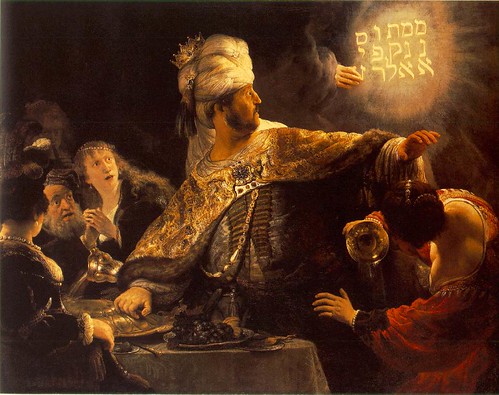
1. Daniel says that Belshazzar was Nebuchadnezzar's son, but he really was Nebuchadnezzar's grandson.
The author is ignorant of the oriental culture of the Babylonians and the Persians and the Jews. Grandsons and even Great Grandsons are often attributed to important fathers no matter how far the generations are apart. They also seem to skip details that some of us in modern western culture would have thought was important..ie the fact that Belshazzar was a co-regent with his father and that there had been 3 kings who reigned shortly after Nebuchadnezzar was not deemed important to include. No where in Daniel does it say that Belshazzar immediately followed Nebuchadnezzar. To imply or assume that is going beyond what the Bible does say.
2. Daniel says the Darius the Mede conquered Babylon when it really was Cyrus the Great.
Then Medes and Persians were one empire! Darius and Cyrus conquered Babylon together and Darius being about 62 at the time ruled for a brief time (about 2 yrs) and Cyrus took over the whole thing. source
3. The Bible say that Ninevah was so large that it took 3 days to cross the city but excavations show that the city is only 5 km across.
Look at the text in question - Jonah 3: 3
Jonah obeyed the word of the LORD and went to Nineveh. Now Nineveh was a very important city—a visit required three days.
Obviously the author of the video is using the KJV, but looking at the NIV is much clearer. It could be taken that it took 3 days to reach the city from where the fish dropped Jonah off. Ninevah is along way from the sea.
If the author was wrong about these three Biblical contradictions, what else could he be wrong about? As for the author's point that there is no evidence where there should be, I think it's only a matter of time. It took centuries to find the archaeological artifacts that we do have. I'm sure there is a lot more to find.

Then the author tries to knock down the thought that the Gospels that correlate. The problem he points out that:
1. Different number of women going to the tomb.
No Gospel disagrees with the other by saying so-and-so was not at the tomb when one of them says she was. None of the Gospels give the total number of women who went to the tomb therefore if it were more 5, then it perfectly concievable that different subsets were named.
2. Different number of angels
It's the same thing with number of angels. If one author offers more detail than another, why would you assume contradiction?
3. Location of the stone
None of the Gospels say that the women witnessed the stone being rolled away. There is no contradiction
4. Who did Jesus appear to first
Considering that Mary Magdalene saw Jesus in the same garden as the tomb just after dawn, I think it's safe to say that she saw him first. To charge contradiction with the two disciples on the way to Emmaus, you would have to say that the episode happened before Mary Magdalene and the other women went to the tomb and judging by the fact that people usually did not travel long distances in the dark of night, I'm certain Mary's encounter happened first.
5. Which disciples went to the tomb.
Does it really make sense to conclude that because Matthew did not record any disciples going to the tomb that there is contradiction with saying Peter went and saying Peter and John went. a contradiction would be to say no one went, Peter did not go, and John did not go. Neither Gospel says that. Where is the contradiction?
When the author talks about Jesus' end times prophecy alleges that Jesus failed to come back in the life time of the people who heard Him. The author has a problem. Jesus could not have been telling people that they would be alive when He comes back. Jesus said that no one knows the day or the hour of his return. He even said he did not know. He told parables illustrating that we have to live like He could come back at any second but not know when. Therefore to understand that Jesus has to return in the lifetime of the hearers means that there is a lack of understanding.
The alleged charge against Matthew saying the Jesus was riding 2 donkeys at the same time is either a lie or a misunderstanding. Jesus was riding a cold...the colt's mother was walking in front of Jesus and the colt. This is how they trained donkey that had never been ridden before.
As for the other alleged contradictions there are answers for them too if you bother to just look at the Bible in its context. For example the obligatory contradiction concerning Jesus' geneology in Matthew and Luke. to the Jewish culture, you don't list everyone in a geneology just the important ones (this is what Matthew did).
I have Doherty's book "Challenging the Verdict" against Strobel's "The Case for Christ". I agree read both. I think that the author of the video is wrong about the time line for the gospels. Not everyone agrees.
These videos do not represent truth and grossly misrepresent history and common sense. An example is the thought that Christianity is just like any other religion without interacting with all of Strobel's reasons for being convinced that it's not. Neither Islam nor Hinduism are based on a body of scripture that can be dated within 30 years of the events themselves. Not just the Gospels but the epistles as well.

Subscribe to:
Posts (Atom)