Showing posts with label Septuagint. Show all posts
Showing posts with label Septuagint. Show all posts
Wednesday, December 8, 2021


Monday, February 17, 2014
Truthbomb Apologetics: How We Got the Bible: Ancient Versions: The Old Testament

Truthbomb Apologetics: How We Got the Bible: Ancient Versions: The Old Testament
Tuesday, September 6, 2011
Online Bibles | Dr. Claude Mariottini – Professor of Old Testament

The Scholarly Biblical Portal of the German Bible Society is making available online Bibles that scholars use in their academic research.
The following online Bibles are currently available:
1. Hebrew Old Testament following the text of the Biblia Hebraica Stuttgartensia.
2. Greek New Testament following the text of the Novum Testamentum Graece (ed. Nestle-Aland), 27. Edition.
3. Greek Old Testament following the text of the Septuagint (ed. Rahlfs/Hanhart).
4. Latin Bible following the text of the Vulgate (ed. Weber/Gryson).
You must register to use these online Bibles. As a registered user you can search any biblical text in these editions. Registration is free of charge.
I'm signing up now!
Online Bibles | Dr. Claude Mariottini – Professor of Old Testament

Tuesday, July 26, 2011
Islam and Christianity A Common Word: A very simple question for Christians. (In What Sense Is God One?)

In what sense is God one? (Scriptural references are appreciated).
Let's take a moment and look at the whole passage:
Let's take a moment and look at the whole passage:
4 Hear, O Israel: The LORD our God, the LORD is one.[a] 5 Love the LORD your God with all your heart and with all your soul and with all your strength. - Deuteronomy 6:4-5 (NIV)
- Deuteronomy 6:4 Or The LORD our God is one LORD; or The LORD is our God, the LORD is one; or The LORD is our God, the LORD alone
4Hear, O Israel: The LORD our God is one LORD: 5And thou shalt love the LORD thy God with all thine heart, and with all thy soul, and with all thy might. - Deuteronomy 6:4-5 (KJV)

For example if I am part of the tribes of Israel and I hear it said to me 'Hear oh Israel the Lord your God the Lord is One'. (Deuteronomy 6:4)
What would I take away from that message? Would I have to have deep knowledge of theological and philosophy to understand this?
What if I was just a simple shepherd tending to my sheep?
So what does it say? Let us just ask what does the just plain person who was sitting in front of Moses, what did they hear? What did they understand? The Lord our God is one what? The Septuagint is of great help here. Recall Exodus 3:14
And God said (8799) unto Moses, I AM (8799) THAT I AM (8799) : and he said (8799) , Thus shalt thou say (8799) unto the children of Israel, I AM hath sent (8804) me unto you.
kai eipen o qeov prov Mwushn egw eimi o wn kai eipen outwv ereiv toiv uioiv Israhl o wn apestalken me prov umav
And now compare John 8:58
Jesus said (5627) unto them, Verily, verily, I say (5719) unto you, Before Abraham was (5635) , I am (5748) .
Egw eimi? In both Old and New Testament. Jesus is claiming to be the same being who spoke to Moses from the Burning Bush. Would someone from Moses time get that? I don't think so because it wasn't revealed until Jesus did it almost 1500 years later. What the Hebrews at the time of Moses understood was that God is one being. Jesus revealed more light as to who and what God is. Did Jesus reveal more info? Yup.
I and my Father are (5748) one.Hmmmm. Jesus used the same terminology for "oneness" as in Deuteronomy 6:4. Jesus makes a distinction between His person and the Father's person, but He makes not distinction in God's being or essence.
Cf. D. Block, has a book "How Many Is God: An Investigation into the Meaning of Deuteronomy 6:4-5," I thought this was a curious title for a book. A bit presumptuous. For example why not title the book 'How Many Beings is God: An Investigation into the Meaning of Deuteronomy 6:4-5."
After all if the Tri-Theist are going to keep coining new phrases, employing sophistry and clever semantics why presume anything?
Again with the Tri-Theist. We Christians - all of us - whether you accepts the distinction of person in the Godhead or ignore it - we all agree that God is one being. The Muslims are correct on that point.
Why presume that God's being is 'one'? I really want to know on what basis do Christians say that God's being is one?
Why presume that God's person is :"one" as thegrandverbalizer does? The Bible doesn't. Yet the Qur'an and the Bible agree that God is one in being.
Why presume that God's person is :"one" as thegrandverbalizer does? The Bible doesn't. Yet the Qur'an and the Bible agree that God is one in being.
If words have meaning what do they mean by that? Curious Muslims (and those searching for truth) want to know.
I want to know why thgrandverbalizer thinks that Christians are twisting words. We all instinctively make a distinction between "being" and "person". No one answers the questions "What are you?" the same as the question "Who are you?" They are different categories and not the same. Here is another important point. I think that the Trinity is important but it's not a litmus test for orthodoxy. I mean there will be countless people in heaven who put their faith in what God revealed to them and not have as much of the big picture as we have today. For example, Neither Abraham, Moses, nor David knew that the Messiah's name would be Jesus, but they knew that God would provide such salvation and they trusted God for that. Neither did they know about God being triune in person. Yet we'd be stupid to think they didn't make it into heaven.
39 These were all commended for their faith, yet none of them received what had been promised, 40 since God had planned something better for us so that only together with us would they be made perfect.- Hebrews 11:39-40
Islam and Christianity A Common Word: A very simple question for Christians. (In What Sense Is God One?)
Septuagint Info
StudyLight.org
Scripture4All - Interlinear Hebrew Old Testament

Sunday, October 3, 2010
Debunking Christianity: Harry McCall on God, Yahweh and Elohim

So, in Genesis 1:1, did an assembly of male gods create the heavens and the earth or did one god create? (If you want to play the Trinity card, then I’ll let your explain the other names of אל + prefixes in the MT text.)What I want to focus on is the point about how the Tetragrammaton (יהוה or YHWH) does not occur in the entire New Testament. McCall is wrong. It does. Recall that the New Testament was written in Greek not Hebrew. Therefore what you want to know is what does the name look like when it is translated into Greek. A great Old Testament text to use to study this point is Exodus 3:14. יהוה is the name by which Moses was to identify God with to the Israelites. It is often pronounced "Yahweh" although we don't know how its really supposed to be announced (but that is another story I don't have time for now). Let's look at Exodus 3:14 in English, Hebrews, and Greek (as it appears in the Septuagint). Please note that Hebrew is read right to left not left to right.
Can you show me why the divine name יהוה does not occur in the entire New Testament? Could it just be that “son of god” fit the Hellenic context of the Greek would while יהוה would have been an abhorrent pagan name for them, especially after the Jews were expelled from Rome in 46 CE?
Secondly, my view is in line with that of Edward Gibbons The History of the Decline and Fall of the Roman Empire. Weather or nor Gibbons was anti-Christian, his views of the end of the Roman Empire agrees with mine.
Another insider's look at how Christianity really worked in the late Empire is discussed in G.W. Bowersock’s award winning book: Julian the Apostate.
Julian, the grandson of Constantine, gives a horrific story about members of his own Christian family were murders and why he remained a non-Christian ("pagan", a derogatory term
English
God said to Moses, "I am who I am . This is what you are to say to the Israelites: 'I AM has sent me to you.' "
Hebrew
וַיֹּ֤אמֶר אֱלֹהִים֙ אֶל־ מֹשֶׁ֔ה אֶֽהְיֶ֖ה אֲשֶׁ֣ר אֶֽהְיֶ֑ה וַיֹּ֗אמֶר כֹּ֤ה תֹאמַר֙ לִבְנֵ֣י יִשְׂרָאֵ֔ל אֶֽהְיֶ֖ה שְׁלָחַ֥נִי אֲלֵיכֶֽם׃
Greek
καὶ εἶπεν ὁ θεὸς πρὸς Μωυσῆν ἐγώ εἰμι ὁ ὤν καὶ εἶπεν οὕτως ἐρεῖς τοῖς υἱοῖς Ισραηλ ὁ ὢν ἀπέσταλκέν με πρὸς ὑμᾶςThe Tetragrammaton comes over to English as "I AM". In Greek it is ἐγώ εἰμι. So now ask yourself..."Does this name appear anywhere in the New Testament? Further who is this name applied to in the New Testament?" Of course ἐγώ εἰμι appears in the New Testament and Jesus applies the divine name to himself that is why the Jews wanted to stone Him. The best indisputable place to see this in John 8:58
English
"I tell you the truth," Jesus answered, "before Abraham was born, I am!"
Greek
εἶπεν αὐτοῖς Ἰησοῦς, Ἀμὴν ἀμὴν λέγω ὑμῖν, πρὶν Ἀβραὰμ γενέσθαι ἐγὼ εἰμί.
Let me be clear: Jesus applied the same Name - "Yahweh" ("ἐγὼ εἰμί") to himself that God used when God spoke to Moses on Mt Sinai!
Debunking Christianity: Harry McCall on God, Yahweh and Elohim

Friday, August 7, 2009
Bart Ehrman Lecturing on "Misquoting Jesus"
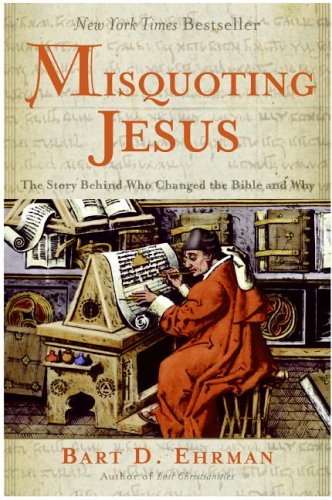
I've had an opportunity to listen to a debate by Bart Erhman on his book, Misquoting Jesus delivered at Stanford. I realized that although I disagree with his conclusions there are somethings
I can learn from him. Rather than spend my time in this post refuting him (Jame White and William Lane Craig already handled him, i want to focus on something he said. He said that Jesus did not use it. Also when the early church and Jewish scholars used the scriptures this was the translation they were using. You can even tell most often it is this translation that is quoted from in the New Testament. I think that even if Jesus did not speak Greek He could read it. This point knock's Ehrman's argument about Jesus not actually saying the words in John 3 because you can't render them in Aramaic. Maybe Jesus and Nicademus carried on the conversation in Greek. We don't know. Although Ehrman got that part wrong, i learned that I can't just ignore everything he says because the part about Niocademus confusing Jesus' admonition to be "Born from above" with the idea of entering his mother's womb a second time make a lot of sense when you understand that the Greek could be understood either way given the context.
| BartEhrmanNTCritic... |
Here is the video!
![Reblog this post [with Zemanta]](https://lh3.googleusercontent.com/blogger_img_proxy/AEn0k_sshLbPVvlL1uOfF736yvXQP6pF3GTzG38XWqCJa_y9Vrx8eFLq8Qvn4MLDYtmB891GbdNQkXD_g3fjHjR4bptykR5F55E9oJzgZUkXqqBJtvCxkEQfFElA0U0dswNxHQOgh0PgQyT_rzxX27c8-s4p=s0-d)
Subscribe to:
Posts (Atom)