Showing posts with label Crucifixion of Jesus. Show all posts
Showing posts with label Crucifixion of Jesus. Show all posts
Sunday, April 3, 2022


Thursday, January 31, 2013
Answering Muslims: Refuting Shabir Ally on the Crucifixion of Jesus

Answering Muslims: Refuting Shabir Ally on the Crucifixion of Jesus
Saturday, December 22, 2012
Answering Muslims: Refuting Zakir Naik on the Crucifixion of Jesus
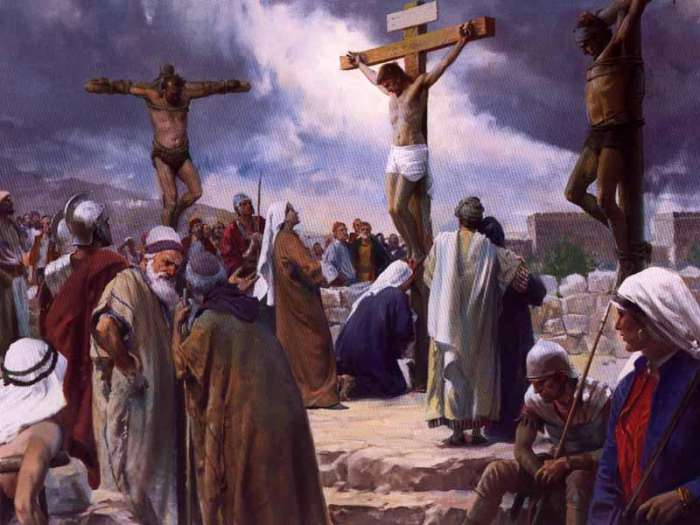
Zakir Naik claims that a careful reading of the New Testament shows that Jesus never died on the cross. But are his arguments sound? Sam Shamoun and I discuss Naik's main arguments in our latest episode of "Jesus or Muhammad?"
Answering Muslims: Refuting Zakir Naik on the Crucifixion of Jesus

Saturday, October 27, 2012
Answering Muslims: Sami Zaatari vs. James White: Was Jesus Crucified?
 A short while ago while James White was in the UK he debated Sami Zaatari on the question: "Was Jesus Crucified?". I'm amazed that this question even needs to be discussed but there are upwards of a billion Muslims on Earth and one of the foundations of popular Islam is that Jesus was not crucified but someone took his place.Everyone should watch this and see how James White ably defends the historical fact that Jesus was crucified.
Answering Muslims: Sami Zaatari vs. James White: Was Jesus Crucified?

Wednesday, June 13, 2012
FacePlant of the Day - Debunking Christianity: Why the Crucifixion ofJesus was a Waste and Rejected as Atonement by Yahweh (God)
 |
A. The Roman method of crucifixion, which included the beating Jesus received before he was nailed to the cross, was done by non-consecrated pagan gentile men who were not set apart as holy in God’s sight. Plus the fact that Jesus’ beating and crucifixion generally was not any different from the thousands of other rebels and criminals the Romans made examples out of. (1)
The closest Old Testament sacrifice that most closely foreshadows what Jesus did is the Day of Atonement. Those rituals are where one should look to see the parallels. The day-to-day sacrifices was offered for an individual by an individual through a priest. The Day of Atonement was performed by the High Priest on behalf of the whole Jewish nation. The fact that Jesus was killed by Gentiles shows that the sacrifices is about all people not just Jews.
B. There is no recorded sacrificial animal in the Hebrew Bible that was ever tortured or made to suffer as atonement to God. The animal was ritualistically sacrificed with a knife, and bled to death quickly. Afterwards, its whole body was brunt (or only its fat and organs burnt) with the sweet smell in the form of smoke of the burning flesh rising up to God.
Of course the animal was not mean not mean to be sacrificed. The wrath of God was not being poured out on the animal. The animal was a stand-in for the person. This was a substitution. Death was not enough. It had to be be a man. Blood innocent of all sin because animals could not justly take our place. Not sin offering! Not all sin offering were burnt offering. Notice in Numbers 6:11 there is a distinction made between burnt offering and sin offerings. They are not always equivalent. Jesus as a sin offering offered in propitiation for us.
By contrast, Jesus was purposely made to suffer under pagan gentile Roman law (not under God’s law as found in Leviticus 1-18). Jesus was neither quickly killed by proper bleeding, nor was his body burnt as recorded in the Gospels. Also even the innocent women, children and babies who were slain with the sword at Jericho and Ai died quickly and then their bodies were burnt so Yahweh could enjoy the sweet aroma of cooking flesh (Joshua 6: 21 & 24).
The people killed at Jericho and Ai were not sin offerings.
Counter to this fact, Jesus’ death failed to qualify as a consecrated sacrifice under any of the Priestly laws of the Hebrew Bible. Again, Jesus’ body was not burnt as a human sacrifice as set by the examples in the in the Hebrew Bible (the Book of Leviticus), and thus Yahweh (God) could not feast upon the smell of its smoke.
There is nothing that says that a sin offering must be a burnt offering.
C. No sacrificial animal, be it human or beast, could still be alive (that is resurrected) after the act of sacrifice was completed and still be a true offering to God. Its life (as carried in its blood) was drained and the victim was sealed in death to God forever in the heavens by the rising smoke from the burning sacrificial flesh.
No where does the Bible say that - Old or New Testaments. Jesus' Resurrection is the guarantee that his sacrifice was accepted.
Keep in mind that the sacrificial system was always meant to be replaced by something greater.
“The multitude of your sacrifices—
what are they to me?” says the Lord.
“I have more than enough of burnt offerings,
of rams and the fat of fattened animals;
I have no pleasure
in the blood of bulls and lambs and goats. - Isaiah 1:10-12
It was a stop gap. A picture of Jesus.
3 But those sacrifices are an annual reminder of sins. 4 It is impossible for the blood of bulls and goats to take away sins.
5 Therefore, when Christ came into the world, he said:
“Sacrifice and offering you did not desire,
but a body you prepared for me; - Hebrews 10:3-5
but a body you prepared for me; - Hebrews 10:3-5
D. No one single one time offering ever atoned once for every sin of the Jewish people, much less all those of the entire future gentile world (contra Paul’s theology in Romans). Plus the fact that Jesus is said to be sinless is only a subjective truth: To the educated religious Jews, he was a Godless blasphemer. To the Christians, he was the perfect sinless lamb of God. .
See Hebrews 10. I don't see how Jesus' see how Jesus' sinlessness could be subjective. Either he kept the law or he didn't. No one dared bring up a single fault. Even Pilate found no fault in him. Those same "educated Jews" knew Jesus was blood innocent. He had done nothing wrong. For proof look at their reaction when Judas tried to give back the money they had given him for betraying Jesus to them.
3 When Judas, who had betrayed him, saw that Jesus was condemned, he was seized with remorse and returned the thirty pieces of silver to the chief priests and the elders. 4 “I have sinned,” he said, “for I have betrayed innocent blood.”
“What is that to us?” they replied. “That’s your responsibility.”
5 So Judas threw the money into the temple and left. Then he went away and hanged himself.
6 The chief priests picked up the coins and said, “It is against the law to put this into the treasury, since it is blood money.” 7 So they decided to use the money to buy the potter’s field as a burial place for foreigners. 8 That is why it has been called the Field of Blood to this day. 9 Then what was spoken by Jeremiah the prophet was fulfilled: “They took the thirty pieces of silver, the price set on him by the people of Israel, 10 and they used them to buy the potter’s field, as the Lord commanded me.”[a] - Matthew 27:3-10
E. There are also two other major factors that would reject the death of Jesus as a sacrifice:
1. Jesus’ blood was shed away from the Temple’s altar on non-consecrated ground.
There are several examples of examples of God accepting sacrifices that had nothing to do with the Temple's altar. For example: Elijah's sacrifice on Mt Carmel. And what about all the sacrifices offered before the temple was even built? What? Aaron's sacrifices as Israel's first High Priest didn't count? Better try that one again.
2. The theology of the late Priestly School that compiled the Levitical Law which controlled the Torah, would have never allowed nor accepted any human sacrifice.
It's not really a question of what the Levitical Law would allow or accept. What does God allow and accept? The thing to remember is that none of us are good enough to atone for our sins. It is like trying to pay off the national debt with a penny. We owe a debt we could never pay and Jesus paid that for those who will accept that gift.
Plus another problem for the early Christians who were seeking to validate the life of Jesus with proof texts from the LXX (and Hebrew Bible) was the fact that the Jewish scriptures (Deut. 21:22 - 23) condemns a person who is hung on a tree as a sinner rejected by God. This problem gives us an insight into just how Paul’s hermeneutics (Gal. 3: 13) reworked the plain meaning of this text when dealing with Jesus.
Finally, the problem of Jesus bleeding to death as he was crucified between two criminals (who were also executed in the same exact same manner) caused a major theological problem. To counter this, medieval artists painted the two other criminals as being simply tied to their crosses (in contrast to Jesus who was the only one the artist depicted as nailed to his cross). This church art work was often commissioned to leave no doubt that it was and could only have been Jesus who shed his blood as a sacrificial atonement for the sin of the world.
So because some people changed the situation to on the cross to fit with their sensibilities, we should accept that as proof that Jesus' was just killed and his death held no greater significant. That is a real poor argument. Contrast that with what Paul said.
Perfectly fits with scripture
End Notes
1. See Josephus, The Jewish War Book 2, Chapter 308 and Philo In Flaccum 72; 84-85.
2. J. Milgrom, Sacrifices and Offering in the Old Testament in The Interpreter’s Dictionary of the Bible: Supplementary Volume, edited by K. Crim ( Nashville, Abingdon Press 1976) pp. 763 - 771).
Harry McCall
The reason why the Resurrection is so important is that it validates the fact that the sacrifice was accepted.
22 “Fellow Israelites, listen to this: Jesus of Nazareth was a man accredited by God to you by miracles, wonders and signs, which God did among you through him, as you yourselves know. 23 This man was handed over to you by God’s deliberate plan and foreknowledge; and you, with the help of wicked men,[d] put him to death by nailing him to the cross. 24 But God raised him from the dead,freeing him from the agony of death, because it was impossible for death to keep its hold on him.25 David said about him:
“‘I saw the Lord always before me.
Because he is at my right hand,
I will not be shaken.
26 Therefore my heart is glad and my tongue rejoices;
my body also will rest in hope,
27 because you will not abandon me to the realm of the dead,
you will not let your holy one see decay.
28 You have made known to me the paths of life;
you will fill me with joy in your presence.’[e]
Because he is at my right hand,
I will not be shaken.
26 Therefore my heart is glad and my tongue rejoices;
my body also will rest in hope,
27 because you will not abandon me to the realm of the dead,
you will not let your holy one see decay.
28 You have made known to me the paths of life;
you will fill me with joy in your presence.’[e]
29 “Fellow Israelites, I can tell you confidently that the patriarch David died and was buried, and his tomb is here to this day. 30 But he was a prophet and knew that God had promised him on oath that he would place one of his descendants on his throne. 31 Seeing what was to come, he spoke of the resurrection of the Messiah, that he was not abandoned to the realm of the dead, nor did his body see decay. 32 God has raised this Jesus to life, and we are all witnesses of it. 33 Exalted to the right hand of God, he has received from the Father the promised Holy Spirit and has poured out what you now see and hear. 34 For David did not ascend to heaven, and yet he said,
“‘The Lord said to my Lord:
“Sit at my right hand
35 until I make your enemies
a footstool for your feet.”’[f]
“Sit at my right hand
35 until I make your enemies
a footstool for your feet.”’[f]
36 “Therefore let all Israel be assured of this: God has made this Jesus, whom you crucified, both Lord and Messiah.” -Acts 2:22-36
Saturday, January 21, 2012
Debunking Christianity: Oprah Winfrey's Half-Sister and The Odds of The Resurrection of Jesus

There are a lot of things that happen to people that go against the overwhelming odds. Let's take the example of Oprah Winfrey's revelation in November 2010 that she has a half-sister named Patricia who was adopted out by her mother shortly after being born. What are the odds of someone discovering late in life that she has a half-sister? I don't know, but surely it's extremely rare. It wasn't a miracle, that's for sure. Things like that do occur from time to time. By contrast, if Jesus arose from the grave then such a thing was a miracle, and as such has even less of a chance of happening than a sister discovering she had a half-sister, by far!
Right out of the gate: What is a miracle? A miracle is not just an improbability. A miracle is not just a rare occurrence. A miracle by definition must contain some impossibility and carry with it the knowledge that it wasn't brought about human interaction or contrivance. I agree that discovering a half-sibling later in life is rare but not miraculous. I would also agree that Jesus' Resurrection is a miracle
Incredibly rare events within the realm of the natural world take place all of the time, like people getting stuck by lightning, winning the lottery, finding a bottle with a note in it that washes up on a beach, or living through a disaster that should have killed them. Yes, these things are all extremely rare, but they happen, all of the time.
How can something be "extremely rare" and yet simultaneously "happen all the time"? Definitely a stumble here at a logical paradox. I think also what's missing here is forgetting that God is involved in each of these occurrences. And I'm not sure how living through a disaster despite all logic that says death was imminent would not be a "miracle".
In a like manner, a natural explanation for the resurrection should almost always be preferred over any claim that Jesus arose from the dead, so long as it has a minimal degree of plausibility (i.e., aliens did not do it). It's the rational thing to conclude. Even if we cannot produce a natural explanation of what actually happened from the so-called evidence, it's still far more reasonable to say we don't think Jesus arose from the dead. Why? Because incredible things happen all of the time.
So any alternate explanation for the Resurrection of Jesus Christ should be preferred as long as it's plausible to someone - doesn't matter if it's true or not. From a stumble to trip. And the first faceplant comes at the assertion that the explanation does not need to be supported by evidence because incredible things happen a lot. Couple of problems here.
1. Something is incredible because it's outside of normal experience and
2. By definition incredible means it doesn't happen all the time - if it did then it would be "credible".
In what follows I'll offer a very brief natural explanation of the claim that Jesus resurrected. Compare it with the claim he physically arose from the dead. You cannot say my natural explanation lacks plausibility because I already admit that it does.
So by his own admission, Loftus' natural explanation is worthless.
As I said, incredible things happen all of the time. What you need to say is that my natural explanation is MORE implausible than the claim that Jesus physically arose from the dead, and you simply cannot do that.
My natural explanation is that the early disciples were visionaries, that is, they believed God was speaking to them in dreams, trances, and thoughts that burst into their heads throughout the day.
No place can you find that in scripture before the Crucifixion among the Apostles. Toe stub while trying to get up.
Having their hopes utterly dashed upon the crucifixion of Jesus they began having visions that Jesus arose from the dead. They began preaching this to people who subsequently had these same kinds of visions.
The problem is that no one began preaching until after the tomb was found empty - and the whole city of Jerusalem knew the tomb was empty. And until the Apostles saw Jesus, they didn't default to belief in the Resurrection.
In these visions they thought Jesus was speaking to them, so they began preaching what they learned from him (Acts 2:17-21; I Cor. 14; 2 Cor. 12:1-10).
So they all had the same visions and heard the same messages? I don't think so. Bad conjecture - another trip.
The most obvious of these revelations was Paul's claim that he learned the Gospel and the Lord's Supper directly from Jesus himself, not from men (Galatians 1:11-12; I Cor. 11:23). The author of Revelation wrote down seven dictated letters from Jesus as the result of his vision (Rev. 2-3).
They "saw" Jesus. They preached what he "revealed" to them. There was no objective evidence for any of this, so there is no reason why we should take their word on it. After all, these visions were subjective experiences.
I don't think there is any such thing as objective evidence that Loftus would accept given that he wants to throw out and disregard eye witness testimony.
With this as a basis for their faith anything can be believed and taught with the authority of Jesus speaking from heaven. All one needs to do is compare this phenomena with the rise of Mormonism.
The origins of Mormonism is quite different. If Loftus wants to make such a comparison as to how Joseph Smith's testimony came about and was transmitted with the Bible, he should be prepared to produce the Golden Plates and the seer stones because the Bible has plenty of historical and manuscript evidence backing it up. FacePlant number 2.
It can also be believed that there was an empty tomb on the basis of a vision from someone who is thought to receive this revelation from Jesus himself. We call these people "liars for Jesus," and we know plenty of them who have claimed they found Noah's Ark.
Either the tomb was empty or it wasn't. Vision? Really?? Does he really want to go there - calling the first 3000+ Christians Liars? People who would know if the tomb was empty or not because they were in Jerusalem when Jesus was crucified and buried? What would they have gained by lying? They weren't making money. They were beaten, jailed, and executed. Oh yeah, I'd lie to get that. More and and more fail. FacePlant number 3.
My natural explanation doesn't require a conspiracy, or that Jesus didn't die on the cross. All it requires is one liar for Jesus, and I think this liar is the author of Mark, the first gospel. He invented the empty tomb sequence. That's it. The rest is history among superstitious people who were wanting to have hard evidence for their claim and would believe Mark's Gospel based upon the visions of a visionary. Just think of Joseph Smith who started the Mormon church. It's the same claim.
No it's not the same claim. Joseph Smith built a theology based on himself. The Apostles pointed to Jesus Christ and said that Jesus has all the answers and didn't leave a book that has so many historical errors and lies like Joseph Smith did. Try again, Mr Loftus.
Stranger things have happened.
Name one.
But a miracle is simply more incredible than my natural explanation, by far. Therefore no reasonable person should believe Jesus arose from the dead. Just as it was utterly incredible but non-miraculous that Oprah would discover she had a half-sister, so also there is no reason to punt to a miracle when it comes to the early church claim that Jesus physically arose from the grave.
Another faceplant. Who said that visions are more plausible than the physical Resurrection? It's not because visions don't reconcile all the facts that we do know. Let's be honest. Lying for the Devil is just as bad as lying for Jesus and Jesus will hold people account for both.
And if my natural explanation doesn't work there are a number of them, any one of which has more probability to it than that Jesus physically arose from the dead.
Good thing for unbelievers there are other explanations because punting to visions and accusing the first Christians of being liars is pretty silly. Other have indeed tried to do better than that. All have failed.
Debunking Christianity: Oprah Winfrey's Half-Sister and The Odds of The Resurrection of Jesus

Wednesday, July 7, 2010
Debate: The Rubicon Crossing and the Resurrection - Holding vs Carrier

 I've come across an interesting written debate on the internet between Jame Patrick Holding and Richard Carrier. The debate is over The Julius Caesar's Rubicon Crossing and Jesus' bodily Resurrection from the dead - Which is better attested to by history? One tell-tale sign that a written debate is good is if there is a lot of back and forth. That means that each side brings up good points that must be answered and challenged. This when it gets good. Holding quotes William Lane Craig's statement in Reasonable Faith and this is what causes such uproar:
Historians of the Roman Empire often refer to "Caesar's crossing the Rubicon" as an undisputed fact of historic significance, even though it is attested only by four ancient writers, two to three generations after the event, all dependent on one eyewitness account [long since disappeared!], and preserved in significantly different forms corresponding to the various authors' ideologies, including one which attributes Caesar's decision to enlarge his frontiers to divine guidance.
I invite anyone with even a passing interest to read Holding's and Carrier's website. For my comment I want to focus on how much attestation we have for the Rubicon crossing. Carrier said he thought that Holding is being nit picky by pointing out that no where in the The Civil War (assuming in any of the 10 copies we have) does Caesar mentioned the Rubicon. I think it might be because Caesar looked at it like crossing the street not a watershed event in his career or history. How could he have known that. I mean he would have to have been God to know that. The thing is a lot of people (especially Muslims) are skeptical because no where in the Gospels does Jesus explicitly says "I am Yahweh, worship me!" and desire to ignore all the evidence that is in the Gospels and yet are willing to see that there is is plenty of Evidence that Julius Caesar crossed the Rubicon. Notice that no where does Holding try to argue that Julius Caesar did not cross the Rubicon and Carrier tries to prove that Jesus did not rise from the Dead. Jesus however does claim to know what was going to happen to him well before his crucifixion and Resurrection.
21From that time on Jesus began to explain to his disciples that he must go to Jerusalem and suffer many things at the hands of the elders, chief priests and teachers of the law, and that he must be killed and on the third day be raised to life. - Matthew 16:21
How did He know know? Gee, Jesus would have to be God or something. Yup, definitely God.
The other point that needs to be made from the stand point of manuscript attestation is that we only have 4 textual attestations for the crossing of the Rubicon.
The fourth point made is that we have the story of the "Rubicon Crossing" in almost every historian of the period, including the most prominent scholars of the age: Suetonius, Appian, Cassius Dio, Plutarch.
This is true, but it is irrelevant. As my co-apologist Mike Licona has noted, replying to the objections of Acharya S, these sources are rather late - later than even Carrier believes the Gospels to be from their sources: Appian wrote in the 2nd century A D, Plutarch after 70, and Suetonius around 115. And to make matters worse for Carrier, our earliest manuscripts of these works are as much as a millennium removed from the originals.
I make this point not to accuse these works of unreliability or having been tampered with, but because I see no reason to think they have been. The point rather is to treat these documents in the same way Carrier treats the Gospels would be unreasonable. (A reader has added that Plutarch does give an account of the personal crossing.)
Carrier has a retort for this, observing first that these other authors "have been confirmed in material evidence and in other sources." Of course the same may be justly said of the Gospels, especially Luke; but Carrier offers no further details at this juncture, so neither will we.
He adds secondly that these authors "often quote and name many different sources, showing a wide reading of the witnesses and documents, and they show a desire to critically examine claims for which there is any dispute." Be that as it may, it would not occur to Carrier that the Gospels lack this because there was no dispute over source material which required this kind of comparative work -- in other words, it is unreasonable to demand that the Gospels do comparative work if their sources are uniform and reliable, as indeed would be first-hand testimony.
On the matter of alleged bias in the Gospels, we refer the reader here, and to here, section titled, "Was Paul a Liar?", for a reply to the matter of the use of oaths, which shows exactly the opposite of what Carrier claims.
So the earliest attestation of Julius Caesar moving a huge army across the Rubicon is well over 100 years after it happened. Does this mean that Suetonius, Appian, Cassius Dio, and Plutarch were wrong? Nope. I wouldn't argue that. But that leaves folks like Richard Carrier in a quandary: Why accept Suetonius, Appian, Cassius Dio, and Plutarch because all four talk of the Rubicon crossing, yet discount Matthew, Mark, Luke, and John who all talk of the crucifixion, empty tomb, and Resurrection? Rejecting one means rejecting both.
While the discussion in the two article is really about the historicity of the Rubicon crossing with the Crucifixion of Christ, it lends itself well to the discussion to just how reliable History is in general and the New Testament in particular.
JP Holding - The Rubicon Crossing and the Resurrection
Richard Carrier - The Rubicon Analogy

Subscribe to:
Posts (Atom)