Showing posts with label Psalms. Show all posts
Showing posts with label Psalms. Show all posts
Saturday, July 3, 2021


Tuesday, January 22, 2013
FacePlant of the Day - John Loftus Mischaracterize Dr. David Heddle's Response
 It's not often that John Lofus uses his blog at Debunking Christianity to respond to those who disagree with him directly. I just saw a blog post in which he responds to Dr David Heddle. I've been reading Heddle's blog for a while now and have thoroughly enjoyed some of the videos of presentations he has done on Physics and Theology. Some really cool stuff. I wanted to point out Loftus' comments because he accuses Heddle of making a strawman argument and that's not true.
 Dr. David Heddle, an associate professor of physics and the Chair of the Mathematics Department at Christopher Newport University, has recently been dogging my steps. He's a Christian. As far as I know he has not read any of my books. He seems to like me better than some other critics, saying, "John Loftus is a much easier to take (I mean that as a genuine compliment) critic of Christianity (and, by leaps and bounds, a far better writer) than the detestable Richard Carrier." That's nice, I guess, even though for every person who might say this, another would say it's the exact reverse. Oh well, you can't piss off everyone after all, even though I try at times. Let's see what he thinks of me when I'm done here. I just cannot let Richard have all the glory. ;-)
From what I've seen of Heddle, I'm sure he'll continue to pray for Loftus and keep trying to point out the errors of Loftus for the benefit of Loftus and those who are deceived. Here is a hint to Joh n Loftus: David Heddle is trying to help you. You should let him.
What brings Heddle to say "shit happens" has to do with my comment regarding last month's Sandy Hook Elementary School shooting, where I wrote:
In a godless universe shit happens without rhyme nor reason. Life is predatory from the ground up. Creatures eat one another by trapping unsuspecting victims in unusual ways, launching surprise attacks out of the blue, and hunting in packs by overpowering prey with brute force and numbers. Sometimes a creature just goes wacko for no reason at all. Humans are not exempt. Sometimes the wiring in our brains goes haywire and we snap. We too are violent and we inherited this trait from our animal predecessors. We also show care and concern to our kith and kin but we can lash out in horrific ways at what we consider an uncaring world.Heddle actually agrees, saying I am
...operating under the misguided assumption that Christianity is a religion that teaches shit never happens.There are lots of things I could say in response. He's probably talking about gratuitous evil, that is, evil that serves no purpose at all in God's scheme of things.
The Bible teaches us to enjoy life, God’s bounty, and temporal happiness. It also promises, like a prescription medication: side effects may include pain, despair, suffering, lapses into grievous sin, weakness, apparent senselessness, persecution, misery, and physical death. Why atheists think that fallen man in a fallen world behaving exactly as the bible tells us is somehow a problem for Christianity is unfathomable. Shit happens. Loftus is correct that a godless world predicts as much. He is incorrect that a world with the god of the bible does not. Both hypotheses fit the data. Link.

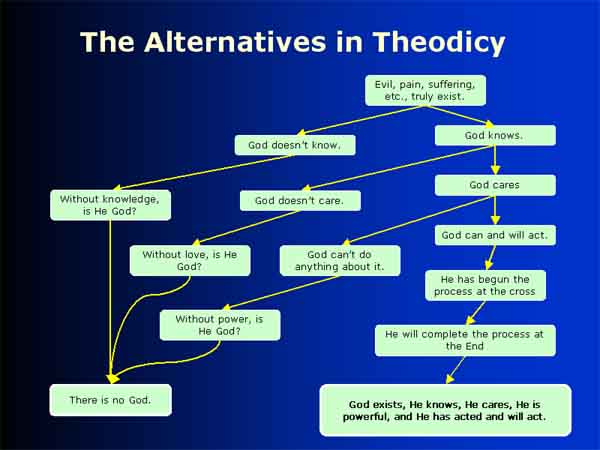
Theologians just haven't figured out whether it exists or not given their conception of God as an omnipotent and omnibenelovent being.
I totally disagree with that. The problem is not that the Bible is clear. The problem is that people do not believe what it says.
It takes a person who has serious mental issues and a whole lot of theological gerrymandering to reconcile them. Nonetheless, the problem isn't that shit happens but so much of it happens. A whole lot of it can hit the fan and be strewn about for a few years, even killing upwards to half the world's population like the Black Death Plague. But then on Heddle's view this too fits the data.
I think the problem is that Loftus and others who raise this objection think they know how much suffering and evil should be allowed to take place. They also seem to think that all the possible evil that can happen does happen and that God does nothing to lessen suffering and restrain evil. The Bible clearly says that he does. None of Loftus' arguments address this point. I would agree with Heddle and would extend his point and point out that sin explains the preponderance of evil and suffering of every living thing.
I'm writing a series of posts on what it takes to be a Christian apologist and Heddle committed the very first blunder, which is to "miscaricaturize your opponent's arguments to the point of failing to even try to understand them, or feigning ignorance as to what they are, and/or being willingly ignorant of them."
Loftus commits the blunder of miscaricaturizing his "opponent's arguments to the point of failing to even try to understand them, or feigning ignorance as to what they are, and/or being willingly ignorant of them"not Heddle.
You see, it's not just that nature is red in tooth and claw, although that is a big factor. It's that an omnibenelovent God doesn't stop the most heinous of sufferings from occurring even though he could do so. [Please, if anyone comments or tries to rebut what I'm saying re-read that last sentence over and over again to get it]. Heddle is commenting on the wrong sort of problem and acting as if he answered the problem I pointed out. That's called strawmanning an argument. This is so obvious a child could see it.
Heddle did answer the point. He talked about all suffering - whether or not you think that it's gratuitous or not. No one, not even Loftus, can tell you that God never stops the worst sufferings from occurring because we would not always know. "Omnibenevolence" does not mean that God does not allow suffering of any kind. And given our limited knowledge we are unable to really know what is best for us or anyone else. The whole point of being a Christian is recognizing and accepting that God does know. If you reject that God has the right to decide what is allowed and what is not then of course you are not only making the wrong argument, you cannot even ask the right question.
Heddle totally ignores that I had said:
In a universe where there is an all powerful, perfectly good, all knowing God this tragedy is not what we would expect to happen. There were innocent children who were brutally massacred. We would not expect that after praying the Lord's prayer to a loving heavenly father that such a deity would allow this to happen, just as we would not expect a father in that school to sit by and do nothing while the gunman killed his children.So it's obvious Heddle is strawmanning my argument.
What could a loving heavenly father have done? There are tons of things. Just have the gunman's brakes fail on the way so he would crash his car into a telephone pole and die. If God knew the man would one day kill these people then he could have killed him in a thousand unsuspecting ways like this. He had twenty years to do it. God could have snapped his omnipotent fingers causing the man to have massive amnesia such that he wouldn't know who he is, or what he was going to do with his guns that morning. God could have caused his guns to misfire if nothing else. God did nothing that a loving father would have done.
When comparing these two hypotheses the God hypothesis fails and the godless hypothesis prevails, hands down, no question, no ifs ands or buts about it.
As human beings we have no idea what to expect. We do not know what all the parameters are or what are all the design goals in God's plan. I'm not proposing just throwing up your hands and crying "mystery". We can't even ask the right questions. I am claiming that we should agree with God. God has told us what we need to know in the Bible. God is sovereign control. And the sufferings we see now are finite and not worthy of comparison (read Romans 8 again).
From this I've devised a first of it's kind test for a delusional person:
When an intelligent person who should know better so badly strawman's an argument, it's a clear and distinct indicator that the person is delusional. In other words, the more intelligent a person is and the more easily the strawman argument can be spotted, then the more it is that what we're dealing with is a delusional person. A delusional person cannot even see what the problem is enough to answer it.
How do ya like me now Heddle? ;-)
Now, far be it from me to offer any Biblical guidance to Dr. Heddle, but his problem is not only an omnibenevolent God's inactivity at the precise moment when he should have acted, but it's also his lies.
I won't presume to speak for Heddle, but I will say that it's Loftus who is delusional. His strawman is that God does not act the way he thinks God should should have. None of us know what God's plan is or the details as what it will take to carry it out. Loftus pretends to know something he can't know and then rejects God based on that ignorance. Delusion illustrated.
For don't we read in the Holy Book of God's assurance he'll protect the innocent, the saved, and the faithful? Or, in the face of other contrary passages, is Heddle going to do a whole lot of theological gerrymandering to reconcile them?
Wow. Most times an atheist attempts to conduct exegesis on the Bible, a faceplant is the result. Loftus attempts to list a whole bunch of scriptures that talk about how God assures his people of God's protection but he does recognize that there are scriptures that tells us that good people do suffer. So do we have a bunch of contradictions? Nope. For once, Loftus pastes relevant Bible passages but makes me wonder about his comprehension abilities. He thinks that they teach that God promises prosperity and safety at all times.
Psalm 46
God is our refuge and strength,
an ever-present help in trouble.
2 Therefore we will not fear, though the earth give way
and the mountains fall into the heart of the sea,
3 though its waters roar and foam
and the mountains quake with their surging.
4 There is a river whose streams make glad the city of God,
the holy place where the Most High dwells.
5 God is within her, she will not fall;
God will help her at break of day.
6 Nations are in uproar, kingdoms fall;
he lifts his voice, the earth melts.
7 The Lord Almighty is with us;
the God of Jacob is our fortress.
8 Come and see what the Lord has done,
the desolations he has brought on the earth.
9 He makes wars cease
to the ends of the earth.
He breaks the bow and shatters the spear;
he burns the shields[d] with fire.
10 He says, “Be still, and know that I am God;
I will be exalted among the nations,
I will be exalted in the earth.”
11 The Lord Almighty is with us;
the God of Jacob is our fortress.
The Psalm does not tell us that there is no trouble or suffering. The promise is that God will be there for his people in the midst of all the trouble and suffering. To what purpose: God's exaltation. Notice that it's not that there will be no war or natural disasters. The promise is deliverance not avoiding suffering.
--------------
Psalm 91
He who dwells in the shelter of the Most High will rest in the shadow of the Almighty. I will say of the LORD, "He is my refuge and my fortress, my God, in whom I trust." Surely he will save you from the fowler's snare and from the deadly pestilence. He will cover you with his feathers, and under his wings you will find refuge; his faithfulness will be your shield and rampart. You will not fear the terror of night, nor the arrow that flies by day, nor the pestilence that stalks in the darkness, nor the plague that destroys at midday. A thousand may fall at your side, ten thousand at your right hand, but it will not come near you. You will only observe with your eyes and see the punishment of the wicked. If you make the Most High your dwelling - even the LORD, who is my refuge - then no harm will befall you, no disaster will come near your tent. For he will command his angels concerning you to guard you in all your ways; they will lift you up in their hands, so that you will not strike your foot against a stone. You will tread upon the lion and the cobra; you will trample the great lion and the serpent. "Because he loves me," says the LORD, "I will rescue him; I will protect him, for he acknowledges my name. He will call upon me, and I will answer him; I will be with him in trouble, I will deliver him and honor him. With long life will I satisfy him and show him my salvation."
This Psalm does not describe life for all believers for all times. I mean to interpret scripture that way means that he assumes a high degree of gullibility. If this is the way he thought when he was a "Christian" no wonder he thinks that Christians are gullible. Does this mean that God does not protect those who put their trust in God? Oh no. But it doesn't mean what Loftus says is correct about God not intervening in the lives of people today. It doesa not mean that God is obligated to keep me from suffering. I trust God that no matter what happen God does what is best for me.
Deuteronomy 33 v 29:
Blessed are you, O Israel! Who is like you, a people saved by the LORD? He is your shield and helper and your glorious sword. Your enemies will cower before you, and you will trample down their high places.
I see no problem here. It's a boast in who God is and what God has promised Israel. I think this passage is horrible for showing Loftus' point. Unless you are Jewish, you can't stand on this promise. and God's promises of safety and victory for Israel as a people are conditioned on their obedience. Seriously bad hermeneutic, Mr Loftus. Context would help.
Psalm 27 v 1 & 5:
The LORD is my light and my salvation-whom shall I fear? The LORD is the stronghold of my life-of whom shall I be afraid? For in the day of trouble he will keep me safe in his dwelling; he will hide me in the shelter of his tabernacle and set me high upon a rock.
Again, this passage is not promising no suffering or trouble! It tells us what God is going to do when those things come and why we don't have to be afraid.
Psalm 31v 20:
In the shelter of your presence you hide them from the intrigues of men; in your dwelling you keep them safe from accusing tongues.
Loftus seems to to think that the Bible is promising that the believer would not suffer people lying on them and making false accusations. Where does it say that? It does not! Those who trust God will be vindicated.
Psalm 32 v 7:
You are my hiding place; you will protect me from trouble and surround me with songs of deliverance.
If there is no trouble or problems, why would we need a hiding place? Sorry this scripture also goes against Loftus' delusions.
Psalm 34 v 7-8:
The angel of the LORD encamps around those who fear him, and he delivers them. Taste and see that the LORD is good; blessed is the man who takes refuge in him.
Again the passage is not saying that you won't need deliverance but that God gives us deliverance when we need it because we will need it.
Psalm 37 v 39-40:
The salvation of the righteous comes from the LORD; he is their stronghold in time of trouble. The LORD helps them and delivers them; he delivers them from the wicked and saves them, because they take refuge in him.
Again we can count on the Lord saving us just as much as we can that we will need saving from trouble.
Psalm 57 v 1:
Have mercy on me, O God, have mercy on me, for in you my soul takes refuge. I will take refuge in the shadow of your wings until the disaster has passed.
Again not that disaster does not come but when in God we can survive it.
Psalm 62 v 5-8:
Find rest, O my soul, in God alone; my hope comes from him. He alone is my rock and my salvation; he is my fortress, I will not be shaken. My salvation and my honor depend on God; he is my mighty rock, my refuge. Trust in him at all times, O people; pour out your hearts to him, for God is our refuge.
Amen. We are completely depended on God. Yes, Mr Loftus, with each scripture you dig yourself a whole further and further down.
Psalm 119 v 114:
You are my refuge and my shield; I have put my hope in your word.
You don't need a shield or a refuge if nothing bad is happening. No promise of no problems here either.
Psalm 121:
I lift up my eyes to the hills-where does my help come from? My help comes from the LORD, the Maker of heaven and earth. He will not let your foot slip - he who watches over you will not slumber; indeed, he who watches over Israel will neither slumber nor sleep. The LORD watches over you- the LORD is your shade at your right hand; the sun will not harm you by day, nor the moon by night. The LORD will keep you from all harm-he will watch over your life; the LORD will watch over your coming and going both now and forevermore.
Yup, still doesn't tell us what Loftus thinks Christians have to believe. Keeping me from harm does not mean that I never have problems.
Psalm 125 v 1-2:
Those who trust in the LORD are like Mount Zion, which cannot be shaken but endures forever. As the mountains surround Jerusalem, so the LORD surrounds his people both now and forevermore.
Still more truth.
Psalm 145 v 18:
The LORD is near to all who call on him, to all who call on him in truth.
Which is why God is the best refuge and shield.
2 Samuel 22 v 31-37:
"As for God, his way is perfect; the word of the LORD is flawless. He is a shield for all who take refuge in him. For who is God besides the LORD? And who is the Rock except our God? It is God who arms me with strength and makes my way perfect. He makes my feet like the feet of a deer; he enables me to stand on the heights. He trains my hands for battle; my arms can bend a bow of bronze. You give me your shield of victory; you stoop down to make me great. You broaden the path beneath me, so that my ankles do not turn.
Notice how the passage does not say we don't have to fight. God equips us and give us what we need so we can fight and fight the way God tells us to do.
Isaiah 12 v 2:
Surely God is my salvation; I will trust and not be afraid. The LORD, the LORD, is my strength and my song; he has become my salvation.
Yup. Still doesn't conflict with reality but does conflict with Loftus.
Isaiah 25 v 9:
In that day they will say, "Surely this is our God; we trusted in him, and he saved us. This is the LORD, we trusted in him; let us rejoice and be glad in his salvation."
This how you praise God after you have been delivered. Good reminder.
Isaiah 43 v 1-5:
But now, this is what the LORD says - he who created you, O Jacob, he who formed you, O Israel: "Fear not, for I have redeemed you; I have summoned you by name; you are mine. When you pass through the waters, I will be with you; and when you pass through the rivers, they will not sweep over you. When you walk through the fire, you will not be burned; the flames will not set you ablaze. For I am the LORD, your God, the Holy One of Israel, your Savior; I give Egypt for your ransom, Cush and Seba in your stead. Since you are precious and honored in my sight, and because I love you, I will give men in exchange for you, and people in exchange for your life. Do not be afraid, for I am with you; I will bring your children from the east and gather you from the west.
Interesting Loftus would choose this passage given that it was fulfilled. Anyone else remember the 1948 creation of the modern state of Israel or that airlifting and repatriation of Jews from all over the world? No? You're welcome.
Matthew 10 v 28-31:
Do not be afraid of those who kill the body but cannot kill the soul. Rather, be afraid of the One who can destroy both soul and body in hell. Are not two sparrows sold for a penny? Yet not one of them will fall to the ground apart from the will of your Father. And even the very hairs of your head are all numbered. So don't be afraid; you are worth more than many sparrows.
These are Jesus' words. Notice that by telling us not to be afraid of those who can kill us because this is so that we can recognize that we may be killed.
1 Peter 3 v 12-13:
For the eyes of the Lord are on the righteous and his ears are attentive to their prayer, but the face of the Lord is against those who do evil. Who is going to harm you if you are eager to do good?
I think the best way to understand just how bad Loftus flubs up here is to point out the context of the passage.
8 Finally, all of you, be like-minded, be sympathetic, love one another, be compassionate and humble. 9 Do not repay evil with evil or insult with insult. On the contrary, repay evil with blessing, because to this you were called so that you may inherit a blessing. 10 For,
“Whoever would love life
and see good days
must keep their tongue from evil
and their lips from deceitful speech.
11 They must turn from evil and do good;
they must seek peace and pursue it.
12 For the eyes of the Lord are on the righteous
and his ears are attentive to their prayer,
but the face of the Lord is against those who do evil.”[a]
and see good days
must keep their tongue from evil
and their lips from deceitful speech.
11 They must turn from evil and do good;
they must seek peace and pursue it.
12 For the eyes of the Lord are on the righteous
and his ears are attentive to their prayer,
but the face of the Lord is against those who do evil.”[a]
Let's help Loftus out. He's confused. He completely missed Peter's point. It's not that you will not suffer for doing good but how you should act if you do. And we should not do things to bring suffering and punishment on ourselves for doing evil.
Hebrews 13 v 5-6:
Keep your lives free from the love of money and be content with what you have, because God has said, "Never will I leave you; never will I forsake you." So we say with confidence, "The Lord is my helper; I will not be afraid. What can man do to me?"
I really like this last passage and it fits well with the way I wanna conclude this. The Bible does not say that we do not have problems and suffering. We are stupid to think that we can tell God what is and isn't too much suffering. I'm amazed that Loftus doesn't really deal with the scriptures that tell us how to deal with suffering. The Bible is full of such passages but I will point to only two now.
18 I consider that our present sufferings are not worth comparing with the glory that will be revealed in us. 19 For the creation waits in eager expectation for the children of God to be revealed. 20 For the creation was subjected to frustration, not by its own choice, but by the will of the one who subjected it, in hope 21 that[h] the creation itself will be liberated from its bondage to decay and brought into the freedom and glory of the children of God. - Romans 8:18-21
So is there a contradiction? The best way to understand this is us the life of Job. Here was a man who was righteous and blameless and God allowed Satan to kill his family, take all he had, and to take his health. The way to deal with suffering is the way Job dealt with his suffering. He turned to God and did not loose his trust. Here is how Job looked at it.
14 Why do I put myself in jeopardy
and take my life in my hands?
15 Though he slay me, yet will I hope in him;
I will surely[a] defend my ways to his face.
16 Indeed, this will turn out for my deliverance,
for no godless person would dare come before him! - Job 13:14-16
and
23 “Oh, that my words were recorded,
that they were written on a scroll,
24 that they were inscribed with an iron tool on[b] lead,
or engraved in rock forever!
25 I know that my redeemer[c] lives,
and that in the end he will stand on the earth.[d]
26 And after my skin has been destroyed,
yet[e] in[f] my flesh I will see God;
27 I myself will see him
with my own eyes—I, and not another. How my heart yearns within me! - Job 19:23-27
that they were written on a scroll,
24 that they were inscribed with an iron tool on[b] lead,
or engraved in rock forever!
25 I know that my redeemer[c] lives,
and that in the end he will stand on the earth.[d]
26 And after my skin has been destroyed,
yet[e] in[f] my flesh I will see God;
27 I myself will see him
with my own eyes—I, and not another. How my heart yearns within me! - Job 19:23-27
Debunking Christianity: Dr. David Heddle, "Shit Happens"
Friday, June 24, 2011
Psalm 23 – A Video Presentation | Dr. Claude Mariottini – Professor of Old Testament

1 The LORD is my shepherd, I lack nothing.
2 He makes me lie down in green pastures,
he leads me beside quiet waters,
3 he refreshes my soul.
He guides me along the right paths
for his name’s sake.
4 Even though I walk
through the darkest valley,[a]
I will fear no evil,
for you are with me;
your rod and your staff,
they comfort me.
5 You prepare a table before me
in the presence of my enemies.
You anoint my head with oil;
my cup overflows.
6 Surely your goodness and love will follow me
all the days of my life,
and I will dwell in the house of the LORD
forever. - Psalm 23
Jesus said:
I am the good shepherd. The good shepherd lays down his life for the sheep. - John 10:1
Psalm 23 – A Video Presentation | Dr. Claude Mariottini – Professor of Old Testament

Sunday, April 11, 2010
Response to Islam and Christianity A Common Word: Part 4: Reply to brother McElhaney..the saga continues..- part 2

Here is part 2 of my latest responses to the thegrandverbalizer. Same rules as part 1.
First of all who is this 'he' that is being spoken of? And who is writing about this 'he'. The whole idea of someone being an eye witness to this event seems to tumble to the ground here. Next maybe McElhaney can look at his Bible and find the cross reference that shows us the scripture 'A bone of him shall not be broken.' Where is this prophecy at?
The "he" is the writer of the gospel. The author is claiming to be an eyewitness. And the prophecy is from Psalm 34:20
. The TNIV is worded as:
[H]e protects all their bones, not one of them will be broken.
The TNIV wording is a revision of the NIV which translates with “his bones” rather than “their bones”:
[H]e protects all his bones, not one of them will be broken.
“John’s use of the psalm seems strange, for the statement in its original context suggests that the Lord protects the godly from physical harm. Jesus’ legs may have remained unbroken, but he was brutally and unjustly executed by his enemies.”
Sounds like I have a counter point to use against brother McElhaney well not exactly read on...
“I firmly believe that Christ fulfills Old Testament law, longings, and prophecies, even when the prophecies were not originally intended by their human authors to be prophecies. But, as a translator, I cannot change the meanings of passages in the Old Testament to be more messianic than they originally were. I believe that intellectual integrity calls for Bible translators not to Christianize the Old Testament”
The above two quotes are taken from:
But how do you respond to something like that? “ even when the prophecies were not originally intended by their human authors to be prophecies”
I disagree on several points. the TNIV is not a revision or improvement on the NIV. It's a paraphrase and as far as I know you would not use it for serious Bible study. I do however agree that we cannot Christianize the Old Testament. It seems that you are using these quotes to suggest that is what modern translations are doing. But just like you do for Hebrew. You can do the same in Greek: Look it up. I did. In John and in Psalm and I could not find a reason to say "their bones" instead of :"his bone",. Most translations into English us "His bones" and it's not because they are Christians. Even non-Christians agree it should "his" not "their". You found one commentator that disagrees. So? And how does the person you quoted know that author of a prophecy did or did not know he was giving a prophecy? The words came from God, did they not?
McElhaney continues...
Ehrman disagrees with the resurrection but not fact of the crucifixion. Most scholars agree that Jesus really died on a cross. Bottom line. Not all believe in the resurrection but almost universally they agree he died on that cross. If you are real interested I will be making a list of these cases soon. And those who disgree about the existence and/or crucifixion admit that they are on the fringe and going against consensus.
Ehrman disagrees with the resurrection but not fact of the crucifixion. Most scholars agree that Jesus really died on a cross. Bottom line. Not all believe in the resurrection but almost universally they agree he died on that cross. If you are real interested I will be making a list of these cases soon. And those who disgree about the existence and/or crucifixion admit that they are on the fringe and going against consensus.
My response:”Not all believe in the resurrection but almost universally they agree he died on the cross.” I think most readers will look at what you wrote quickly without giving pause. 'Not all believe in the resurrection'. Hmm. I wonder what was meant by that. In fact could you name me a single scholar who is not a Christian who believes Jesus rose from the dead?
The challenge makes no sense because anyone who believes that Jesus rose from the dead, by definition, is Christian. And my point was that non-Christian "experts" agree that Jesus was crucified and many Muslims say he wasn't based on the Qur'an and then try to read that into the New Testament.
When we talk about scholarship are Christians on the fringe or the consensus when they say that 'Jesus rose from the dead'? If not than where are the facts and figures taken from that disprove this?
The challenge makes no sense because anyone who believes that Jesus rose from the dead, by definition, is Christian. And my point was that non-Christian "experts" agree that Jesus was crucified and many Muslims say he wasn't based on the Qur'an and then try to read that into the New Testament.
When we talk about scholarship are Christians on the fringe or the consensus when they say that 'Jesus rose from the dead'? If not than where are the facts and figures taken from that disprove this?
It depend on who you talk to. All Christians will say Jesus rose from the dead and it's the best fit explanation given the evidence we have. This is how William Lane Craig and Gary Habermas and Michael Licona approach the Resurrection. Skeptics, Agnostics, and Apostates disagree...but what else would you expect?
McElhaney states,
Can you find a single Hebrew Scholar who says that Isaiah 53 was fulfilled before Isaiah spoke this prophecy?
Can you find a single Hebrew Scholar who says that Isaiah 53 was fulfilled before Isaiah spoke this prophecy?
My response: The assumption lies in the fact that you think it's some future prophecy awaiting fulfillment in the first place. The first part in avoiding a trap is knowing there is one in the first place. Nice try.
It's an honest question you claimed that Isaiah was written in a past tense showing that it wasn't about a future messiah and all I asked was for you to give the name of a single Hebrew Scholar that agrees with you. I guess you can't.
It's an honest question you claimed that Isaiah was written in a past tense showing that it wasn't about a future messiah and all I asked was for you to give the name of a single Hebrew Scholar that agrees with you. I guess you can't.
McElhaney says,
“I agree that there is nothing wrong with "was:". I'm saying that does not mean that the events are about the past and Hebrew scholars bear that out. For centuries Jews interpreted this text as being fulfilled in the future. Remember this prophecy was given 700 years before Jesus was born. That is why I think your contention is no contention at all. Some Jews changed their interpretation so that they could side-step Jesus.”
My response: Could you please tell me which Jews changed their interpretation and provide documentation? Which Jews? What was the original interpretation that they had that they changed?
"(Jewish doctrine, by definition, did not change w/ Jesus, though they did counter Christian typological readings of their Scripture in their own commentaries.)
http://www.protevi.com/john/S/PDF/MedievalJewishChristianRelationships.pdf
"(Jewish doctrine, by definition, did not change w/ Jesus, though they did counter Christian typological readings of their Scripture in their own commentaries.)
http://www.protevi.com/john/S/PDF/MedievalJewishChristianRelationships.pdf
My response: Again I don't think my above questions are being answered. 'Some Jews changed their interpretation so that they could side-step Jesus'. When I pressed brother McElhaney on this issue he thought that by providing a link to a PDF that I would not go and read it.
No, I fully expected you to read it. Thanks.
It does not answer the questions. You made a claim so you should back away from it or press forward with proof. Which Jews did this? What was the original interpretation and what was it exactly they changed? Seems to me it looks like the Christians are the one's doing the changing. Maybe brother McElhaney could single out from the above PDF file link the section that makes his point clear?
I think this point needs more detail than I am prepared to go through here. I will ask that we skip this point and for me to do more research and write a full post on why I believe this to be true. I read it and saw some documentation but I will have to dig it up again.
No, I fully expected you to read it. Thanks.
It does not answer the questions. You made a claim so you should back away from it or press forward with proof. Which Jews did this? What was the original interpretation and what was it exactly they changed? Seems to me it looks like the Christians are the one's doing the changing. Maybe brother McElhaney could single out from the above PDF file link the section that makes his point clear?
I think this point needs more detail than I am prepared to go through here. I will ask that we skip this point and for me to do more research and write a full post on why I believe this to be true. I read it and saw some documentation but I will have to dig it up again.
That is not what I argued at all. You left a lot of the argument out. I was pointing out that there were times when people flocked to him but not because they wanted to follow him or support his Ministry. That was the point of Isaiah 53. They weren't following him for the right reason and when the going got tough they all left at best, agreed to his execution at worst.
My response: I have already responded to this before. Rather or not Jesus was popular seems very subjective. I allowed for McElhaney to establish his point but doesn't seem he wants to allow for mine. However, on the issue of Jesus being popular or not I leave it to the readers to look at the evidences given by both sides.
The people were saying "Crucify him!" and "Let his blood be on our hands and that of our children" Does that seem like something they would do if the majority of folks really liked Jesus?
McElhaney continues...
But do they submit and obey Jesu? Do they make him Master of their lives? Nope. Not the majority. That's not popular because people are going after the Jesus they want not the Jesus He is. Same thing while Jesus was planet side.
My response: Again to me this is emotionally charged rhetoric that is very subjective.
How is this emotionally charged? I made a point. I disagree that you can take two passages from Jesus' early ministry and then apply them to his whole ministry when the Gospels clearly tells us the opposite by the time of the crucifixion?
McElhaney says,
“The word being disputed is "chalal" and "pieced" is one of the translations. I have a Hebrew interlinear Bible and it translates the word "being - pierced". If you want to see all the possible translations for the words and how often it shows up in the OT go to this link: Chalal”
My response: I didn't see the link however, here is a link that Is useful to us both from a Christian source.
This link allows McElhaney and other Christians to capture their point about the word being translated as pierced and for the Jews to capture their point about the word being translated as wounded.
McElhaney states,
You can't be pierced without being wounded.
You can't be pierced without being wounded.
My response: True you can't be pierced without being wounded, however you can be wounded without being pierced!
McElhaney states the following,
Let me say that the difference is that if a person dies because of something it's because that something leads to that death. I think that another way to put it is that the death follows necessarily. Dying for us means that Jesus did not have to die but chose to do it. If this is what you mean, then we need to look to see if we have other scriptures that say Christ died because of us or for us. I think the New Testament clearly teaches that Jesus voluntarily gave up his life and picked it back up.
Let us fix our eyes on Jesus, the author and perfecter of our faith, who for the joy set before him endured the cross, scorning its shame, and sat down at the right hand of the throne of God. - Hebrews 12:2
My response: Deuteronomy 24:16 clearly disagrees with your theological interpretations.
So you are trying to argue that substitutional atonement is contradicted by Deuteronomy 24:16? Sorry. But there are problems with that. Jesus is shown to carry the same function as the Passover lamb and the lambs sacrificed during Yom Kipur celebrations. You can't apply Deuteronomy 24:16 because that isn;t the same context.
So you are trying to argue that substitutional atonement is contradicted by Deuteronomy 24:16? Sorry. But there are problems with that. Jesus is shown to carry the same function as the Passover lamb and the lambs sacrificed during Yom Kipur celebrations. You can't apply Deuteronomy 24:16 because that isn;t the same context.
McElhaney also says in his previous post,
“Not my words at all. There can't be a contradiction because this is the word of God. Muhammad said so too. Therefore if you have an interpretation that causes logical contradiction than you r interpretation can't be right.”
My response: McElhaney says “Muhammed said so too” I was wondering if McElhaney could show what he is talking about? Perhaps elaborate a little?
'
I'm saying that Muhammad testified that the Hebrew Bible was the word of God and Muslims should respect it. That means Isaiah has no contradictions.
I'm saying that Muhammad testified that the Hebrew Bible was the word of God and Muslims should respect it. That means Isaiah has no contradictions.
My response: You said above 'Muhammad said so too' and now say that, 'Muhammed testified that the Hebrew Bible was the word of God.' However, you have yet to prove this. Claiming is one thing but where is the proof?
- And do not dispute with the followers of the Book except by what is best, except those of them who act unjustly, and say: We believe in that which has been revealed to us and revealed to you, and our God and your God is One, and to Him do we submit. [Qur'an 29:46]
The above references seem to imply that Muhammad doubted the veracity of the Jewish Scriptures (we say seem because the last two narratives say nothing of biblical textual corruption. They merely speak of the Jews writing a book which led them to abandon the Torah). The major problem with these narratives is that they happen to contradict other reports which claim that Muhammad actually confirmed the textual authenticity of these very Scriptures:
Narrated Abdullah Ibn Umar:And:
A group of Jews came and invited the Apostle of Allah (peace_be_upon_him) to Quff. So he visited them in their school.
They said: AbulQasim, one of our men has committed fornication with a woman; so pronounce judgment upon them. They placed a cushion for the Apostle of Allah (peace_be_upon_him) who sat on it and said: Bring the Torah. It was then brought. He then withdrew the cushion from beneath him and placed the Torah on it saying: I believed in thee and in Him Who revealed thee.
He then said: Bring me one who is learned among you. Then a young man was brought. The transmitter then mentioned the rest of the tradition of stoning similar to the one transmitted by Malik from Nafi' (No. 4431). (Sunan Abu Dawud, Book 38, Number 4434)
The apostle wrote to the Jews of Khaybar according to what a freedman of the family of Zayd b. Thabit told me from ‘Ikrima or from Sa‘id b. Jubayr from Ibn ‘Abbas: ‘In the name of God the compassionate the merciful from Muhammad the apostle of God friend and brother of Moses WHO CONFIRMS WHAT MOSES BROUGHT. God says to you, O scripture folk, and you will find it in your scripture "Muhammad is the apostle of God; and those with him are severe against the unbelievers, merciful among themselves. Thou seest them bowing, falling prostrate seeking bounty and acceptance from God. The mark of their prostrations is on their foreheads. That is their likeness in the Torah and in the Gospel like a seed which sends forth its shoot and strengthens it and it becomes thick and rises straight upon its stalk delighting the sowers that He may anger the unbelievers with them. God has promised those who believe and do well forgiveness and a great reward." I adjure you by God, AND BY WHAT HE HAS SENT DOWN TO YOU, by the manna and quails He gave as food to your tribes before you, and by His drying up the sea for your fathers when He delivered them from Pharaoh and his works, that you tell me, DO YOU FIND IN WHAT HE SENT DOWN TO YOU that you should believe in Muhammad? IF YOU DO NOT FIND THAT IN YOUR SCRIPTURE THEN THERE IS NO COMPULSION UPON YOU. "The right path has become plainly distinguished from error" so I call you to God and His Prophet’ (313). (The Life of Muhammad: A Translation of Ibn Ishaq’s Sirat Rasul Allah, with introduction and notes by Alfred Guillaume [Oxford University Press, Karachi, Tenth impression 1995], p. 256; capital emphasis ours)
According to what I heard from ‘Ikrima, freedman of Ibn ‘Abbas or from Sa‘id b. Jubayr from Ibn ‘Abbas, Jews used to hope that the apostle would be a help to them against Aus and Khazraj before his mission began; and when God sent him from among the Arabs they disbelieved in him and contradicted what they had formerly said about him. Mu‘adh b. Jabal and Bishr b. al-Bara’ b. Ma‘rur brother of B. Salama said to them: ‘O Jews, fear God and become Muslims, for you used to hope for Muhammad’s help against us when we were polytheists and to tell us that he would be sent and describe him to us.’ Salam b. Mishkam, one of the B. al-Nadir, said, ‘He has not brought us anything we recognize and he is not the one we spoke of to you.’ So God sent down about that saying of theirs: ‘And when a book comes to them from God CONFIRMING what they have, though beforehand they were asking for help against those who disbelieve, when there came to them what they knew, they disbelieved in it, so God’s curse rests on the unbelievers.’
Malik b. al-Sayf said when the apostle had been sent and they were reminded of the condition that had been imposed on them and what God had covenanted with them concerning him, ‘No covenant was ever made with us about Muhammad.’ So God sent down concerning him: ‘Is it not that whenever they make a covenant a party of them set it aside? Nay most of them do not believe.’
Abu Saluba al-Fityuni said to the apostle: ‘O Muhammad, you have not brought us anything we recognize and God has not sent down to you any sign that we should follow you.’ So God sent concerning his words, ‘We have sent down to thee plain signs and only evildoers disbelieve in them.’ (P. 257; bold, capital and italic emphasis ours)
Source: http://www.answeringislam.net/Responses/Osama/zawadi_mhd_duplicity.htm
AS a Muslim are you really prepared to admit that Muhammad was wrong about the Hebrew scriptures being the Word of God? Can you still do that and be a Muslim? I agree with Muhammad regarding this point. Therefore if there is a contradiction then that means I did not understand what I read. I'm missing something. The Hebrew scriptures are inerrant. We should at least both agree on that.
My response: I am not quite sure that Muhammed (pbuh) said that Judges, Ester, Ruth, Joshua, Micah, Jonah, and so forth were the word of God! However if you have any evidence that shows that he did I would be more than happy to look at it.
I wrote in my previous post,
The word rendered here as "death" should actually read "deaths." The Hebrew word here is "b’motav," which is a conjugated plural word. It is not death it is 'death'
McElhany replied by saying,
“How does this bolster your point?”
This is a good point by McElhaney to spot the mistake above. Actually I wanted to say this, “The word rendered here as 'death” should actually read “deaths.” The Hebrew word here is “b'motav,” which is a conjugated plural word. It is not death it is 'deaths'.
The point being is that deaths are in the plural and this doesn't refer to someone singular.
Is this an attempt to use the revisionists interpretation that Isaiah 53 refers to Israel as a nation and not Messiah? Please go back and look at what that list of respected Jewish teachers taught.
Is this an attempt to use the revisionists interpretation that Isaiah 53 refers to Israel as a nation and not Messiah? Please go back and look at what that list of respected Jewish teachers taught.
My response: So am I to understand brother McElhaney you have no desire to interact with the Hebrew text at all?
No. That is not what I'm saying.
You seemed interested in helping me out when I made a grammar mistake in saying death should be deaths. Now your not so ready to say it's a grammar mistake when you see the word 'deaths'. How could I be giving a 'revisionist interpretation' when I didn't even offer what it could mean. I simply am showing you the Hebrew text! Next what 'list of respected Jewish teachers' are you talking about?
This one:http://www.hearnow.org/isa_com.html
No. That is not what I'm saying.
You seemed interested in helping me out when I made a grammar mistake in saying death should be deaths. Now your not so ready to say it's a grammar mistake when you see the word 'deaths'. How could I be giving a 'revisionist interpretation' when I didn't even offer what it could mean. I simply am showing you the Hebrew text! Next what 'list of respected Jewish teachers' are you talking about?
This one:http://www.hearnow.org/isa_com.html
Am I also to understand that any Jew that doesn't become or is not a Christian is not a 'respected teacher'?
Not only this but the word 53:9 "His grave was assigned with wicked men." See Ezekiel. 37:11-14, wherein Israelis described as "cut off" and God promises to open its "graves" and bring Israel back into its own land
Again that is a stretch Isaiah and Ezekiel are not talking about the same time and the same context.
McElhaney responds by saying,
“Are you really trying to argue that Isaiah, who ministered almost 300 years before Ezekiel were saying the same thing in the same context? I don't think so.”
My response: No I am not going to say that Ezekiel said the same thing or even in the same context. I am going to note however as are people who read this how quickly you brushed the point aside. I know it maybe uncomfortable for you to look at the facts but to try and dodge the point doesn't help your case.
McElhaney continues..
I didn't brush aside anything. I want you to show why you can say that you can connect them like that. There is no reason to. I'm saying that you would have to say that both men ministering almost 300 years apart are talking about the same thing in the same context in order for you to be right. And you can't do that.
My response:I'm sorry brother McElhaney but you do not write rules up as you go along. I don't have to say that both men living 300 years apart are talking about the same thing in the same context! You have some very strange and inconsistent standards. By your standards much of what you would present as evidence for Jesus in the TNCH would be rejected. In fact truth be told you have just conceded this entire exchange between us.
I disagree. First Isaiah 53 is not talking about the nation of Israel. Second both Isaiah and Ezekiel are talking about totally different things. If you would like to press this further then please provide other examples where you think New Testament writers are playing fast and loose with the Old Testament.
I disagree. First Isaiah 53 is not talking about the nation of Israel. Second both Isaiah and Ezekiel are talking about totally different things. If you would like to press this further then please provide other examples where you think New Testament writers are playing fast and loose with the Old Testament.
In fact you have just rejected the gospel of Matthew. Especially Matthew 2:15 “where he stayed until the death of Herod. And so was fulfilled what the Lord had said through the prophet: "Out of Egypt I called my son."
Bad example. Jesus was the Father's son, and he left Egypt just like the connotation of the prophecy. Remember many of the OT prophecies have a double fulfillment where it gets fulfilled in the lifetimes of the people people who hear it and several centuries down the road.If you want other examples of this we can go there.
McElhaney says,
“It's about context. How does your interpretation better fit the context than the basic Christian interpretation?”
My response: I offer no interpretation I only offer Jewish translation of the Hebrew scriptures. Again if a person wants to know what the Jews think the interpretation is they should probably write to them. (www.jewsforjudaism.org)
I think the Jews are quite capable of coming up with their own understanding of their scriptures.
I agree but again not all Jews agree with them. And when you say that Ezekiel is talking about returning Israel from exile that Isaiah is saying the same thing you are offering an interpretation and I disagree with that because it can't be supported.
My response: Woah! I mean woah! Can we please calm down for a minute brother McElhaney. Could you please give the link and exact quote where I said, “Ezekial is talking about returning Israel from the exile and Isaiah is saying the same thing”. I mean we have said allot back and forth and I did re-read my replies to you but I hope you could help me out in finding this particular quote of mine? I said nothing of the kind. I was simply stating something that your still struggling with. I showed a simple example where being 'cut off' does not have to be literal it can be allegorical.
But Israel in Ezekiel was cut off. Jerusalem was destroyed and the people in exile.
McElhaney ask,
“What translation are you reading to get "disease" out of verse 10?”
This is answered above at the beginning.
It's not in my Hebrew Bible. I'll look up yours.
My response: So now that you have looked it up in my Bible what do you have to say?
I still need to look at your link. But I will get to it.
I still need to look at your link. But I will get to it.
In fact if you research the Torah you will be hard pressed to find any mention of the afterlife at all. Imagine that McElhaney that Moses and the gang were running around the wilderness with no concept of an afterlife. This after coming from Egypt!
Jesus disagrees. When the Saducees who denied Resurrection and After lives went after Jesus....He pawned them.
29 Jesus replied,"You are in error because you do not know the Scripturesor the power of God.30 At the resurrection people will neither marry nor be given in marriage;they will be like the angels in heaven.31 But about the resurrection of the dead--have you not read what God said to you,32'I am the God of Abraham, the God of Isaac, and the God of Jacob'?He is not the God of the dead but of the living."33When the crowds heard this, they were astonished at his teaching. - Matthew 22:29-33
My response: Well brother McElhaney Jesus may have taken them to the pawn shop but the store clerks are feeling a bit cheated. I mean after all he did tell them they were in error not just knowing the power of God but by also not knowing the scriptures. So do you want to show us in the Torah where heaven, hell and the afterlife are mentioned? If not word may get around and Jesus won't be taking anymore items to the pawn shop.
You also don't understand what Jesus said.
32'I am the God of Abraham, the God of Isaac, and the God of Jacob'?He is not the God of the dead but of the living."
You also don't understand what Jesus said.
32'I am the God of Abraham, the God of Isaac, and the God of Jacob'?He is not the God of the dead but of the living."
It wasn't an intentional embellishment. I just stated what I was going to write about. I moved the goal post to try to make it a harder thing to prove and ended up confusing you. My apologies.
My response: Well I appreciate the apology.
Thanks.
Thanks.
My response: Yes exactly like that! Ignore context and use creative imagination isn't that right! You see even you can admit that it's not hard to do!
Of course it's easy to do. But that is not what the writers of the New Testament did.
My response that is exactly what the New Testament writers did.
McElhaney says,
“See what you have done. You have reworded scriptures in the New Testament and the wrangled Old Testament verses out of context to fit what you are saying. I understand that you are accusing Christians of doing that. But can you show how i have done that in my exegesis?”
My response: Well I didn't know that there were Christians who felt that the 'Old Testament' consisted of 'wrangled' verses!
I didn't say that. I said that you have to twist verse out of context to do what you are accusing Christians of doing.
My response: If you didn't say that the Old Testament had wrangled versesin it than we may have to stop this exchange. I mean who is writing to me than? Could you please tell me who was the person who wrote the following to me above, “the wrangled Old Testament verses”
I didn't say that. I said that you have to twist verse out of context to do what you are accusing Christians of doing.
My response: If you didn't say that the Old Testament had wrangled versesin it than we may have to stop this exchange. I mean who is writing to me than? Could you please tell me who was the person who wrote the following to me above, “the wrangled Old Testament verses”
If your have several people responding to me at once please let me know so we can sort this out. I thought I was having an exchange with you alone.
“How could a person possibly take a 'wrangled' verse out of context if it's already 'wrangled'?
According to Jews, Christians, and Muhammad, the verses of the Old Testament are inerrant and perfect - not wrangled.
My response: According to someone who posted to me under the Alias of Marcus McElhaney the Old Testament is indeed wrangled. I quote...
According to Jews, Christians, and Muhammad, the verses of the Old Testament are inerrant and perfect - not wrangled.
My response: According to someone who posted to me under the Alias of Marcus McElhaney the Old Testament is indeed wrangled. I quote...
“See what you have done. You have reworded scriptures in the New Testament and the wrangled Old Testament verses out of context to fit what you are saying.”
It was a typo. I wanted to say was: You have reworded scriptures in the New Testament and wrangled the Old Testament verses out of context to fit what you are saying. I understand that you are accusing Christians of doing that. But can you show how i have done that in my exegesis?” Sorry for the confusion. It has only been me writing to you.
As far as showing where you have taken things out of context in your exegesis have shown where your exegesis is not consistent. When we look back at how you understand the word offspring which the Jews understand to be literal descendants.
Not all Jews do. Just some of them you read.
Not all Jews do. Just some of them you read.
My response: Well if you can show me the Hebrew interlinear dictionary or lexicon where the word offspring means, “all those who would believe because we will all be resurrected just as Jesus was.” It would probably help me allot.
It's in the context of Isaiah 53 - a messiah who saves his people throught his death and resurrection. The belief part is throughout Old and New Testament. Read Romans 4.
“However, if you want me to show you where New Testament writers took passages of the 'Old Testament' out of context to fit what they wanted them to say I would be more than happy to do that. I don't expect you to take me up on it but I just thought I would throw that out there for what it's worth.
Sure...let's hash them out. And see if you are right. IF you think that it's true then you must not accept the New Testament as the word of God, right? If the Injil is not the New Testament, what is it? And where can I read it?
Sure...let's hash them out. And see if you are right. IF you think that it's true then you must not accept the New Testament as the word of God, right? If the Injil is not the New Testament, what is it? And where can I read it?
My response: Well first off I have to tell you that as a Muslim and a person who believes in consistent principles I must reject Matthew's interpretation of Hosea 11:1 as stated in Matthew 2:15. As a Muslim I refuse to believe that Jesus burned incense to graven images! I believe it to be blasphemous. I do respect you as a Christian and a human being.
Who says Jesus burned Incense to a graven image?
I would help you brother McElhaney in your time of need. However, if we met face to face and you told me that Jesus burned incense to graven images we would have to do some dancing on the concrete, and I don't mean M.C Hammer. The only way I could believe that Jesus even remotely in any way shape or form fits the description of Hosea 11:1 is if I completely ignore it's immediate context. However, if I ignore the context than Matthew does not meet the criteria you have set. You would have to show me that both Matthew and Hosea are talking about the same thing in the same context in order for you to be right. And you can't do that.
The Injeel is obviously not the New Testament if it was written after Jesus and we find internal evidence that Jesus went and preached the gospel. Obviously Jesus was not holding Matthew, Mark, Luke and John under his arms and quoting from them.
“And Jesus went about all Galilee, teaching in their synagogues, andpreaching the gospel of the kingdom.” Mat 4:23
“And Jesus went about all the cities and villages, teaching in their synagogues, and preaching the gospel of the kingdom, and healing every sickness and every disease among the people.” Matthew 9:35
So what is the Injel and where can I get a copy?
Jesus did many other things as well. If every one of them were written down, I suppose that even the whole world would not have room for the books that would be written. John 21:25
Wow! That sounds like there is allot more information about Jesus than we are led to believe. I mean that sounds like an awfully big library!
Where does it say that those books were written?
Now Jesus Himself began His ministry at about thirty years of age, being (as was supposed)the son of Joseph,the son of Heli, (Luke 3:23)
Jesus began preaching at about 30 years of age. So here we have the God incarnate walking around earth, eating, drinking, just 'hanging out'. This seems rather uneventful for me too.
He was raising the dead, healing all kinds of diseases, walking on water, preaching the good news...what more would you want?
I mean we have 30 years of Jesus life not really recorded. We have information about Jesus that if we are to believe John 21:25 that it could fill up the whole world. I understand this to be an embellishment; however 30 years detail of a person's life probably is allot. Are we to assume that for 30 years Jesus didn't utter a word? If he did say something I would want to know! Are to understand that the Bible doesn't contain all of Gods word? If Jesus is the word of God and he lived for 33 years and we don't know that he said anything for 30 years than we really can't say that the Bible contains all of God's word.
Brother McElhaney states,
I'm aware of textual variants but I believe everything that we can know that Jesus said really was said by him.
My response: So there are some things that Jesus may have said that is not in the New Testament
Of course. Why would anyone say anything different? Do we need to know those things to be saved and be pleasing to God? Guest not because if we needed it, we would have it.
Even we as Muslims have a collection of secondary information in Islam called “ahadith” and we grade them according to what the Prophet (saw) said, did not say, probably didn't say and is an outright fabrication. So even we look at things from a critical perspective. We as Muslims don't even accept at face value everything that someone has attributed to Muhammed (saw) as saying.
How do you know? And from what I know not all Muslims agree with you. Do you accept the Qur'an as inerrant and infalliable?
How do you know? And from what I know not all Muslims agree with you. Do you accept the Qur'an as inerrant and infalliable?
My response: I would be interested in knowing any Muslim who believes in the ahadith who disagrees that Muslims do not take everything attributed to the prophet at face value.
However, there could be another argument advanced. Maybe Jesus was indeed a liar. Maybe he did lie.
That would make the Qur'an wrong.
My response: How would that make the Qur'an wrong?
Because the Qur'an says Jesus was a prophet and that prophets are sinless.
That would make the Qur'an wrong.
My response: How would that make the Qur'an wrong?
Because the Qur'an says Jesus was a prophet and that prophets are sinless.
Now this may seem shocking to you for me as Muslim to bring forth the point but consider what the following Christian web site had to say on the matter.
It's important to realize that this spirit was also allowed to be a lying spirit in Micaiah's tongue as well. But,why would God allow one of His own prophets to speak a lie, for we can be sure that Micaiah was not on God's crap list. No, this is where we need to realize that God will work ALL things according to the counsel of HIS will.
Micaiah was one of God's true profits. The lying spirit was not in his mouth. He even told Ahab the truth but Ahab did not listen! He listened to the others with the lying spirits.
God wanted Ahab to fall, so he allowed a lying spirit to cause a great deception. As a result, Ahab went to Ramothgilead, and fell.
Is there an allegory here? Nay,but only one of God's sovereignty.
I agree that God used the lying Spirit but this isn't something that God forced Ahab to be stupid. He knew he should have listened to the good prophet.
My response: The interesting thing is that the lying spirit stood before God saying that it would do 'such and such' and God even said 'Go do it you shall succeed'. So again it shows that if God wanted he could have given Ahab the guidance but choose not to do so.
God did give Ahab guidance. He knew the truth about the advice he was getting but decided to believe the lies because it suited him. He didn't want to listen to God.
They really were not God's prophets - the ones that lied.
My response: So am I to understand you disagree with those Christians who said,”this spirit was also allowed to be a lying spirit in Micaiah's tongue as well”
Yes I disagree! The only reason we know about the lying spirit is because Micaiah told Ahab and Jehosaphat what went down in Heaven.
I honestly have no readily available answer on that.
I do. Read Deuteronomy 13
My response: You ever thought about the implications of that for Christ Jesus? That maybe people thought he was a false prophet? Especially many of the Israeli tribes that lived during that time?
That is why the Resurrection is important. The destruction of Jerusalem in 70 AD and Jesus' own crucifixion, burial, and resurrection are all validation that Jesus told the truth.
I do. Read Deuteronomy 13
My response: You ever thought about the implications of that for Christ Jesus? That maybe people thought he was a false prophet? Especially many of the Israeli tribes that lived during that time?
That is why the Resurrection is important. The destruction of Jerusalem in 70 AD and Jesus' own crucifixion, burial, and resurrection are all validation that Jesus told the truth.
I could only assume that maybe God let Jesus lie to allow Christians like yourself to realizes that he is not infallible? Maybe we could see the sovereignty of God at work here too.
Jesus did not lie.
Jesus did not lie.
My response: I don't believe Jesus lies either and that is why I try and keep my distance from Luke.
I mean what am I to do McElhaney it does present a pickle! I mean here we have Jesus saying in Luke 24: 46 “And said unto them, Thus it is written, and thus it behooved Christ to suffer, and to rise from the dead the third day” .
Jesus would only be a liar if Jesus did not rise the third day. But He did. And false lying Prophets under the law were supposed to be executed immediately.
Jesus would only be a liar if Jesus did not rise the third day. But He did. And false lying Prophets under the law were supposed to be executed immediately.
My response but the Gospels make Jesus out to be a liar. They make Jesus say that he will be like Jonah for three days and three nights and than we turn around and find out it's simply just not so.
Um..it was true.
So I could conclude that Jesus is a liar and the sovereignty of God is at work. Or because of my theological supposition that Jesus is not a liar I could also assume that someone interpolated this statement in the mouth of Jesus. This way I wouldn't have to sacrifice Jesus I would just sacrifice my trust in the reporter.
Your thought that the old testament denies Jesus' 3 -day burial is the faulty presupposition.
Your thought that the old testament denies Jesus' 3 -day burial is the faulty presupposition.
My response: I have not seen the statement“it is written, and thus it behooved Christ to suffer, and to rise from the dead the third day” It cannot be a faulty presupposition when I know that that the Old Testament canon of both Protestants and Catholics contains no such prophecy or statement. This is not a presupposition it is a readily falsifiable. So far Isaiah 53 and Jonah both fall flat.
I mean who is right and who is wrong? Is Luke right making Jesus out to be a liar? Or is Islam right in saying that the prophets don't lie? Islam and the 'Luke' can't both be right. So who is wrong?
Prophets do sin...If I understand Islam it's not just that prophets can't lie they can't sin. And Jonah was a prophet and he rebelled against God...showing that a prophet can still be used of God and still be a sinner. So Islam is wrong. As for Luke you haven't shown Jesus lied. Ever consider why Jonah had to be in the fish 3 days? Why not 1 day? Wouldn't you have been ready to repent in under 5 minutes?! Why let Jonah twist in the wind 3 days! I believe so that Jesus could use him as a sign of his own burial centuries later.
Prophets do sin...If I understand Islam it's not just that prophets can't lie they can't sin. And Jonah was a prophet and he rebelled against God...showing that a prophet can still be used of God and still be a sinner. So Islam is wrong. As for Luke you haven't shown Jesus lied. Ever consider why Jonah had to be in the fish 3 days? Why not 1 day? Wouldn't you have been ready to repent in under 5 minutes?! Why let Jonah twist in the wind 3 days! I believe so that Jesus could use him as a sign of his own burial centuries later.
My response: First I am not out to prove Jesus is a liar. I am out to say that I do not believe Luke's implication that Jesus is a liar. I will admit I am basing my presuppositions on my theological belief as a Muslim that Jesus did not lie or commit sins. As I can see that the Old Testament has no such prophecy I am not ready to believe Jesus is a liar. Instead I think that Luke is the culprit. So I base my conclusion not just on my presupposition as a Muslim but upon falsifiable evidence; in this case a complete lack thereof. You have a very just question and I really love your literal approach to Jonah. Why did Jonah have to be in the fish for 3 days and 3 nights. Very good point! I hope though that your consistent in your dealing with this issue in the future that you promised to 'save for another time'.
Jonah was in the fish for three day and three nights because Jesus was going to be buried for three days. God left Jonah for a sign and I bet Jonah didn't even know it.
Thank you for the link and I agree that you don't go to hell for protecting what God has given you. I will give the link a good read through to get my questions answered.
My reply: Please do let me know if you have any questions from the link, and also if you feel there are any questions that I am not answering, or have not answered.
Do you know what the New Testament teaches about how you get right with God?
9That if you confess with your mouth, "Jesus is Lord," and believe in your heart that God raised him from the dead, you will be saved.10 For it is with your heart that you believe and are justified, and it is with your mouth that you confess and are saved. - Romans 10:9-10
This is the Gospel. This is the main and plain thing. Notice it says nothing about the TULIP or you have to accept libertarian free will, or you have to believe or not believe that you can loose your salvation. None of that matters when it comes to going to heaven and avoiding hell. I'm not saying that none of these issues are not important. They are but you hold either one of these and still be a Christian. WE are promised in Scripture that this is all that is required for salvation.
My response: So this is wonderful news to the Mormons, Church of Christ,Branch Davidians, Seventh Day Adventist and Oneness Pentecostals.
I believe as it stands that you are a sincere Christian who believes in the deity of Christ his bodily resurrection, in the Trinity and that he died for you.
That is the definition of what a Christian believes.
That is the definition of what a Christian believes.
My response: It seems to me that belief in the Trinity per say is not necessary to be a Christian. All that is necessary is belief that Jesus is Lord and that God raised him from the dead.
You have to believe that Jesus is Kurios - LORD in order to be a Christian. You have to believe that He is the image of the invisible God according to several of the epistles. That means Jesus is God. The Father is God. The Holy Spirit is God...therefore the Trinity is necessary.
I have no idea if you believe you are 'one of the elect' or if Jesus really did die for everybody meaning 'everybody as in the whole entire population of this planet'.
You have to believe that Jesus is Kurios - LORD in order to be a Christian. You have to believe that He is the image of the invisible God according to several of the epistles. That means Jesus is God. The Father is God. The Holy Spirit is God...therefore the Trinity is necessary.
I have no idea if you believe you are 'one of the elect' or if Jesus really did die for everybody meaning 'everybody as in the whole entire population of this planet'.
One who believes those things is elect. There is no way you can believe those things and not turn your back on it and not be elect.
My reply: I'm going to have to disagree with you on these things too. I know what I believed as a Christian and no one can tell me I was not sincere or a believer. Just like when you believed that Shroud of Turin was a fake without question. However, you did some research and it looks like it may not necessarily be a fake beyond question. Right now you are holding to certain truths; however as you yourself state you have to go where the facts lead. Yet I really highly doubt that you would be willing to say, “Even if the facts lead me to believe that Jesus was not God, died on the cross rose the third day and is part of the Trinity.” The moment you say that everyone is going to accuse you of not being part of 'the elect'. However,because you are not willing to make such a statement I have to suspect your honesty even in dealing with me in this exchange.
I am willing to say that. If I ever deny the essentials than I was never "Born again". There is no scriptural basis to think someone can become unborn again.
I am willing to say that. If I ever deny the essentials than I was never "Born again". There is no scriptural basis to think someone can become unborn again.
I have no problem saying that if the facts lead me me away from the Islam I would leave Islam. My prayer since the beginning has been to God and God alone.
Good to know.
Than let's say you wake up and say you know what Islam makes more sense! It all adds up and you become a Muslim. You know what everyone will say?Oh that McElhaney he never knew the Lord. You know if he knew Jesus he never would have left Jesus.
And they'd be right. There is no way to be a muslim and still believe in the deity of Christ his bodily resurrection, in the Trinity and that he died for you
My response: This leads me to believe that your statement on accepting the truth wherever it leads you is not entirely accurate.
IT is totally consistent. If you accept the essential truth claims of Christianity than you deny the claims of Islam. They conflict and both can't be simultaneously true.
McElhaney continues...
That isn't the only way to be sure. If you never turn aside and alwaysprofess the Truth and keep seeking it and keep working at what God has given you to do...that is how you know you have something. You can't fake the funk forever. Sooner or later people who aren't for real will fall off even if they thought that were real at some me point.
That isn't the only way to be sure. If you never turn aside and alwaysprofess the Truth and keep seeking it and keep working at what God has given you to do...that is how you know you have something. You can't fake the funk forever. Sooner or later people who aren't for real will fall off even if they thought that were real at some me point.
My response: Well my 'About Me' page as my theological, legal and spiritual positions as a Muslim. So I would like to know where you stand on OSAS. Do you believe in 'once saved we are always saved' or do you believe that it's possible to loose our salvation?
If God saves you then you can't loose your salvation. It takes God to save you and it takes God to keep you. I do not like Dan Corner's formulation of the position because he thinks that you can live any kind of way and God will never revoke your Christian card. My position is different. If you disobey God's commands and live after the flesh and die that way) you never was born again at any time.
By "God" I mean the God of the Bible. By "love" I mean the concept that is described as "Hesed" in the Old Testament and "Agape" in the New Testament"
My response: I would say that I know that Allah loves me because he has given me the guidance of Islam and this is a huge blessing. I think most people on this earth want to know why they are here and most people would really love to know the truth of that. What do we think of when we think of Love. A bond and affection or intimacy. For me a sign of God's love for me is that unconditionally his mercy and blessings rain down upon me. Rather I am good or bad. Allah's rain falls down upon the just and the unjust. For me when I look at the fact that I was created out of nothing that the creator would even regard me a nothing for a brief moment in time is more love than any of us could ever imagine. Allah owes us nothing yet gives us so much.
Jesus said that no one is good but God. So what about your sin. How does your debt get paid? God doesn't owe us squat but we do owe God.
If you are looking for more of a theological rather than a person response you would probably do well to check the following link it's quite brief.
I hope this will help you and all those seeking more truth on higher spiritual matters that are of a concern to us all. I hope and pray that Allah opens the chest and pours mercy and guidance into the hearts of the children of Adam. Where ever the truth may take us. I pray that Allah guides us to what he loves.
Islam and Christianity A Common Word: Part 4: Reply to brother McElhaney..the saga continues..
![Reblog this post [with Zemanta]](https://lh3.googleusercontent.com/blogger_img_proxy/AEn0k_t9tXvouSzrvuP2XOs-nIV52n4fAdjNZANcvZLJrkK5aWDufvv1I2sbBThtU0vzpArWul4f9pbNTVK_PRmZV-XWkbL-H-XssmJYcdD6ddQnnNsGk5m1Ivs8QZTjRsgttxxArqmU8B2f-R21CaaSrJb3=s0-d)
Subscribe to:
Posts (Atom)