Showing posts with label Richard Carrier. Show all posts

Sunday, August 4, 2013

Debunking Christianity: Two New Books on the Historicity of Jesus by Richard Carrier and Robert Price

John Loftus has recently posted an article discussing two books by Richard Carrier and Robert Price challenging the Historicity of  Jesus' existence. Carrier has finally decided to write a book trying to explain what he thinks about Jesus. Price has been up front and honest that he does not think that Jesus existed and that most historians and scholar (Christians or not) disagree with him. However up until now Carrier has not been as dogmatic about it, but just suggested that Jesus did not exist. Loftus posted the following video. Carrier does not make a point to allege that he can prove emphatically that Jesus did not exist, but now he has written a book. I won't try to say that he is now saying the he can prove that Jesus did not exist because I have not read the book. However, the video does seem to explain that Carrier thinks that it is reasonable to hold the idea that Jesus may not have existed. 


Richard Carrier's version


However Bart Ehrman says something qualitatively different

Bart Ehrman's Version


So which is it? Ehrman is an Agnostic. Carrier is an atheist. They both reject the Bible as being infallible. They both reject Christianity. They both reject Jesus' Resurrection. They disagree about Jesus' existence as a living person. They both can't be right.  How do you know? The preponderance of evidence is on Ehrman's side. What about other professional historian?

Various other Historians


Debunking Christianity: Two New Books on the Historicity of Jesus by Richard Carrier and Robert Price

Saturday, January 12, 2013

Debunking Christianity: Richard Carrier on the Argument From the Scale of the Universe

Just found out this great example of a "hand-waving" argument. 

For what it's worth, at least I'm not the only one who thinks Jeff Lowder's arguments don't work against my particular arguments. Here's Carrier from page 290 of my anthology, The End of Christianity:
We cannot predict from “a very powerful self-existent being created life by design” that he would do this by creating trillions of galaxies and billions of light years of empty intergalactic space and then sit around and twiddle his thumbs for ten billion years before finally deciding to create life in just one tiny place. That’s not even expected at all, much less with 100 percent certainty.16

-------------
16. See extensive analysis of this point in: Nicholas Everitt, The Non-Existence of God (New York: Routledge, 2003), 213–26; and John Loftus, Why I Became an Atheist: Personal Reflections and Additional Arguments (Trafford Publishing, 2008), 95–110.
This is hand-waving at its best. People who make such "arguments" cannot tell you how they know that  that there a better design is possible.  The Bible does not tell us that God did not not create life anywhere else  in the universe. The Bible does not tell us  one way or the other. It's silly to think that the size of the universe and the time scales involved is not part of the design. Richard Carrier and John Loftus' expectations are ill-informed. It takes time to bake a cake with the chef's intervening throughout the process. Why would the universe and the story of humanity be any different. The Bible tells us that it's not a surprisxe to God and that God has been doing a lot more than just "twiddling his thumbs".

Debunking Christianity: Richard Carrier on the Argument From the Scale of the Universe

Sunday, April 29, 2012

Say Hello to my Little Friend » Blog Archiv » Does Richard Carrier Exist?

So what if someone applied Dr Richard Carrier's arguments against Jesus' existence to disproving Carrier's own existence? With an assist from Dr Tim McGrew, Glenn (from the "Say Hello to my Little Friend" podcast and blog) takes a look at if Carrier's arguments could be shown to disprove the existence of Carrier himself and is falsified because Carrier exists. You can read the article at the following link.

Say Hello to my Little Friend » Blog Archiv » Does Richard Carrier Exist?

Thursday, April 26, 2012

Debunking Christianity: The Christian Reaction to Jesus Mythicism

John Loftus has posted another blog post on the duel between Dr Bart Ehrman and Dr Richard Carrier over whether Jesus was a real person or not. Loftus takes issue with what David Marshall wrote regarding Carrier and that Marshall disagrees with Carrier's conclusion.  Loftus writes:


For the record, Carrier is no fool. He's brilliant and a much better informed scholar than Marshall is, or ever will be. 


It's amazing that Loftus would write such a thing because there are many, many more scholars with better credentials than Loftus' who disagree with Loftus. Is Loftus saying that the man/woman's conclusions and scholarship with the better credentials should be accepted and anyone else with less degrees and books and journal articles should be rejected? If so, then why should anyone listen to Loftus at all? And how do you judge credentials? Brilliance? How does he know that Marshall is less informed? He doesn't. As for whether or not Carrier is a fool or not, the Bible says:


1 The fool[a] says in his heart,

    “There is no God.”

They are corrupt, their deeds are vile;

    there is no one who does good.
2 The Lord looks down from heaven

    on all mankind

to see if there are any who understand,

    any who seek God.

3 All have turned away, all have become corrupt;

    there is no one who does good,

    not even one. 


Psalm 14:1-3


Debunking Christianity: The Christian Reaction to Jesus Mythicism

Wednesday, April 25, 2012

Debunking Christianity: Did Jesus Exist? An All Out War Is Going On

Threatening Hulk, Avengers Earth Mightiest 203John Loftus wrote a blog post about the war being waged over Jesus' existence. He agrees that Jesus was a living person but does not believe what the Bible says about Him. He points out that he thinks that the argument is pointless because Jesus' historical existence being true does not mean that what the Bible says about Him is true. I agree with that. However I see why some Atheists/Agnostics like Dr Richard Carrier and Robert Price desire to deny Jesus' existence because that means the Bible has to be wrong - all of what we call the "New Testament".  No Resurrection. No point to Christianity.


But the myth that Jesus did not exist is a minority opinion. We have evidence for Jesus. Plenty of evidence. People deny this evidence because it keeps them from having to deal with who Jesus is and our accountability to Him. Also asserting that we know that what the Bible says about Jesus is not something that neither Loftus or anyone could possibly prove. They keep trying, but failing that, they punt to denying Jesus' very existence. Rather sad.


Debunking Christianity: Did Jesus Exist? An All Out War Is Going On

Monday, February 13, 2012

FacePalm of the Day - Debunking Christianity: David Marshall "Knows" God is Not Silent!


pics on Sodahead
I always find the argument that God does not exist because he's hidden to be such a failure, I'm surprised unbelievers can raise it with a straight face. It seems to take try to make two points: 1. God is hidden because Atheists don't detect him. or 2. Too many people have different ideas of who God is so they can't possibly experiencing anything real.  Let's examine one of John Loftus' recent posts to see just how bad this fails.

One of the arguments why Richard Carrier is not a Christian is that God is silent. David Marshall, author of several Christian apologetic books, says instead that he knows God is not silent. He said of Carrier and me that our claim is one we "cannot possibly know to be true. " Really?

Is it that God is silent or is it that Loftus and others are not listening?  I'd like to know why the fault has to lie either in God or in everyone else and not themselves? Why are we deluded and he isn't?

John:
Marshall, do you mean that we cannot PROVE God is silent? Is that the standard here? Such a standard is utterly unreasonable. That Which Disconfirms UFOs From Mars Also Disconfirms God’s Existence.

Oh okay, John Lofus admits that he can't prove that God is silent. 

David:
John: It's not a matter of proving it, it's a matter of knowing it. You can't even know it. And given that the language of nature is "read" similiarly by so many billions, and given the other ways that God speaks, you should be more skeptical of your own, perhaps unduly biased, intuitions.
David Marshall makes a point that seems obvious. He's not saying that he knows God is not silent he is saying that Loftus and Carrier can't demonstrate that God have never spoken to anyone. Again we find Loftus skeptical of everything and everyone but himself -- that is what being truly deluded is. 

John:
David, seriously, what are you talking about? Are you saying there is objective evidence coming from the subjective experiences of people around the world that all point to YOUR particular God concept or theology? If so, then tell us what all of them agree about after having these experiences. The lowest common denominator is that there is a supernatural force out there. But even then you must explain the numbers of people who have not had any such experiences, such as atheists and agnostics. To see some atheist demographics check this out.

So an Atheist or Agnostics lack of experiencing a relationship with God is not a subjective experience? Hint: Yes it is. 


Do atheists count? If so, there is no common denominator at all.
Yes, they do. The fact that they do not experience God is explained in the Bible itself. Ever read:

You also have to explain why you thin4k a majority of people in any given time period are correct. Popular opinions of one time period have given way to the advances of science. Just think the geocentric universe as but one of many examples. You would probably be the first person on some issues to say the majority opinion is not necessarily correct.

Geocentricism is a horrible example because the Bible does not tell us that the earth the center of the Universe. That was something people did. It did not come from God. 

And you also need to explain why religious people disagree about the content of said experiences. Your theory must be able to explain any disagreements. My theory is that religious experiences are subjective and therefore all in the brain, and that religious people interpret their experiences through the lens of their religious culture. Religious people have experiences and the brain interprets them within the confines of what categories they have been taught in their respective religious cultures.

28 Furthermore, just as they did not think it worthwhile to retain the knowledge of God, so God gave them over to a depraved mind, so that they do what ought not to be done. 29 They have become filled with every kind of wickedness, evil, greed and depravity. They are full of envy, murder, strife, deceit and malice. They are gossips, 30 slanderers, God-haters, insolent, arrogant and boastful; they invent ways of doing evil; they disobey their parents; 31 they have no understanding, no fidelity, no love, no mercy. 32 Although they know God’s righteous decree that those who do such things deserve death, they not only continue to do these very things but also approve of those who practice them.- Romans 1:28-32

There is no need to posit a God who provides these experiences, especially the one you believe in, since your concept of God is a very specific one unlike other concepts. Your God is sending mixed messages to religious people around the world, some of which are misogynist, warlike, extremely ascetic, hateful, homophobic, racist, and so forth.
I extremely disagree. The Bible is no where near that convoluted or unclear that we can't know what God is like or what He expects from us. The reason why people come to different conclusions is because we don't always just obey the Bible. We try to tack on our own spins. When we do that of course there is going to be disagreement and confusion. We need to get self out of the way and just listen to God. Jesus tells us how to answer the question for why people seem to be getting mixed messages.

1 “Very truly I tell you Pharisees, anyone who does not enter the sheep pen by the gate, but climbs in by some other way, is a thief and a robber. 2 The one who enters by the gate is the shepherd of the sheep. 3 The gatekeeper opens the gate for him, and the sheep listen to his voice. He calls his own sheep by name and leads them out. 4 When he has brought out all his own, he goes on ahead of them, and his sheep follow him because they know his voice. 5 But they will never follow a stranger; in fact, they will run away from him because they do not recognize a stranger’s voice.” 6 Jesus used this figure of speech, but the Pharisees did not understand what he was telling them.
 7 Therefore Jesus said again, “Very truly I tell you, I am the gate for the sheep. 8 All who have come before me are thieves and robbers, but the sheep have not listened to them. 9 I am the gate; whoever enters through me will be saved.[a] They will come in and go out, and find pasture. 10 The thief comes only to steal and kill and destroy; I have come that they may have life, and have it to the full.
   11 “I am the good shepherd. The good shepherd lays down his life for the sheep. 12 The hired hand is not the shepherd and does not own the sheep. So when he sees the wolf coming, he abandons the sheep and runs away. Then the wolf attacks the flock and scatters it. 13 The man runs away because he is a hired hand and cares nothing for the sheep.
   14 “I am the good shepherd; I know my sheep and my sheep know me— 15 just as the Father knows me and I know the Father—and I lay down my life for the sheep. 16 I have other sheep that are not of this sheep pen. I must bring them also. They too will listen to my voice, and there shall be one flock and one shepherd. 17 The reason my Father loves me is that I lay down my life—only to take it up again. 18 No one takes it from me, but I lay it down of my own accord. I have authority to lay it down and authority to take it up again. This command I received from my Father.”
 19 The Jews who heard these words were again divided. 20 Many of them said, “He is demon-possessed and raving mad. Why listen to him?”
 21 But others said, “These are not the sayings of a man possessed by a demon. Can a demon open the eyes of the blind?” - John 10:1-21

If you are getting mixed messages - you are not one of His Sheep.

Think he'll have more to say? ;-)


I think so. I mean it's like shooting fish in a barrel. It's been answered 2000 years ago!


Debunking Christianity: David Marshall "Knows" God is Not Silent!
Enhanced by Zemanta

Wednesday, February 8, 2012

Debunking Christianity: An Interview With Richard Carrier About His Book, "Proving History"

Dr Richard Carrier has a new book coming out, "Proving History". Apparently Bayes Theorem plays a major role in his arguments. John Loftus posted an interview with Dr Carrier in which he posed some questions about the book. There were a couple of things in the interview that caught my attention, but I will only bring up one now. .

At one point, Dr Carrier said:


That Matthew is deliberately contradicting Mark because he is arguing against Mark is vastly more probable than that Matthew and Mark are correctly describing exactly the same events.


I've got to ask "Why is it more probable that Matthew deliberately contradicts Mark?" Carrier accuses Christians of the mistake


...in fundamentalist “harmonizations” of Gospel contradictions: they think they have “rebutted” the conclusion that the Gospels are contradicting each other if they can think of “any” possible way to harmonize the accounts, developing a fanciful “just so” story that makes everything fit, by assuming a hundred things not in evidence. But that ignores the fact that that account is actually extremely improbable.


Yet Carrier does the exactly this if he can't explain why Matthew deliberately contradicting Mark is more plausible than other Christian interpretations. Biases can go both ways. Read the whole interview at the following link.

Debunking Christianity: An Interview With Richard Carrier About His Book, "Proving History"

Monday, February 6, 2012

FacePalm of the Day: Debunking Christianity: Richard Carrier On The Eclipse of the Sun At The Death of Jesus

John Loftus posted an argument that Dr Richard Carrier has included in his upcoming book, claiming that the Bible's truthfulness is discredited by the claim that Darkness covered the world for three hours  while Jesus was alive and on the cross and there is no other record of it happening.  Here is what Loftus posted. 
I've received an uncorrected advance reading copy of Richard Carrier's book Proving History: Bayes's Theorem and the Quest for the Historical Jesus. I'll say more about it later after I've finished reading it. But he highlights a serious problem for inerrantists that I'd like to share. In chapter three he evaluates the claim of the gospels that at the death of Jesus "there was darkness over the whole world from the sixth hour until the ninth" (Mark 15:33; Matthew 27:45; Luke 23:44-45). If it was meant to be taken literally per Luke, who claims it was an eclipse of the sun ("...for the sun stopped shining"), it could not have happened.

Why? Because a three hour eclipse over the whole world is scientifically impossible. They only last a few minutes, not three hours. They do not cover the whole earth at the same time either, since they only cover parts of it as earth revolves. An eclipse additionally could not have occurred during the Passover, for the Passover was always celebrated during the full moon. This means the moon was on the opposite side of the earth from the sun at that time. Lastly, the entire world at the time had its astrologer/astronomers and not one of them mentioned it. Carrier writes, "This is a slam dunk argument...establishing beyond any reasonable doubt the non-historicity of this solar event."
One of the comments on the post bears careful scrutiny because it attempts to deal with Christian answers to the objection Carrier and Loftus are trying to run up the proverbial flag pole:

extian
John, you might be aware that many apologists like to point out that the passages never specifically mention an eclipse, only a "darkness" and that "the sun stopped shining" - a supernatural event with no natural reference. They will quote Africanus (AD 221) who referenced Thallus, a first-century historian, as corroborating the darkness event.

The problem is that we don't have Thallus' original words, we don't know where he got his sources, and we don't know if Africanus was right in assuming that the "darkness" Thallus refers to was actually the same "darkness" described in the crucifixion story. Thus, the "darkness" remains uncorroborated.

I believe Richard Carrier wrote an article on this on infidels.org, but he also might've included it in this book.
I have indeed heard this defense against the charge that the darkness did not happen. Ironically, extian states the argument better than Loftus does. .Three of the four gospels say it did. Let's look at the passages.

33 At noon, darkness came over the whole land until three in the afternoon. - Mark 15:33

45 From noon until three in the afternoon darkness came over all the land. - Matthew 27:45

44 It was now about noon, and darkness came over the whole land until three in the afternoon, 45 for the sun stopped shining. And the curtain of the temple was torn in two. - Luke 23:44-45

The sun not shining is definitely not an eclipse. I would not go that far as throwing out the account. I think that no one has enough data to say that it didn't happen and therefore throwing out the Gospels is not just not warranted but silly. I'm amazed how much much weight is being given to Dr Richard Carrier. Loftus does not make it clear whether he is stating that the darkness was caused by an eclipse or is it just him saying that. Either way, it greatly undermines the argument against the Gospel accounts because none of them say it was an eclipse.

Debunking Christianity: Richard Carrier On The Eclipse of the Sun At The Death of Jesus
Enhanced by Zemanta

Sunday, February 5, 2012

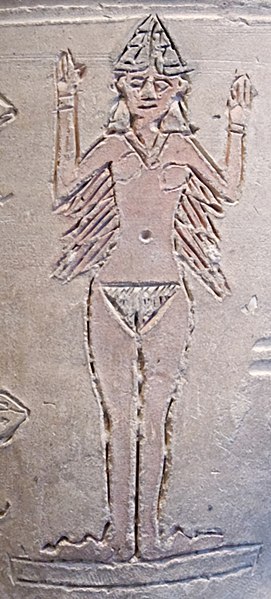
Is There A Connection Between Jesus and Inanna?

I've done several  blog posts on the Christ Myth, and I think that there is another one in order. The Christ Myth is the theory that what we believe about Jesus was cobbled together from myths and stories of  dying and rising gods from pagan sources predating Jesus. This time I want to look at the myth of Inanna. I researching on Ehteshaam Gulam on YouTube I came across the following video:


Recall that Ehteshaam Gulam has debated Mary Jo Sharp on the topic of whether or not Jesus died on the cross and lost miserably. Being the sore looser he seems to be, it seems that he has decided to attack another topic that Mary Jo Sharp has spent a great deal of her considerable skills fighting against - the Christ Myth. But rather than engage in a scholarly moderated debate (that she did offer to do with him), he made the video embedded above. Go Figure. Personally, I think it was because he doesn't want to be trounced again.

But be that as it may, in the video he makes the claim that three figures can be pointed out as being just like Jesus - died and rose again.

1. Inanna
2. Osirus - which I have already address here.
3. Apollonius of Tyana - which I have also already posted on here

I admit Inanna is a new one for me and surprise, surprise - Inanna is a she! I had never heard of her before I saw this video. I want to focus on Inanna on this post because I have seen the claims for Osius and Apollonius resoundly destroyed by Jame White, James P. Holding, Lee Strobel, and others. Ehteshaam Gulam claims that further information on Inanna can be found at:
http://www.infidels.org/library/modern/richard_carrier/improbable/crucified.h... 


James Holding asks: "Who on earth would believe a religion centered on a crucified man?" Well, the Sumerians perhaps. One of their top goddesses, Inanna (the Babylonian Ishtar, Goddess of Love and "Queen of Heaven"), was stripped naked and crucified, yet rose again and, triumphant, condemned to Hell her lover, the shepherd-god Dumuzi (the Babylonian Tammuz). This became the center of a major Sumerian sacred story, preserved in clay tablets dating over a thousand years before Christ.[1] The corresponding religion, which we now know included the worship of a crucified Inanna, is mentioned by Ezekiel as having achieved some popularity within Jerusalem itself by the 6th century B.C. The "women weeping for Tammuz" at the north gate of the Jewish temple (Ezekiel 8:14) we now know were weeping because Inanna had condemned him to Hell, after herself being crucified and resurrected. So the influence of this religious story and its potent, apparently compelling allure upon pre-Christian Judaism is in evidence.[2]
Even so, my point is not that the Christians got the idea of a crucified god from early Inanna cult. There may have been some direct or indirect influence we cannot trace. We can't rule that out--the idea of worshipping a crucified deity did predate Christianity and had entered Jewish society within Palestine. But we don't know any more than that.[3] Rather, my point is that we have here a clear example of many people worshipping a crucified god. Therefore, as a matter of principle--unless Holding wants to claim that Inanna really was resurrected--it appears that people would worship a false crucified god. Therefore, Holding cannot claim this is improbable.
 I also think that  Ehteshaam Gulam should pay close attention to the third note:

[3] I caution strongly against overzealous attempts to link Christianity with prior religions--see my critical comment on "Kersey Graves and The World's Sixteen Crucified Saviors" (2003); and for a good comparative study see Hans-Josef Klauck, The Religious Context of Early Christianity: A Guide to Graeco-Roman Religions (2000). But I can't deny there are some intriguing parallels, including those between this story of Inanna and the story of the Incarnation of the Lord told in the Ascension of Isaiah. There are many important differences, but it is curious that in the Sumerian story Inanna descends through the seven gates of Hell, with a different encounter at each stage, and her humiliation and crucifixion are at the bottom. Similarly, in the Jewish story the Savior (Jesus) descends through the seven heavens, with a different encounter at each stage, and his humiliation and crucifixion are at the bottom. Jesus also supposedly said he would be "three days and three nights" in the grave (Matthew 12:40), while Inanna herself was dead for three days and three nights. Of course, we are told Jesus was not actually dead for three nights, only at most two, but it is still curious why there would be a tradition of his saying otherwise, a tradition matching that of Inanna.
       I admit these parallels are worth noting, but they are too little to make much of. For instance, Jonah 1:17 also shares the three-days-and-nights motif (and Matthew 12:40 explicitly draws from it), which, as I explain elsewhere, probably derived from a common ancient concept of death. See Richard Carrier, "Jewish Law, the Burial of Jesus, and the Third Day" (2002). On the Jonah parallel specifically (as a motif for death and resurrection), see Evan Fales, "Taming the Tehom," in Jeff Lowder & Bob Price, eds., The Empty Tomb: Jesus Beyond the Grave (2005). Therefore, the suggestion is not that the Christians "got the idea" of a third-day motif from Inanna cult (directly or by transmission through later religions), but that they "got the idea" from the same cultural concepts governing the construction of the Inanna myth.

 However this brings up some questions for me. What is mean here by "crucifixion"? The Sumarians did not crucify people and certainly not a thousand years before Jesus?

 Crucifixion was in use at a comparatively high rate among the Seleucids, Carthaginians, and Romans from about the 6th century BC to the 4th century AD. In the year 337, Emperor Constantine I abolished it in the Roman Empire out of veneration for Jesus Christ, the most famous victim of crucifixion.[2][3] It was also used as a form of execution in Japan for criminals, inflicted also on some Christians. (Wikipedia - Crucifixion)

I want to know how does the Ascension of Isaiah have anything to do with the Gospel narrative, given that  it's not canonical and post dates the four Biblical gospels. Gonna have to reach farther than that. So I decided to see if such evidence exists that Inanna was what is being alleged. The article does include some references but it turns out that there are multiple versions of Inanna's story.

One version can be found on Wikipedia - under Inanna's Descent to the Underworld and the other at Aren’t there some striking parallels between the Jesus and Inanna stories?

The versions of the story I looked at both agree that Inanna went to the underworld ornately dressed but by the time she reached the bottom she was naked. But she took off her clothes one by one - she was not stripped by force. The Wikipedia version of the story does not even mention any violence towards her. But the other article does describe her being put on a stake or meat hook.  Nothing like the crucifixion Jesus endured. Look at this from the second article.I'm going to bold the original text and annotate it with some some additional points:

Some parallels, but nothing striking.  Inanna, the Sumerian goddess of love, procreation, and war, was at times considered either a virgin or very promiscuous.  In some versions of the story, Inanna descends to the underworld to visit her sister Ereckigala, the goddess of death.  As she passes through seven gateways, she is forced to surrender all seven articles of her clothing, one item at a time, finally arriving at her sister's lair naked. 

No where in the Bible does it say anything about seven gates to hell or seven gates to heaven. The myths make Inanna seem schizophrenic.  There are also various reasons why Inanna even wanted go to hell. The being naked part by the time she reaches the final destination is consistent. I wonder why? Wink wink. Nudge nudge.

Ereckigala becomes furious and kills Inanna, then hangs her on a meathook or nail. 

 Inanna's minister, Nincubar, sends a pair of flies to Ereckigala to bargain for Inanna's release.  Ereckigala releases Inanna on the condition that she find someone to take her place.  Inanna is either reincarnated into a new body or is resurrected to life, ascends from the underworld, and finds that her consort, Tammuz, had taken over her throne.  She sends Tammuz to the underworld in her place. 
 
I just don't see how this is like the Gospels at all. Inanna did not die as a substitution for anyone. Someone else was substituted in her place. That's backwards. If Christians wanted to make something up based on the same ideas as Inanna, why flip it?


Critics claim that Inanna was crucified, though no cross or tree was involved, and, besides, she was already dead when placed upon the meathook or nail. 

That's a good point.

Critics claim that Inanna was resurrected, which is true in some pre-Christian versions of the story, so this is a valid similarity.  However, since the death and resurrection took place in the underworld, and not in ours, the similarity lacks much in the way of comparisons to Jesus.

Critics claim that Inanna was a savior.  She was not.

Exactly, her death and resurrection changed nothing on earth or had any meaningful effect on anyone else.  not directly involved in the story. If you need to appeal to the myth of Inanna to find a corresponding story of a dying and rising God to compare to Jesus Christ, you are really despersately scraping the proverbial bottom of the barrel .  Jesus is the one and only.


Enhanced by Zemanta

Friday, January 13, 2012

Fistbump of the Day - He Lives: I am Richard Carrier. I have demonstrated this. I have refuted that.

I've often been amazed that Dr Richard Carrier's work critiques of the Bible and Christianity is given such weight. It's often erroneous and empty of any real weight or substance. In a recent blog post, Dr David Heddle posted a recent exchange he had with Carrier on Carrier's charge that the Gospels of Matthew and Luke are in conflict on the events surrounding Jesus' birth. Dr Heddle wrote:

It boggles the mind when people claim, definitively, that they have refuted the bible. If they were to say: Here is a serious problem for those who affirm biblical inerrancy--well that would be one thing. But to claim to have demonstrated error--not just to have made a decent case for error--well that takes an especially small mind.

Such a mind is that of Richard Carrier.

Read the post at this link:

He Lives: I am Richard Carrier. I have demonstrated this. I have refuted that.
Enhanced by Zemanta

Saturday, December 10, 2011

He Lives: Bad to Worse

I really enjoy Dr David Heddle's blog. In this post he takes both Dr Richard Carrier and John Loftus to task.

I see why such thoughts as Loftus' are "free." Carrier and Loftus are among your best and brightest? Sucks to be you.

Read the post at the link to see why he would write that.

He Lives: Bad to Worse
Enhanced by Zemanta

Tuesday, July 26, 2011

Debunking Christianity: Quote of the Day on Hitler, by Richard Carrier

John Loftus posted the following quote from Dr Richard Carrier

Even if Hitler had to pretend to be a Christian to get people behind his program against the Jews (and it was a public program, as Mein Kampf makes clear, and of course the fact that thousands of Germans happily carried it out), then the idea that atheism caused the holocaust is clearly refuted. [via email]


So if a man was not really a Christian and he lead thousands away from following Christian principles, then how can Christianity be at fault for the Holocaust? Hmmm. Does the Bible explain what happened? Yes it does.

For the time will come when people will not put up with sound doctrine. Instead, to suit their own desires, they will gather around them a great number of teachers to say what their itching ears want to hear. - 2 Timothy 4:3

Even if Hitler was not an atheist he sure was not a Christian.

Debunking Christianity: Quote of the Day on Hitler, by Richard Carrier
Enhanced by Zemanta

Thursday, June 9, 2011

The End of Pascal's Wager: Only Nontheists Go to Heaven

John Loftus posted the following article by Dr. Richard Carrier on his blog on May 18th, 2011. I decided to annotate the article. My comments will be in red. For a philosopher, Carrier makes some really untenable presuppositions.

The End of Pascal's Wager: Only Nontheists Go to Heaven
The following argument could be taken as tongue-in-cheek, if it didn't seem so evidently true. At any rate, to escape the logic of it requires theists to commit to abandoning several of their cherished assumptions about God or Heaven. And no matter what, it presents a successful rebuttal to any form of Pascal's Wager, by demonstrating that unbelief might still be the safest bet after all (since we do not know whose assumptions are correct, and we therefore cannot exclude the assumptions on which this argument is based).

Bold claims about what Carrier is going to accomplish with is arguments. Can he do it?

Argument 1: Who Goes to Heaven?
It is a common belief that only the morally good should populate heaven, and this is a reasonable belief, widely defended by theists of many varieties. Suppose there is a god who is watching us and choosing which souls of the deceased to bring to heaven, and this god really does want only the morally good to populate heaven. He will probably select from only those who made a significant and responsible effort to discover the truth. For all others are untrustworthy, being cognitively or morally inferior, or both. They will also be less likely ever to discover and commit to true beliefs about right and wrong. That is, if they have a significant and trustworthy concern for doing right and avoiding wrong, it follows necessarily that they must have a significant and trustworthy concern for knowing right and wrong. Since this knowledge requires knowledge about many fundamental facts of the universe (such as whether there is a god), it follows necessarily that such people must have a significant and trustworthy concern for always seeking out, testing, and confirming that their beliefs about such things are probably correct. Therefore, only such people can be sufficiently moral and trustworthy to deserve a place in heaven--unless god wishes to fill heaven with the morally lazy, irresponsible, or untrustworthy.

Dr Carrier may believe that it's reasonable to assume that only the morally good should populate heaven, but that isn't what the Bible tells us. There is no one who is good.


6 All of us have become like one who is unclean,
   and all our righteous acts are like filthy rags;
we all shrivel up like a leaf,
   and like the wind our sins sweep us away.- Isaiah 64:6

And that was written about theists! How much more worse off are unbelievers!? Hell is default. It is what we deserve without God's grace and mercy - it is an undeserved and unearned gift..

21 But now apart from the law the righteousness of God has been made known, to which the Law and the Prophets testify. 22 This righteousness is given through faith in Jesus Christ to all who believe. There is no difference between Jew and Gentile, 23 for all have sinned and fall short of the glory of God, 24 and all are justified freely by his grace through the redemption that came by Christ Jesus. 25 God presented Christ as a sacrifice of atonement, through the shedding of his blood—to be received by faith. He did this to demonstrate his righteousness, because in his forbearance he had left the sins committed beforehand unpunished— 26 he did it to demonstrate his righteousness at the present time, so as to be just and the one who justifies those who have faith in Jesus.- Romans 3:21-26
8 For it is by grace you have been saved, through faith—and this is not from yourselves, it is the gift of God— 9 not by works, so that no one can boast. 10 For we are God’s handiwork, created in Christ Jesus to do good works, which God prepared in advance for us to do.- Ephesians 2:8-10


Regardless of whether or not you think the Bile is true or not, you can't deny that it refutes the basis of Carrier's first argument. Strike one.

But only two groups fit this description: intellectually committed but critical theists, and intellectually committed but critical nontheists (which means both atheists and agnostics, though more specifically secular humanists, in the most basic sense). Both groups have a significant and trustworthy concern for always seeking out, testing, and confirming that their beliefs about god (for example) are probably correct, so that their beliefs about right and wrong will probably be correct. No other groups can claim this. If anyone is sincerely interested in doing right and wrong, they must be sincerely interested in whether certain claims are true, including "God exists," and must treat this matter with as much responsibility and concern as any other moral question. And the only two kinds of people who do this are those theists and nontheists who devote their lives to examining the facts and determining whether they are right.

I have to give Carrier a little credit here because the Bible tells us to test and question and search for truth.

20 Do not treat prophecies with contempt 21 but test them all; hold on to what is good, 22 reject every kind of evil. - 1 Thessalonians 5:20-22

But given the above presuppositions, I'd have to ask how concerned Carrier is with finding truth because he ignored what the Bible says about how people are saved. At the same time, it's not by intellectualism that theses things are discerned.

26 Brothers and sisters, think of what you were when you were called. Not many of you were wise by human standards; not many were influential; not many were of noble birth. 27 But God chose the foolish things of the world to shame the wise; God chose the weak things of the world to shame the strong. 28 God chose the lowly things of this world and the despised things—and the things that are not—to nullify the things that are, 29 so that no one may boast before him. - 1 Corinthians 1:26-29


Argument 2: Why This World?
It is a common belief that certain mysteries, like unexplained evils in the world and god's silence, are to be explained as a test, and this is a reasonable belief, widely defended by theists of many varieties. After all, if no test were needed, then God could and would, out of his compassion and perfect efficiency, simply select candidates at birth and dispense with any actual life in this world, since God would immediately know their merits.

Agreed some people think this way, but this isn't what the Bible teaches. God's hiddeness and unexplained evils are not tests to see who is moral enough to go to heaven.

Free will cannot negate this conclusion, since if God cannot know us because we might freely reverse ourselves, then God cannot fill heaven with trustworthy people: for anyone in heaven may through an unexpected act of free will become or do evil. And given an eternity, it is probable that most of the population of heaven will do something evil. After all, if free will prevents him, then God cannot predict who will or won't do evil and thus he can never select those who will be forever good from those who will not, except by some inductive test.

No where does the Bible say human beings have free will especially how Carrier defines it. God knows what we will do in any and all situations. He is critiquing "Open Theism" and most Christians are not Open theists! The Bible tells us a lot about how we come into knowledge of God..

 24 “The God who made the world and everything in it is the Lord of heaven and earth and does not live in temples built by human hands. 25 And he is not served by human hands, as if he needed anything. Rather, he himself gives everyone life and breath and everything else. 26 From one man he made all the nations, that they should inhabit the whole earth; and he marked out their appointed times in history and the boundaries of their lands. 27 God did this so that they would seek him and perhaps reach out for him and find him, though he is not far from any one of us. 28 ‘For in him we live and move and have our being.’ As some of your own poets have said, ‘We are his offspring.’
 29 “Therefore since we are God’s offspring, we should not think that the divine being is like gold or silver or stone—an image made by human design and skill. 30 In the past God overlooked such ignorance, but now he commands all people everywhere to repent. 31 For he has set a day when he will judge the world with justice by the man he has appointed. He has given proof of this to everyone by raising him from the dead.” Acts 17: 24-31
We are all, each one of us, put in the most optimal place, time, and circumstances for us to best find God.  

Since those who will be forever good must naturally be rare in comparison to the set of all those people appearing to be good up to their deaths, it follows that, lacking a reliable inductive test, most of the population of heaven will not be genuinely good. It follows that a god who wanted better results would probably distinguish the genuinely good, and thus deserving, from the untrustworthy and undeserving, by subjecting all candidates to a reliable test, and it would be reasonable to conclude that this world only exists for such a purpose.

If God only wanted deserving people in heaven, then not one of us would ever go. God does not look for righteousness in us, he imputes it to us. Strike two.


Argument 3: No God or Evil God
If presented with strong evidence that a god must either be evil or not exist, a genuinely good person will not believe in such a god, or if believing, will not give assent to such a god (as by worship or other assertions of approval, since the good do not approve of evil). Most theists do not deny this, but instead deny that the evidence is strong. But it seems irrefutable that there is strong evidence that a god must either be evil or not exist.

The Bible does not tell us that only genuinely good people believe in a good God.

18 But someone will say, “You have faith; I have deeds.”
   Show me your faith without deeds, and I will show you my faith by my deeds. 19 You believe that there is one God. Good! Even the demons believe that—and shudder.
 20 You foolish person, do you want evidence that faith without deeds is useless? 21 Was not our father Abraham considered righteous for what he did when he offered his son Isaac on the altar? 22 You see that his faith and his actions were working together, and his faith was made complete by what he did.- James 2:18-22

If demons know it, and they are evil, then of course evil people can recognize the fact of God's existence.


For example, in the bible Abraham discards humanity and morality upon God's command to kill his son Isaac, and God rewards him for placing loyalty above morality. That is probably evil--a good god would expect Abraham to forego fear and loyalty and place compassion first and refuse to commit an evil act, and would reward him for that, not for compliance. Likewise, God deliberately inflicts unconscionable wrongs upon Job and his family merely to win a debate with Satan. That is probably evil--no good god would do such harm for so petty a reason, much less prefer human suffering to the cajoling of a mere angel. And then God justifies these wrongs to Job by claiming to be able to do whatever he wants, in effect saying that he is beyond morality. That is probably evil--a good god would never claim to be beyond good and evil. And so it goes for all the genocidal slaughter and barbaric laws commanded by God in the bible. Then there are all the natural evils in the world (like diseases and earthquakes) and all the unchecked human evils (i.e. god makes no attempt to catch criminals or stop heinous crimes, etc.). Only an evil god would probably allow such things.

Why did Abraham go along with the idea of sacrificing Isaac? Abraham knew that the promises of God was contingent on Isaac living, so he obeyed God knowing that God was going to work it out. It was not an issue of evil; or good. The issue was "Can I trust God to keep his promises?" It was for this that Abraham was called "righteous".

17 By faith Abraham, when God tested him, offered Isaac as a sacrifice. He who had embraced the promises was about to sacrifice his one and only son, 18 even though God had said to him, “It is through Isaac that your offspring will be reckoned.” 19 Abraham reasoned that God could even raise the dead, and so in a manner of speaking he did receive Isaac back from death. - Hebrews 11:17-19

As for Job, there was a reason why Job went through what he went through. Job grew closer to God.

1 Then Job replied to the LORD:
 2 “I know that you can do all things;
   no purpose of yours can be thwarted.
3 You asked, ‘Who is this that obscures my plans without knowledge?’
   Surely I spoke of things I did not understand,
   things too wonderful for me to know.
 4 “You said, ‘Listen now, and I will speak;
   I will question you,
   and you shall answer me.’
5 My ears had heard of you
   but now my eyes have seen you.
6 Therefore I despise myself
   and repent in dust and ashes.” - Job 42:1-6
Strike Three.
Argument 4: The Test
Of the two groups comprising the only viable candidates for heaven, only nontheists recognize or admit that this evidence strongly implies that God must be evil or not exist. Therefore, only nontheists answer the test as predicted for morally good persons. That is, a morally good person will be intellectually and critically responsible about having true beliefs, and will place this commitment to moral good above all other concerns, especially those that can corrupt or compromise moral goodness, like faith or loyalty. So those who are genuinely worthy of heaven will very probably become nontheists, since their inquiry will be responsible and therefore complete, and will place moral concerns above all others. They will then encounter the undeniable facts of all these unexplained evils (in the bible and in the world) and conclude that God must probably be evil or nonexistent.

Again there is no evidence that God is evil or does not exits. Without God, how do you even know what "evil" is? How do you know how "good" you are?

In other words, to accept such evils without being given a justification (as is entailed by god's silence) indicates an insufficient concern for having true beliefs. But to have the courage to maintain unbelief in the face of threats of hell or destruction, as well as numerous forms of social pressure and other hostile factors, is exactly the behavior a god would expect from the genuinely good, rather than capitulation to the will of an evil being, or naive and unjustified trust that an apparently evil being is really good--those are not behaviors of the genuinely good.

Actually Carrier's position is not "courage to maintain unbelief in the face of threats of hell or destruction, as well as numerous forms of social pressure and other hostile factors, is exactly the behavior a god would expect from the genuinely good". It is capitulation to one's self.  It is turning your back on the one who made you and love you.  This is not genuinely "good" but it is "stupid".

Therefore only intellectually committed but critical nontheists are genuinely good and will go to heaven. Therefore, if a god exists, his silence and allowance of evil (in the world and the bible) are explained and justified by his plan to discover the only sorts of people who deserve to populate heaven: sincere nontheists. And this makes perfect sense of many mysteries, thus explaining what theists struggle to explain themselves.

Strike four.  The Bible is proof that God is not silent. God does not tempt anyone for evil nor does evil. So He does not test us the way Carrier is suggesting. 
  13 When tempted, no one should say, “God is tempting me.” For God cannot be tempted by evil, nor does he tempt anyone; 14 but each person is tempted when they are dragged away by their own evil desire and enticed.- James 1:13-14
  • God's hiddenness is necessary on this account, since his presence would inspire people to behave as if good out of fear or selfish interests, not out of courage or compassion or a sense of personal integrity.
Without God you have no true courage, compassion, or personal integrity.  We are sinners deserving of hell - eternal separation from a holy God.

  • A false, evil image of God in the bible is necessary in order to test whether the reader will place morality or faith first, so this tests moral courage in the face of assertions, threats and promises of reward. It also tests cognitive trustworthiness, since it is wrong to trust what someone merely wrote, over scientifically established truths and the direct evidence of reason and the senses.
It's about trusting God or our  flawed  understanding, reason and senses.
  • Natural evils and unchecked human evils are also necessary on this account, since only in such a way can a god "demonstrate" that no moral power is behind the universe, that there is no custodian, and by that means lead a rational, compassionate observer to conclude there is no god. If the universe were well-ordered, with inherent moral enforcement and the containment or restriction of evils, observers would conclude there is a god and thus, again, might act as if good out of fear or hope of reward.
Just because things aren't meted out the way you think they should be and things happen you cannot explain does not mean that God is not running things. If God eradicated all evil now, he would have to destroy all of us. In stead He decided to save some of us because Her wanted to.

18 I consider that our present sufferings are not worth comparing with the glory that will be revealed in us. 1920 For the creation was subjected to frustration, not by its own choice, but by the will of the one who subjected it, in hope 21 that[h] For the creation waits in eager expectation for the children of God to be revealed. the creation itself will be liberated from its bondage to decay and brought into the freedom and glory of the children of God.
 22 We know that the whole creation has been groaning as in the pains of childbirth right up to the present time. 23 Not only so, but we ourselves, who have the firstfruits of the Spirit, groan inwardly as we wait eagerly for our adoption to sonship, the redemption of our bodies. 24 For in this hope we were saved. But hope that is seen is no hope at all. Who hopes for what they already have? 25 But if we hope for what we do not yet have, we wait for it patiently.- Romans 8:18-25
    The only way to truly test human beings is to see if we will become nontheists after serious and sincere inquiry into these matters: to see if we have the courage and fortitude to choose morality over faith or loyalty, and be good without fear or hope of divine reward. No other test will ensure a result of the genuinely good being self-selected into a predictable belief-state that can be observed in secret by god.

    Carrier failed to show that the test for being good enough to go to heaven  is contingent on choosing morality over faith. The Bible does not say that.  Carrier could deny that the Bible is true, but he based his whole argument on what Christians believe. Therefore the Bible is relevant.  It's not about being genuinely good. We are morally good and live holy lives through God's grace.

    Conclusion
    Since this easily and comprehensively explains all the unexplainable problems of god (like divine hiddenness and apparent evil), while other theologies do not (or at least nowhere so well), it follows that this analysis is probably a better explanation of all the available evidence than any contrary theology. Since this conclusion contradicts the conclusion of every form of Pascal's Wager, it follows that Pascal's Wager cannot assure anyone of God's existence or that belief in God will be the best bet.

    It does not explain theodicy or divine hiddeness at all. If you start from the Christian viewpoint, as Carrier does, then you have to agree that God has revealed Himself to humanity. .Unbelief is not a sure bet.in the slightest because if there is a  God holding us accountable for what we do,  not one of us can meet that standard. Only one worldview, Christianity, offers a way for dealing with your sin which must be dealt with. Sorry, but Pascal's Wager is still on the table.

    The End of Pascal's Wager: Only Nontheists Go to Heaven
    Enhanced by Zemanta

    Thursday, April 21, 2011

    Monday, March 28, 2011

    Richard Carrier Blogs: Is Obama a War Criminal?

    Heavens to Betsy!!!! I actually agree with Richard Carrier on something!!!! I'm shocked and happy that he chose to speak out condemning the nonsense that President Obama should be considered a war criminal. I don't agree with everything Obama says and does but I think something had to be done to stop the slaughter of people in Libya. One might even argue that using military force was the best option, but if it wasn't what would have been? I don't know. I liked how Mr Carrier pointed out that Obama's action was not unconstitutional and as I have pointed out in a post of my own other Presidents have done the same thing. I recommend this post because it's well done and articulated well. The one point I have a problem with is that Carrier said that there was nothing we could have done in Rwanda or Bahrain. What about Darfar? I think there must have been something more we could have done to save lives. It's easy to sit back and judge those decisions not having been there and judge who to save and who to let die. I'm sorry but I really think that economics and racism has played a part in making those decisions through out American History. Carrier wrote:
    It was thus absolutely necessary for Obama to tip the scales away from Qadaffi's success (it will be a disaster for us if he wins--we need him to fail, in every conceivable sense of the word). Who succeeds him is irrelevant, even if its someone ambivalent or hostile to the U.S. That's because we have bigger interests here: as long as the precedent is not established that Qadaffi's methods will go unhindered and unpunished, and as long as the precedent is set instead that America supports the democracy trend raging through the whole region even when we aren't assured of gaining an ally (and that we will not support, even by acquiescence, any anti-democracy regime's use of violence--not even in Bahrain, where we are otherwise helpless), then the entire balance of power in the region is shifted in America's favor, which will be a great benefit to us in the long run. Because an anti-American party elected into power today will, if democracy is sustained, be voted out eventually. In fact, that's the only way the region ever can move forward toward better relations with the U.S. We need democracy in the region. And we will not have it if we sit idly by and let Qadaffi holocaust his own citizens, and then, by extension, any other ruler who will take the hint and do the same, knowing we'll do nothing about it.


    I have to agree with his assessment of why we had to intervene in Libya. The question I have is what about all the precedents where the United States did indeed sit idly by and let ____  holocaust his own citizens, and then, by extension, any other ruler who will take the hint and do the same, knowing we'll do nothing about it.? For there have been many. I don't really have answers for how to do this. It's got to be on a case-by-case basis - true - but who do you save and who do you sacrifice on the altar of American interests? What happens when we have to give an account for that?'

    Truth is that Obama is not a war criminal. We live in an age where people make truly stupid judgments without really knowing what they talk about. This is a case in point and Richard Carrier has written a post explaining how stupid mistaken Obama's critics have been, at least on this point. Obama doesn't just get a pass, we need to keep examining his policies just like any other President. Again, he is just a man, whom I would assume, is just trying to do the best job he can. So how should Obama respond to sheer stupid and idiotic comments offered against him? The FacePalm. You can disagree with Obama without being racist or Stupid.

    Here is a clip from the Daily Show that was mentioned in Carrier's post:


    Richard Carrier Blogs: Is Obama a War Criminal?
    Enhanced by Zemanta