 Image via Wikipedia
Here is the third part of Mariano's series about God taking human form in the Old Testament. This one brings in more Jewish sources.
God Took Human Form (Before the Time of Jesus), part 3 of 5 | True Freethinker
 Image via Wikipedia


Jewish Scholars Claude Joseph Goldsmith Montefiore and Herbert Martin James Loewe,
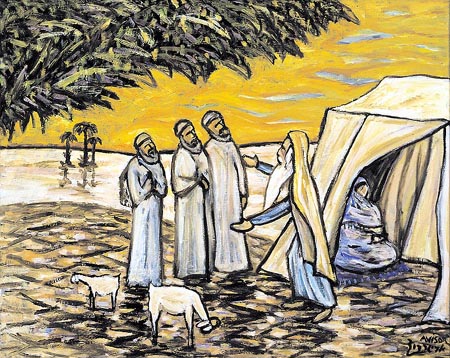
“If man should be humble, there is a sense in which God is strangely humble too: If a pupil is ill, and the teacher goes to visit him, the other pupils go before to announce the coming of the teacher. But when God went to visit Abraham in his illness, He went first, before the angels (Gen. XVIII, 1, 2). Is there anyone more humble than He? (Tanh., Wayera, 2, f. 31b.)” [emphasis added]


 I heard that Michael Behe was going on tour and I'm grateful that Peter Williams blogged one of his appearances. This one is Behe in discussion with theistic evolutionist Prof Michael Reiss at Charles Darwin House, London, on Monday 22nd November. Definitely worth checking out. Hopefully a video or and audio will be posted soon as well.




Through the centuries theologians and philosophers from a wide range of backgrounds and interests have tried various responses to explain what appears to be a logical contradiction in the following five propositions:1. God exists.2. God is all-powerful.3. God is all-knowing.4. God is all-good.5. Evil exists.
Does this mean God justifies His means by His ends? Yes. Is that wicked? No. An end-justifies-the-means ethic is fallacious and therefore wicked for finite men (who can neither control nor know all the results of their choices), but it is perfectly fitting for the infinite God (who both controls and knows all the results of His choices)–and, after all, God being supreme need not justify His choices to anyone:So then He has mercy on whom He desires, and He hardens whom He desires. You will say to me then, “Why does He still find fault? For who resists His will?” On the contrary, who are you, O man, who answers back to God? The thing molded will not say to the molder, “Why did you make me like this,” will it? Or does not the potter have a right over the clay, to make from the same lump one vessel for honorable use and another for common use? (Rom. 9:15–21).Does the reality of evil make the existence of the Christian God impossible? No. For good reasons, God created a world that contained evil. For those same reasons, as we have seen, the Christian position does not self-contradict.

We have seen, then, that the atheist’s claim that there is a contradiction in believing in the coexistence of God and evil is false, and that the Christian faith does have reasonable explanations for how the God of the Bible and evil could coexist.10 For God to create a good and moral universe, He needed to make creatures with free will. Along with free will came the possibility—and, as it turned out, the reality—that these creatures freely would choose evil. God, however, is willing and able to redeem this fallen world and abolish evil. He will do it, and all will be well.
A False Choice. Meister presents a false choice between libertarian freedom and “sham” freedom. That choice presupposes that for the compatibilist–that is, one who holds determinism and moral responsibility/free choice to be compatible, as I have argued–there is no difference between how a stone responds to gravity and how a child responds to his or her parent’s command. Hidden within this mistake is a deeper one: the assumption that “a real ability to choose one way or the other”—“libertarian freedom”—is the same thing as free will, that is, a will that is not predetermined. Compatibilists assert that moral agents (God, angels, and men) choose, but that choosing per se and choosing indeterminately are not synonymous.
Those who live according to the flesh have their minds set on what the flesh desires; but those who live in accordance with the Spirit have their minds set on what the Spirit desires. The mind governed by the flesh is death, but the mind governed by the Spirit is life and peace. The mind governed by the flesh is hostile to God; it does not submit to God’s law, nor can it do so. Those who are in the realm of the flesh cannot please God.- Romans 8:5-8


He talks about the types of proofs, Pascal's wager, first cause arguments, cosmological arguments, arguments from design, morality, desire, and more. There is a lot of great content packed into this 76-minute lecture


The natural world is all that we can detect with our 5 senses and instruments used to interact with those senses when the scale of perception surpasses the limitations of those senses. The supernatural world then would be that which we cannot detect with senses or instruments (at the present time). This means that at the present time there is no evidence which we can discern supporting the supernatural. If and when we become able to detect the supernatural, it will have moved into the realm of the natural, as we can then detect it.Here is the part that causes growning:
This means that at the present time there is no evidence which we can discern supporting the supernatural. If and when we become able to detect the supernatural, it will have moved into the realm of the natural, as we can then detect it.




So what prompted me to do a Radio Free Geneva? Well, first, the clips from the Ankerberg Show with Norman Geisler and his dismissal of the utter refutation of his horrific "farmer and the boys in the swimming pond" illustration (and the misquotation of Matthew 23:37 as well). But after spending the first half hour on that topic, I moved into the material posted by TurretinFan here on the blog (link). I cannot think of any clearer condemnation of the biblical gospel on the part of Rome than Clement XI's Unigenitus, and I explained that by reading major portions of it. The parallels between the condemnations of Rome and the arguments of Arminians like Geisler, Hunt, etc., are striking. You might want to listen to this one sitting down! Here's the program.
Tomorrow we will have another DL at the regular Thursday evening time (4pm MST). I will be reviewing portions of the debate that took place in Mexico City including William Lane Craig and Richard Dawkins.


Some of Rome's rejections of Scriptural truth are more clear than others. One particularly clear set of examples comes from the dogmatic Constitution, "Unigenitus,"dated Sept. 8, 1713, and authorized by Clement XI. I've previously posted a full list of the 101 "errors" condemned (link to full list).
There many alleged errors identified. I've taken the liberty to highlight a few of them. Remember, these are what the Roman church has officially proclaimed to be errors.
Scripture
The Power of God in Salvation
- 79. It is useful and necessary at all times, in all places, and for every kind of person, to study and to know the spirit, the piety, and the mysteries of Sacred Scripture.
- 80. The reading of Sacred Scripture is for all.
- 81. The sacred obscurity of the Word of God is no reason for the laity to dispense themselves from reading it.
- 82. The Lord's Day ought to be sanctified by Christians with readings of pious works and above all of the Holy Scriptures. It is harmful for a Christian to wish to withdraw from this reading.
- 83. It is an illusion to persuade oneself that knowledge of the mysteries of religion should not be communicated to women by the reading of Sacred Scriptures. Not from the simplicity of women, but from the proud knowledge of men has arisen the abuse of the Scriptures, and have heresies been born.
- 84. To snatch away from the hands of Christians the New Testament, or to hold it closed against them by taking away from them the means of understanding it, is to close for them the mouth of Christ.
- 85. To forbid Christians to read Sacred Scripture, especially the Gospels, is to forbid the use of light to the sons of light, and to cause them to suffer a kind of excommunication.
Particular Redemption
- 30. All whom God wishes to save through Christ, are infallibly saved.
- 31. The desires of Christ always have their effect; He brings peace to the depth of hearts when He desires it for them.
Justification by Faith that Works through Love
- 32. Jesus Christ surrendered Himself to death to free forever from the hand of the exterminating angel, by His blood, the first born, that is, the elect.
Faith as the Gift of God
- 51. Faith justifies when it operates, but it does not operate except through charity.
The Church
- 69. Faith, practice of it, increase, and reward of faith, all are a gift of the pure liberality of God.
Total Depravity
- 72. A mark of the Christian Church is that it is catholic, embracing all the angels of heaven, all the elect and the just on earth, and of all times.
- 73. What is the Church except an assembly of the sons of God abiding in His bosom, adopted in Christ, subsisting in His person, redeemed by His blood, living in His spirit, acting through His grace, and awaiting the grace of the future life?
- 74. The Church or the whole Christ has the Incarnate Word as head, but all the saints as members.
- 75. The Church is one single man composed of many members, of which Christ is the head, the life, the subsistence and the person; it is one single Christ composed of many saints, of whom He is the sanctifier.
The Absolute Necessity of Grace
- 38. Without the grace of the Liberator, the sinner is not free except to do evil.
- 39. The will, which grace does not anticipate, has no light except for straying, no eagerness except to put itself in danger, no strength except to wound itself, and is capable of all evil and incapable of all good.
- 40. Without grace we can love nothing except to our own condemnation.
- 41. All knowledge of God, even natural knowledge, even in the pagan philosophers, cannot come except from God; and without grace knowledge produces nothing but presumption, vanity, and opposition to God Himself, instead of the affections of adoration, gratitude, and love.
- 42. The grace of Christ alone renders a man fit for the sacrifice of faith; without this there is nothing but impurity, nothing but unworthiness.
- 48. What else can we be except darkness, except aberration, and except sin, without the light of faith, without Christ, and without charity?
The Irresistibility of Grace
- 1. What else remains for the soul that has lost God and His grace except sin and the consequences of sin, a proud poverty and a slothful indigence, that is, a general impotence for labor, for prayer, and for every good work?
- 2. The grace of Jesus Christ, which is the efficacious principle of every kind of good, is necessary for every good work; without it, not only is nothing done, but nothing can be done.
- 5. When God does not soften a heart by the interior unction of His grace, exterior exhortations and graces are of no service except to harden it the more.
- 9. The grace of Christ is a supreme grace, without which we can never confess Christ, and with which we never deny Him.
Unjust Excommunication
- 10. Grace is the working of the omnipotent hand of God, which nothing can hinder or retard.
- 11. Grace is nothing else than the omnipotent Will of God, ordering and doing what He orders.
- 12. When God wishes to save a soul, at whatever time and at whatever place, the undoubted effect follows the Will of God.
- 13. When God wishes to save a soul and touches it with the interior hand of His grace, no human will resists Him.
- 14. Howsoever remote from salvation an obstinate sinner is, when Jesus presents Himself to be seen by him in the salutary light of His grace, the sinner is forced to surrender himself, to have recourse to Him, and to humble himself, and to adore his Savior.
- 15. When God accompanies His commandment and His eternal exhortation by the unction of His Spirit and by the interior force of His grace, He works that obedience in the heart that He is seeking.
- 16. There are no attractions which do not yield to the attractions of grace, because nothing resists the Almighty.
- 17. Grace is that voice of the Father which teaches men interiorly and makes them come to Jesus Christ; whoever does not come to Him, after he has heard the exterior voice of the Son, is in no wise taught by the Father.
Yes, folks, those are things that Rome has officially taught are errors - yet many of these teachings are the truth, as I think will be obvious to most of those reading.
- 91. The fear of an unjust excommunication should never hinder us from fulfilling our duty; never are we separated from the Church, even when by the wickedness of men we seem to be expelled from it, as long as we are attached to God, to Jesus Christ, and to the Church herself by charity.
- 92. To suffer in peace an excommunication and an unjust anathema rather than betray truth, is to imitate St. Paul; far be it from rebelling against authority or of destroying unity.


“Jerusalem, Jerusalem, you who kill the prophets and stone those sent to you, how often I have longed to gather your children together, as a hen gathers her chicks under her wings, and you were not willing." - Matthew 23:37


 I for one agree science is wonderful and I love it. However I disagree with John Loftus about how science relates to Christianity. His post deserves a Facepalm because science, when it is not biased by naturalistic materialism,points to God - His presence, intelligence, and power. And finally how can science "save" a soul given that the majority of materialists deny the existence of the human soul.


Right now, digital comics are like a rock sitting on top of a hill, just inches from tipping over the edge. Digital comics are full of potential energy that's just waiting to explode into something new, but it will take nurturing, careful choices, and a willingness to break from tradition to make it work. Full penetration for the market is going to require relatively cheap reading devices, an audience that has been educated about the pros and cons of digital comics, a price point that customers and publishers find appealing, and some kind of standard format that scales across platforms and provides a chance for an open source solution to prevent monopolies.Very thoughtful indeed!!!
We're living in exciting times, and digital comics may be the most important development in comic books since Jerry Siegel and Joe Shuster created Superman. It has the potential to change everything, but if handled wrong, it will change nothing. Staying educated about the risks, rewards, and vagaries of digital comics can only be a good thing, especially when you decide to take the plunge yourself.
We're obviously very pro-digital comics at ComicsAlliance, but no one actually believes that digital comics will destroy print comics. What's more likely is that the two would exist in a mutually beneficial relationship. Maybe some monthly comics will turn a profit digitally and end up in deluxe trades down the line. Maybe digital comics will provide an easy way to enhance printed stories. Right now, we don't know. We can guess, but most of all, we can hope.


