Friday, March 2, 2012

FacePalm of the Day: Debunking Christianity: Quote of the Day, by gooddogbaddog01

John Loftus has posted a quote he sees fond of on his blog.  Look at it below.

Christians think they are being rational and logical. But when they try to rationalize their faith based on evidence, they tend to resort to what is "possible", and then claim that they have won the argument because something is merely "posslble". Short of providing real evidence for the existence of the Christian God, they dive into philosophy, in order to somehow logically prove the necessity of the existence of god. To me, however this is no different than mental gymnastics, resulting in endless rabbit trails around epistemology, metaphysics and ontology. It is, simply, making stuff up.
John Loftus immediately commented:

johnwloftus
Boy, this sounds a lot like me. ;-)

I don't think this person really understand what Christianity is. I mean if you switch out his words and use opposite words, you get the following:

[Atheists] think they are being rational and logical. But when they try to rationalize their [doubts] based on evidence, they tend to resort to what is ["probable"], and then claim that they have won the argument because something is merely ["probable"]. Short of providing real evidence for the [non]existence of the Christian God, they dive into philosophy, in order to somehow logically prove the unnecessity of the existence of god. To me, however this is no different than mental gymnastics, resulting in endless rabbit trails around epistemology, metaphysics and ontology. It is, simply, making stuff up.

 Yes, indeed it does sound a lot like John Loftus. The fact that the same thing can be said, invalidates the statement against Christianity.

Should Batman Kill the Joker? Perspectives from Five Famous Philosophers

Comics Alliance has posted a great article discussing a deeply philosophical question: Should Batman Kill the Joker? It's based on a post by Tauriq Moosa, an ethicist writing for the site Big Think. In it, he argued against Batman's famed "no killing" policy. He says that Batman has a moral obligation to rid the world of the Joker. I totally disagree. Batman is a man. He has not obligation to choose who deserves to die. The article in Comics Alliance does not bring this up but I've got to wonder why is Batman obligated to do anything? But setting that aside, the Comics Alliance article does take the question Moosa asks and answers and imagines how 5 of the greatest Western philosophers might answer the same question.

1. Immanuel Kant
2. John Stuart Mill
3. Thomas Hobbes
4. John Rawls
5. Friedrich Nietzsche

This is a fun thought experiment. I think one of the defining things about Batman, one of the things that makes him a hero, is that he will not take a human life.  He refuses to cross the line that would make him not better than the evil that he fights. The article is well worth your time if you like discussing and thinking of morality.

Read More: http://www.comicsalliance.com/2012/03/02/batman-kill-joker-philosophy/#ixzz1nzjX2T5
Enhanced by Zemanta

Old Errors in New Garb: Response Part 3

Here is Dr James White's third response to a video by Sam Gipp which advanced the "King James Only" ideology.


Old Errors in New Garb: Response PartThree

Wednesday, February 29, 2012

Apologist Interview: Ravi Zacharias - Apologetics 315

Brian Auten has posted his awesome interview with Ravi Zacharias. It's really great to hear. Take a look at the following link to hear the interview!

Apologist Interview: Ravi Zacharias - Apologetics 315

Debunking Christianity: Articulett on the OTF

John Loftus posted some comments from Articulett on the Debunking Christianity blog.While there is much that could be considered, I'd like to raise a single point that I'm driven to raise. She is quoted as having written:


So, naturally, as an outsider to your faith (most of us are former believers) you look as brainwashed to us as they do to you. You all look like you are leaping over probabilities to confirm your respective biases. How do you imagine you are different? You would need to give us the kind of evidence you'd require to take their supernatural beliefs seriously if you wanted us to do the same for yours. And you haven't. No theist has. It's all word games.

MY question is how does the atheists know that in order to reach the conclusion that there is no God, that he/she is not "leaping over probabilities" and possiblilities "to confirm their respective biases"? For example, the notion that a good God would not create hell or send people there is a bias based on subjective opinion about what one's concept of God. Would not want to know God as God truly is and not what you think God should be?

Debunking Christianity: Articulett on the OTF
Enhanced by Zemanta

A Bronze Helmet from the Time of Neco | Claude Mariottini - Professor of Old Testament

I'm always fascinated to find out about archeological finds that corroborate the Bible. Dr Mariottini always posts great content that sometimes includes such information. Dr Mariottini wrote the following.
Archaeologists have found a Greek bronze helmet covered with gold leaf that is 2,600-year-old. The bronze helmet probably belonged to a Greek mercenary who fought with Neco, a pharaoh of Egypt. The helmet was discovered in the waters of Haifa Bay, in Israel.
Neco (his name also appears as Necho in some translations of the Bible), was a pharaoh of the 26th Dynasty (Saite). He ruled from 609 to 595 B.C. Neco appears in the Hebrew Bible as the one who caused the death of Josiah, king of Judah, at Megiddo in 609 (see 2 Kgs. 23:28–30; 2 Chr. 35:20–27).

Read the whole article at the following link:

A Bronze Helmet from the Time of Neco | Claude Mariottini - Professor of Old Testament

Google The Right Way [Infographic]

Get more out of Google
Created by: HackCollege
[Via How-To Geek]


Google The Right Way [Infographic]
Enhanced by Zemanta

Leap Years Explained [Video]

Here is a great video about Leap Years


Leap Years Explained [Video]

Is Your Job Killing You? [infographic]


Is Your Job Killing You? [infographic]

Responding to the Same Old Falsehoods Packaged in New Garb

Dr James White has posted a video responding to Sam Gipp's "defense" of the King James Only doctrine. Hint: Gipp's arguments are still bad. Here is Gipp's video:


And Here is part 1 of Dr White's reply:


Responding to the Same Old Falsehoods Packaged in New Garb
Enhanced by Zemanta

The Navy's Electromagnetic Railgun - G4tv.com

Does this remind anyone else of the rail gun used in Transformers: Revenge of the Fallen? I wonder how long this has been in development? And what else is on the drawing board?


Here is link to the scene from Transformers: Revenge of the Fallen http://www.youtube.com/watch?v=wr7RpLQ8pZo


The Navy's Electromagnetic Railgun - G4tv.com

Tuesday, February 28, 2012

Debunking Christianity: On Definitions of Faith and Arguments Against It

You may be aware that John Loftus has been posting a lot about what "faith" is. It's amazing that he has still failed to have correctly define it. Here is a list of definitions has has used put together from two recent blog posts.  Loftus wrote:

Skeptics define "faith" differently than believers. It's hard to find a middle ground between us because we see faith differently. Here are a few skeptical definitions of faith:

Yup, I think it is impossible to believers and non-believers are not capable to agree on this. Here are some of those quotes.


Mark Twain defined faith as “believing what you know ain’t true.”

Sam Harris: "Faith is the license religious people give themselves to keep believing when reasons fail."

In the documentary Religulous, Bill Maher said “Faith means making a virtue out of not thinking.”

Richard Dawkins: “The whole point of religious faith, its strength and chief glory, is that it does not depend on rational justification. The rest of us are expected to defend our prejudices.”

John Loftus: "Faith is an attitude or feeling whereby someone attributes a higher degree of probability to the evidence than what the evidence calls for."
And from Dr Matt McCormick

-To take something on faith or to believe by faith is to believe it despite contrary or inadequate evidence. It is to believe anyway when there's not enough support from evidence and reason to clear the way.

-The overcoming of doubts or counter-evidence is the essential feature of faith.

-If someone's reaction to my arguments against the resurrection and other religious beliefs is that she has faith, then she is conceding the central point. In effect, she is acknowledging that in order to believe those religious doctrines, one must ignore the inefficiencies in the evidence and believe anyway.

-If there is sufficient evidence to justify the conclusion, then faith isn't needed. So to suggest that faith and evidence jointly justify is acknowledging that the evidence by itself isn't enough, and I will ignore that gap and believe anyway.

-In fact, the need to invoke faith to bridge the gap affirms the inadequacy of the evidence.

-In effect, the faith response amounts to, "I'm going to believe anyway, despite those objections." That's just dogmatic irrationality, not a serious consideration that the critic must give some further objection to.


Debunking Christianity: On Definitions of Faith and Arguments Against It

Professor Matt McCormick's Definition of Faith

In the latest post, Loftus said something in the comments that I think bears scrutiny:

FTFDad, it doesn't matter how they define it. This is an argument over how it is best defined.

My response: Who are you to tell me what I mean when I use the word "faith"? There have been few arguments I have seen about how to define a single word in English. My vote is to go with the Biblical definition, but people like Loftus and McCormick would never agree to that. I say that because none of them have seem to argue that the Bible defines it the way they do. Baring that...why don't we just decide the way we do all other English words: Etymology. Where does this word come from? I came up with a couple of links that one can look at that shows what the word originally meant:


And you would notice that in no way did it mean to believe or trust in something without proof or contrary to evidence. In today's vernacular we do use "faith" that way, but that is not how the people who first translated the Bible into English would have thought of what "faith" means. And for sure the Bible writers did not think that was what :"pistas:" means - the word that is often translated to "faith" in English Bibles.


Now faith is the substance of things hoped for , the evidence of things not seen .- Hebrews 11:1


Crosswalk.com is very handy. The Biblical text is hyperlinked to Strong's Concordance. One could click on the words and look up some lexical aids to see what words mean. Can we find anything in the Greek words that lends credibility to idea that when we believe, we should just turn our brains off and ignore and contrary facts or evidence? I don't mind if you check yourself. Go ahead. I'll wait.

Nope, nothing about believing despite "counterfactuals". Sorry, but Atheists have no leg to stand on in mis-defining "Faith" as they often do. It doesn't matter what  "faith" means now in the English vernacular when you are trying  to understand what the the Gospel writers were saying 2000 years ago. Where they using your definition? If you think "Faith" is believing something even if you can prove its false, then you are not using the same concepts that the writers of the Bible were using.and you should repent of the error.

Sugarcoating the Bible | Claude Mariottini - Professor of Old Testament

Dr Mariottini has posted some comments about an article by Steven James, writing a post for CNN Belief Blog, in which he argued for Christians to stop "sugarcoating" the Bible. I agree. Dr Mariottini wrote:

In previous posts I have argued for translating the biblical text as literally as possible and as readable as necessary. I rather prefer that the reader struggle with the text as it is than to offer a reading that is more of an interpretation than a translation of the text.

I could not agree more!!


Sugarcoating the Bible | Claude Mariottini - Professor of Old Testament
Enhanced by Zemanta

Peregrinations: The Crux of Cosmic History

Rick Gerhardt recently gave an important sermon at his home church. Thankfully, he posted it on his blog.


Rick Gerhardt :: The Crux of Cosmic History from Antioch Church on Vimeo.


Peregrinations: The Crux of Cosmic History

Monday, February 27, 2012

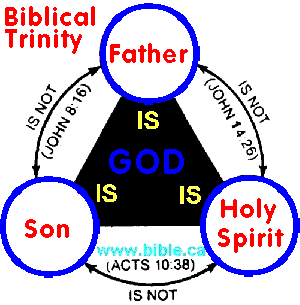
ID.Plus: 'Understanding the Trinity' - bethinking publish new paper on Trintiy

Dr Peter S Williams has posted a link to a paper he has written on the Trinity. Take a look.

ID.Plus: 'Understanding the Trinity' - bethinking publish new paper on Trintiy
Enhanced by Zemanta

Jesus and the Story of Osiris and Horus (William Lane Craig) - YouTube


pics on Sodahead
Mariano pointed out this great video to me. It's Dr William Lane Craig answering the question about if there really is a parallel between Osirus and Horus to Jesus. Worth looking at, so you don't become deceived by such a silly thought.


Jesus and the Story of Osiris and Horus (William Lane Craig) - YouTube
Enhanced by Zemanta