Saturday, July 21, 2012

FacePlant of the Day - Debunking Christianity: Why James Holmes' Rampage is the Result of the Teachings of Christianity

The shooting of 70+ people who had assembled to watch The Dark Knight Rises just after midnight July 20, 2012 by 24 year-old James Holmes is truly deplorable - tragic - and can't be valiated or rationalized in any way. I mean he killed twelve people! I don't think that any sane person who thinks that this was a good thing in any kind of way. When Christians point out that Atheism doesn't give unbelievers a moral foundation they are not arguing that Atheists cannot recognize evil nor deplore it. They should! We all should! I am glad that people like John Loftus can write:

My heart goes out to all of the victims including the people of Aurora and the owner of the theater who's business will never be the same. There is a lot of commentary about this tragic incident and its repercussions in our free society. I would like to discuss why it was wrong. Do I even need to say why? Source

No - we know it is wrong. And yes, Loftus is right that innocent people suffered and didn't deserve to have their lives stolen from them in varying degrees. However Loftus did not talk about why that is wrong. I agree that it wrong but if you think that we all products of random, uncaused, undirected, and natural processes, why does it matter? Of course it matters but why? If those people who died in such a terrible way no longer exists or if Holmes gets off (unlikely) how is Justice served? Does it even matter if Justice exists? Who says? Who decides? What if you disagree? It's questions like these that a godless worldview cannot answer. But I don't want to digress too far from the faceplant of the day.

This incident reminds me of the massacre in Norway from last year when Anders Behring Breivik went on his shooting spree in Norway. We all wanna know what happened. Why did this happen? Last year John Loftus blamed the incident on Anders Behring Breivik being a Christian (source) Fortunately he avoids this blunder regarding Holmes but Cathy Cooper falls for it. 

I see about three  reasons that are being given for Holmes' rampage. Some Christians are blaming Hollywood and or comic books inspiring violence. I totally reject this because anyone who knows anything about what the Batman character symbolizes and stands for could not bed inspired to hurt others. If someone were that confused that would mean that they were completely incapable of understanding written text or television or images or movies. Such a person should be locked up. I really liked how Comics Alliance posted a single image from one Frank Miller's Batman stories that sums up Batman's relationship with guns (on the right)

As for how Cathy Cooper blames Christian doctrine, let us look at a faceplant in the making.

In times like this, when something horrendous happens, people tend to hypothesize as to the reasons why. As most everyone knows by know, the "nice Christian boy," James Holmes massacred 12 innocent people and wounded many more in his rampage in a Colorado movie theatre. 

What does a "nice Christian boy" believe? What does a "nice Christian boy" do? Does a "nice  Christian boy" shoot over 70 people?  Being raised in a church or even attending a church does not make you a Christian. I'd like to know what is about Holmes that leads Cooper to conclude that Holmes is a Christian. Fail number 1.

One hypothesis was put forth by the Christian apologist, Rick Warren, in one of his latest tweets, when he said, "When students are taught they are no different from animals, they act like it."  The implied hypothesis being, that it's the result of teaching science, and in particular, Darwinianism and materialism.  I propose that there is a better explanation.

"Impiled hypothesis"? So Cooper is putting words in Pastor Rick Warren's mouth and has no proof that he was saying that Holmes did what he  did because he was taught that science was bad. I wonder if she knows that Holmes had been a graduate school student in neural biology which would mean a steady stream of Darwinism. If I were more like Cooper I would suggest that it was studying neural biology that drove Holmes insane, but I don't think that way. Neither does Warren. Warren does not hate science and he would not equate learning that we are no different from animals with all science. I mean let's have some honesty here. Fail number 2.

 My hypothesis, which is not new by the way  [and wrong], as I have pointed out numerous times, the great Christian philosopher Pelagius pointed out long ago, that if you promulgate the notion that people are born bad, and cannot help but to sin, but will still gain entrance into paradise as long as they "repent"-- they are more likely to sin, repent, sin, repent--and repeat when necessary.  Pelagius was wise, and realized that this belief would lead to "moral laxity"--which is quite evident in our predominantly Christian society, and amongst Christians in particular. 

And I point out again that Pelagius does not represent what Christians believe in the slightest. We never have. He was defeated and rebutted centuries ago! If she is so familiar with Pelagius she should also be familiar with Augustine and should be willing to explain why Pelagius is right but Augustine is wrong other than Pelagius butchering of the Gospel fits with her meanderings. Fail number 3. Here this will help if you don't know how about the debate between Pelagius and Augustine. Click here. Spoiler: Augustine won.

 My hypothesis is that when Christians are taught they are "born sinners" and cannot help but to sin, as they are taught it is not possible for them to be perfect, and that they are nevertheless given the "free gift" of salvation, they will have more of a tendency to act immorally, or, when Christians are taught they live in a world that is dominated by Satan, that it leads to immorality.  Either way, it leads to immorality, and chaos, and Christianity provides believers with a basis for the belief that they are absolved from taking responsibility for their own bad behavior.  Jesus does that for them. 

Nope. Jesus does not absolve us of responsibility. Jesus makes it possible for us live free from sin. Here Cooper really butchers what Christianity is. Why would the free gift of Salvation  lead to a tendency to act immorally? It doesn't and it shouldn't.  Paul was accused of this and as I have shown before in previous posts, Paul would not agree. Regardless of whether or not you think that the Bible is wrong and not truth, you cannot agree that the Bible teaches us that it is okay for us to continue to sin. And if you think it is just Paul, look at the mistake you are making:


Live such good lives among the pagans that, though they accuse you of doing wrong, they may see your good deeds and glorify God on the day he visits us. - 1 Peter 2:12


I do not think that we can say that James Holmes lives up to that. Failure number 4.


As Benge Nsenduluka pointed out in the article he wrote for the Christian Post, James Holmes was a "normal Christian boy" heavily involved in his local Presbyterian church.  As Rev. G. Aiken Taylor pointed out in his article, What Presbyterians Believe:

Next we see how Cooper hilariously tries to throw Christian doctrine under the  bus.
Everything is Determined by God
Presbyterians believe that everything which happens takes place according to the will of God and can be fully understood only in the will of God. Nothing can come to any man that He does not allow for his own purposes and glory. He overrules the actions of evil men and brings their evil to naught. He works all things after the counsel of His own will and turns all things--even apparent evil--to ultimate good in the lives of those who love Him, who are called according to His purpose.
Yeah, so?

Original Sin
Human nature is rather sinful and "inclined to evil as the sparks fly upward." We see undesirable behavior and sinful tendencies in the smallest infant, and we observe that without discipline and restraint human beings inevitably live selfishly. This view of human nature Presbyterians describe by the term "Original Sin" because human imperfection seems to be both innate and instinctive. This imperfection (sin) taints every facet of our personalities. Consequently the description of Original Sin to which Presbyterians subscribe is summarized in the doctrine of Total Depravity. Mankind, we say, is inevitably (originally) and altogether (totally) marked by sin on account of the Fall.
That describes our state without Jesus. It is what you are born into and what you choose to continue to be in when you reject God. Good luck with that. 

Total Depravity
The doctrine of Total Depravity also suggests man's helplessness. Human beings are not only sinful, they are also helplessly sinful. We are spiritually dead in our sins, bound under the guilt and penalty of sin and unable to do anything to please God. None of our works are pure and therefore pleasing to God. All our righteousness is as filthy rags. We do not even have it in us to turn to Him that we may be cleansed and healed.
Agreed. Honestly look at yourself. You know you have failed to live up to the standard of right and wrong you have placed on yourself, let alone God's.

Jesus Takes Responsibility for Their Sins, and Absolves Them from Having to do so Themselves
He, the Eternal Son, took upon Himself our nature, lived a sinless life as a man and died on the Cross in a sacrifice which somehow paid the price of our redemption from sin-we know not how but we believe it. In a victory over death and the grave our Lord rose from the dead and returned to the Father from Whom He sent the Holy Spirit to apply to those who would believe the effects of His work. In the gift of the Holy Spirit-by grace through faith-the originally sinful nature of man is transfigured to become Godly and possessed of the capacity to be God-like. This "new life" begins now in the hearts of those who believe in and receive Jesus Christ.
Jesus does not take the responsibility for our sin or the responsibility to do right! Jesus takes the accountability. He is our propitiation. We are never declared "innocent" but in Christ we are "Not guilty". Cooper has this confused.

Everything, Including Faith and Salvation is Determined by God
In keeping with the doctrine of Sovereignty, under which God is seen to determine all things, Presbyterians believe that the knowledge of Christ and the acceptance of Christ which leads to Salvation also come from God. We are saved by faith alone and this faith itself is a gift of God. Our personal redemption is not due to any goodness of our own for we have none; neither is it earned by our good works for sinners cannot accumulate "credit" leading to redemption.
Now we can see that while they say it is possible to become "Godly" [where?] they counter that with Original Sin, which would indicate that no matter what, humans have a tendency to be immoral.

Original sin is not in contention with salvation. Original sin is the reason we need a savior. We need to be freed from sin. Read Romans 5 again. And keep going to Romans 6. 

Now follow the logic.  If one like James Holmes, performs an act such as murdering innocent people, then that act could not have occurred unless God willed it to be.   Recall, as stated above, that Presbyterians believe nothing can come to any man that He does not allow for his own purposes and glory. He overrules the actions of evil men and brings their evil to naught.  Now we see the double bind message that is propagated by the Christian Presbyterian belief system.

Yes, God is in control of everything! But Holmes sin in killing and shooting so many people is not part of something that God desired or even wanted. God has a reason for willing it.  God has reason for allowing it. I don't know what it is but I know God is good and God knows what God is doing. Cooper is missing something. Whenever any one of us does anything good, that is because God over-ruled our evil nature and blessed us to do good. I don't think she understands Christian theology in general or Presbyterians in general.

As to not having to "reinvent the wheel," and to save time, I will quote at length as to the meaning of "double bind":
Gregory Bateson and his colleagues defined the double bind as follows (paraphrased):
The situation involves two or more people, one of whom (for the purpose of the definition), is designated as the "victim". The others are people who are considered the victim's superiors: figures of authority (such as parents), whom the victim respects.
Repeated experience: the double bind is a recurrent theme in the experience of the victim, and as such, cannot be resolved as a single traumatic experience.
A "primary injunction" is imposed on the victim by the others in one of two forms:
(a) "Do X, or I will punish you";
(b) "Do not do X, or I will punish you".
(or both a and b)The punishment may include the withdrawing of love, the expression of hate and anger, or abandonment resulting from the authority figure's expression of helplessness.
A "secondary injunction" is imposed on the victim, conflicting with the first at a higher and more abstract level. For example: "You must do X, but only do it because you want to". It is unnecessary for this injunction to be expressed verbally.
If necessary, a "tertiary injunction" is imposed on the victim to prevent them from escaping the dilemma. See phrase examples below for clarification.
Finally, Bateson states that the complete list of the previous requirements may be unnecessary, in the event that the victim is already viewing their world in double bind patterns. Bateson goes on to give the general characteristics of such a relationship:
When the victim is involved in an intense relationship; that is, a relationship in which he feels it is vitally important that he discriminate accurately what sort of message is being communicated so that he may respond appropriately;
And, the victim is caught in a situation in which the other person in the relationship is expressing two orders of message and one of these denies the other;
And, the victim is unable to comment on the messages being expressed to correct his discrimination of what order of message to respond to: i.e., he cannot make a metacommunicative statement.Thus, the essence of a double bind is two conflicting demands, each on a different logical level, neither of which can be ignored or escaped. This leaves the victim torn both ways, so that whichever demand they try to meet, the other demand cannot be met. "I must do it, but I can't do it" is a typical description of the double bind experience.
For a double bind to be effective, the victim must be unable to confront or resolve the conflict between the demand placed by the primary injunction and that of the secondary injunction. In this sense, the double bind differentiates itself from a simple contradiction to a more inexpressible internal conflict, where the victim really wants to meet the demands of the primary injunction, but fails each time through an inability to address the situation's incompatibility with the demands of the secondary injunction. Thus, victims may express feelings of extreme anxiety in such a situation, as they attempt to fulfil the demands of the primary injunction albeit with obvious contradictions in their actions."
The Christian belief system has many "double binds" as illustrated above, such as the free will/determinist double bind, and the godly/born sinner double bind, and so forth. Now, these double binds lead to mental illness, such as schizophrenia, as indicated below:

No double binds. We don't have free will. We do have will of our own but it is enslaved to sin - that is what a "born sinner" means. That is why we must be Born again if we are to be godly. If there is confusion here it belongs to those who would reject the scripture. Funny how it makes no sense when you start by rejecting it at the start. Fail number four.
The Double Bind Theory was first articulated in relationship to schizophrenia, but Bateson and his colleagues hypothesized that schizophrenic thinking was not necessarily an inborn mental disorder but a learned confusion in thinking. Many people have forgotten that Bateson and his colleagues were working in the Veteran's Administration Hospital (1949–1962) with World War II veterans. As soldiers they'd been able to function well in combat, but the effects of life-threatening stress had affected them. At that time, 18 years before Post-Traumatic Stress Disorder was officially recognized, the veterans had been saddled with the catch-all diagnosis of schizophrenia. Bateson didn't challenge the diagnosis but he did maintain that the seeming nonsense the patients said at times did make sense within context—and he gives numerous examples in section III--Pathology in Relationship (in Steps to an Ecology of Mind). For example, a patient misses an appointment, and when Bateson finds him later the patient says 'the judge disapproves'; Bateson responds, "You need a defense lawyer" see following (pp. 195–6) Bateson also surmised that people habitually caught in double binds in childhood would have greater problems—that in the case of the schizophrenic, the double bind is presented continually and habitually within the family context from infancy on. By the time the child is old enough to have identified the double bind situation, it has already been internalized, and the child is unable to confront it. The solution then is to create an escape from the conflicting logical demands of the double bind, in the world of the delusional system. (see in Towards a Theory of Schizophrenia-Illustrations from Clinical Data.
One solution to a double bind is to place the problem in a larger context, a state Bateson identified as Learning III, a step up from Learning II (which requires only learned responses to reward/consequence situations). In Learning III, the double bind is contextualized and understood as an impossible no-win scenario so that ways around it can be found.
Bateson's double bind theory was never followed up by research into whether family systems imposing systematic double binds might be a cause of schizophrenia. This complex theory has been only partly tested, and there are gaps in the current psychological and experimental evidence required to establish causation The current understanding of schizophrenia takes into account a complex interaction of genetic, neurological as well as emotional stressors, including family interaction and it has been argued that if the double bind theory overturns findings suggesting a genetic basis for schizophrenia then more comprehensive psychological and experimental studies are needed, with different family types and across various family contexts.*
We have already heard of some of the emotional stressors that triggered James Holmes' rampage, such as dropping out of the PhD neuroscience program at Colorado University. I hypothesize that this combination of factors including the double bind message of Christianity that he was taught and believed, combined with the stressors of his life, led him to his rampage.

Wonder where her psychology degree is. And she still hasn't explained how she thinks Holmes is a christian or that she even understands what that means.

 The other horn of my disjunction goes without saying. I merely note that we are all aware of the cases of the immoral actions and chaos committed by those who, whether they are Christian or non-Christian, are the result of their belief that they are controlled by Satan or possessed by demons or Satan and so on, and is the result of the teachings of Christianity. So either way, whether it be cases such as James Holmes or the other cases just mentioned, they are the result of the teachings of Christianity. This is the best explanation. Yes, James Holmes was a "normal Christian boy"--what a scary thought.

Satan does not need to take control of the godless. All Satan would have to do is just let you do just what you would naturally do - sin.  In effect you can't argue that Satan possessed or controlled a person because original sin means that one could not tell a difference. I don't think she managed to show at all that Holmes is a Christian or acted within Christian concepts or ideas. Had he been a Christian this tragedy would have never happened.
_______________
Cathy Cooper

* http://en.wikipedia.org/wiki/Double_bind


Addendum:  I merely mentioned the other disjunct because I was waiting for an example, and I knew it was forthcoming.  Christians are so predictable.  Here it is: http://christiandiarist.com/tag/james-holmes/
The Christian Diarist says it all in his title, "Satan Rears Himself in Colorado Shootings."

According to the Christian Diarist:
The suspected triggerman, 24-year-old James Holmes, will be described variously as “troubled” or “unstable” or “detached from reality.” But I am convinced that the young killer was operating under satanic influence.

Of course, to attribute today’s murder spree in the Rock Mountain State to the supernatural machinations of the evil one is to invite ridicule from those who refuse believe there are demonic forces at work in this fallen world of ours.
But the Scripture warns us that “we wrestle not against flesh and blood, but against principalities, against powers, against the rulers of the darkness of this world, against spiritual wickedness in high places.”
Now, we have both disjuncts.  In this case, James Holmes is absolved of his responsibility by the Christian Diarist as his actions are "due to Satan."  Whether the person claims they are guided or controlled by Satan or whether others make the claim, either way, we can see the negative consequences of the Christian belief system on this subject.

No where did  The Christian Diarist say that Holmes was not responsible. Holmes is a sinner. That is what sinners do. Same thing for all of us. I see nothing wrong with point out that there is such a thing as Satan action is wrong, but that does not mean we are not responsible. We are. Why do you think unrepentant sinners end up in hell? Sinners deserve hell because we have rebelled against God.  Repentant sinners get grace - not of themselves. Hell is default.

Note, that the Christian doctrine expressed by the Christian Diarist is also a Christian double bind, as it teaches that everything is determined by God, and then turns around and blames Satan when something bad happens, as they claim he is responsible for the evils in the world, when they just said that God determines everything!!  Again, this lead to mental illness such as schizophrenia.

Nope. There is plenty of blame to go around. More than enough of it is yours. 

I hypothesize that this combination of factors including the double bind message of Christianity that he was taught and believed, combined with the stressors of his life, led him to his rampage, or it's the result of people believing the Christian teachings and doctrines that we live in a world that is dominated by Satan, which leads to immorality.  Either way, it leads to immorality, and chaos, and Christianity provides believers with a basis for the belief that they are absolved from taking responsibility for their own bad behavior.  Jesus does that for them.
How do you know what Holmes' believed? WE are not told in the Bible that we are not having to take responsibility for own bad behavior (and we all have bad behavior). AS stated above. We are responsible. If you want to be saved you need God. to save you - and it's not because you deserve it more than another.  It's by grace. We are told to control ourselves and that if you don't it's proof that you are not one of God's people.

13 You, my brothers and sisters, were called to be free. But do not use your freedom to indulge the flesh[a]; rather, serve one another humbly in love. 14 For the entire law is fulfilled in keeping this one command: “Love your neighbor as yourself.”[b] 15 If you bite and devour each other, watch out or you will be destroyed by each other.
16 So I say, walk by the Spirit, and you will not gratify the desires of the flesh. 17 For the flesh desires what is contrary to the Spirit, and the Spirit what is contrary to the flesh. They are in conflict with each other, so that you are not to do whatever[c] you want. 18 But if you are led by the Spirit, you are not under the law.
19 The acts of the flesh are obvious: sexual immorality, impurity and debauchery; 20 idolatry and witchcraft; hatred, discord, jealousy, fits of rage, selfish ambition, dissensions, factions 21 and envy; drunkenness, orgies, and the like. I warn you, as I did before, that those who live like this will not inherit the kingdom of God.
22 But the fruit of the Spirit is love, joy, peace, forbearance, kindness, goodness, faithfulness, 23 gentleness and self-control. Against such things there is no law. 24 Those who belong to Christ Jesus have crucified the flesh with its passions and desires. 25 Since we live by the Spirit, let us keep in step with the Spirit. 26 Let us not become conceited, provoking and envying each other. - Galatians 5:13-26


This subject inevitably bring up the issue of theodicy. I think the best way to anwer how God could allow such suffering is to remind anyone reading this Jesus' answer.

Now there were some present at that time who told Jesus about the Galileans whose blood Pilate had mixed with their sacrifices. Jesus answered, “Do you think that these Galileans were worse sinners than all the other Galileans because they suffered this way? I tell you, no! But unless you repent, you too will all perish. Or those eighteen who died when the tower in Siloam fell on them—do you think they were more guilty than all the others living in Jerusalem? I tell you, no! But unless you repent, you too will all perish.”
Then he told this parable: “A man had a fig tree growing in his vineyard, and he went to look for fruit on it but did not find any. So he said to the man who took care of the vineyard, ‘For three years now I’ve been coming to look for fruit on this fig tree and haven’t found any. Cut it down! Why should it use up the soil?’
“‘Sir,’ the man replied, ‘leave it alone for one more year, and I’ll dig around it and fertilize it. If it bears fruit next year, fine! If not, then cut it down.’” - Luke 13:1-9

Let's look at the fact that as more information drops we will find more and more information that will make it impossible to claim that James Holmes is a Christian. Just like Anders Behring Breivik a little more data will show that James Holmes was not a Christian.  Remember this little jem from David Wood: http://mmcelhaney.blogspot.com/2011/08/answering-muslims-on-radicalization-of.html

I doubt that we will be get an apology for trying to paint Holmes as a Christian. There was no such retraction regarding Anders Behring Breivik.

Debunking Christianity: Why James Holmes' Rampage is the Result of the Teachings of Christianity
Enhanced by Zemanta

What Colors Mean In Different Cultures [Infographic] | Daily Infographic


What Colors Mean In Different Cultures [Infographic] | Daily Infographic

Thursday, July 19, 2012

FacePlant of the Day - Debunking Christianity: One of the worst Christian argument I have ever had the displeasure to argue against

It is truly a blessing when you write a blog post and you get a response - even if the response is disagreeable. I thank God for Jonathan MS Pearce. Not that I agree with him, or the things he posts. but you got to give him some credit for posting his own own blog posts instead of just trying to get me to post what he wants. No, Johnathan Pearce takes responsibility for his failure. Good Job! I find this very interesting. In this post he tries to summarize several days of back and forth and I have to say he did a very poor job of representing my position. He imposes an anachronistic standard of interpretation on the Bible that he would bristle at if someone applied the same standards to his writing. He telescopes time and leaves out details. He would say that I would be wrong to tell him what details he does and does not include, but he seems perfectly alright to accuse the Gospel writers of contradictions or being flat out wrong.

Recently, I posted a piece on biblical contradictions and how Christians harness cognitive dissonance tohelp them find desperate ways in which to defend ideas of inerrancy. I looked to show that they use a circular approach without realising it:

1) The Bible never makes contradictions
2) All alleged contradictions can be harmonised
3) Since the Bible never makes contradictions, all harmonisations are inherently more probable than the idea that there are contradictions
4) All harmonisations stand
C) Therefore, there are no contradictions in the Bible

Here is one example of where Pearce goes off the rails. I have been studying the Bible for years. I have come to the conclusion that the Bible has no contradictions because I haven't found any. A harmonization is not enough.  Either there is an explanation or there isn't. I keep finding out that when I don't understand a discrepancy in the text the problem is me - not the text.

The example of contradiction I gave in the original post was this:

Mark 5:1-2
They came to the other side of the sea, into the country of the Gerasenes. 2 When He got out of the boat, immediately a man from the tombs with an unclean spirit met Him, 

Matt 8:28 
When He came to the other side into the country of the Gadarenes, two men who were demon-possessed met Him as they were coming out of the tombs. They were so extremely violent that no one could pass by that way. 

Luke 8:26-7 
Then they sailed to the country of the Gerasenes, which is opposite Galilee. 27 And when He came out onto the land, He was met by a man from the city who was possessed with demons; 

Now for this post i am not interested in the contradiction of place, which seems fairly cut and dry as explained in the previous post.

Not cut or dry. But I have written on this and gone back and forth with Pearce on it. You can find it here: http://mmcelhaney.blogspot.com/2012/07/bible-contradiction-where-did-jesus.html and there: http://mmcelhaney.blogspot.com/2012/07/responding-to-jonathan-pearce-on-divine.html

I would like to concentrate on the number problem:

When He came to the other side into the country of the Gadarenes, two men who were demon-possessed met Him as they were coming out of the tombs.

He was met by a man from the city who was possessed with demons;

So let us move on to this rather obtuse defence (and that is being generous). It comes in the form of a blog post from Marcus McElhaney who was, as far as I can make out, once banned from this site. Since then, he has taken it upon himself to devote most of his blogging to attempting to debunk DC, so to speak. Except he monumentally fails. And he does so with aplomb here. As ever, he continually illustrates Danth's Law, defined here:
States: “If you have to insist that you've won an internet argument, you've probably lost badly.” Named after a user on the role-playing gamers’ forum RPG.net. Danth’s Law was most famously declared in “The Lenski Affair”, between microbiologist Richard Lenski and the editor of Conservapedia.com, Andrew Schlafly, who cast doubt upon Prof Lenski’s elegant experimental demonstration of evolution. After what is widely held to be one of the greatest and most comprehensive put-downs in scientific argument from Prof Lenski, Mr Schlafly declared himself the winner.
So, Pearce does not think he won? Neither do I. Also, I was not banned from Debunking Christianity. I left when GearHedED admitted to being a pig and not worth talking to because I'd be casting my pearls before swine.  Not worth the time. Vocal people at DC are only interested in pontificating about how much they hate Christianity and not really interested in discussion. Don't bother them with the facts, they're "minds" are already made up. Just like John Loftus. Since then I haven't made a single comment on the DC blog. But I have made the comments I wanted to make here. Just like Pearce did today although I have enough class to read and disagree with him on my blog no matter how stupid his ideas are!

The exchanges we have are heavy on the rhetoric due to the long and annoying history we have of arguing stuff. Marcus plays a numbers game, as follows, to circumvent the problem that one Gospel claims there was one demoniac whilst the other claims there were two:
As for the number of men Jesus met and healed. Mark and Luke definitely says that there was one one guy while Matthew says there were two. The thing is how is this a contradiction? A contradiction would be if Mark and Luke had said that there was only one man. They don't. Each of the Gospel contains details that are not in the others. But none of those details contradicts the details in the others. If I tell you that Jack and Jill went to the mall and bought a DVD, but I tell another person that Jill went to Walmart and bought a DVD, did I contradict myself? Nope. I just didn't give the same detail. A contradiction would be if the mall did not have a Walmart. You don't have such a thing in this case.

To which I replied, somewhat rhetorically:
This is the funniest defence I have seen. This was the JP Holding defence I warned you not to use. This is ridiculous because no two claimed numbers that are different can ever be a contradiction because one number is always smaller than the other, and is thus claimed to be a subset of another.

If I said i played football against a team of 10 men the other day (when there should be eleven), you would claim, "that's OK, you obviously meant 11 men since 11 men includes 10 men. Just because you said 10 doesn't mean there weren't 11!"

Ridiculous, silly. You would only see this from someone who can't bear for the accounts to differ. This is so ad hoc and improbable as to literally be laughed at. I laughed at this.

So, as mentioned, you reasons are incredibly improbable and would require redefining language into being used in ways it is not...

Your Jack and Jill analogy is simply a false analogy. it is not numerical.

If I say yesterday in a news report "1 person was shot at a bank robbery" that does not leave the possibility that I could mean "2 people were shot yesterday in a bank robbery".

I would simply be wrong in my first claim.

To which Marcus opined:
I would have said the football team must be 11. You don't know how many men Jesus met unlike you know how many people there should be on a football team. You have to go on what the text says. Again they don't conflict because neither tells you there was only one man. Just because Mark and Luke does not tell us about both of them does not mean they didn't know about him.

I chipped in:
Wow. I can't believe you really believe your own shit. You were unable to rebut my football analogy. In order for you to claim you understanding you would have to qualify. This is absolutely empirically true. If you claim what you do in all seriousness (I honestly don't think you really believe that) you would have to, and I now expect you to, when told any number in any context, ask the commentator to qualify themselves.

Jim: Hey Marcus, I just ate 2 donuts.
Marcus: That's great Jim, but i was having this argument about inerrancy and now I have to ask you whether by 2, you mean 3...or 4... or 5... or 5001...

Jane: Hey Marcus. I just stayed in Vancouver for 6 nights.
Marcus: That's lovely. but by 6 nights, did you actually mean 7... 8... 9... 2546...

Marcus' mum: Marcus, can you go and buy me 2 chairs?
Marcus: Sure.... Here you are.
Mum: Why have you bought me 56 chairs?
Marcus: Well, 56 includes 2 right? So I am technically not wrong.
Mum: Marcus, did I teach you to be such an idiot?

Etc Etc
Marcus is claiming that whenever someone is in a pickle (in danger of contradiction) and they make a numeric claim, then that number can be interpreted as being of any value higher than the actual number quoted. The problem with this is as follows:

1) With the language used, there is no precedent for this happening in normal conversations.
2) There is no reason to believe, and no evidence to believe, that this would be the case in this instance, unless one was desperate enough to want it to be true.
3) This would make no sense, would invalidate, any conversation involving number that people have had and do have.
4) No two numbers can contradict unless, as Marcus claims, the word "only" is utilised.

Go back and read the exchange and better yet the text.Neither Mark or Luke tells us there was only one man. These books existed individually and isolated from one another for years. There are generations  of Christians who only had Mark. Or who only had Matthew. Or who only had Luke. Or only had John.And that means that they would not have known about the second man if they only had Mark or Luke. A discrepancy or a difference in details does not a contradiction make nor  a difference in detail a necessary error. The answer I gave is the same answer that has been given for centuries.  In order to reject it you have to show that Mark and Luke did not know that there was a second man  and/or that they were saying that there was no second man.

Marcus:
I am not arguing against numerical contradiction. I am arguing that Matthew chose to include then number of the demon possessed men Jesus healed on this occasion and Mark and Luke only talks about one of them, I don't know why but this not the only occasion that the gospels differ in details. Different details do not equal a contradiction. I know people like you will disagree but this makes sense. Of the three, which one would be most likely be an eyewitness of the event? Matthew. Notice he was one of the twelve and most likely would have been present and seen the two men with his own eyes. Mark and Luke were not eyewitness to the event and they only spotlighted...

Different details do not make a contradiction if those details do not contradidict. Omitting one man form the account is not a coNtadiction because neither Mark or Luke says that there was only one man there. Don 't like it? Too bad.

Prove that the apostle named Matthew is not the author of the Gospel that bears his name. I dare you.

I am not saying Mark or Luke got anything wrong. You are and nothing to show for it.

Notice a slight move away towards now defending it in the context of Matthean priority. What Marcus is pleading is that one of the Gospel writers had no need to mention two demoniacs since it must be that only one of them was doing interesting enough stuff to warrant being mentioned.

 Um no. I'm not arguing that Matthew was written first or that it supersedes Mark, Luke, or John. I'm saying that Mark and Luke or not obligated to talk about the second man just because Matthew did. We don't know how much either knew about what details Matthew gave or not given that each was writing to a different audience.

 However, given that the other Gospel writer mentioned him, it looks like both warranted mention.

 And just where do Mark and John mention the other man? Keep in mind that the above text wasn't even written to Pearce. It was directed to another commentator who agree with Pearce. However he neglects to mention that there was another commentator. Does that mean that Pearce and I are in contradiction and that his account should not be considered because he did not mention the second commentator? Nope. There are several other reasons to discount his arguments.
I STILL can't believe you believe that stuff. I think you are merely paying lip service to your own cognitive dissonance.

Your numerical defence is so shoddy it makes me laugh.

If , in a court of law, I claimed I was assaulted by 3 men, and then the defence claimed, or a witness claimed, there were two men who assaulted me, this would be a contradiction that called into question at least one of the accounts. They would NOT SAY "well, three includes the number 2!"

When skeptics deny AGW (sadly misrepresenting science), they use different numbers than the climate scientists. This is to contradict the scientists. You DON'T hear people claiming "well the larger number includes the smaller number!"

I could go on with these analogies which you have failed to defend.

THEY ARE NOT DIFFERENT DETAILS such that one claimed he was wearing sandals and another witness claimed he had blonde hair such that the two pieces of information could be pieced together. There are two claims of the same subject - the numerical value of the demoniacs. If you don't get this, and keep making your rather embarrassing defences, then there is no hope for you... you need to give me concrete examples where people writing history say one thing but mean another, numerically speaking. Tell me where a quote when someone says "the army was 10,000 strong" actually meant something like "the army was 150,000 strong" because 10,000 is a subset of 150,000! You are utterly bastardising the English language. I have illustrated this with many analogies which you have simply ignored.

You are using understanding of the language that is not only not used, but highly improbable, and you don't even have the gall to admit it.

Marcus again:
Neither would a court of law conclude that no assault happened or that either witness is a liar. This is the kind of thing you would expect from eyewitness testimony. Of the three accounts Matthew gives less information about the even than the others - Mark and Luke. The only detail given in Matthew that isn't in Mark or Luke was that there was a second man who was healed. The man who is detailed in Mark and Luke is quite busy in the story and maybe he was only mentioned because he wanted to go with Jesus and the other man didn't ask to go with Jesus. Here is an important point that might help you

"In any case, no contradiction exists. A contradiction occurs only if one statement makes the other impossible and there is absolutely no way for them to be reconciled. For example, let's say we put two apples on a table. Statement 1: There are two apples on the table. Statement 2: There is only one apple on the table. These two statements contradict each other. Now read these two statements: Statement 1: There are two apples on the table. Statement 2: There is an apple on the table. These two statements do not contradict each other. In the same way, the biblical accounts do not represent a contradiction. All three accounts describe demon possession and the power that Jesus has over the spirit world. All three tell us that He made a point to cross the sea to save someone from the demons. All three affirm that there was at least one man who was plagued by demons. The fact that the three accounts differ in some minor details only proves that they were written by three different authors, each of whom chose to focus on a different aspect of the account."


And me again:
Look how you change the frame of the conversation here. I am NOT denying the event happened. I am claiming that one account contradicts the other. In the court case, this would be hugely important, because in one case (3) we have one more person than the other case (2) such that if we believed the 2, and 3 was true, there would be a guilty person walking free. If we believed the 3, and 2 was true, then we would have incarcerated an innocent person.

The point about the biblical accounts is to get someone like you to admit that some of the details might be wrong. They may or may not be important details (this one isn't). But if one can show that unimportant details could be wrong, how can we be sure that important ones are correct?

You are literally defining an ad hoc hypothesis (http://en.wikipedia.org/wiki/Ad_hoc_hypothesis) and you don't seem to understand this.

The problem is, and your next point clearly proves this, is that you depend on the fallacy of equivocation in order to sustain your argument. Your are conflating "immediately a man from the tombs with an unclean spirit met Him" with meaning "at least one". If he meant that, he would have said that. I have shown rather conclusively that by utilising that logic, you would not be able to have sensible conversations normally. I have clearly shown above where equivocation gets you.

You elucidate a pragmatic contradiction similar to a zen koan.

Taken with a traditional and sensible understanding of the words used, it is contradictory. Your attempts to get yourself out of this position is fairly amusing, but it doesn't cut the mustard.

Do you ever, in you everyday life, use this understanding of language? Because you could never have a sensible conversation involving numbers, and you certainly couldn't do maths.

But if it makes you happy that to think this allows you to still hold that Mark 5 and Matthew8 don't contradict each other, then go for it. You are only deluding yourself.

Marcus then starts to get even more ridiculous, claiming that early Christians would have had a different understanding of number. Of course, he does this whilst providing no supporting evidence:
 
As for how this plays out in how we talk to one another today. We don't. But for centuries, this was not a problem. Because in that culture it would not have been looked at the way we see it today. The bottom line neither Matthew, Luke, or Mark tells us anything about the event that makes either account false...

You haven't shown that either Matthew, Mark, or Luke are wrong. All you have managed to prove is that they tell the story with different details. The details do not conflict, but taken together you get a complete picture about what happened. What part of Matthew saying that there were two men, make anything that Mark or Luke said impossible to have happened? Nothing. Ont top of that for there to be something wrong in either account you would have to show that Mark and Luke did not know about the second man. You can't. Sorry, but going against the Word of God invites failure.
Um nope. I'm not saying that they did not understand the difference between one and two. I'm saying that they would not balk at Matthew saying that there were two men, while Mark and Luke give a great deal of detail of only one of them plus all the information that Matthew gives except for the total number of men Jesus healed in the incident.

Notice the complete lack of any supporting evidence for his claims. And finally, for this post, though it goes on, me again:
"As for how this plays out in how we talk to one another today. We don't. But for centuries, this was not a problem. Because in that culture it would not have been looked at the way we see it today. "

What a load of ad hoc BS. Please provide evidence of this. By the way, I ran a little experiment the other day. I heard, in conversation, numbers used about 47 times throughout the day. Of them, not a single conversation would have made sense with your understanding of the language.

Not 1.

0%.

I have never before seen such flagrant flailing. It's dishonest, to be honest.

I actually used this thread in teaching someone about logical fallacies. I copied and pasted the replies. He sent me back emails saying how much he laughed at your answers. That they define ad hoc.

Dude, you are so far out on this, it's not funny. You have 0% evidence that people use language like this and then try to assert they do.

Maths depends on numbers having different and discrete numerical value.

Language depends on it.

You don't realise that in order to claim that a number is a subset of another number, you HAVE to talk about the set to begin with.

eg:
15 hooligans were hanging around the football ground. One of the hooligans...

or

a hooligan...

walked up to the policeman.

The second option is still stretching it. YOU CANNOT without any context at all simply say:

A hooligan walked up to the policeman...

When another account says:

2 hooligans walked up to the policeman...

and expect people not to see a contradiction. This is how language works. You are SPECIAL PLEADING your case for a use of language for which you are providing no proof of it being probable (or even possible without equivocation).
It's all so obviously petty. I realise it has no great consequence. What is fascinating is the cognitive dissonance on show. You really get a feel, in a conversation like this, for how the Christian mind works. The answer is irrationally, a priori siding with the non-contradictory theory even if it is inherently far less plausible (and arguably impossible) than the theory that the bible may well be errant. 

Cognitive dissonance is Pearce's because Matthew is not in contradiction with with Mark or Luke.

Rather than accept that one and two are contradictory in any normal understanding of the sentences, Marcus' dissonance makes it far more plausible that:

1) Any use of a number can actually mean any number higher than the quoted number

I never said that. The Language Mark and Luke use does not tell us that there was only one man. 

2) This is the case irrespective of surrounding grammatical constructions (or lack thereof)

"When He got out of the boat, immediately a man from the tombs with an unclean spirit met Him, " 

So what part of this phrase means that there was not another man.  Let us check Luke,

"And when He came out onto the land, He was met by a man from the city who was possessed with demons;"

And what have I missed. Where did Luke say that there was only one man?  

3) That this wouldn't cause undue conversational confusion, even though we can clearly see it does

For centuries a lot of Christians were not confused.

4) That people actually do this, even though I have anecdotally shown that they don't

I'm not arguing that Matthew, Mark, or Luke were confused about how many demoniacs there were. I'm arguing that Pearce is when there is no reason to be. 

5) That early Christians had a different numeric understanding than modern ones

I never said that. Pearce did. 

6) Matthew priority

Nothing I said means categorically that Matthew was written first.  We don't really know which one is written first. Many people believe they have really good reasons they think Mark was written first but they can't really prove that there was a "Q" source or that Mark or Luke copied from Mark. There are many hypothesis-es and opinions but I see no reason to think that these accounts disagree in the slightest.

7) That there were two demoniacs, but one was just not doing a lot

Fits what the text actually says. 

8) That Christians who did not have access to both accounts would still have an accurate understanding of what went on

I never said that all Christians would know that there were two men. I don't think it's even really necessary to know that there were two men to get the point of the story. 

So on and so forth. He HAS to believe all of the above is more plausible than:

This is exactly what I mean about Pearce misrepresenting me.  He claims that there are eight people that seem implausible. I don't believe any of these things as being true. Pearce understand what I have written no better than he understands the Bible. 

1) The two accounts are contradictory in that claim.

Whoah, bring in good ole Ockham for a shave with his Razor, please. What an elegantly simple hypothesis I just brewed up! It is sad to see potentially rational beings be so evidently irrational. Just remember, if anyone uses a number in conversation of writing tomorrow, that according to Marcus, they could be inferring any number higher than the one provided. Who needs accuracy!

Pearce would have a point if there was indeed a contradiction. Let again requote something Pearce interesting left out:

A contradiction occurs only when one statement makes the other impossible. If Mark or Luke said that only one demoniac came to Jesus while Matthew says that two came out, that would be a contradiction. If there are two demoniacs, there is certainly at least one; therefore, there is no contradiction.


Debunking Christianity: One of the worst Christian argument I have ever had the displeasure to argue against
Enhanced by Zemanta

Neil deGrasse Tyson Says the Enterprise Is the Greatest Starship Ever - Topless Robot

I wasn't at San Diego Comic Con 2012 last weekend (or ever), but I've been scouring the internet for news and videos to see what I missed. And I heard about the following event that we are so blessed that was it was actually recorded! Four words: Dr Neil deGrasse Tyson


Video Description:

Every Comic-Con ends with one of the event's most popular panels, the Starship Smackdown, in which 12 spacecraft battle it out for sole supremacy (based not on armament or shielding, but, usually, whose captain is best with the ladies). This year, it came down to--astonishingly and agonizingly--the USS Enterprise NCC-1701 (1960's television series) vs. the USS Enterprise NCC-1701-A refit (original motion pictures). Enjoying his first Comic-Con appearance, astrophysicist Dr. Neil deGrasse Tyson stood to offer his cosmic perspective on which of the two very worthy vessels should win the day. The hall, and ultimately the panel of judges, agreed.


Neil deGrasse Tyson Says the Enterprise Is the Greatest Starship Ever - Topless Robot

Neil deGrasse Tyson Says the Enterprise Is the Greatest Starship Ever - Topless Robot

Saturday, July 14, 2012

Responding to Jonathan Pearce on Divine Inspiration

When talking to unbelievers about the Bible, it can be difficult to convince them that the Bible should be taken as authoritatively.  They reason that you can't use the Bible as testimony in favor of itself because its "circular". The problem is that many unbelievers attempt to use the Bible to disprove the Bible due to it's content  or some imagined contradiction. And when an objection is raised that the Bible does not say what they say it does, they cry "Circular reasoning!"  Wrong of course, but Jonathan Pearce has issued a challenge that puts the disagreement into perspective.

I challenge you to prove to me how the bible is divinely inspired without appealing to the bible at all.

I would say that there are six really good pieces of evidence pointing to a divine hand behind God. There are several Bible passages that tell us that the Bible is true. People like Pearce reject that  because the Bible can't be it's own witness. Before we go through these six strands of evidence, let's look at how Jesus answered this charge when it was used on him.

13 The Pharisees challenged him, “Here you are, appearing as your own witness; your testimony is not valid.”
14 Jesus answered, “Even if I testify on my own behalf, my testimony is valid, for I know where I came from and where I am going. But you have no idea where I come from or where I am going. 15 You judge by human standards; I pass judgment on no one. 16 But if I do judge, my decisions are true, because I am not alone. I stand with the Father, who sent me. 17 In your own Law it is written that the testimony of two witnesses is true. 18 I am one who testifies for myself; my other witness is the Father, who sent me.”
19 Then they asked him, “Where is your father?”
“You do not know me or my Father,” Jesus replied. “If you knew me, you would know my Father also.” 20 He spoke these words while teaching in the temple courts near the place where the offerings were put. Yet no one seized him, because his hour had not yet come. John 8:13-20
Ultimately, God backs up the Bible because it came from God. All the following evidence points to this.

A. Uniqueness

The Bible isn't a single book, it is a collection of 66 books, over 40 authors, written on three continents, over 1500 years. It's telling a single story and a nonconflicting message. There is no way all the authors could have known each other or talked to one another to get the story together.  Not everyone agrees that the Bible does not conflict internally or with external evidence, but they are wrong. If you think the Bible contains contradictions you are making a positive assertion that you have to demonstrate is true. People who assert that there are contradictions in the Bible, they have the burden of proof.

B. Best Attestation

Honest scholars - believers and unbelievers - admit that when it comes to being the earliest ancient text copied, widely distributed, and translated, nothing comes closer than the Bible. I think Dr Daniel Wallace put it best.


"The wealth of material that is available for determining the wording of the original New Testament is staggering: more than fifty-seven hundred Greek New Testament manuscripts, as many as twenty thousand versions, and more than one million quotations by patristic writers. In comparison with the average ancient Greek author, the New Testament copies are well over a thousand times more plentiful. If the average-sized manuscript were two and one-half inches thick, all the copies of the works of an average Greek author would stack up four feet high, while the copies of the New Testament would stack up to over a mile high! This is indeed an embarrassment of riches."

Dan Wallace 

Source

Does this mean that the entire text is true? Nope. The text is not true because of this evidence, but if it were not true it would mean that the Bible would most likely be wrong.  This does not just include the copies text itself being well-attested but also the content of the text. For example a scholar so liberal that he thinks that Jesus was not buried or physically resurrected named Dr. John Dominic Crossan. He says:


Pontius Pilate was the Roman governor of Judea and, appointed by the emperor Tiberius, he ruled from 26 to 36 C.E. He and the Jewish high priest Caiaphas collaborated not wisely but too well and they were both eventually removed from office by their Roman masters. Jesus’ execution is as historically certain as any ancient event can ever be but what about all those very specific details that fill out the story? - Dr John Dominic Crossan  Source
Another example. A lot of people don't realize it that the first three centuries of Christianity have a few examples of Jesus being discussed by non-Christians and Christians after of the cannonical Bible ends.How is it that no other piece of literature from the time of the New Testament has been so well preserved, given that we know some people did their best to destroy it?

Here is a good link that lists over two hundred such citations: Historical Jesus - Two Centuries Worth of Citations

C. Fulfilled Prophecy

One big reason I believe the Bible is reliable is that it contains fulfilled prophecy. By this I mean that it makes predictions about historical events and those event have either come true or haven't happened yet. There is not a single prophecy that has fallen to the ground unfulfilled.  For example God gave the Prophet Daniel a prophecy predicting the fall of the Babylonia Empire and the rise of the Persian Empire before it happened. He also predicted the rise of the Greek Empire and Alexander the Great and how it was split up after his death. And He predicted the Roman Empire.. Some have tried to circumvent this by attempting to date Daniel as late as possible so that the Daniel who was taken from Jerusalem in the 580s BC could not have written it. I think it's a pathetic attempt to deny the miracle so that they can believe that the Bible is not true. There is plenty of evidence to conclude that the Book of Daniel is reliable. There are many such prophecies that can be studied and discussed.

I do not have enough time to really discuss all the examples, but I would like to point out that we see a lot of prophecies concerning the Messiah in the Old Testament - about his person, origins, and mission. These things are either fulfilled in the New Testament or will be fulfilled in the future by Jesus. Because of the prophecies that have already been fulfilled I see no reason to not believe that the unfulfilled ones won't be completed.

There are well over 100 prophecies about the Messiah in the Old Testament. The chances that one person could have fulfilled just eight of them in a single lifetime has been calculated to be one in one hundred million billion. Want an image? Think of covering the whole state of Texas with silver dollar coins to a depth of two feet. Mark one of them. Mix them up. And then have a blindfolded person pick that coin. The odds are just the same a one person fulfilling eight of them. Now let's make it really interesting. What are the odds of fulfilling 48 of them? Mathematician Peter W. Stoner computed the probability to be one in a trillion, trillion, trillion, trillion, trillion, trillion, trillion, trillion, trillion, trillion, trillion, trillion, trillion. My favorite objection  that is often raised that Jesus had read the prophecies and purposely and methodically fulfilled them like he had a "to-do list". Does this make sense? Kinda. I mean we know that Jesus was conscious of what he was doing and he even said that he did somethings to fulfill scriptures. Fair enough.  Of course that means he orchestrated being betrayed for 30 pieces of silver, to be descended from King David, being born in Bethlehem, and the time in which he born? Oh and his mother would be a virgin?! Okay.  Fine by me. He'd have to be God or something to have done that.(See Lee Strobel's The Case for Christ page 183,184  ).

D.  Archaeology

As near as I can find archaeology confirms the Bible. Many of the people, places,and things found in the scripture have been confirmed or now has evidence pointing to them. Here are a few examples.

1. Pilate. There was a time that people thought Pontius Pilate was made up - that was until the 1960s when an inscription on limestone (from the first century) was discovered in what had been Caesarea in Israel.


Line One: TIBERIEUM,,
Line Two: (PON) TIUS
Line Three: (PRAEF) ECTUS IUDA (EAE)

The  Translation: "Pontius Pilate, Prefect of Judea."

The Gospels tells us that Pilate existed and who he was, but now have lots of evidence that it make no sense to doubt that Pilate exists. Source

2. Also the High Priest,  Caiaphas, that presided over Jesus' trial has often been labeled a fabrication by skeptics because there seemed to be no mention of him outside the Bible. After a few years, Jews would rebury their dead relatives in limestone boxes now called ossuaries. A two thousand year-old ossuary was recovered bearing an inscription in Aramaic (the language of the region) : "Miriam daughter of Yeshua son of Caiapha, priest of Ma’azya from Beit Imri." This was the bone box of Caiaphas' granddaughter. Evidence for Caiaphas' existence outside of the Bible. source

3. John 5 tells us that in the city of Jerusalem there had been a pool called Bethesda surrounded by five colonnade. Up until the 19th century, a lot of people thought it was a myth, but then it was found.

This archaeological discovery proved beyond a doubt that the description of this pool in the Gospel of John was not the creation of the Evangelist. It reflected an accurate and detailed knowledge of the site. The Gospel speaks of (a) the name of the pool as Bethesda; (b) its location near the Sheep Gate; (c) the fact that it has five porticos; with rushing water. All these details are corroborated through literary and archaeological evidence affirming the historical accuracy of the Johannine account.[23]

It can't be underscored how important this is. People had used the concept that pool was mythical as a reason to conclude that the writer of John had no idea what he was talking about. Oops.  Source

Yes, the Bible being correct about somethings that can be confirmed in archaeology does not mean that everything is correct - is the object you will get. However, if we can find absolutely no evidence confirming Biblical content we'd be justified to chuck the Bible. You know....like the Book of Mormon. However we have much more solid ground regarding the Bible.

E. Undesigned Coincidences 

There are two things to consider here. One is that the Gospels each having different details is a good thing. They interlock and shed light on each other by providing corroborating details that can't be explained by the writers of the Gospels getting together and working it out this way. I'm going to just provide a single example now but there are many others. John only tells us about Mary Magdalene going to the tomb Easter morning. But when she finds the tomb open and tells Peter and the other disciple that the tomb is empty we find something interesting:


Early on the first day of the week, while it was still dark, Mary Magdalene went to the tomb and saw that the stone had been removed from the entrance. So she came running to Simon Peter and the other disciple, the one Jesus loved, and said, “They have taken the Lord out of the tomb, and we don’t know where they have put him!”- John 20:1,2


Who's "we"? Well, we know from Matthew, Mark, and Luke that Mary Magdalene was not alone when she went to the tomb early Easter morning. She had other women with her. Although, John spotlights only Mary Magdalene, he does not say that only Mary Magdalene was the only woman at the tomb. For further information look up the work of Dr Tim McGrew because there are many, many other examples. Here is a place to start looking up more information: link.


F.  Evidence of Intimate knowledge of the Time and Place

Peter J Williams does a lecture where he explains how the Gospel writers get things correct that only people who have knowledge of first century Palestine correct. These are details that you can't just make up. For example, the percentage of popular people names in the Gospels with respect to the total names of persons in the Jewish population of the first century matches what you would expect given the data that has been collected about the names of people in the population during that time. For example, you would expect that a great number of men who lived during the time of the New Testament was named "Yeshua" and "John" and "Simon", but not many Thaddeus. The percentage of people in the Bible named John and Yeshua and Mary match what you would expect from studying population data from that time. But you find no such  in correspondence in other Jewish population centers in places like Alexandria, Egypt.

Here is one of Dr Peter J Williams' lectures to understand this point better.


Lecture with Dr. Peter Williams from Lanier Theological Library on Vimeo.


G.  Geography.

I like the fact that the Bible is grounded in reality. It didn't take place once upon a time, a long, long time ago  in a land far, far away. That's how the Greek myths and other myths are placed - no real historical time or place that you can touch or feel. The Bible is different. The Bible talks about real people who actually existed and real places and describe real events that we know took place. The counter I run into most often against this point is that getting a lot of incidental details correct doesn't mean the whole Bible is true. Objectors can't have it both ways. Had the Bible contained such incidental errors it would be enough to reject it. As a matter of fact sometimes accusations are made that things like geography are indeed wrong in the Bible, but upon closer examination this never bears out. It makes no sense to reject the Bible based on the error of incidental details. Does not hold because it does not make incidental mistakes on geography - neither in the Old Testament of the New Testament. It's a good test, because a person who had never been to the places or experienced the things the writers say they did would not be able to get such things right. It is interesting how objectors are quick to use such things to try to reject scripture but then deny the incidental details if they support Biblical reliability.

Here is a link to such an example. link


Mark 5:1-2
They came to the other side of the sea, into the country of the Gerasenes. 2 When He got out of the boat, immediately a man from the tombs with an unclean spirit met Him,

Matt 8:
When He came to the other side into the country of the Gadarenes, two men who were demon-possessed met Him as they were coming out of the tombs. They were so extremely violent that no one could pass by that way.

Luke 8:26,27
Then they sailed to the country of the Gerasenes, which is opposite Galilee. 27 And when He came out onto the land, He was met by a man from the city who was possessed with demons;

Unbelievers think that there is a contradiction between Mark and Luke over against Matthew. Did Jesus go to the city of Gerasa or to the city of Gadara? Neither. The texts say the incident of the demoniacs being healed happened away from a city but in a region that contained both cities. Matthew referred to the area by it's capital and most important city, while Mark and Luke used the city closest to where the action really took place - near a cliff, near a cemetery, and near lake. No contradiction at all!


Conclusion

I have presented 6 reasons why I think we can conclude that the Bible is reliable but also why it's different than any other book. It's not the pure products of human minds. It's purity transcends the writers. Our faith is based on the inerrancy of the Bible. If any part of it is false, why should you believe any part of it? I find that giving up Biblical inerrancy is the first real step to apostasy. This is not saying that you should believe that Bible is true despite evidence that it has errors. I'm saying that the Bible doesn't have those contradictions. There is not a single contradiction or objection against the Bible that has not already been raised and dealt with. The thing to remember is that we don't need to now everything. and God has not chosen to reveal everything to us. God has revealed to us everything we need through God's word - The Bible.

Enhanced by Zemanta

Friday, July 13, 2012

The Divine Institution of Marriage: Our New Video with IV and Crown Rights

Dr James White has again teamed up with Ivey Conerly on another Spoken Word project. This defending God's definition of "Marriage."'.


The Divine Institution of Marriage: Our New Video with IV and Crown Rights

Thursday, July 12, 2012

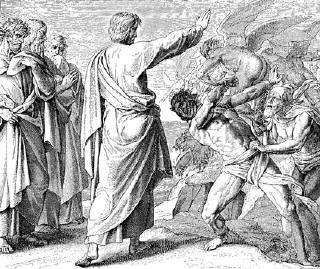
Bible Contradiction - Where Did Jesus Drive the Demons into Pigs?

I have been conversing with Jonathan Pearce over the past week who maintains that the Bible can't be reliable because it contains "numerous contradictions". Although he was reluctant at first to back up that conclusion and discuss those passages that he thinks conflict with one another, he did provide the following example.

I will humour you.

Mark 5:1-2
They came to the other side of the sea, into the country of the Gerasenes. 2 When He got out of the boat, immediately a man from the tombs with an unclean spirit met Him,

Matt 8:
When He came to the other side into the country of the Gadarenes, two men who were demon-possessed met Him as they were coming out of the tombs. They were so extremely violent that no one could pass by that way.
Luke 8:
Then they sailed to the country of the Gerasenes, which is opposite Galilee. 27 And when He came out onto the land, He was met by a man from the city who was possessed with demons;

Now the standard reply is that they are two towns in the same general region so there is no contradiction. However, this is silly. The contradiction is plain. All accounts use the time connective 'when' which implies in all cases immediacy. When this happened, this happened. Thus, no traveling can be done. Looking at any map, the use of Gerasa is nonsensical (at least 12 miles from Gadara - ie further from the lake) - it is inland and too far for the sense to be made. Here is the hilariously bad bad harmonisation from Barne's noted on the bible:

"Country of the Gergesenes - Mark Mar 5:1 says that he came into the country of the "Gadarenes." This difference is only apparent.

"Gadara" was a city not far from the Lake Gennesareth, one of the ten cities that were called "Decapolis." See the notes at Matthew 4:25. "Gergesa" was a city about 12 miles to the southeast of Gadara, and about 20 miles to the east of the Jordan. There is no contradiction, therefore, in the evangelists. He came into the region in which the two cities were situated, and one evangelist mentioned one, and the other another. It shows that the writers had not agreed to impose on the world; for if they had, they would have mentioned the same city; and it shows. also, they were familiar with the country. No men would have written in this manner but those who were acquainted with the facts. Impostors do not mention places or homes if they can avoid it."

So bad it's funny.

Then there is the problem that Matthew clearly states two demons, not one.

You will have an answer, no doubt. It's just that to think it is plausible takes some wild gerrymandering.

Yes, indeed there are answers that don't require punting to the conclusion that the Bible is contradicting itself. Pearce recognizes that the passages are referring to two cities: Gerasa and Gadara. What I don't get why he think Mark and Luke think Jesus went to one city and that Matthew says that he went to the other? The texts do not say that it. They say that he went to the region containing those cities. The miracle that happened did not occur in a city or town. Pigs weren't kept in towns, as far as I can tell. The pigs are also an important point because it shows that the area was primarily populated by Gentiles - which is what Archaeology and extra Biblical sources tells us. Had the people been Jews, they would have neither cared about loosing a heard of pigs nor owned pigs.

As for the number of men Jesus met and healed. Mark and Luke definitely says that there was one one guy while Matthew says there were two.  The thing is how is this a contradiction? A contradiction would be if Mark and Luke had said that there was only one man. They don't. Each of the Gospel contains details that are not in the others. But none of those details contradicts the details in the others. If I tell you that Jack and Jill went to the mall and bought a DVD, but I tell another person that Jill went to Walmart and bought a DVD, did I contradict myself? Nope. I just didn't give the same detail. A contradiction would be if the mall did not have a Walmart. You don't have such a thing in this case. We know that Jesus went to an area containing two cities, Gerasa and Gadara, and while he was there he cast demons out of two men that met Him as he came ashore and they knew who Jesus is. The demons drove some pigs mad and they drove themselves off a cliff into the Lake and drowned. No need to bring up phantom contradictions.  If Pearce or anyone disagrees, I'd love to know what is so bad or false about understanding the text this way.

Wednesday, July 11, 2012

This Made The Amazing Spider-Man Completely Unrealistic [Image]


Of course, no one uses Bing!

This Made The Amazing Spider-Man Completely Unrealistic [Image]

Scripture Reliability Lectures Referenced on the Dividing Line

Turretinfan has posted a quote from Dr James White reminding listeners to his webcast today regarding a conference from last year on  reliability of scripture. This is real important. It is about how we can be sure we can trust scripture.

This morning I listened, for the 2nd time, to a 3 1/2 hour seminar recorded in Scotland, I believe, in Edinburgh. The presenters (the audio file did a horrible job and explaining who was who) were Peter J. Williams, Dirk Jongkind, and Simon Gathercole. I just found a link, thankfully, here. I would highly recommend this series for everyone. The presentations are lively, well done, and very understandable. I have benefited from them greatly. In particular, Peter J. Williams' presentation was very useful.Here is a video of a similar presentation Dr. Williams gave. I likewise truly enjoyed Dirk Jongkind's dismantling of a particularly troubling section of Ehrman's work. I would love to hear Bart's response in a one-on-one discussion.

Here is the video from Dr Peter J Williams that is referenced above.


Lecture with Dr. Peter Williams from Lanier Theological Library on Vimeo.


Scripture Reliability Lectures Referenced on the Dividing Line