Saturday, July 18, 2009

Responding To Attempted Rebuttal to Hugh Ross (Part 2)

I have been in...um...."discussion" with Andrew (aka Askegg) concerning evidence for the existence of God and the evidence of the Bible being true. Sure tempers have flare and disputes come in but I think it's useful because if your worldview can't stand up to scrutiny then you need another scrutiny. In one of my salvos I fired off a link to a lecture from Dr. Hugh Ross concerning how astrophysics points to the God of the Bible. As always my comments are in red. My original link can be found here.

Refuting Dr. Hugh Ross (part 2)

// July 17th, 2009 // 0 comments // Blog

I posted the other day about Dr. Hugh Ross’s lecture titles “Astrophysics Points to the God of the Bible” and promised I would refute his three rebuttals to his argument.

First, I must point out that Dr. Ross makes the following claim in his lecture:

“None of the rebuttals are scientific in nature. When you see your sceptical audience abandon a scientific refutation with a philosophical refutation, that means you’ve really won the debate.”

It seems to allude Dr. Ross that his entire argument has been philosophical in nature. Sure, during the lecture he has presented a great deal of hard proved scientific fact (which no one disputes), but to conjure a knob twiddling God to explain the cosmological constants is a philosophical point. In scientific terms it’s an hypothesis for which he has no data to support. In layman’s terms, it’s bullshit.

You have yet to come up with a better explanation for why those cosmological constants are set the way they are? Why? If you don't like attributing it to God then you need to propose a different theotu explaining this.

Reality is just the way it is. Science is our way of trying to understand it, and mathematical models are just that – models. They do not dictate how the universe works, they describe how it works. That’s why rational people leave these “laws” open to change, for it’s entirely possible that our current models of the universe are totally wrong. Since the “laws” of the universe just describe reality, then where does the impetuous for an author of these laws come from? If anything, we authored them.

I think that you are confusing "law" with "theory" A scientific law is based on models that not just describe realiity but predict reality! Things like the Gravitational Law and the Laws of Motion and Thermodynamics are really things I'd like to see you prove need changing. Now if you are referring to the Theory of Evolution, I agree with you. The theory will change when people wise up.

Dr. Ross would have you believe that God (more specifically the God of the Bible) authored these physical laws and set the cosmological constants to their current values. Again, in this lecture he simply asserts this without granted us the reasoning behind why all the other contender Gods are discounted.

No other religion, with the exceptions of Islam and Judaism say that the universe was created ex nihilo. They discount themselves.

Of course, this line of reasoning simply begs the question. If you are going to explain the attributes of the universe are due to a divine being, then why does this divine being have the attributes and qualities it does? Why does it have these values and not others? Why does God care about us, rather than not? Why is God all knowing? Why is he omnipotent? Why does God have a personal interest in the lives of his favourite animals (who were created in his image) and not the others? Why is God so vain that he requires constant worship?

When you look a the attributes of the universe, the creator must be omnipotent and omniscient in order to make it all work! And God care about all of his creation. Christians do not believe that God cares only about humans and not the other parts of creation. God demands worship not because of vanity but because He deserves it. No less. If you wrote a song or invented a car would you not deserve credit? God is responsible for our very existence, why would you not worship Him. To do otherwise is stupid.

Dr. Ross goes on to say:

“Stephen Hawking does not realise when he has abandoned science and become a philosopher.”

Really Hugh? Really? On what exactly are you basing that statement? It seems to me that whenever someone states a position equally probable but counter to your own you simply label it’s “philosophy not science” and claim victory. I see this as the height of hypocrisy since the final point of your argument toward God is philosophical. Perhaps Dr. Ross doesn’t actually know that philosophy is the highest form of mathematics?

You haven't suggested an position equally tenable. You failed to do so. I only agree with you on one thing. The best Ross can argue is that there is a God who created everything. To get the God of the Bible you need revelation to know more of His character - what He is about. This what the Bible says:

1Now faith is being sure of what we hope for and certain of what we do not see. 2This is what the ancients were commended for. 3By faith we understand that the universe was formed at God's command, so that what is seen was not made out of what was visible.- Hebrews 11:1-3

Atheism is Dead: Atheists: “No God, No Reason, Just Whining”


Mariano has posted a great letter to the "New Atheists" on his blog. I enjoyed reading it.


Atheism is Dead: Atheists: “No God, No Reason, Just Whining”

President Obama's NAACP 2009 Speech


Transcript:

President Obama's NAACP speech, New York, July 16, 2009.

Transcript of speech as delivered.

Text of remarks as prepared.

*********
Text of Sen. Barack Obama NAACP speech, Cincinnati, July 14, 2008


THE WHITE HOUSE
Office of the Press Secretary
__________________________________________________________________________________________________________________
For Immediate Release
July 17, 2009

REMARKS BY THE PRESIDENT
TO THE NAACP CENTENNIAL CONVENTION

Hilton New York
New York, New York

7:00 P.M. EDT

THE PRESIDENT: Thank you. What an extraordinary night, capping off an extraordinary week, capping off an extraordinary 100 years at the NAACP. (Applause.)

So Chairman Bond, Brother Justice, I am so grateful to all of you for being here. It's just good to be among friends. (Applause.)

It is an extraordinary honor to be here, in the city where the NAACP was formed, to mark its centennial. What we celebrate tonight is not simply the journey the NAACP has traveled, but the journey that we, as Americans, have traveled over the past 100 years. (Applause.)

It's a journey that takes us back to a time before most of us were born, long before the Voting Rights Act, and the Civil Rights Act, Brown v. Board of Education; back to an America just a generation past slavery. It was a time when Jim Crow was a way of life; when lynchings were all too common; when race riots were shaking cities across a segregated land.

It was in this America where an Atlanta scholar named W.E.B. Du Bois -- (applause) -- a man of towering intellect and a fierce passion for justice, sparked what became known as the Niagara movement; where reformers united, not by color, but by cause; where an association was born that would, as its charter says, promote equality and eradicate prejudice among citizens of the United States.

From the beginning, these founders understood how change would come -- just as King and all the civil rights giants did later. They understood that unjust laws needed to be overturned; that legislation needed to be passed; and that Presidents needed to be pressured into action. They knew that the stain of slavery and the sin of segregation had to be lifted in the courtroom, and in the legislature, and in the hearts and the minds of Americans.

They also knew that here, in America, change would have to come from the people. It would come from people protesting lynchings, rallying against violence, all those women who decided to walk instead of taking the bus, even though they were tired after a long day of doing somebody else's laundry, looking after somebody else's children. (Applause.) It would come from men and women of every age and faith, and every race and region -- taking Greyhounds on Freedom Rides; sitting down at Greensboro lunch counters; registering voters in rural Mississippi, knowing they would be harassed, knowing they would be beaten, knowing that some of them might never return.

Because of what they did, we are a more perfect union. Because Jim Crow laws were overturned, black CEOs today run Fortune 500 companies. (Applause.) Because civil rights laws were passed, black mayors, black governors, and members of Congress served in places where they might once have been able [sic] not just to vote but even take a sip of water. And because ordinary people did such extraordinary things, because they made the civil rights movement their own, even though there may not be a plaque or their names might not be in the history books -- because of their efforts I made a little trip to Springfield, Illinois, a couple years ago -- (applause) -- where Lincoln once lived, and race riots once raged -- and began the journey that has led me to be here tonight as the 44th President of the United States of America. (Applause.)

Because of them I stand here tonight, on the shoulders of giants. And I'm here to say thank you to those pioneers and thank you to the NAACP. (Applause.)

And yet, even as we celebrate the remarkable achievements of the past 100 years; even as we inherit extraordinary progress that cannot be denied; even as we marvel at the courage and determination of so many plain folk -- we know that too many barriers still remain.

We know that even as our economic crisis batters Americans of all races, African Americans are out of work more than just about anybody else -- a gap that's widening here in New York City, as a detailed report this week by Comptroller Bill Thompson laid out. (Applause.)

We know that even as spiraling health care costs crush families of all races, African Americans are more likely to suffer from a host of diseases but less likely to own health insurance than just about anybody else.

We know that even as we imprison more people of all races than any nation in the world, an African American child is roughly five times as likely as a white child to see the inside of a prison.

We know that even as the scourge of HIV/AIDS devastates nations abroad, particularly in Africa, it is devastating the African American community here at home with disproportionate force. We know these things. (Applause.)

These are some of the barriers of our time. They're very different from the barriers faced by earlier generations. They're very different from the ones faced when fire hoses and dogs were being turned on young marchers; when Charles Hamilton Houston and a group of young Howard lawyers were dismantling segregation case by case across the land.

But what's required today -- what's required to overcome today's barriers is the same as what was needed then. The same commitment. The same sense of urgency. The same sense of sacrifice. The same sense of community. The same willingness to do our part for ourselves and one another that has always defined America at its best and the African American experience at its best. (Applause.)

And so the question is, where do we direct our efforts? What steps do we take to overcome these barriers? How do we move forward in the next 100 years?

The first thing we need to do is make real the words of the NAACP charter and eradicate prejudice, bigotry, and discrimination among citizens of the United States. (Applause.) I understand there may be a temptation among some to think that discrimination is no longer a problem in 2009. And I believe that overall, there probably has never been less discrimination in America than there is today. I think we can say that.

But make no mistake: The pain of discrimination is still felt in America. (Applause.) By African American women paid less for doing the same work as colleagues of a different color and a different gender. (Laughter.) By Latinos made to feel unwelcome in their own country. (Applause.) By Muslim Americans viewed with suspicion simply because they kneel down to pray to their God. (Applause.) By our gay brothers and sisters, still taunted, still attacked, still denied their rights. (Applause.)

On the 45th anniversary of the Civil Rights Act, discrimination cannot stand -- not on account of color or gender; how you worship or who you love. Prejudice has no place in the United States of America. That's what the NAACP stands for. That's what the NAACP will continue to fight for as long as it takes. (Applause.)

But we also know that prejudice and discrimination -- at least the most blatant types of prejudice and discrimination -- are not even the steepest barriers to opportunity today. The most difficult barriers include structural inequalities that our nation's legacy of discrimination has left behind; inequalities still plaguing too many communities and too often the object of national neglect.

These are barriers we are beginning to tear down one by one -- by rewarding work with an expanded tax credit; by making housing more affordable; by giving ex-offenders a second chance. (Applause.) These are barriers we're targeting through our White House Office on Urban Affairs, through programs like Promise Neighborhoods that builds on Geoffrey Canada's success with the Harlem Children's Zone -- (applause) -- that foster a comprehensive approach to ending poverty by putting all children on a pathway to college, and giving them the schooling and after-school support that they need to get there. (Applause.)

I think all of us understand that our task of reducing these structural inequalities has been made more difficult by the state and structure of our broader economy; an economy that for the last decade has been fueled by a cycle of boom and bust; an economy where the rich got really, really rich, but ordinary folks didn't see their incomes or their wages go up; an economy built on credit cards, shady mortgage loans; an economy built not on a rock, but on sand.

That's why my administration is working so hard not only to create and save jobs in the short-term, not only to extend unemployment insurance and help for people who have lost their health care in this crisis, not just to stem the immediate economic wreckage, but to lay a new foundation for growth and prosperity that will put opportunity within the reach of not just African Americans, but all Americans. All Americans. (Applause.) Of every race. Of every creed. From every region of the country. (Applause.) We want everybody to participate in the American Dream. That's what the NAACP is all about. (Applause.)

Now, one pillar of this new foundation is health insurance for everybody. (Applause.) Health insurance reform that cuts costs and makes quality health coverage affordable for all, and it closes health care disparities in the process. Another pillar is energy reform that makes clean energy profitable, freeing America from the grip of foreign oil; putting young people to work upgrading low-income homes, weatherizing, and creating jobs that can't be outsourced. Another pillar is financial reform with consumer protections to crackdown on mortgage fraud and stop predatory lenders from targeting black and Latino communities all across the country. (Applause.)

All these things will make America stronger and more competitive. They will drive innovation, they will create jobs, they will provide families with more security. And yet, even if we do all that, the African American community will still fall behind in the United States and the United States will fall behind in the world unless we do a far better job than we have been doing of educating our sons and daughters. (Applause.)

I hope you don't mind -- I want to go into a little detail here about education. (Applause.) In the 21st century -- when so many jobs will require a bachelor's degree or more, when countries that out-educate us today will out-compete us tomorrow -- a world-class education is a prerequisite for success.

There's no two ways about it. There's no way to avoid it. You know what I'm talking about. There's a reason the story of the civil rights movement was written in our schools. There's a reason Thurgood Marshall took up the cause of Linda Brown. There's a reason why the Little Rock Nine defied a governor and a mob. It's because there is no stronger weapon against inequality and no better path to opportunity than an education that can unlock a child's God-given potential. (Applause.)

And yet, more than half a century after Brown v. Board, the dream of a world-class education is still being deferred all across the country. African American students are lagging behind white classmates in reading and math -- an achievement gap that is growing in states that once led the way in the civil rights movement. Over half of all African American students are dropping out of school in some places. There are overcrowded classrooms, and crumbling schools, and corridors of shame in America filled with poor children -- not just black children, brown and white children as well.

The state of our schools is not an African American problem; it is an American problem. (Applause.) Because if black and brown children cannot compete, then America cannot compete. (Applause.) And let me say this, if Al Sharpton, Mike Bloomberg, and Newt Gingrich can agree that we need to solve the education problem, then that's something all of America can agree we can solve. (Applause.) Those guys came into my office. (Laughter.) Just sitting in the Oval Office -- I kept on doing a double-take. (Laughter and applause.) So that's a sign of progress and it is a sign of the urgency of the education problem. (Applause.) All of us can agree that we need to offer every child in this country -- every child --

AUDIENCE: Amen!

THE PRESIDENT: Got an "Amen corner" back there -- (applause) -- every child -- every child in this country the best education the world has to offer from cradle through a career.

That's our responsibility as leaders. That's the responsibility of the United States of America. And we, all of us in government, have to work to do our part by not only offering more resources, but also demanding more reform. Because when it comes to education, we got to get past this whole paradigm, this outdated notion that somehow it's just money; or somehow it's just reform, but no money -- and embrace what Dr. King called the "both-and" philosophy. We need more money and we need more reform. (Applause.)

When it comes to higher education we're making college and advanced training more affordable, and strengthening community colleges that are the gateway to so many with an initiative -- (applause) -- that will prepare students not only to earn a degree, but to find a job when they graduate; an initiative that will help us meet the goal I have set of leading the world in college degrees by 2020. We used to rank number one in college graduates. Now we are in the middle of the pack. And since we are seeing more and more African American and Latino youth in our population, if we are leaving them behind we cannot achieve our goal, and America will fall further behind -- and that is not a future that I accept and that is not a future that the NAACP is willing to accept. (Applause.)

We're creating a Race to the Top fund that will reward states and public school districts that adopt 21st century standards and assessments. We're creating incentives for states to promote excellent teachers and replace bad ones -- (applause) -- because the job of a teacher is too important for us to accept anything less than the best. (Applause.)

We also have to explore innovative approaches such as those being pursued here in New York City; innovations like Bard High School Early College and Medgar Evers College Preparatory School that are challenging students to complete high school and earn a free associate's degree or college credit in just four years. (Applause.)

And we should raise the bar when it comes to early learning programs. It's not enough just to have a babysitter. We need our young people stimulated and engaged and involved. (Applause.) We need our -- our folks involved in child development to understand the latest science. Today, some early learning programs are excellent. Some are mediocre. And some are wasting what studies show are by far a child's most formative years.

That's why I've issued a challenge to America's governors: If you match the success of states like Pennsylvania and develop an effective model for early learning; if you focus reform on standards and results in early learning programs; if you demonstrate how you will prepare the lowest income children to meet the highest standards of success -- then you can compete for an Early Learning Challenge Grant that will help prepare all our children to enter kindergarten all ready to learn. (Applause.)

So these are some of the laws we're passing. These are some of the policies we are enacting. We are busy in Washington. Folks in Congress are getting a little tuckered out. (Laughter.) But I'm telling them -- I'm telling them we can't rest, we've got a lot of work to do. The American people are counting on us. (Applause.) These are some of the ways we're doing our part in government to overcome the inequities, the injustices, the barriers that still exist in our country.

But all these innovative programs and expanded opportunities will not, in and of themselves, make a difference if each of us, as parents and as community leaders, fail to do our part by encouraging excellence in our children. (Applause.) Government programs alone won't get our children to the Promised Land. We need a new mind set, a new set of attitudes -- because one of the most durable and destructive legacies of discrimination is the way we've internalized a sense of limitation; how so many in our community have come to expect so little from the world and from themselves.

We've got to say to our children, yes, if you're African American, the odds of growing up amid crime and gangs are higher. Yes, if you live in a poor neighborhood, you will face challenges that somebody in a wealthy suburb does not have to face. But that's not a reason to get bad grades -- (applause) -- that's not a reason to cut class -- (applause) -- that's not a reason to give up on your education and drop out of school. (Applause.) No one has written your destiny for you. Your destiny is in your hands -- you cannot forget that. That's what we have to teach all of our children. No excuses. (Applause.) No excuses.

You get that education, all those hardships will just make you stronger, better able to compete. Yes we can. (Applause.)

To parents -- to parents, we can't tell our kids to do well in school and then fail to support them when they get home. (Applause.) You can't just contract out parenting. For our kids to excel, we have to accept our responsibility to help them learn. That means putting away the Xbox -- (applause) -- putting our kids to bed at a reasonable hour. (Applause.) It means attending those parent-teacher conferences and reading to our children and helping them with their homework. (Applause.)

And by the way, it means we need to be there for our neighbor's sons and daughters. (Applause.) We need to go back to the time, back to the day when we parents saw somebody, saw some kid fooling around and -- it wasn't your child, but they'll whup you anyway. (Laughter and applause.) Or at least they'll tell your parents -- the parents will. You know. (Laughter.) That's the meaning of community. That's how we can reclaim the strength and the determination and the hopefulness that helped us come so far; helped us make a way out of no way.

It also means pushing our children to set their sights a little bit higher. They might think they've got a pretty good jump shot or a pretty good flow, but our kids can't all aspire to be LeBron or Lil Wayne. (Applause.) I want them aspiring to be scientists and engineers -- (applause) -- doctors and teachers -- (applause) -- not just ballers and rappers. I want them aspiring to be a Supreme Court Justice. (Applause.) I want them aspiring to be the President of the United States of America. (Applause.)

I want their horizons to be limitless. I don't -- don't tell them they can't do something. Don't feed our children with a sense of -- that somehow because of their race that they cannot achieve.

Yes, government must be a force for opportunity. Yes, government must be a force for equality. But ultimately, if we are to be true to our past, then we also have to seize our own future, each and every day.

And that's what the NAACP is all about. The NAACP was not founded in search of a handout. The NAACP was not founded in search of favors. The NAACP was founded on a firm notion of justice; to cash the promissory note of America that says all of our children, all God's children, deserve a fair chance in the race of life. (Applause.)

It's a simple dream, and yet one that all too often has been denied -- and is still being denied to so many Americans. It's a painful thing, seeing that dream denied. I remember visiting a Chicago school in a rough neighborhood when I was a community organizer, and some of the children gathered 'round me. And I remember thinking how remarkable it was that all of these children seemed so full of hope, despite being born into poverty, despite being delivered, in some cases, into addiction, despite all the obstacles they were already facing -- you could see that spark in their eyes. They were the equal of children anywhere.

And I remember the principal of the school telling me that soon that sparkle would begin to dim, that things would begin to change; that soon, the laughter in their eyes would begin to fade; that soon, something would shut off inside, as it sunk in -- because kids are smarter than we give them credit for -- as it sunk in that their hopes would not come to pass -- not because they weren't smart enough, not because they weren't talented enough, not because of anything about them inherently, but because, by accident of birth, they had not received a fair chance in life.

I know what can happen to a child who doesn't have that chance. But I also know what can happen to a child that does. I was raised by a single mom. I didn't come from a lot of wealth. I got into my share of trouble as a child. My life could have easily taken a turn for the worse. When I drive through Harlem or I drive through the South Side of Chicago and I see young men on the corners, I say, there but for the grace of God go I. (Applause.) They're no less gifted than me. They're no less talented than me.

But I had some brakes. That mother of mine, she gave me love; she pushed me, she cared about my education; she took no lip; she taught me right from wrong. Because of her, I had a chance to make the most of my abilities. I had the chance to make the most of my opportunities. I had the chance to make the most of life.

The same story holds true for Michelle. The same story holds true for so many of you. And I want all the other Barack Obamas out there, and all the other Michelle Obamas out there -- (applause) -- to have the same chance -- the chance that my mother gave me; that my education gave me; that the United States of America has given me. That's how our union will be perfected and our economy rebuilt. That is how America will move forward in the next 100 years.

And we will move forward. This I know -- for I know how far we have come. Some, you saw, last week in Ghana, Michelle and I took Malia and Sasha and my mother-in-law to Cape Coast Castle, in Ghana. Some of you may have been there. This is where captives were once imprisoned before being auctioned; where, across an ocean, so much of the African American experience began.

We went down into the dungeons where the captives were held. There was a church above one of the dungeons -- which tells you something about saying one thing and doing another. (Applause.) I was -- we walked through the "Door Of No Return." I was reminded of all the pain and all the hardships, all the injustices and all the indignities on the voyage from slavery to freedom.

But I was reminded of something else. I was reminded that no matter how bitter the rod, how stony the road, we have always persevered. (Applause.) We have not faltered, nor have we grown weary. As Americans, we have demanded, and strived for, and shaped a better destiny. And that is what we are called on to do once more. NAACP, it will not be easy. It will take time. Doubts may rise and hopes may recede.

But if John Lewis could brave Billy clubs to cross a bridge -- (applause) -- then I know young people today can do their part and lift up our community. (Applause.)

If Emmet Till's uncle, Mose Wright, could summon the courage to testify against the men who killed his nephew, I know we can be better fathers and better brothers and better mothers and sisters in our own families. (Applause.)

If three civil rights workers in Mississippi -- black, white, Christian and Jew, city-born and country-bred -- could lay down their lives in freedom's cause, I know we can come together to face down the challenges of our own time. (Applause.) We can fix our schools -- (applause) -- we can heal our sick, we can rescue our youth from violence and despair. (Applause.)

And 100 years from now, on the 200th anniversary of the NAACP -- (applause) -- let it be said that this generation did its part; that we too ran the race; that full of faith that our dark past has taught us, full of the hope that the present has brought us -- (applause) -- we faced, in our lives and all across this nation, the rising sun of a new day begun. (Applause.)

Thank you, God bless you. God bless the United States of America. (Applause.)

END 7:37 P.M. EDT
---

Why You Should Be A Christian. Response to Richard Carrier Pt 6/6


A well-written essay is on the internet called, "Why I am Not Christian" by Richard Carrier (on the left). It's long, respectful, and well written. It compels a response. His criticisms of Christians are well founded but his charges against God are mistaken and unfounded. The essay was written in 2006 and is divided into six parts. I'm going to interact with his responses and divide my essay also into six parts. His words will be in black and mine will be red. His Top four reasons for rejecting Christianity are:
1. God is Silent.
2. God is inert.

3. Inadequate evidence for God.

4. Christianity predicts a different universe.

Here is the conclusion.


Christianity entails that God, like any other person, would say and do at least some things we would all see. Since we haven't seen such things, the Christian theory is falsified by the evidence. Christianity also entails that God would have made the universe differently than we observe it to be. So it is falsified again by the evidence. A failed prediction means a failed theory, especially when these failures apply to the very design of the universe itself. At the same time, there is insufficient evidence for any of the essential propositions of Christianity. So the Christian hypothesis contradicts a lot of evidence, makes numerous failed predictions, is not the best explanation of the universe we find ourselves in, and fails to find sufficient evidence in its own support. Therefore, I believe Christianity is false.

God does thing s that we can all see all the time. The fact that you continue to breathe, let-alone exist, is at the whim of God. I disagree that Christianity is falsified just because people like Richard Carrier do not see the evidence that they think they should. I have addressed Carriers accusations of failed predictions and contradicted evidence and shown them for what they are: his own delusion. It's not the Bible who is wanting it's Richard Carrier's logic and people like him.

Friday, July 17, 2009

Responding To Attempted Rebuttal to Hugh Ross


I have been in...um...."discussion" with Andrew (aka Askegg) concerning evidence for the existence of God and the evidence of the Bible being true. Sure tempers have flare and disputes come in but I think it's useful because if your worldview can't stand up to scrutiny then you need another scrutiny. In one of my salvos I fired off a link to a lecture from Dr. Hugh Ross concerning how astrophysics points to the God of the Bible. As always my comments are in red. My original link can be found here.

I have been listening to a lecture given by a Dr. Hugh Ross, who (according to the profile on his web site).

“… became convinced that the Bible is truly the Word of God!”

For those who can stand it, here is a direct link to the MP3 recording.

The lecture itself is filled to the brim with amazing scientific facts, interesting insights, and flawed thinking. Much of the sermon (yes, I am comfortable calling it that) points to the intricate details of the universe and how if any one of the cosmological constants were different, then life would not be possible. Somehow (for reasons he does not go into in any depth) this eliminates all other contender Gods, leaving Yahweh standing true. I cannot comment on the reasoning of this, because none is presented. Neither does Dr. Ross offer the obvious alternative that none of the God stories are true. God’s are myths and fantasy.

Andrew, I take this as a jab against the Bible. Why? Ross really didn't bring up any story in the Bible that you reject aside from Genesis chapter 1. Ross' point is that the universe is too complex and intricate to be developed by itself over billions of years. So are arguing with the fine-tuning or that it makes sense that all of it came out of no where on it's own with everything lining up that we just happen to be the logical resort?

Of course, this is an argument from design. Essentially, Dr. Ross is arguing that the universe we see is so complex and fine-tuned that it simply must have been designed for human life. It seems it has not occurred to him that life on Earth has evolved to fit the conditions here, or that there is no possible way that life may have evolved differently – without human life at all. Indeed, it seems for much of the universes 14.7 billion year lifespan it has done fine without us.

How do you know that life on earth evolved? You assert this without any proof what so ever. We have nothing to do with keeping the universe together now. Ross was in no way arguing that the Universe needs us.

Positing a God to solve the apparent problem of design does not actually solve the issue. If God is at all complex, then (by exactly the same argument) he must have been created as well. This obviously leads to an infinite regress which solves nothing. Theists just wave their hands and say “Well, obviously God was always here” as if that actually proves something.

I was hoping for better from you! Who says God has to have a creator? The universe - space and time - all have a beginning, which all scientists today agree (name one who does not) . We have no evidence that God had a beginning. God is infinite. Deal with it.

Interestingly, the only logical escape from this argument (as far as I have been able to determine) is that God is the least complex thing imaginable. I would assert that something which does not exist is absolutely without any attributes which require explanation; therefore God does not exist.

You are making assumptions for which you have no evidence.

How can it be that the same argument which proves God also disproves him? Oh yes – the concept of God is bullshit.

'Cause they ain't the same argument. And watch your language.

Those well versed in debating theology will recognise Dr. Ross’s second error – he is referring to life as we know it. That says nothing about the potential infinite number of ways in which other forms of life may have evolved, or the bio-chemical systems on which it may depend. Indeed, even within the framework of the chemistryr for the known universe some have theorised silicon based life systems (to name only one).

In order for this argument to work, you would have prove such life exist.

Near the end of this torturous lecture Dr. Ross addresses a number of common rebuttals to the argument he put forward. Unsurprisingly he manages to completely misunderstand them and offers horrible analogous straw men to burn before his devoted audience. In order to do them justice (and to limit the size of my blog posts after the last round of lengthy and boring tirades) I will be addressing each of these in separate and subsequent posts.

I'd like to see just how much justice you do, Andrew, because so far not very impressive. I was expecting new arguments and I am disappointed. I'll look at the next posts to see if it improves.

Biblical Evidence: Part 3 - Science


The Bible is not a science book, but it does contain truths that have been confirmed by the Bible. Here is a list of scientific facts gleaned from the Bible. source

The Bible and Science
Scientific Principle Biblical Reference
Cosmology/Astronomy
Time had a beginning 2 Timothy 1:9, Titus 1:2, 1 Corinthians 2:72
The universe had a beginning Genesis 1:1, 2:4, Isaiah 42:5, etc.3
The universe was created from the invisible Hebrews 11:34
The dimensions of the universe were created Romans 8:38-395
The universe is expanding Job 9:8, Psalm 104:2, Isaiah 40:22, Isaiah 42:5, Isaiah 44:24, Isaiah 45:12, Isaiah 48:13, Isaiah 51:13, Jeremiah 10:12, Jeremiah 51:15, Zechariah 12:16
Creation of matter and energy has ended in the universe (refutes steady-state theory) Genesis 2:3-47
The universe is winding down and will "wear out" (second law of thermodynamics ensures that the universe will run down due to "heat death"-maximum entropy) Psalm 102:25-278
Describes the correct order of creation Genesis 1 (see Day-Age Genesis One Interpretation)
Number of stars exceeds a billion Genesis 22:17, Jeremiah 33:229
Every star is different 1 Corinthians 15:4110
Pleiades and Orion as gravitationally bound star groups Job 38:3111
Light is in motion Job 38:19-2012
The earth is controlled by the heavens Job 38:331
Earth is a sphere Isaiah 40:2213 Job 26:1014
At any time, there is day and night on the Earth Luke 17:34-3515
Earth is suspended in space Job 26:716
Earth Sciences
Earth began as a waterworld. Formation of continents by tectonic activity described Genesis 1:2-9, Psalm 104:6-9, Proverbs 3:19, Proverbs 8:27-29, Job 38:4-8, 2 Peter 3:517
Water cycle described Ecclesiastes 1:7; Isaiah 55:10, Job 36:27-2818
Valleys exist on the bottom of the sea 2 Samuel 22:1619
Vents exist on the bottom of the sea Job 38:1620
Ocean currents in the sea Psalm 8:821
Air has weight Job 28:2522
Winds blow in circular paths Ecclesiastes 1:623
Biology
The chemical nature of human life Genesis 2:7, 3:1924
Life of creatures are in the blood Leviticus 17:1125
The nature of infectious diseases Leviticus 13:4626

Importance of sanitation to health

Numbers 19, Deuteronomy 23:12-13, Leviticus 7-927

Sometimes people accuse the Bible of getting scientific facts incorrect. These are errors on the accuser's part. Here is a great article illustrating that.

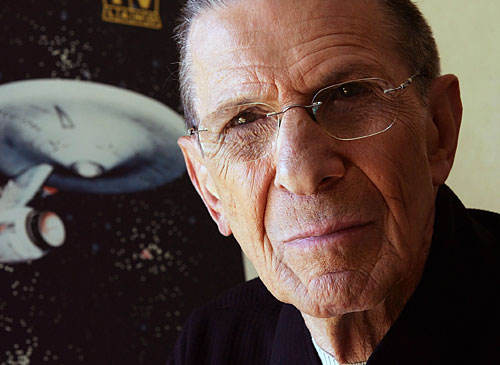
What Hollywood Believes - Leonard Nimoy


When Nimoy was asked if he was a religious man he answered:

"No, not particularly. I certainly don't live in s kosher home although I was raised in a kosher environment. My wife and I are affiliated with a temple...but I consider myself more spiritual than religious."


I've heard that he was raised Jewish and the Vulcan salute came from Judaism. The interview points to Nimoy's hobby is photographing "the divine feminine." This is envisioning femaleness as divine. This belief is mirrored in the Da Vinci Code. I'm a fan of Star Trek and I am disappointed that He is not a follower of Jesus. Worshipping the female body is idolotry pure and simple.

Thursday, July 16, 2009

Biblical Evidence: Part 2 - History


The God of the Bible is unique among how many other religions look at their god. The thing is that the God of the Bible shows Himself real and active in Human History. The Bible records real historical events that can be substantiated outside of the Bible. Furthermore we can also see the Bible makes several predictions and seeing those things come true in History. Prophecies fulfilled in History will be the focus of this post. There are three examples I will cover but there are many others.

1. The Destruction of Tyre

"Norman Geisler explains Ezekiel's prediction that the city of Tyre "would be destroyed and its ruins cast into the sea (26:2). This provoked scoffing because, when Nebuchadnezzar destroyed Tyre, he left the ruins right where they fell--on the land. But 200 years later, Alexander the Great attacked Tyre and the inhabitants withdrew to an island just off the coast for safety. In order to reach them, Alexander threw all of the debris, stones, timbers, dust, and everything else, into the sea to build a causeway that would reach the island." [6] If events so far in the future can be accurately predicted, certainly the events of the past have been accurately recorded!" source


Ezekiel 26 describes the destruction of Tyre by Nebuchadnezzar and by Alexander the great. Ezekiel ministered in the 6th century BCE and The final destruction of Tyre came 2 Centuries later. Here is a great article.

2. Prediction of the major World Empires

Daniel chapter 2 recounts the story of a dream that Nebuchadnezzar of Babylon had that he wanted to be so sure of the interpretation that he demanded that the interpreter of the dream also tell him what the dream was. Daniel does just that. In chapter 2, verses 24-49, Daniel says that God is saying that three major empires will follow the Babylonians and describes them. Their names are not given, but because of the details given and the fact that 3 major empires did rise in succession we know them as the Persians, Greeks, and Romans. How do we know that this was not written after the fact. Well, this part of Daniel was written before the Persians-Medes conquered Babylon (mentioned in Daniel 5). I'm, sure some skeptics may wonder if Daniel really existed, but I'll table that for another post. The important thing now is the point that we have a biblical prediction that actually takes place in real time concerning events that the human author could not know about.

2. Alexander the Great.
The book of Daniel is an apocalyptic Book. It makes prophecies that have yet to be fulfilled, but some of them have take place. Consider Daniel 8:1-8, The Goat with big horn being split into four smaller horns represents Alexander the Great. When he died his empire was split among his 4 generals. Again this was a couple centuries before the man was even born. Recall at this time, Greece was a backwater. No one really thought that it would ever be a world player.

3. Cyrus - The great.
Cyrus King of Persia was prophesied to return the Jews from exile about 2 hundred years before the fall of Jerualem in 586 BCE and about 3 hundred years before Cyrus was even in power.

27 who says to the watery deep, 'Be dry,
and I will dry up your streams,'

28 who says of Cyrus, 'He is my shepherd
and will accomplish all that I please;
he will say of Jerusalem, "Let it be rebuilt,"
and of the temple, "Let its foundations be laid." ' - Isaiah 44:27,28

and look at

1 "This is what the LORD says to his anointed,
to Cyrus, whose right hand I take hold of
to subdue nations before him
and to strip kings of their armor,
to open doors before him
so that gates will not be shut:

2 I will go before you
and will level the mountains [a] ;
I will break down gates of bronze
and cut through bars of iron.

3 I will give you the treasures of darkness,
riches stored in secret places,
so that you may know that I am the LORD,
the God of Israel, who summons you by name.

4 For the sake of Jacob my servant,
of Israel my chosen,
I summon you by name
and bestow on you a title of honor,
though you do not acknowledge me. - Isaiah 45:1-4


And the Prophecy of the returning exiles

13 I will raise up Cyrus [b] in my righteousness:
I will make all his ways straight.
He will rebuild my city
and set my exiles free,
but not for a price or reward,
says the LORD Almighty." - Isaiah 45:13


Do we have any secular evidence that this happened? Yes. The Cyrus Cylinder not only confirms Cyrus' existence but it also confirms what the Bible says that he did.

The Decree of Return for the Jews, 539 BCE
CYRUS THE GREAT

There are more examples than just these four, but I want to focus now on providing extra Biblical information substanciating Jesus.

Extra-Biblical Historical Evidence for the LIFE, DEATH, and RESURRECTION of JESUS

My friend Mariano left the following link and comment on one of my earlier blog post.

In the first 3 centuries there are at least 236 known references to Jesus.
But I know that the skeptic will complain that there are not 237.
Historical Jesus.

Why You Should Be A Christian. Response to Richard Carrier Pt 5/6


A well-written essay is on the internet called, "Why I am Not Christian" by Richard Carrier (on the left). It's long, respectful, and well written. It compels a response. His criticisms of Christians are well founded but his charges against God are mistaken and unfounded. The essay was written in 2006 and is divided into six parts. I'm going to interact with his responses and divide my essay also into six parts. His words will be in black and mine will be red. His Top four reasons for rejecting Christianity are:
1. God is Silent.
2. God is inert.

3. Inadequate evidence for God.

4. Christianity predicts a different universe.

Here is my refutation of point 4.


4. Christianity Predicts a Different Universe

I mentioned before that the Christian hypothesis actually predicts a completely different universe than the one we find ourselves in. For a loving God who wanted to create a universe solely to provide a home for human beings, and to bring his plan of salvation to fruition, would never have invented this universe, but something quite different. But if there is no God, then the universe we actually observe is exactly the sort of universe we would expect to observe. In other words, if there is no God then this universe is the only kind of universe we would ever find ourselves in, the only kind that could ever produce intelligent life without any supernatural cause or plan. Hence naturalist atheism predicts exactly the kind of universe we observe, while the Christian theory predicts almost none of the features of our universe. Indeed, the Christian theory predicts the universe should instead have features that in fact it doesn't, and should lack features that in fact it has. Therefore, naturalism is a better explanation than Christianity of the universe we actually find ourselves in. Since naturalism (rejecting the supernatural) is the most plausible form of atheism I know, this is what I shall mean by "atheism" from here on out.[8] Let's look at a few examples of what I mean.

This is not a a good argument it is based on the following sentence:

"For a loving God who wanted to create a universe solely to provide a home for human beings, and to bring his plan of salvation to fruition, would never have invented this universe, but something quite different. "

But this is not what the Bible says.

15He is the image of the invisible God, the firstborn over all creation. 16For by him all things were created: things in heaven and on earth, visible and invisible, whether thrones or powers or rulers or authorities; all things were created by him and for him. 17He is before all things, and in him all things hold together. - Colossians 1:15-17

Origin and Evolution of Life

First, the origin of life. Suppose there is no God. If that is the case, then the origin of life must be a random accident. Christians rightly point out that the appearance of the first living organism is an extremely improbable accident. Of course, so is winning a lottery, and yet lotteries are routinely won. Why? Because the laws of probability entail the odds of winning a lottery depend not just on how unlikely a win is--let's say, a one in a billion chance--but on how often the game is played. In other words, if a billion people play, and the odds of winning are one in a billion, it is actually highly probable that someone will win the lottery. Now, if the game is played only once, and the only ticket sold just happens to be the winner, then you might get suspicious. And if the game was played a billion times, and each time only one ticket was sold and yet every single time that ticket happened to be the winner, then you would be quite certain someone was cheating. For nothing else could explain such a remarkable fact.

Therefore, the only way life could arise by accident (i.e. without God arranging it) is if there were countless more failed tries than actual successes. After all, if the lottery was played by a billion people and yet only one of them won, that would surely be a mere accident, not evidence of cheating. So the only way this lottery could be won by accident is if it was played countless times and only one ticket won. To carry the analogy over, the only way life could arise by accident is if the universe tried countless times and only very rarely succeeded. Lo and behold, we observe that is exactly what happened: the universe has been mixing chemicals for over twelve billion years in over a billion-trillion star systems. That is exactly what we would have to see if life arose by accident--because life can only arise by accident in a universe as large and old as ours. The fact that we observe exactly what the theory of accidental origin requires and predicts is evidence that our theory is correct.

The theory stands rejected as sated here. He started out talking about the origin of the universe and then talking about how life began. They are not the same thing. There is no proof of billions of failed attempts to start a universe. And no proof of billion of failed attempts to start life. Show me a failed universe.

Of course, we haven't yet proven any particular theory of life's origin true. But we do have evidence for every element of every theory now considered. Nothing about contemporary hypotheses of life's origin rests on any conjecture or assumption that has not been observed or demonstrated in some circumstance. For example, we know porous rocks that can provide a cell-like home were available near energy-rich, deep-sea volcanic vents. We know those vents harbor some of the most ancient life on the planet, indicating that life may well have begun there. And we know these vents would have provided all the necessary resources to produce an amino-acid-based life, and that they had hundreds of millions of years of time in which to do so. In a similar way, we have evidence supporting every other presently viable theory: we know homochiral amino acids can be mass-produced in a supernova and thus become a component of the early comets that bombarded the early Earth; we know that amino acids that chain along a common crystalline structure in clay will chain in a homochiral structure; we know simple self-replicating chains of amino acids exist that do not require any enzymes working in concert; and so on.[9] So by the rules of sound procedure, the accidental theory is well-grounded in a way intelligent design theory is not. We have never observed or confirmed the existence of any sort of divine actions or powers that God would have needed to "create" the first life--nor have we demonstrated the existence of any such agent, not even indirectly (as we have for natural theories of life's origin). So the intelligent design theory is completely ad hoc, in exactly the way our accidental theory is not, and is therefore not presently credible.

Is accidental origin proven or not. He ended the previous paragraph by saying it was. Now he saying that no theory has been proven.

The situation is even worse than that, really. For the Christian theory does not predict what we observe, while the natural theory does predict what we observe. After all, what need does an intelligent engineer have of billions of years and trillions of galaxies filled with billions of stars each? That tremendous waste is only needed if life had to arise by natural accident. It would have no plausible purpose in the Christian God's plan. You cannot predict from "the Christian God created the world" that "the world" would be trillions of galaxies large and billions of years old before it finally stumbled on one rare occasion of life. But we can predict exactly that from "no God created this world." Therefore, the facts confirm atheism rather than theism. Obviously, a Christian can invent all manner of additional "ad hoc" theories to explain "why" his God would go to all the trouble of designing the universe to look exactly like we would expect it to look if God did not exist. But these "ad hoc" excuses are themselves pure concoctions of the imagination--until the Christian can prove these additional theories are true, from independent evidence, there is no reason to believe them, and hence no reason to believe the Christian theory.

Christians don't have to prove why God has "wasted" so much time and unused stars because how can Carrier assert that it is waste? Just because we don't know the purpose does not mean it's a waste or unneeded. Again, Carrier is assuming that He knows what the perfect created universe should look like and no human could possibly know that. I'd say that given the purposes God has in mind, the universe is what it should be to bring those purposes to fruition.

The same analysis follows for evolution. The evidence that all present life evolved by a process of natural selection is strong and extensive. I won't make the case here, for it is enough to point out that the scientific consensus on this is vast and certain.[10] And as it happens, evolution requires billions of years to get from the first accidental life to organisms as complex as us. God does not require this--nor does taking so long make much sense for God, unless he wanted to deliberately fabricate evidence against his existence by planting all the evidence for evolution--all the fossils, all the DNA correlations, the vast scales of time over which changes occurred, everything. Again, there is no credible reason to believe the Christian God would do this, and no actual evidence that he did. In contrast, the only way we could exist without God is if we live at the end of billions of years of meandering change over time. Lo and behold, that is exactly where we observe ourselves to be. Thus, atheism predicts the overall evidence for evolution, including the vast time involved and all the meandering progress of change in the fossil record, whereas Christian theism does not predict any of this--without adding all manner of undemonstrated ad hoc assumptions, assumptions the atheist theory does not require.

The assumption that all species evolved from one single cell is an assumption yet to be demonstrated. Through Natural Selection we do see changes into a species but a fish to an amphibian; an amphibian to a reptile; a reptile into a mammal; and then finally us has not been proven.

Even DNA confirms atheism over Christianity. The only way life could ever arise by accident and evolve by natural selection is if it was built from a chemical code that could be copied and that was subject to mutation. We know of no other natural, accidental way for any universe to just stumble upon any kind of life that could naturally evolve. Also, as best we know, the only chemicals that our present universe could accidentally assemble this way are amino acids (and similar molecules like nucleotides). And it is highly improbable that an accidentally assembled code would employ any more than a handful of basic units in its fundamental structure. Lo and behold, we observe all of this to be the case. Exactly as required by the theory that there is no God, all life is built from a chemical code that copies itself and mutates naturally, this code is constructed from amino-acid-forming nucleotide molecules, and the most advanced DNA code only employs four different nucleotide molecules to do that. The Christian theory predicts none of this. Atheism predicts all of it. There is no good reason God would need any of these things to create and sustain life. He could, and almost certainly would, use an infallible spiritual essence to accomplish the same ends--exactly as all Christians thought for nearly two thousand years.

DNA is perfectly plausible for Christian Theism. God maintained that all living things would reproduce after their own kind. DNA was discovered independently of atheism, theism, and evolution. It points to theism because it shows design, not undirected accidents. Large mutations are by-and-large never beneficial. The goal of reproduction is passing DNA sequences exactly to the next generation.

Again, the only way a Christian can explain the actual facts is by pulling out of thin air some unproven "reason" why God would design life in exactly the way required by the theory that life wasn't designed by God--a way that was demonstrably inferior to what he could have done. Either God must have a deliberate intent to deceive, which no "good" or "loving" God who "wanted" us to know the truth would ever have, or God has some other motive that just "happens" to entail, by some truly incredible coincidence, doing exactly the same thing as deceiving us into thinking he doesn't exist, which at the same time just "happens" to require adding needless imperfections in our construction. In the one case, Christianity is refuted, and in the other it becomes too incredible to believe--unless the Christian can prove from actual evidence that this coincidental reason really does exist and really has guided God's actions in choosing how to design life and the universe it resides in. The possibility is not enough. You have to prove it. That has yet to happen.

Carrier has inadequately proven that the universe is one that does not show that God exist so it is a circular argument.

We can find more examples from the nature of life. For example, a loving God would infuse his creation with models of moral goodness everywhere, in the very function and organization of nature. He would not create an animal kingdom that depended on wanton rape and murder to persist and thrive, nor would animals have to produce hundreds of offspring because almost all of them will die, most of them horribly. There would be no disease or other forms of suffering among animals at all. Yet all of these things must necessarily exist if there is no God. So once again, atheism predicts what we see. Christianity does not.

None of that proves that there is no God, only that you have no idea why it is not the design. In order to believe in God you don't need to understand exactly why the universe is the way it is. What if I complained about the way you write and told you, "I wouldn't have said it that way! Therefore you don't exist!"This is the argument that Carrier is using. It makes no sense.

The Human Brain

As a more specific example, consider the size of the human brain. If God exists, then it necessarily follows that a fully functional mind can exist without a body--and if that is true, God would have no reason to give us brains. We would not need them. For being minds like him, being "made in his image," our souls could do all the work, and control our thoughts and bodies directly. At most a very minimal brain would be needed to provide interaction between the senses, nerves, and soul. A brain no larger than that of a monkey would be sufficient, since a monkey can see, hear, smell, and do pretty much everything we can, and its tiny brain is apparently adequate to the task. And had God done that--had he given us real souls that actually perform all the tasks of consciousness (seeing, feeling, thinking)--that would indeed count as evidence for his existence, and against mere atheism.

What?! First off, "made in his image" does not mean that we should not need physical brains like God. If you are going to use that you might as well argue that we don't need physical bodies either. So this breaks down to the argument:

If I were creating the universe and I was all benevolent, I would create the universe to look like such. But because the universe is not such, there is no God. Here is the fatal flaw: God is not like you or me.

In contrast, if a mind can only be produced by a comparably complex machine, then obviously there can be no God, and the human brain would have to be very large--large enough to contain and produce a complex machine like a mind. Lo and behold, the human brain is indeed large--so large that it kills many mothers during labor (without modern medicine, the rate of mortality varies around 10% per child). This huge brain also consumes a large amount of oxygen and other resources, and it is very delicate and easily damaged. Moreover, damage to the brain profoundly harms a human's ability to perceive and think. So our large brain is a considerable handicap, the cause of needless misery and death and pointless inefficiency--which is not anything a loving engineer would give us, nor anything a good or talented engineer with godlike resources would ever settle on.

Carrier, if the human brain is so inconvenient would you like to give up yours? No?neither would I.

But this enormous, problematic brain is necessarily the only way conscious beings can exist if there is no God nor any other supernatural powers in the universe. If we didn't need a brain, and thus did not have one, we would be many times more efficient. All that oxygen, energy, and other materials could be saved or diverted to other functions. We would also be far less vulnerable to fatal or debilitating injury, we would be immune to brain damage and defects that impair judgment or distort perception (like schizophrenia or retardation), and we wouldn't have killed one in every ten of our mothers before the rise of modern medicine. In short, the fact that we have such large, vulnerable brains is the only way we could exist if there is no God, but is quite improbable if there is a God who loves us and wants us to do well and have a fair chance in life. Once again, atheism predicts the universe we find ourselves in. The Christian theory does not.[11]

Again, a lot of conclusions made without any proof. Who said that your design of the Human Brain is better than the one we have. And if there is continued conscious existence after death, as the Bible says, then you don't need to a brain for consciousness. Prove there is no continued consciousness after death.

Finely Tuning a Killer Cosmos

Even the Christian proposal that God designed the universe, indeed "finely tuned" it to be the perfect mechanism for producing life, fails to predict the universe we see. A universe perfectly designed for life would easily, readily, and abundantly produce and sustain it. Most of the contents of that universe would be conducive to life or benefit life. Yet that is not what we see. Instead, almost the entire universe is lethal to life--in fact, if we put all the lethal vacuum of outer space swamped with deadly radiation into an area the size of a house, you would never find the comparably microscopic speck of area that sustains life. Would you conclude that the house was built to serve and benefit that subatomic speck? Hardly. Yet that is the house we live in. The Christian theory completely fails to predict this--while atheism predicts exactly this.

Again Christian teaching is misrepresented. No where does the Bible teach that the whole universe was set up to sustain our lives. If Carrier disagrees i would like to know where does the Bible teach us that? It's not even a part of CS Lewis' definitions that Carrier said he was using to define Christianity.

The fact that the universe is actually very poorly designed to sustain and benefit life is already a refutation of the Christian theory, which entails the purpose of the universe is to sustain and benefit life--human life in particular. When we look at how the universe is actually built, we do find that it appears perfectly designed after all--but not for producing life. Lee Smolin has argued from the available scientific facts that our universe is probably the most perfect universe that could ever be arranged for producing black holes.[12] He also explains how all the elements that would be required to finely tune a perfect black-hole-maker also make chemical life like ours an extremely rare but inevitable byproduct of such a universe. This means that if the universe was designed, it was not designed to make and sustain us, but to make and sustain black holes, and therefore even if there is a God he cannot be the Christian God. Therefore, Christianity is false.

Only true if you think God's intention was that we could inhabit anywhere in the universe. It wasn't His intention at all.

24"The God who made the world and everything in it is the Lord of heaven and earth and does not live in temples built by hands. 25And he is not served by human hands, as if he needed anything, because he himself gives all men life and breath and everything else. 26From one man he made every nation of men, that they should inhabit the whole earth; and he determined the times set for them and the exact places where they should live. 27God did this so that men would seek him and perhaps reach out for him and find him, though he is not far from each one of us. 28'For in him we live and move and have our being.' As some of your own poets have said, 'We are his offspring.' - Act 17:24-28

Smolin explains how a universe perfectly designed to produce black holes would look exactly like our universe. It would be extremely old, extremely large, and almost entirely comprised of radiation-filled vacuum, in which almost all the matter available would be devoted to producing black holes or providing the material that feeds them. We know there must be, in fact, billions more black holes than life-producing planets. And if any of several physical constants varied by even the tiniest amount, the universe would produce fewer black holes--hence these constants have been arranged into the perfect combination for producing the most black holes possible. The number and variety and exact properties of subatomic particles has the same effect--any difference, and our universe would produce fewer black holes. Christianity predicts none of these things. What use does God have for quarks, neutrinos, muons, or kaons? They are necessary only if God wanted to build a universe that was a perfect black hole generator.

You can't say why the universe is designed this way - for the purposes of generating black holes - only that it is.


Think about it. If you found a pair of scissors and didn't know what they were designed for, you could hypothesize they were designed as a screwdriver, because scissors can, after all, drive screws. In fact, there is no way to design a pair of scissors that would prevent them being used as a screwdriver. But as soon as someone showed you that these scissors were far better designed to cut paper, and in fact are not the best design for driving screws, would you stubbornly hang on to your theory that they were designed to drive screws? No. You would realize it was obvious they were designed to cut paper, and their ability to drive screws is just an inevitable byproduct of their actual design. This is exactly what we are facing when we look at the universe: it is not very well designed for life, though life is an inevitable byproduct of what the universe was more obviously designed for: black holes. So if the universe was intelligently designed, it clearly was not designed for us.

Bad analogy becuase Just like someone has to tell you what scissors are for, why would you think you would know what the universe is for. The purpose for the universe is bigger than us.

But that is not the only explanation. If the universe was indeed perfectly designed to sustain and benefit life--if the whole cosmos was hospitable and beneficial--that would be evidence it was intelligently or supernaturally designed, since only an intelligent or supernatural being would ever have such a goal in mind. But this does not follow for black holes. Smolin explains why. Black holes possess all the same properties that our own Big Bang must have possessed before expanding into the present cosmos, so it seems likely that every black hole might produce a new universe inside it. Smolin then demonstrates that if every black hole produces a new universe slightly different than its parent, then our universe is the inevitable outcome of literally any possible universe that could arise at random. If any universe emerges randomly from a primordial chaos, no matter what arrangement of particles and physical constants that universe accidentally ends up with, it will always produce at least one black hole (even if only by collapsing in on itself), which in Smolin's theory will reset the whole slate, producing an entirely new universe with a newly randomized set of properties. This new universe will in turn produce at least one more black hole, and therefore one more roll of the dice, and on and on, forever. There is nothing that could ever stop this from continuing on to infinity.

Some of these early random universes will just by chance have properties that produce more black holes than other universes, and will thus produce far more baby universes than their cousins do. The more black holes a universe produces, the more likely it is that some of the new universes this causes will also be good at making black holes, or even better. And eventually this chain of cause and effect will generate perfect or near-perfect black hole producers, after an extended and inevitable process of trial and error. Therefore, if the whole multiverse began with any random universe from some primordial chaos, eventually a universe exactly like ours would be an inevitable and unstoppable outcome. Hence Smolin's theory predicts exactly our universe, with all its finely tuned attributes, without any God or intelligent design.

Smolin's theory has not been proven. Wonder what orifice he pulled this one out of?


Now, Smolin's theory has yet to be proven. It is at present just a hypothesis--but so is Christianity. Just like Christianity, there are elements to Smolin's theory that are conjectural and not independently proven to exist. However, the most important element--the fact that unintelligent natural selection can produce incredibly precise fine tuning over time--has been proven, whereas any sort of divine activity has not. We have never observed a single proven case of a god causing anything, much less any fine-tuning of the properties of our universe. But we have found overwhelming evidence for a process that produces very amazing fine-tuning without any intelligence behind it, and that is evolution by natural selection. This is a known precedent--unlike bodiless minds or divine causation. And a theory based on known precedents is always less ad hoc than a theory based on completely novel and unobserved mechanisms. So Smolin's theory already has an edge over creationism.

Carrier says "the fact that unintelligent natural selection can produce incredibly precise fine tuning over time--has been proven," How? Where? A Fine-Tuning has never been obeserved coming out of something chaotic.

Even so, there are still some ad hoc elements to Smolin's theory, and therefore it is not yet a fact, just a hypothesis. But suppose for a moment that Smolin's theory is the only possible way our universe could come to exist without a God. It is certainly one possible way. No Christian can yet refute Smolin's theory or prove it is not the correct explanation. There are also other theories now that explain our exact universe without a God, like chaotic inflation theory. But let's assume we ruled out all those alternatives, and all we had left was Smolin's theory and the Christian's theory. Then, if Christianity was false, Smolin's theory would necessarily be true.

Huh? You have more evidence for someone creating the universe then for Smolin's hypothesis.

Now observe the facts: the universe is exactly the way Smolin's theory predicts it would be, right down to peculiar details--such as the existence and properties of obscure subatomic particles, and the fact that the universe is almost entirely devoted to producing and feeding black holes, is almost entirely inhospitable to life, and almost never produces life. Christianity predicts none of these things, and in fact many of these details seem quite improbable if Christianity is true. In contrast, atheism would predict every single one of those details, exactly as we observe. Once again, Christianity predicts a different universe than the one we have--while atheism predicts exactly the universe we have. This even extends to the Big Bang theory itself. In no way does Christianity predict God would "create" a universe with a long deterministic process from a Big Bang. But if Smolin's theory is the only possible explanation of our universe without God, then it necessarily follows that our universe must have begun with a Big Bang and evolved slowly over many eons. Yet again, atheism predicts a Big Bang universe. Christianity does not.

Even aside from physics, the nature of the world is clearly dispassionate and blind, exhibiting no value-laden behavior or message of any kind, and everything we find turns out to be the inevitable product of mindless physics. The natural world is like an autistic idiot savant, a marvelous machine wholly uncomprehending of itself or others. This is exactly what we should expect if it was not created and governed by a benevolent deity. Yet it is hardly explicable on the theory that there is such a being. Since there is no observable divine hand in nature as a causal process, it is reasonable to conclude there is no divine hand. Conversely, all the causes whose existence we have confirmed are unintelligent, immutable forces and objects. Never once have we confirmed the existence of any other kind of cause. And that is strange if there is a God, but not at all strange if there isn't one. Nowhere do we find in the design of the universe itself any sort of intention or goal we can only expect from a conscious being like us, as opposed to the sort of goals exhibited by, say, a flat worm, a computer game, or an ant colony, or an intricate machine like the solar system, which simply follows inevitably from natural forces that are fixed and blind.

Given the lack of any clear evidence for God, and the fact that (apart from what humans do) everything we've seen has been caused by immutable natural elements and forces, we should sooner infer that immutable natural elements and forces are behind it all. Likewise, the only things we have ever proven to exist are matter, energy, space, and time, and countless different arrangements of these. Therefore, the natural inference is that these are the only things there are. After all, the universe exhibits no values in its own operation or design. It operates exactly the same for everyone, the good and bad alike. It rewards and craps on both with total disregard. It behaves just like a cold and indifferent machine, not the creation of a loving engineer. Christianity does not predict this. Atheism does.

Atheism does not predict the universe we have...it just refutes a characature of whay Carrier thinks that Christians believe.

The Original Christian Cosmos

A Christian might still balk and ask, "Well, what other universe could God have made?" The answer is easy: the very universe early Christians like Paul actually believed they lived in. In other words, a universe with no evidence of such a vast age or of natural evolution, a universe that contained instead abundant evidence that it was created all at once just thousands of years ago. A universe that wasn't so enormous and that had no other star systems or galaxies, but was instead a single cosmos of seven planetary bodies and a sphere full of star lights that all revolve around an Earth at the center of God's creation--because that Earth is the center of God's love and attention. A complete cosmos whose marvelously intricate motions had no other explanation than God's will, rather than a solar system whose intricate motions are entirely the inevitable outcome of fixed and blind forces. A universe comprised of five basic elements, not over ninety elements, each in turn constructed from a dizzying array of subatomic particles. A universe governed by God's law, not a thoroughly amoral physics. A universe inhabited by animals and spirits whose activity could be confirmed everywhere, and who lived in and descended from outer space--which was not a vacuum, but literally the ethereal heavens, the hospitable home of countless of God's most marvelous creatures (both above and below the Moon)--a place Paul believed human beings could live and had actually visited without harm.

Excuse me. I don't know where Carrier is getting any of this. There is no proof that Paul thought anything Carrier says he did.

That is, indeed, exactly the universe we would expect if Christianity were true--which is why Christianity was contrived as it was, when it was. The first Christians truly believed the universe was exactly as Christian theism predicted it to be, and took that as confirmation of their theory. Lo and behold, they were wrong--about almost every single detail! Paul truly believed that the perfect order of the heavens, the apparent design of human and animal bodies, and the perfect march of the seasons had no other explanation than intelligent design, and in fact he believed in God largely because of this, and condemned unbelievers precisely because they rejected this evidence.[13] But it turns out none of this evidence really existed. Christians have long abandoned their belief that the perfect order of the heavens can only be explained by God, since they now know it is entirely explained by physics and requires no intelligent meddling or design. And a great many Christians have abandoned their belief that the apparent design of human and animal bodies can only be explained by God, since they now know it is entirely explicable by natural evolution.

All the evidence we now have in hand only compounds Paul's error. For what we know today is exactly the opposite of what Paul would have expected. It is exactly the opposite of what his Christian theory predicted. Paul certainly would have told you that God would never use billions of years of meandering and disastrously catastrophic trial and error to figure out how to make a human. God would just make humans. And Paul certainly believed that is exactly what God did, and surely expected the evidence would prove it. But the evidence has not. It has, in fact, proved exactly the opposite. Likewise, Paul naturally believed God simply spoke a word, and Earth existed. One more word, and the stars existed. That's exactly what the Christian theory predicts. But that isn't what happened.

Again, Christians can fabricate excuses for why God did things differently--but that's all just ad hoc. Like Christianity, none of these excuses have been demonstrated to be true. It is even doubtful such excuses would be compatible with Christianity. As noted earlier, God can do essentially anything, so what he does is pretty much limited only by what he wants to do. Christianity says he wants us to be good and set things right, which entails that God wants us to know what is good and how to set things right. Christianity says God wants to do what is good, and his choices are guided by his love of love and his hatred of hatred--therefore anything he designed would be the good and admirable product of a loving being. There is no way to "define away" these conclusions. If any of these conclusions are false, Christianity is false. But these conclusions entail that certain things would be true about our universe that are in fact not true.

The existence of a divine creator driven by a mission to save humankind, for example, entails that his creation would serve exactly that end, better than any other. And that means he would not design the universe to look exactly like it would have to look if God did not exist. Instead, if I wanted people to know which church was teaching the right way to salvation, I would lead the way for them by protecting all such churches with mysterious energy fields so they would be invulnerable to harm, and its preachers alone would be able to work miracles day after day, such as regenerating lost limbs, raising the dead, or calming storms. The bibles of this church would glow in the dark so they could always be read and would be indestructible--immune to any attempt to mark, burn, or tear them, or change what they said. Indeed, I would regard it as my moral obligation to do things like this, so my children would not be in the dark about who I was and what I was about, so they would be able to find out for sure what was truly good for them.

So, too, the Christian God would design a universe with moral goals built in. For example, if I were to make a universe, and cared how the people in it felt--whether they suffered or were happy--I would make it a law of nature that the more good a person really was, the more invulnerable they would be to harm or illness, and the more evil, the weaker and more ill. Nature would be governed by survival of the kindest, not survival of the fittest. Obviously, such a law would not be possible unless the universe "knew" what good and evil was, and cared about the one flourishing rather than the other. And unlike mere survival, which does its own choosing through the callous mechanism of death, if the very laws of the universe served a highly abstract good instead, that would be inconceivable without a higher mind capable of grasping and caring about all these deep abstract principles--as we know humans do, and the universe does not. So a physical law like this would indeed provide good evidence the universe was created by a loving God.

But, lo and behold, that is not the universe we live in. Even if a God made this universe, it could not be the Christian God because no God who wanted us to know the truth would conceal it by making a universe that looked exactly like a universe with no God in it. The simple fact is that Christianity does not predict our universe, but a completely different one. Atheism, however, predicts exactly the kind of universe we find ourselves in. So the nature of the universe is another failed prediction, confirming our previous conclusion that Christianity is false.

All of this is wrong. There is no proof that the Bible teaches any of these things that Carrier says that early Christians believed about the universe. None what so ever. Therefore this whole line of argumentation must be thrown out. It's offered with one any background reference as to why Carrier says Christians thought this about the universe.