Here are a couple of interactions James White had on British podcasts earlier this year. James White crossed swords with Roger and Faith Forester on Calvinism and the realitity of hell
Here is a video showing how far some people are willing to go to accept scientific evidence for the Big Bang - time/space bursting into existence out of nothing - and all the while ignoring that the universe was designed and created. Sad really. But this what you get when you ignore God!
Francis Crick is quoted on Apologetics 315 as follows:
"An honest man, armed with all the knowledge available to us now, could only state that in some sense, the origin of life appears at the moment to be almost a miracle, so many are the conditions which would have had to have been satisfied to get it going. But this should not be taken to imply that there are good reasons to believe that it could not have started on the earth by a perfectly reasonable sequence of fairly ordinary chemical reactions. The plain fact is that the time available was too long, the many microenvironments on the earth's surface too diverse, the various chemical possibilities too numerous and our own knowledge and imagination too feeble to allow us to be able to unravel exactly how it might or might not have happened such a long time ago, especially as we have no experimental evidence from that era to check our ideas against."
- Francis Crick
I've followed Brian and have added more context to Crick's comments. I like the quote...even the longer one. The thing I need to point out that the shorter quote does not endorse a belief in God or the Bible. I think the only thing that the longer quote does is point out the awesome wonder of the origin of life given what we know contrasted with what we do not know.
"Philosopher Bruce Little speaks on the argument from evil in this lecture entitled: Evil and the God Who Knows. If God is all-loving and all-powerful, why so much evil in the world? An important and helpful discussion of the issue and its facets. Original (with notes) at bethinking.
I agreed with much Dr. Little said. I just would have thought a little differently. In order to destroy evil - to get rid of it, God would have to get rid of every single human being who ever live now lives, and will ever live.
I have come across a YouTube four-part series of videos where Lee Strobel's convictions are challenged. I want to present multiple viewpoints on this blog. Mr. Strobel is a busy guy and he can't answer each and every crackpot challenge. So I'll take this one.
The author of the videos made the mistake of trying to explain Lee Strobel's conversion away as He only started seriously studying the Bible as a believer looking for proof. This is false. By his own testimony, that I have read with my own eyes and heard in person with my own ears, he began to study the Bible to disprove it! He was an atheist. The creator of this serious must not know Strobel well at all.
What else is wrong? The author attempts to knock down Lee Strobel's remark that archaeology supports the Bible by pointing out examples showing where the Bible conflicts with archaeology. He offers 3 major points
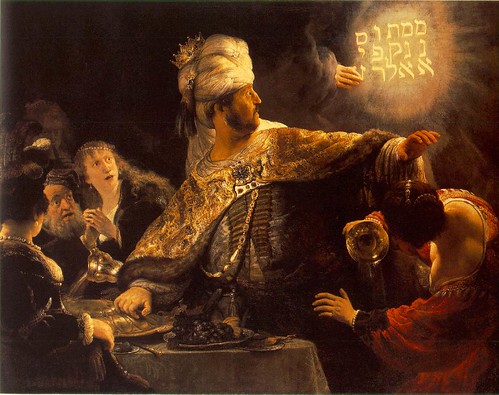
1. Daniel says that Belshazzar was Nebuchadnezzar's son, but he really was Nebuchadnezzar's grandson.
The author is ignorant of the oriental culture of the Babylonians and the Persians and the Jews. Grandsons and even Great Grandsons are often attributed to important fathers no matter how far the generations are apart. They also seem to skip details that some of us in modern western culture would have thought was important..ie the fact that Belshazzar was a co-regent with his father and that there had been 3 kings who reigned shortly after Nebuchadnezzar was not deemed important to include. No where in Daniel does it say that Belshazzar immediately followed Nebuchadnezzar. To imply or assume that is going beyond what the Bible does say. 2. Daniel says the Darius the Mede conquered Babylon when it really was Cyrus the Great.
Then Medes and Persians were one empire! Darius and Cyrus conquered Babylon together and Darius being about 62 at the time ruled for a brief time (about 2 yrs) and Cyrus took over the whole thing. source
3. The Bible say that Ninevah was so large that it took 3 days to cross the city but excavations show that the city is only 5 km across.
Look at the text in question - Jonah 3: 3
Jonah obeyed the word of the LORD and went to Nineveh. Now Nineveh was a very important city—a visit required three days.
Obviously the author of the video is using the KJV, but looking at the NIV is much clearer. It could be taken that it took 3 days to reach the city from where the fish dropped Jonah off. Ninevah is along way from the sea.
If the author was wrong about these three Biblical contradictions, what else could he be wrong about? As for the author's point that there is no evidence where there should be, I think it's only a matter of time. It took centuries to find the archaeological artifacts that we do have. I'm sure there is a lot more to find.
Then the author tries to knock down the thought that the Gospels that correlate. The problem he points out that:
1. Different number of women going to the tomb.
No Gospel disagrees with the other by saying so-and-so was not at the tomb when one of them says she was. None of the Gospels give the total number of women who went to the tomb therefore if it were more 5, then it perfectly concievable that different subsets were named.
2. Different number of angels
It's the same thing with number of angels. If one author offers more detail than another, why would you assume contradiction?
3. Location of the stone
None of the Gospels say that the women witnessed the stone being rolled away. There is no contradiction
Considering that Mary Magdalene saw Jesus in the same garden as the tomb just after dawn, I think it's safe to say that she saw him first. To charge contradiction with the two disciples on the way to Emmaus, you would have to say that the episode happened before Mary Magdalene and the other women went to the tomb and judging by the fact that people usually did not travel long distances in the dark of night, I'm certain Mary's encounter happened first.
5. Which disciples went to the tomb.
Does it really make sense to conclude that because Matthew did not record any disciples going to the tomb that there is contradiction with saying Peter went and saying Peter and John went. a contradiction would be to say no one went, Peter did not go, and John did not go. Neither Gospel says that. Where is the contradiction?
When the author talks about Jesus' end times prophecy alleges that Jesus failed to come back in the life time of the people who heard Him. The author has a problem. Jesus could not have been telling people that they would be alive when He comes back. Jesus said that no one knows the day or the hour of his return. He even said he did not know. He told parables illustrating that we have to live like He could come back at any second but not know when. Therefore to understand that Jesus has to return in the lifetime of the hearers means that there is a lack of understanding.
The alleged charge against Matthew saying the Jesus was riding 2 donkeys at the same time is either a lie or a misunderstanding. Jesus was riding a cold...the colt's mother was walking in front of Jesus and the colt. This is how they trained donkey that had never been ridden before.
As for the other alleged contradictions there are answers for them too if you bother to just look at the Bible in its context. For example the obligatory contradiction concerning Jesus' geneology in Matthew and Luke. to the Jewish culture, you don't list everyone in a geneology just the important ones (this is what Matthew did).
I have Doherty's book "Challenging the Verdict" against Strobel's "The Case for Christ". I agree read both. I think that the author of the video is wrong about the time line for the gospels. Not everyone agrees.
These videos do not represent truth and grossly misrepresent history and common sense. An example is the thought that Christianity is just like any other religion without interacting with all of Strobel's reasons for being convinced that it's not. Neither Islam nor Hinduism are based on a body of scripture that can be dated within 30 years of the events themselves. Not just the Gospels but the epistles as well.
Brian has again posted a great article on theistic arguments. This time, he defines the Fine-Tuning argument for the existence of God. I know Brian is right, a lot of deists try to argue that an omnipotent God, described in the Bible, is not necessary to explain fine-tuning. However, I believe that such a God would have to be omnipotent because how else could he control and direct every single particle and its energy in all of reality to make everything come out as it has so that life as we know it is possible? God must be omnipotent to do all of that.
Chad has posted a great post on his blog, Truthbomb Apologetics. It's a link to a blog called The Apologetic Front hosting a video discussing the Jehovah Witness church and their teaching that Jesus returned invisibly in 1914...yeah, I know, but some people still buy it. Check out the video below and visit Chad's Blog.
Brian has posted an interesting Lecture by Dr. Charles Thaxton. Thaxton's title is Darwin's Surprise: Why Darwin Wouldn't Write the Origin Were He Alive Today.
This is great lecture. I like the idea of looking at what data Darwin had available to him in the 1850's versus what we have now, namely the cell and DNA. Thraxton even discusses problems with his theory that was known in Darwin's own time. This is a must-listen and should be considered.
I can answer the question posed in the title of my post in one word: No. Many people think that Christians stole ideas from Zoroaster thereby mythologizing Jesus. There are several problems with this view. The first problem has to do with dating and with sources of information we have regarding Zoroaster himself. The second problem is that Zoroaster's life that we have documented does not parallel Jesus.
There are several opinions when Zoroaster lived and when the religion started. Some say 6000 BCE or 600 BCE. For the sake of argument lets take 600 BCE, arising from Persia. The earliest written records we have were written down between 6th-9th centuries C.E. Adherents (yes, there are still follower s of Zoroaster today) believe that Zoroaster himself lived 1500 - 1000 BCE. In other words, no one is really sure when Zoroaster lived. Therefore for the majority of the time the religion has been practices it's been based on oral stories before being written down. The time scale between the time Zoroaster actually lived and his stories written down is extremely large compared to Jesus and the New Testament, no matter how late you want to date any book in the New Testament. Of course myth and legend must have clear crept into Zoroastrianism during 2000 years. Not to mention it is far more likely Judaism influenced Zoroastrianism rather than the other way around since Judaism came first. In contrast we can date the creed from 1st Corinthians 15 to just a few years after Jesus' crucifixion that most historians agree really happen. And if you reject that argument you still have to admit that the creed found in 1st Corinthians 15 is from the 50's or 60's CE and that Christians had been teaching the death, burial, and resurrection of Jesus since Christianity's earliest days, proving that the belief did not come from legend based on people who were not eyewitnesses.
1. Zoroaster was born of a virgin and "immaculate conception by a ray of divine reason."
Zoroaster's mom was married when she gave birth to him, and there's nothing suggesting she was celibate while married. The "ray of divine reason" was apparently a purely spiritual thing, and Zoroaster's body actually was created the usual way. 2. He was baptized in a river.
Zoroaster receives a revelation while on the banks of a river. That's the closest parallel to be found. 3. In his youth he astounded wise men with his wisdom.
Sort of. At age 7, he was put under the care of magi, who he frequently argued with. Later, the magi had him imprisoned, but he was freed after he made the legs grow back on a horse. 4. He was tempted in the wilderness by the devil.
There is a parallel in the Zoroaster story to Jesus' temptation, and, yes, it does apparently predate the Jesus story by a couple hundred years. However, Zoroaster's "temptation" wasn't by the "devil" (in Zoroastrian literature, Ahriman) and it may or may not have been in the wilderness (the texts don't say). Zoroaster is tempted by a demon, not by Ahriman himself. And his temptation doesn't involve turning stones to bread or leaping from towers, just dialogue between Zoroaster and the demon. 5. He began his ministry at age 30.
True, but the earliest reference to his being thirty is post-Christian. 6. Zoroaster baptized with water, fire, and "holy wind."
First of all, there's no reference to Zoroaster baptizing with any of these things. Second of all, there's no Biblical reference to Jesus baptizing with any of these things! Is the fact that neither of them do these things a parallel? 7. He cast out demons and restored the sight to a blind man.
There's no reference to Zoroaster casting out demons, and the earliest reference to his giving eyesight to the blind is from the 10th century A.D. 8. He taught about heaven and hell, and revealed mysteries, including resurrection, judgment, salvation and the apocalypse.
Zoroaster did teach about heaven and hell, and resurrection into a non-dying body. Judgment is done by other gods, but with Zoroaster pleading the case of those who are faithful to him, though, unlike with Christianity, the faithful are not automatically saved. Salvation is achieved by works alone, unlike Christianity. And the apocalypse Zoroaster spoke of was a flood of molten metal. Sounds like a pretty good comparison, huh? However, most of this is from post-Christian writings. Also, most of these subjects begin on the Bible's Old Testament, which predates the earliest Zoroastrian references by several hundred years. 9. He had a sacred cup or grail.
First of all, Zoroaster did not have a sacred cup or grail. Second of all, Jesus (at least according to the Bible) did not have a sacred cup or grail. The Christian "holy grail" is believed by some to be the cup Jesus drank from at the last supper, and others say it was a chalice that collected Jesus' blood at the crucifixion. But as far as its being 'sacred', the Bible makes no such claim. This is a medieval non-Biblical legend. 10. He was slain.
Ummm...okay. So were Caesar, Abraham Lincoln and John Dillinger. Is this supposed to be significant? Let's look at how Zoroaster was slain and see if there is any comparison to how Jesus was slain, shall we? One story has him murdered at the age of 77 by a wizard. Another has him killed in battle. Both of these stories date from the 15th century at the earliest. 11. His religion had a eucharist.
Since they believe in salvation by works alone, why would they have a eucharist? The closest thing they have to a eucharist is a ritual involving the haoma plant, but they don't claim the plant is Zoroaster's body or blood. Besides, the earliest reference to this ritual is post-Christian. 12. He was the "Word made flesh."
No reference to this, implicit or explicit. 13. Zoroaster's followers expect a "second coming" in the virgin-born Saoshyant or Savior, who is to come in 2341 CE and begin his ministry at age 30, ushering in a golden age.
First, there's nothing about his being thirty, or of the redeemer being Zoroaster himself. Even the religion disagrees with itself on exactly what's going to happen, though the date of 2341 CE is given (although how this date compares to Jesus, I have no idea). A pre-Christian text (around 400 B.C.) refers to a single redeemer who ushers in a golden age. Later post-Christian texts suggest there will be three redeemers conceived by virgins who bathe in a lake in which Zoroaster's sperm is being divinely preserved. One of these redeemers will eradicate death. Only the one pre-Christian reference could be considered valid, but that one mentions nothing about the return of Zoroaster himself or virgin birth.
Any honest person would have to agree that Zoroaster does not equal Jesus Christ. They are too different. Here are some more sources
Was Jesus Zoroaster or Buddah? - This ia good article however the author rejects Jesus and Christianity, however, great information on Buddha and Zoroaster.
Brian has posted a great lecture from Michael Green. I really enjoyed it. Michael Green talks about what Apologetics is and what the Gospel really is. I think anyone interested in Christianity and Apologetics should listen to it. It is given from the the European point-of-view and it is very interesting,
I'm excited. I really enjoy Gary Habermas and there is no more important part of Christianity than the Resurrection! Here is an audio interview in which Habermas discusses the historicity of Jesus' Resurrection.
It's a good debate. The thing is William Lane Craig was again awesome demonstrating that without God as ultimate authority on Morality, right and wrong have no meaning. What is to stop me from claiming whatever I want to do or say is right despite what your needs and desires if moraliy is relative? Nothing. As for DR. Torbjörn Tännsjö perfomance, three words come to mind: "Crash and Burn!"


![Reblog this post [with Zemanta]](https://lh3.googleusercontent.com/blogger_img_proxy/AEn0k_uxZ4_v2CiBQfb2iRynmjKjCYZXOcs6CsUlD7MEB9MwTF9MeGZV_6FYVBgujubxkV3lU3qO5UjTnwqMMWtHWLy_NWrInF2gwWZ52SQ2ZM0iVum7kU3geK6vuRtU6iewiA8BYi5M-lAvZhvOzSxJ967m=s0-d)

![Reblog this post [with Zemanta]](https://lh3.googleusercontent.com/blogger_img_proxy/AEn0k_v3Cn5R1gfAFJf1vRbhZ5FiFVtY0i26cXDIlKFDEjCbuU9CKnyNqlUoYorxbHded1wQILtfXNypH7-cDbc-ZpWyg5CKqwaaUK9-9vwgKDMBRaRbfjoR2GBgmdbMnB8rKc25vv13nkjGQVXh3faE28zz=s0-d)

![Reblog this post [with Zemanta]](https://lh3.googleusercontent.com/blogger_img_proxy/AEn0k_vi9O5vnGgaWZpWnb39GB0huvEa1rzP1NrCe4TN-3vmqvydznekWPc8J9UDWLf6Bc1YZG_kR_WBrwVnNcqqxamYMLAfvRzrujjUpE2DPciplI1wBkoCfE3PPKw-EeWlr8fntR4SYhyVK6BcY6rUghU=s0-d)

![Reblog this post [with Zemanta]](https://lh3.googleusercontent.com/blogger_img_proxy/AEn0k_svfHldOe3_xDfL6DA4luheGHP2bOsKjTa72-JmBZ1EOmr0aaQFD0yIy75bw5z39GnW7ueKp3XYqW07y5EPfuZVznq9Q3oMtg9YQHS9Cm9wvkfqQJcYiTADZMwS35Zut6-bYbk15PxHW2ZO_jqNBrB2=s0-d)

![Reblog this post [with Zemanta]](https://lh3.googleusercontent.com/blogger_img_proxy/AEn0k_vPuDyzFFGc6rzgc_XFo-YpofiCF18b9MSGwGQYTFV4fRVLsxbaNVlEwzGlod7Vy7bF9VtVzmEMyq6-_wfTvDO2i-bzARe-np8O_UWvqG-kTeVzVHXuSyWb3KhC-ezwMRLAVo7w_MS6H1fRWGezJ9n_=s0-d)



![Reblog this post [with Zemanta]](https://lh3.googleusercontent.com/blogger_img_proxy/AEn0k_uZanrFF8JLQBJfBzuKyUGv4fwnOl0fPK60r0Qaqh6o_mKf7XaHWqsP766tdlFknuG0rO6lKYkzqlBA00hdL1M-5hD29HLGQrjHFQSodQ__-DdlM3ZHhbhLKiIct0rI6gvWuqlGp3pLkJ7H5xHg6jQ=s0-d)

![Reblog this post [with Zemanta]](https://lh3.googleusercontent.com/blogger_img_proxy/AEn0k_uyWNQfyUEV-GxRdvuAIwFH6Fo1-3OWyIeDMvozl97H5sB9bnTHoIbEb2qPTgEn9t089jpSWZkohi_Y1OicXsr2YNF_bJQcJTm1_iSKb7-N6hBtxOngnDeqO-EeXvjmfB4-EZAP0dpT2btaOGeG6HJh=s0-d)

![Reblog this post [with Zemanta]](https://lh3.googleusercontent.com/blogger_img_proxy/AEn0k_uhYo1jTT6PnOBkcuRSCmqhnKsLO6MlAbJo-_wFHqmNwUvrszTb_EQd58W-treONiqmxJt5Dc-D1edA2v4_6THd24eR0jdKZTlS4eCQHFxRh7fSb3eyJvIVIwxhGzO7ovSUf4HE5QCVOvIEa9uF2eC1=s0-d)

![Reblog this post [with Zemanta]](https://lh3.googleusercontent.com/blogger_img_proxy/AEn0k_t3B0YK-wLGgLT5KGK-HGPjdxwgPdnMpM-VUA3hO7L57U7dGuLzqC6aHZfdflXV0KZX_ogP3t65TVMf5wGI-SYYWAe2-Yh7bbghSG4TICTiWxzPe-G1o15-zlezMHSyNrwovH14ZaYYgdz2hny3D0K6=s0-d)


![Reblog this post [with Zemanta]](https://lh3.googleusercontent.com/blogger_img_proxy/AEn0k_sVFFgAKoqZj_8hUGq9LSlgrvemvH5rrPPdOeBXQ5u1E6cinD5W-CHzi_GaKVOrOXgLBTsa0Zwb3YpMLjHHxYrw5A5ezSG8jpZLvGRnJH3Rdki-rlMfBJ5hEO_zzQOUhdFHvZZYIpYUKuvVlgjTdCTC=s0-d)

![Reblog this post [with Zemanta]](https://lh3.googleusercontent.com/blogger_img_proxy/AEn0k_sGXJCnIaE3UZZJDu5iJ06h1sx6rncMc7d7m8ntFsOCIEbiBdvO49h-NWAHFJaUiLj8LczWTqCN3pEyKNUACipKsbbebxHa3UMxGs6SYy32FkwUueKiosZr0AoIvhL_il1mfFhYwwVmeBTzJKNnB5o=s0-d)

![Reblog this post [with Zemanta]](https://lh3.googleusercontent.com/blogger_img_proxy/AEn0k_vSlUntKurJQva6wZt7aIb2SnFNr8Q01DSwaBkhIAarIOTdW45qgUEE-VFU5IEFU-5cMMorOA_uZH0vkBBElfqtg46z6xZTBKUHLK6sySpvH_FB8LcxMrBn8rTjI-NL_On0s-CZ1UgOfNVd0L1Qvcw=s0-d)