Mariano's second part in a two-part series examining the theology in movies and television. This one focuses on two television shows: Reaper and Supernatural.
Theology at the Movies and on Television, part 2 of 2 | True Freethinker
Personal blog that will cover my personal interests. I write about Christian Theology and Apologetics, politics, culture, science, and literature.
Sunday, May 16, 2010
“Signature of Controversy,” Stephen Meyer, et al. – Free eBook Download | True Freethinker
Mariano has posted a link to a free ebook in which criticisms of the book Signature In the Cell, by Stephen Meyer, are examined and discussed. I think it's an important book. Meyer's book has been tagged as the book critics against Intelligent Design must deal with. So far I am unimpressed with their feeble attempts.
“Signature of Controversy,” Stephen Meyer, et al. – Free eBook Download | True Freethinker
Saturday, May 15, 2010
Does God Capriciously Play With Our Lives? No.
I found the picture on the left and it struck me as problematic because people actually think that God is like that: at best that God doesn't care about our sufferings or worse gleefully hits us with them! This is not what the Bible tells us about God. The question "Why do bad things happen to good people?" presupposes that there are good people who don't deserve the bad things that happen. The problem is that there is no such thing as someone who is so "good" that they don't deserve bad things from happening. We are all deserving of hell and total separation from God! Of course bad things are going to happen to us! What is more incredible and hard to understand why does God give us mercy and blessings at all!
44But I tell you: Love your enemies[a] and pray for those who persecute you, 45that you may be sons of your Father in heaven. He causes his sun to rise on the evil and the good, and sends rain on the righteous and the unrighteous. 46If you love those who love you, what reward will you get? Are not even the tax collectors doing that? - Matthew 5: 44-46
Labels:
Bible,
Gods,
Problem of evil,
Problem of Suffering,
Theology
Friday, May 14, 2010
Video: Laura Bush Is All For Gays And Abortions Now « Crushable
Here is an interesting video: Laura Bush supporting gay uber-rights and abortion. No wonder her husband's administration kept her mouth shut when he was in the White House.
Video: Laura Bush Is All For Gays And Abortions Now « Crushable
Skarlet's Two Cents: Forget who-dun-it. Who is responsible for this mess?!?
I came across this article from Brennon's blog, Brennon's Thoughts. It is a good article I wanted to comment on the points made. I like the title. I would like to add to it. Who is accountable for this mess? If there is someone accountable, whom is the responsible party accountable to? The article is from an Arminian position and I think everyone should think about what she wrote I recently realized that I equate responsibility with accountability. I think most people do. The problem is that the two ideas are real different. You can be both responsible and accountable for something but necessarily. For example you can only be blamed for something if you are accountable to someone. Without someone to hold you accountable there can be no condemnation or accountability. You can have responsibility but no accountability. It's hard to think of an example because almost every responsibility has the weight of accountability. God does not deserve blame for our sins, but He is responsible because he could have stopped Adam, but He didn't. There are many examples in the Bible and in my own life that God has stopped me from sinning and in those cases in my life God made sure that I understood that I wanted to do something and He said No. Yet at other times He allowed me to go ahead and let me mess up so that He could use it for a purpose. I think this is true for everyone. Does this mean that without God's decisions and actions, evil would not exist? Yes. Does this make God the author of evil or accountable? No. I mean who is God accountable to? Who is that rules over God. No one. This means that God is not culpable, but it does mean that God is the only free-will agent because of humans we are slaves to sin until Jesus frees us when the Holy Spirit convicts and the the Father draws us. I see where the author is coming from but I don't think that it torpedoes the Calvinist position at all. Another point is that suffering and evil are not purposeless. God has a reason for everything and there is no way we can possibly understand it all now. The best we have is to trust God.
28And we know that in all things God works for the good of those who love him, who have been called according to his purpose. For those God foreknew he also predestined to be conformed to the likeness of his Son, that he might be the firstborn among many brothers. - Romans 8:28-29
Skarlet's Two Cents: Forget who-dun-it. Who is responsible for this mess?!?
Labels:
Accountability,
Arminian,
Arminianism,
Bible,
Calvinism,
Christianity,
Evil,
Free Will,
Sin
The Destroyed Bible – On How to Reconstruct the Bible, part 1 | True Freethinker
Labels:
Bible,
Christianity,
Mariano,
Textual criticism
Dr. Claude Mariottini - Professor of Old Testament: Was Ruth Barren?
Dr Mariottini wrote a great post about Ruth. I'm amazed that there are people who think that Ruth was barren before she married Boaz, but the text does not say that. May be they think that because she had no children with her first husband. But as Mariottini points out that does not fly!
Dr. Claude Mariottini - Professor of Old Testament: Was Ruth Barren?
Labels:
Bible,
Book of Ruth,
Claude Mariottini,
Old Testament,
Ruth
Ex-Scientologist Reveals Details Behind 'Dangerous Cult,' Tom Cruise in New Book | PopEater.com
Amy Scobee is an ex-scientologist and she has written book about the cult she left. This is an interesting interview.
nineEx-Scientologist Reveals Details Behind 'Dangerous Cult,' Tom Cruise in New Book | PopEater.com
He Lives: Internet Atheist Facts O' Fun
Anyone who has spent anytime looking at the arguments of atheists who share their ideas on the internet has realized that many of them have similar arguments and have similar worldviews. David Heddle has established a list of these arguments. Hilarious. Also sad.
He Lives: Internet Atheist Facts O' Fun
Thursday, May 13, 2010
Did Paul's Companions Share His Experience on the Road to Damascus?
In his latest attempt to show contradictions in the Bible, Shane appeals to an old one:
Shane further tries to shore up his contention by providing the further argument:
Here's a piece of information.
I appreciate Shane carefully checking out the text. I think he has put his finger on the point of the contention: In the context of Acts 22:9 does "akouo" mean "understand" or "hear" in the same way as "hear" in Acts 9:7. "Akouo" is in both Acts 9:7 and Acts 22:9. Does this mean that "hear" means the audible experience of sound waves bouncing off the ear drum and sending information to be interpreted by the brain? Or does it mean to harken or responding to what is heard? Again context matters.
If you follow both accounts they are parallel and follow the same flow. We are told what Jesus tells Paul before we are told what his companions reaction was.In addition in the context of the Greek text the difficulty is that in greek Akouo at times mean to hear and in other instances to understand. So which is it? Which one makes more sense. We have a single author in Acts. Why would he give an account in Chapter 9 conflicting with what he says Paul says in the 22nd chapter. Luke is not a moron or an idiot...he is careful in everything he writes and much of it can be corroborated with other evidence and none can rebut it. Therefore, I certainly think that understand is a correct translation of Act 9:22. We use "hear" even in English to mean "understand". How often do I feel like telling Shane, "You are not hearing me!" Would anyone think that I'm saying that he does not know I'm communicating with him in my writing? No they would understand I am saying that he does not understand.
One might wonder if I'm just blowing smoke by suggesting that the King James Version has missed the thought being expressed in these verses? Um....no.
What I'm saying is that there is no contradiction between Acts 9:7 and Acts 22:9. Again you have to wrestle the text out of context and then read the problem into the text.
Some more links that will help to Akouo the text.
All passages that contain "akouo" in Acts.
The KJV New Testament Greek Lexicon - Akouo
Here is another biblical issue.
Acts 9:7- "They stood speechless, hearing the voice but seeing no one".
Acts 22:9 (regarding the same story) "they saw the light but did not hear the voice".
Both descriptions contradict each other. According to one the men with Saul saw no one but heard the voice. According to the other they did hear the voice.
Shane further tries to shore up his contention by providing the further argument:
Here's a piece of information.
The NIV version and the NAS version try to remove the contradiction in Acts 22:9 by translating the phrase as "did not understand the voice". But the Greek word "akouo" is translated 373 times in the NT as "hear", "hears", or "heard" and only in Acts 22:9 is it translated as "understood".
I nfact, the word "understood" is occurs 52 times in the NT, but only in Acts 22:9 is it translated from the Greek word "akouo".
I appreciate Shane carefully checking out the text. I think he has put his finger on the point of the contention: In the context of Acts 22:9 does "akouo" mean "understand" or "hear" in the same way as "hear" in Acts 9:7. "Akouo" is in both Acts 9:7 and Acts 22:9. Does this mean that "hear" means the audible experience of sound waves bouncing off the ear drum and sending information to be interpreted by the brain? Or does it mean to harken or responding to what is heard? Again context matters.
If you follow both accounts they are parallel and follow the same flow. We are told what Jesus tells Paul before we are told what his companions reaction was.In addition in the context of the Greek text the difficulty is that in greek Akouo at times mean to hear and in other instances to understand. So which is it? Which one makes more sense. We have a single author in Acts. Why would he give an account in Chapter 9 conflicting with what he says Paul says in the 22nd chapter. Luke is not a moron or an idiot...he is careful in everything he writes and much of it can be corroborated with other evidence and none can rebut it. Therefore, I certainly think that understand is a correct translation of Act 9:22. We use "hear" even in English to mean "understand". How often do I feel like telling Shane, "You are not hearing me!" Would anyone think that I'm saying that he does not know I'm communicating with him in my writing? No they would understand I am saying that he does not understand.
One might wonder if I'm just blowing smoke by suggesting that the King James Version has missed the thought being expressed in these verses? Um....no.
In fact, the man known affectionately among theologians as the “dean of Greek scholars,” A.T. Robertson, wrote in regard to the difference in cases:
In 22:9 Paul says that the men “beheld the light” (to men phos etheasanto), but evidently did not discern the person. Paul also says there, “but they heard not the voice of him that spake to me” (ten de phonen ouk ekousan tou lalountos moi). Instead of this being a flat contradiction of what Luke says in 9:7 it is natural to take it as being likewise (as with the “light” and “no one”) a distinction between the “sound” (original sense of phone as in John 3:8) and the separate words spoken. It so happens that akouo is used either with the accusative (the extent of the hearing) or the genitive (the specifying). It is possible that such a distinction here coincides with the two senses of phone. They heard a sound (9:7), but did not understand the words (22:9) [1930, pp. 117-118, parenthetical items in orig.].
Consider also the words of Greek expert Ray Summers:
Some verbs take their object in a case other than the accusative. There is a variety of usage at this point. Akouo may take its object in the genitive or the accusative. Usually akouo with the genitive means “to hear without understanding.” This probably explains the difficulty involved in Acts 9:7 and 22:9. The incident is the experience of Paul in seeing the light and hearing the voice on the road to Damascus. Acts 9:7 states that Paul’s companions heard the voice (akouo with the genitive); Acts 22:9 says they did not hear the voice (akouo with the accusative). Thus both constructions say the same thing; the companions of Paul did not understand what the voice said to Paul; to them it was unintelligible sound (1950, p. 51).
Numerous other Greek scholars have expressed the same viewpoint (see, for example: Arndt and Gingrich, 1957, pp. 31-33; Blackwelder, 1958, p. 139; Kittel, 1993, p. 216; Thayer; 1979, pp. 22-23; Vincent, 1975, p. 571; and Vine, 1985, p. 296). The word “hear” in Acts 22:9 can be used to indicate that it was a sound—not a voice—that the men heard on the road to Damascus. Source: http://www.apologeticspress.org/articles/533
What I'm saying is that there is no contradiction between Acts 9:7 and Acts 22:9. Again you have to wrestle the text out of context and then read the problem into the text.
Some more links that will help to Akouo the text.
All passages that contain "akouo" in Acts.
The KJV New Testament Greek Lexicon - Akouo
On Reading the Cell’s Signature | The BioLogos Forum
I've been commenting back and forth with Chuck O'Connor on John Loftus' blog. Unfortunately, Chuck denies the Bible and Christianity and see no value in them or those of us who believe in them. During the course of the exchange, I challenged him to provide a rebuttal to Stephen C. Meyer's book Signature in the Cell. He graciously provided an article to which I have linked to, written by Dr. Francisco Ayala, University Professor at the University of California, Irvine.On Reading the Cell’s Signature | The BioLogos Forum
I thought it good to make comment on this essay. I have to admit to being profoundly disappointed. I expected to see a good argument that Meyer is wrong and that there no reason to think that our genetic structure was designed - scientifically. Instead, I see a bunch of philosophical drivel combined with bad theology.
How should a person of faith respond to Signature of the Cell? I am an evolutionary scientist who would suggest the following considerations.
The keystone argument of Signature of the Cell is that chance, by itself, cannot account for the genetic information found in the genomes of organisms. I agree. And so does every evolutionary scientist, I presume.
The article starts off well. I mean it sets me up for thinking that it will advance an alternate explanation for where the genetic information came from over time. Did he offer one? No, not here. He then says something very interesting to me:
Why, then, spend chapter after chapter and hundreds of pages of elegant prose to argue the point? It is as if in a book about New York, the author would tell us that New York is not in Europe, and then dedicate most of the book to advancing evidence that, indeed, truly, New York is not in Europe.
Signature of the Cell offers Intelligent Design (ID) as the alternative explanation to chance in order to account for genetic information. This suggestion turns out to be no more convincing than a proposal by the author of the book about New York, who having exhausted all possible ways of telling us that New York is not in Europe, would now offer Peoria as the alternative city to visit. We would rather read about New York’s architecture, splendid avenues, and great parks; about the rich culture and ethnic diversity of the city; about its restaurants, concert venues, theatres, and wonderful sights in and around the city. But regarding natural selection, genetics, ecology, development, physiology, and behavior in the evolution of genetic information, there is nothing substantive in Signature of the Cell.
Now I have not read all of Dr. Ayala's work, but in this essay he agrees that chance does not explain where genetic information comes from but never say where it does comes from but instead spends his time talking about how intelligent design is not the answer. Arguing that New york is not in Europe. We all agree. But he never says where New York is located. So where did the extra genetic information that had to be added to the first common ancestor come from if evolution is true? Ayala is silent in this article, but I believe that this is one of the points that Meyer is speaking of in his book.
Ayala wrote:
The human genome includes about twenty-five thousand genes and lots of other (mostly short) switch sequences, which turn on and off genes in different tissues and at different times and play other functional roles. There are also lots and lots of DNA sequences that are nonsensical. For example, there are about one million virtually identical Alu sequences that are each three-hundred letters (nucleotides) long and are spread throughout the human genome. Think about it: there are in the human genome about twenty-five thousand genes, but one million interspersed Alu sequences; forty times more Alu sequences than genes. It is as if the editor of Signature of the Cell would have inserted between every two pages of Meyer’s book, forty additional pages, each containing the same three hundred letters. Likely, Meyer would not think of his editor as being “intelligent.” Would a function ever be found for these one million nearly identical Alu sequences? It seems most unlikely. In fact, we know how these sequences come about: one new Alu sequence appears in the genome for every ten newborns, generation after generation. The Designer at work? Unlikely: many of these sequences damage the genome causing abortion of the fetus during the early weeks of life.
Perhaps one could attribute the obnoxious presence of the Alu sequences to degenerative biological processes that are not the result of ID. But was the Designer incompetent or malevolent in not avoiding the eventuality of this degeneration? Come to think of it: why is it that most species become extinct? More than two million species of organisms now live on Earth. But the fossil record shows that more than ninety-nine percent of all species that ever lived became extinct. That is more than one billion extinct species. How come? Is this dreadful waste an outcome intended by the Designer? Or is extinction an outcome of degeneration of genetic information and biological processes? If so, was the Designer not intelligent enough or benevolent enough to avoid the enormity of this waste?
Ayala then tries to use things like the alu sequences to say that we aren't designed because it's poor design. This is a mumbo jumbo philosophical argument. something like what Hitchens, Dennet, or Harris uses. How can you assume that it's a poor design or a bug if you don't know what the original specs were? how do you know it's not "feature"? You don't. I'm an engineer and when I write code myself, what sense would it make for someone to look at my code and nitpick if they don't know what the design criteria and functions were supposed to be? Or even without knowing what all the limiting factors are, you are ill equipped to evaluate a design!
Then Ayala goes all theological:
I do think that people of faith may find in the world many reasons that support their belief in God. But I don’t think that intelligent design is one of them. Quite the contrary. Indeed, there are good reasons to reject ID on religious grounds, in addition to scientific grounds. The biological information encased in the genome determines the traits that the developing organism will have, in humans as well as in other organisms. But humans are chock-full of design defects. We have a jaw that is not sufficiently large to accommodate all of our teeth, so that wisdom teeth have to be removed and other teeth straightened by an orthodontist. Our backbone is less than well designed for our bipedal gait, resulting in back pain and other problems in late life. The birth canal is too narrow for the head of the newborn to pass easily through it, so that millions of innocent babies—and their mothers—have died in childbirth throughout human history.
I could go on about human features that betray a design that certainly is not intelligent. I will add only one more consideration. More that twenty percent of all human pregnancies end in spontaneous abortion during the first two months of pregnancy. That is because the human genome, the human reproductive system, is so poorly designed. Do I want to attribute this egregiously defective design to God, to the omnipotent and benevolent God of the Christian faith? No, I don’t. It would not do to say that God designed intelligently the human genome and that it then decayed owing to natural processes. If God would have designed the human genome, surely He would have done it so that this enormous misfortune would not happen. Think of it: twenty percent of all human pregnancies amount to twenty million abortions every year. I shudder at the thought of this calamity being attributed to God’s specific design of the human genome. To me, this attribution would amount to blasphemy.
Who are you or I to judge the design defective. Does the pot have the right to tell the potter that it is defective? Efficiency can't be measured with the information that we have and we don't know what all the purposes are that are being met by the design being like it is. It's blasphemous to call what God has done as being poorly designed or executed. You can say you don;t understand. you can say it makes no sense to you, but who died and made you, me, or Ayala the standard of what benevolence is or what as good design for the human body is. This is poor and short-sited theology where man is the standard and God is held accountable to that standard instead of the other way around.In case you are unfamiliar with the imagery in Jeremiah 18 and Romans 9, we are the pots and God is the potter.
Related articles by Zemanta
- The Human Genome (singularityblog.singularitysymposium.com)
- Blog - The Genome Pioneers (technologyreview.com)
- Scientist's Paper Refutes 'Intelligent Design' Theory With Facts (dvorak.org)
Labels:
Biology,
Christianity,
DNA sequence,
Evolution,
Francisco Ayala,
Genetics,
Stephen C. Meyer
Wednesday, May 12, 2010
More Zombie Stupidity
Okay, done laughing? Good. There are some people who actually view things this way. Not only do they have really think that "Christianity" and "Atheism" are like this but it's wrong. Christians don't believe this. Atheists don't describe their beliefs this way either. The picture is important because it does show what some Atheists erroneously think Christians believe and vice versa. I have heard both misrepresent the other this way. This post is to call for people to honestly represent the beliefs of others, if you are going to critique them, whether you agree with them or not. Or you should shut up.
4903.jpg (JPEG Image, 883x900 pixels) - Scaled (70%)
Theology at the Movies, in Books and on Television, part 1 of 2 | True Freethinker
Mariano, has written a great article analyzing the theological fallacies behind the movies Constantine and Seven Pounds. He is spot on. I think that there is an effort to bring Judeo-Christian theology to the same level as any other fairy tale or myth to be played with, changed, or retconned at will. I'm not even sure if we can say that it's consciously intentional but to change the message is to take ownership - making it easier to ignore as a myth. Discussions like these are necessary so that we don't forget what the real message is and confuse fact with fiction.
Theology at the Movies, in Books and on Television, part 1 of 2 | True Freethinker
Labels:
Christianity,
culture,
Judeo-Christian,
Mariano,
Retroactive continuity,
Theology
A Failure to Do Real Apologetics: The Classical Face-plant #2 : RealApologetics Blog
So, the classical apologist says that we can’t yet appeal to Scripture as our final authority – at least regarding the resurrection. For that reason, Craig asserts that we should accommodate to the unbelieving mind. We should do whatever it takes – even suspend the truthfulness of the Word of God (!) – so that unbelievers will become Christians. Forget the fact that our most trustworthy testimony and description of who Jesus is comes from the Bible and that God commands us to take every thought captive to the obedience of Christ, the Bible must be set aside until the proper time (post-salvation). Piece by piece, chip by chip, we (religiously neutrally) work our way towards the fullness of the Christian worldview.I understand the frustration. When I listen to debates by William Lane Craig and Dinish D'Souza.
and their opponents attack scriptural inerrancy and the Bible text is challenged, I want to see them fight for the truth of the Bible. At the same time I see that they are avoiding these issues because they see that the their opponent is on;ly trying to shift the focus of the Gospel. I have never heard William Lane Craig or D'Souza compromise the truth of the Bible but arguing from external evidence outside the Bible does have a place in witnessing. Some people actually get saved because of the work of Craig and D'Souza.. For some their apologetic works and i see the hand of God in their ministries and i am certain that God is using them. That is what matters. I see Dr. Craig's endorsement of molinlism as problematic and even unbiblical but ui don't think believing it means that you are doing a disservice to non-believers because in witnessing debating the existence of God and the Resurrection it wouldn't come up. I hope Craig will soon stop teaching molinism because it's not scriptural but if you want to have the sovereignty of God and human free will in the same worldview I don't see how you can teach anything else.
A Failure to Do Real Apologetics: The Classical Face-plant #2 : RealApologetics Blog
Tuesday, May 11, 2010
Commenting On "This Generation" - Mark 8:38;9:1; Matthew 24:34
I've been in discussion with a regular commenter on John W. Loftus' blog named Shane. We have been going back and forth on a post Loftus did regarding how do we know our worldviews are right or wrong. You can read the original posts and comments here. I wrote a response to that post here and you can read the exchange there. I challenged Shane to go to scripture and really check to see if there is an unambiguous interpretation. He has brought up two scriptures.
And
Mark 8:38-9:1 (New International Version)
38If anyone is ashamed of me and my words in this adulterous and sinful generation, the Son of Man will be ashamed of him when he comes in his Father's glory with the holy angels."Mark 9
1And he said to them, "I tell you the truth, some who are standing here will not taste death before they see the kingdom of God come with power."And
Matthew 24:34 (New International Version)
34I tell you the truth, this generation[a] will certainly not pass away until all these things have happened.Footnotes:
Shane believes that both scriptures are talking about Jesus' second coming and would say that it shows that Jesus could not be a prophet or what we claim because Jesus did not return during the lifetime of those who heard Jesus make the prophecy in person. It's interesting to me that Shane thinks that Jesus is talking about the same thing in both passages although they are two different contexts at two different times.
I appreciate District Superintendent Harvey Burnett chiming in on the text for Mark. I agree with him. His answer is in the comments section for the post on my blog again found here. The only thing I would add to what his said is don't use the New Living Translation for exegesis. It's a paraphrase not a real translation. "generation" in Mark 9:1 does not mean the same things as Matthew 24:34. Elder Burnett did such a great job I see no reason to add to his explanation for why Jesus was not saying that the the Kingdom would be manifested physically in the lifetime of his first disciples.
Instead, let's turn our focus to the the context of Matthew 24. Verse 34 is in context of Jesus answering a question of his disciples. Jesus issued a prophecy in verse 2. Look at verses 1 and 2.
1Jesus left the temple and was walking away when his disciples came up to him to call his attention to its buildings. 2"Do you see all these things?" he asked. "I tell you the truth, not one stone here will be left on another; every one will be thrown down."
In verse 3, the disciples wanted to know two things: when would the temple be destroyed and when would his coming be and the end of the age?
3As Jesus was sitting on the Mount of Olives, the disciples came to him privately. "Tell us," they said, "when will this happen, and what will be the sign of your coming and of the end of the age?"
Verse 4-34 is Jesus answering the question. Here is where things get interesting. Historically there has been 3 interpretations and one of them is Shane's that Jesus is talking about the end of the world. The other ones make more sense,.Either Jesus is talking about a real historical event - the destruction of the temple - that would happen in the lifetime of those present, or the disciples were asking about the end of the world and the temple destruction. It is my opinion that verse 34 is talking about the destruction of the temple when Jesus says "these things". So here is the question. Was Herod's temple destroyed during the the lifetime of those present when this prophecy was given? Yes. This prophecy cold be dated towards the end of Jesus' earthly ministry just before he was crucified and resurrected. - say 30 AD. The Jews rebelled against Rome and the Romans didn't take kindly to that in 70 AD. They destroyed Jerusalem and the Temple. The Jews ceased to exist as a political nation until 1948 AD! This fact is well attested in history - Roman history and in Josephus. Because the destruction was never mentioned anywhere else other than in this context (Olivet Discourse), some people think that the entire New Testament should be dated before 70 AD.
I already know what the counter argument is so let me raise it myself. How can we say that Jesus is right about no stone being left one on top of another if the "Wailing Wall" is still here today? Simple. The Wailing Wall is part of the huge platform that was built to give the builders a level surface on which to build the temple in a remarkable, almost unreproducible feat of ancient engineering. When Jesus spoke this prophecy he wasn't referring to the platform, he was talking to the buildings that had stood on top of the platform. Jesus was probably standing on that platform when he said this. Therefore Jesus was right....validating Himself as prophet, king, and Lord because had He been wrong than everything else He ever said is suspect. It's just following the evidence where it leads. Jesus was not saying that there were those listening to him at that moment who would see his second coming, he was saying that they would live to see the destruction of the temple.
Now the thing to remember is that not everyone agrees with me that Matthew 24 points to any future fulfillment as well as to 70 AD. I was in an online written debate with my friend Mike Felker who believes that all of Matthew 24 was fulfilled in 70 AD and is not talking about the second coming at all. I disagree, but there are many people who would agree with them. I believe Jesus was talking about 60 AD and events beyond the time we now live. You can read that debate by going to the last post at http://mmcelhaney.blogspot.com/2010/02/apologetic-front-my-last-response-to.html and in that post is links to all the other posts. The interesting thing is that the answer to this question is not essential doctrine. What I mean by that is you can either endorse my interpretation or Mike's and still be orthodox. It's not a salvation issue. That's not saying that it's not important. I mean I would like to know which viewpoint is right but that is how I see it now. The truth is all we have to do is wait and we will see which one is right when Jesus returns. If Mike is right, Shane is wrong while Mike and I still go to heaven and live lives used of God.. If I'm right, Shane is wrong while Mike and I still go to heaven and live lives used of God.With Elder Burnett's assist on the texts form Mark, it is obvious to see that Shane misinterpreted the scripture. Either way the Bible is right.
- Matthew 24:34 Or race
Shane believes that both scriptures are talking about Jesus' second coming and would say that it shows that Jesus could not be a prophet or what we claim because Jesus did not return during the lifetime of those who heard Jesus make the prophecy in person. It's interesting to me that Shane thinks that Jesus is talking about the same thing in both passages although they are two different contexts at two different times.
I appreciate District Superintendent Harvey Burnett chiming in on the text for Mark. I agree with him. His answer is in the comments section for the post on my blog again found here. The only thing I would add to what his said is don't use the New Living Translation for exegesis. It's a paraphrase not a real translation. "generation" in Mark 9:1 does not mean the same things as Matthew 24:34. Elder Burnett did such a great job I see no reason to add to his explanation for why Jesus was not saying that the the Kingdom would be manifested physically in the lifetime of his first disciples.
Instead, let's turn our focus to the the context of Matthew 24. Verse 34 is in context of Jesus answering a question of his disciples. Jesus issued a prophecy in verse 2. Look at verses 1 and 2.
1Jesus left the temple and was walking away when his disciples came up to him to call his attention to its buildings. 2"Do you see all these things?" he asked. "I tell you the truth, not one stone here will be left on another; every one will be thrown down."
In verse 3, the disciples wanted to know two things: when would the temple be destroyed and when would his coming be and the end of the age?
3As Jesus was sitting on the Mount of Olives, the disciples came to him privately. "Tell us," they said, "when will this happen, and what will be the sign of your coming and of the end of the age?"
Verse 4-34 is Jesus answering the question. Here is where things get interesting. Historically there has been 3 interpretations and one of them is Shane's that Jesus is talking about the end of the world. The other ones make more sense,.Either Jesus is talking about a real historical event - the destruction of the temple - that would happen in the lifetime of those present, or the disciples were asking about the end of the world and the temple destruction. It is my opinion that verse 34 is talking about the destruction of the temple when Jesus says "these things". So here is the question. Was Herod's temple destroyed during the the lifetime of those present when this prophecy was given? Yes. This prophecy cold be dated towards the end of Jesus' earthly ministry just before he was crucified and resurrected. - say 30 AD. The Jews rebelled against Rome and the Romans didn't take kindly to that in 70 AD. They destroyed Jerusalem and the Temple. The Jews ceased to exist as a political nation until 1948 AD! This fact is well attested in history - Roman history and in Josephus. Because the destruction was never mentioned anywhere else other than in this context (Olivet Discourse), some people think that the entire New Testament should be dated before 70 AD.
I already know what the counter argument is so let me raise it myself. How can we say that Jesus is right about no stone being left one on top of another if the "Wailing Wall" is still here today? Simple. The Wailing Wall is part of the huge platform that was built to give the builders a level surface on which to build the temple in a remarkable, almost unreproducible feat of ancient engineering. When Jesus spoke this prophecy he wasn't referring to the platform, he was talking to the buildings that had stood on top of the platform. Jesus was probably standing on that platform when he said this. Therefore Jesus was right....validating Himself as prophet, king, and Lord because had He been wrong than everything else He ever said is suspect. It's just following the evidence where it leads. Jesus was not saying that there were those listening to him at that moment who would see his second coming, he was saying that they would live to see the destruction of the temple.
Now the thing to remember is that not everyone agrees with me that Matthew 24 points to any future fulfillment as well as to 70 AD. I was in an online written debate with my friend Mike Felker who believes that all of Matthew 24 was fulfilled in 70 AD and is not talking about the second coming at all. I disagree, but there are many people who would agree with them. I believe Jesus was talking about 60 AD and events beyond the time we now live. You can read that debate by going to the last post at http://mmcelhaney.blogspot.com/2010/02/apologetic-front-my-last-response-to.html and in that post is links to all the other posts. The interesting thing is that the answer to this question is not essential doctrine. What I mean by that is you can either endorse my interpretation or Mike's and still be orthodox. It's not a salvation issue. That's not saying that it's not important. I mean I would like to know which viewpoint is right but that is how I see it now. The truth is all we have to do is wait and we will see which one is right when Jesus returns. If Mike is right, Shane is wrong while Mike and I still go to heaven and live lives used of God.. If I'm right, Shane is wrong while Mike and I still go to heaven and live lives used of God.With Elder Burnett's assist on the texts form Mark, it is obvious to see that Shane misinterpreted the scripture. Either way the Bible is right.
Labels:
Bible,
Bible Defended,
Bible Exegesis,
Christianity,
God,
Jesus,
Mount of Olives,
Shane
Secrets of Iron Man’s New Suits | Underwire | Wired.com
The blog has been heavy lately. Time for some fun. I love articles like this one. Just how feasible is Iron Man's armor? How did they figure out how to make it work for a person to actually wear it? How did they switch from practical effects to computer generated ones. This article answers many of these.
Secrets of Iron Man’s New Suits | Underwire | Wired.com
Related articles by Zemanta
- Iron Man 2: The Making of Iron Man's Armor (screenrant.com)
- The New Iron Man 2 Costumes Will Rate as High as the Movie (prweb.com)
- Why Can't 'Iron Man 2' (The Game) Be As Good As 'Iron Man 2' (The Movie)? (multiplayerblog.mtv.com)
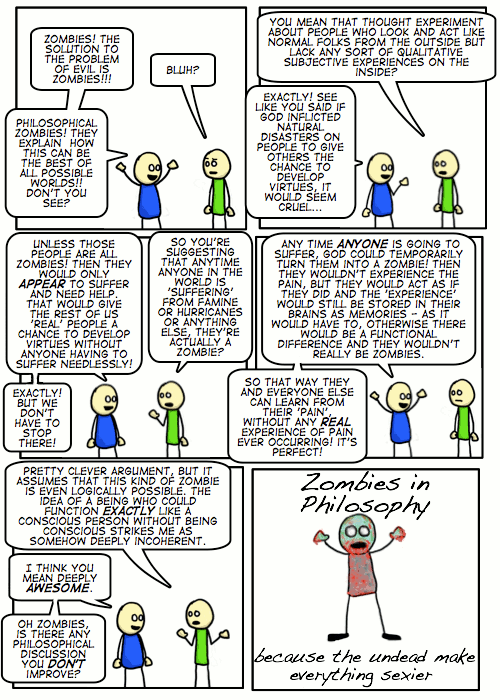
Philosophical Zombies?
Okay, this strip made me laugh. I hope it's a complete joke because if anyone is really teaching this as an answer to the problem of suffering they need help. I don't think mental health professionals can help...might take a full-blown exorcism. It's amazing every time atheists resort to telling Christians that we believe in zombies because it shows that they know nothing of the Bible or about zombies.
The Bible most definitely gives answers for why we have evil and suffering. It doesn't matter if you don't like the answer because it's not subjective. Bad things do happen to "good" people. You can do everything you can to be good and do good and yet at times life falls apart...to say nothing of the consequences of our own personal sins. This is just the way it is. You want better?
2008-12-21.png (PNG Image, 500x700 pixels) - Scaled (94%)
The Bible most definitely gives answers for why we have evil and suffering. It doesn't matter if you don't like the answer because it's not subjective. Bad things do happen to "good" people. You can do everything you can to be good and do good and yet at times life falls apart...to say nothing of the consequences of our own personal sins. This is just the way it is. You want better?
7What shall we say, then? Is the law sin? Certainly not! Indeed I would not have known what sin was except through the law. For I would not have known what coveting really was if the law had not said, "Do not covet."[b] 8But sin, seizing the opportunity afforded by the commandment, produced in me every kind of covetous desire. For apart from law, sin is dead. 9Once I was alive apart from law; but when the commandment came, sin sprang to life and I died. 10I found that the very commandment that was intended to bring life actually brought death.
11For sin, seizing the opportunity afforded by the commandment, deceived me, and through the commandment put me to death. 12So then, the law is holy, and the commandment is holy, righteous and good. 13Did that which is good, then, become death to me? By no means! But in order that sin might be recognized as sin, it produced death in me through what was good, so that through the commandment sin might become utterly sinful.
14We know that the law is spiritual; but I am unspiritual, sold as a slave to sin. 15I do not understand what I do. For what I want to do I do not do, but what I hate I do. 16And if I do what I do not want to do, I agree that the law is good. 17As it is, it is no longer I myself who do it, but it is sin living in me. 18I know that nothing good lives in me, that is, in my sinful nature.[c] For I have the desire to do what is good, but I cannot carry it out. 19For what I do is not the good I want to do; no, the evil I do not want to do—this I keep on doing. 20Now if I do what I do not want to do, it is no longer I who do it, but it is sin living in me that does it.
21So I find this law at work: When I want to do good, evil is right there with me. 22For in my inner being I delight in God's law; 23but I see another law at work in the members of my body, waging war against the law of my mind and making me a prisoner of the law of sin at work within my members. 24What a wretched man I am! Who will rescue me from this body of death? 25Thanks be to God—through Jesus Christ our Lord!
So then, I myself in my mind am a slave to God's law, but in the sinful nature a slave to the law of sin. - Romans 7:7-25
2008-12-21.png (PNG Image, 500x700 pixels) - Scaled (94%)
Labels:
Answering Atheism,
Atheism,
Problem of evil,
Zombies
Apologetics 315: William Lane Craig debates John Shook - Does God Exist? MP3 Audio
Here is a debate from a couple of years ago between William Lane Craig and John Shook. They are debating the existence of God.
Apologetics 315: William Lane Craig debates John Shook - Does God Exist? MP3 Audio
The video is at this link: William Lane Craig debates John Shook in Canada, 2008
This debate was one of the best debates I've ever heard Dr. William Lane Craig debate in. It wasn't because Dr. Shook had good or new arguments supporting Atheism. Shook however is a good debater and provided a challenge. Shook had some really silly stuff but he had a home-filled advantage.
And here is Dr Craig commenting on the debate in an interview.

I liked hearing Dr W. L. Craig's take on the debate. I learned a lot from this exchange.
Apologetics 315: William Lane Craig debates John Shook - Does God Exist? MP3 Audio
The video is at this link: William Lane Craig debates John Shook in Canada, 2008
This debate was one of the best debates I've ever heard Dr. William Lane Craig debate in. It wasn't because Dr. Shook had good or new arguments supporting Atheism. Shook however is a good debater and provided a challenge. Shook had some really silly stuff but he had a home-filled advantage.
And here is Dr Craig commenting on the debate in an interview.
I liked hearing Dr W. L. Craig's take on the debate. I learned a lot from this exchange.
Labels:
Apologetics,
Atheism,
Christianity,
Debates,
Existence of God,
God,
John Shook,
William Lane Craig
Monday, May 10, 2010
President Obama Slams Video Games, Blogs, iPads - G4tv.com
President Obama has said:
I found this quote from G4TV. It strikes me as disingenuous because it was the very same information pipes that lead to his election. I agree that these things can be a distraction but any tool can be if it is misused. We can't let others think for us. We must analyze and critique the information we consume. We should throw away the crap and cleave to what is good.
Read more: http://g4tv.com/thefeed/blog/post/704566/President-Obama-Slams-Video-Games-Blogs-iPads.html?utm_source=g4tv&utm_medium=rssfeeds&utm_campaign=TheFeed#ixzz0naXLe0I3
President Obama Slams Video Games, Blogs, iPads - G4tv.com
"With iPods and iPads; Xboxes and PlayStations -- none of which I know how to work -- information becomes a distraction, a diversion, a form of entertainment, rather than a tool of empowerment, rather than the means of emancipation," Obama said. "All of this is not only putting new pressures on you. It is putting new pressures on our country and on our democracy," he added.
Obama also said an education can help people make sense of the different viewpoints and voices "clamoring for attention on blogs, on cable, on talk radio."
I found this quote from G4TV. It strikes me as disingenuous because it was the very same information pipes that lead to his election. I agree that these things can be a distraction but any tool can be if it is misused. We can't let others think for us. We must analyze and critique the information we consume. We should throw away the crap and cleave to what is good.
Read more: http://g4tv.com/thefeed/blog/post/704566/President-Obama-Slams-Video-Games-Blogs-iPads.html?utm_source=g4tv&utm_medium=rssfeeds&utm_campaign=TheFeed#ixzz0naXLe0I3
President Obama Slams Video Games, Blogs, iPads - G4tv.com
Labels:
Barack Obama,
culture,
Education,
IPod,
President,
Talk radio,
United States,
Video game
Islam and Christianity A Common Word: An Ancient Christian Art: Quoting Out of Context part 4
To realize how big a problem these issues are have you not considered why apologist James White is slowly backing away in subtle ways from the issue of rather the Bible is inerrant?
Please see my full article here: http://thegrandverbalizer19.blogspot.com/2010/01/james-white-backs-away-from-biblical.html
Any how this is a rather interesting quote from apologist James White
“Consider the example of the New Testament. Did the New Testament writers display a modernistic view the validity and transmission of the Old Testament text?”
Well James that would be hard to ascertain considering that you quoted from N.T Wright in a recent debate with Shabir Allay here: http://thegrandverbalizer19.blogspot.com/2009/11/did-jesus-die-as-willing-sacrifice.html that we don't even know who the New Testament writers are and it doesn't matter!
So how are you going to ascertain the view of someone you don't even know? Is FBI scale forensics really necessary for the common person to have faith in the word of God?
I'm confused is he saying that Dr. James R. white does nto agree that the New Testament writers are known to us? I read the king James Only Controversy and therein Dr. White said no such thing but the opposite. You don't know Muhammad. You don't know what he was like when he was happy. Or when he was sad. You can't say you know him or any of the men that memorized and/or transcribed the Qur'an. By your thinking...how do you know you can trust them?
“Or did they recognize that God had preserved the text in such a way that they could quote from the Greek Septuagint (the text known to their target audience) and still identify this translation as the Word of God?Surely, their use of the Greek translation of the Hebrew Old Testament raises all sorts of challenging, difficult questions.”
I'm gonna assume that this quote is also from Dr. White.
I'll give one example to show just how difficult and challenging the questions raise can be. (Matthew 21:1-11)
1 When they drew near Jerusalem and came to Bethphage on the Mount of Olives, Jesus sent two disciples,
saying to them, "Go into the village opposite you, and immediately you will find an ass tethered, and a colt with her.3 Untie them and bring them here to me.
And if anyone should say anything to you, reply, 'The master has need of them.' Then he will send themat once."
4 This happened so that what had been spoken through the prophet might be fulfilled:
"Say to daughter Zion, 'Behold, your king comes to you, meek and riding on an ass, and on a colt, the foal of a beast of burden.'"
The disciples went and did as Jesus had ordered them.
5 They brought the ass and the colt and laid their cloaks over them, and he sat upon them.
6 The very large crowd spread their cloaks on the road, while others cut branches from the trees and strewed them on the road.
The crowds preceding him and those following kept crying out and saying: "Hosanna 7 to the Son of David; blessed is he who comes in the name of the Lord; hosanna in the highest."
And when he entered Jerusalem the whole city was shaken 8 and asked, "Who is this?"
And the crowds replied, "This is Jesus the prophet, 9 from Nazareth in Galilee."
Once again Matthew was quote mining and this time it was disastrous. It is disastrous on several accounts. Who ever wrote the gospel of Matthew misunderstood the original Hebrew text. Instead the Greek Septuagint was relied upon resulting in the mistaken belief that the so called “prophecy” was about Jesus riding upon two donkeys!
Again look what Christian scholars have had to say about the matter.
4 [4-5] The prophet: this fulfillment citation is actually composed of two distinct Old Testament texts,Isaiah 62:11(Say to daughter Zion) and Zechariah 9:9. The ass and the colt are the same animal in the prophecy, mentioned twice in different ways, the common Hebrew literary device of poetic parallelism. That Matthew takes them as two is one of the reasons why some scholars think that he was a Gentile rather than a Jewish Christian who would presumably not make that mistake (see Introduction).
5 [7] Upon them: upon the two animals; an awkward picture resulting from Matthew's misunderstanding of the prophecy.
The source is from: (http://www.usccb.org/nab/bible/matthew/matthew28.htm)
What misunderstanding? Are we to believe that his misunderstanding is divinely inspired? Did the Holy Spirit inspire this misunderstanding?
No problem here. Jesus was riding the colt and the colt's mother walked ahead leading the colt. This was standard in that day for a colt that had never been ridden. Matthew was not wrong. The Septuagint is not wrong. The Hebrew is not wrong.
Not only that but did Jesus really say the following:
“Jesus sent two disciples,
2
saying to them, "Go into the village opposite you, and immediately you will find an ass tethered, and a colt with her.3 Untie them and bring them here to me.”
Since it is shown that Matthew (or whom ever wrote this) made such a huge error do Christians really expect us Muslims to believe that the above conversation really took place? Is not literary imagination at work here?
I've just shown that Matthew is not wrong. And anyone including Muslims should believe the text.
Since this is an obvious case of a person (Matthew?) quote mining and making a huge mistake in the process it makes one wonder. How many other instances are words put in the mouth of Jesus?
Did Jesus really say the following? (Matthew 28:19-20)
- 11 Then Jesus approached and said to them, "All power in heaven and on earth has been given to me.
- 19
- Go, therefore, 12 and make disciples of all nations, baptizing them in the name of the Father, and of the Son, and of the Holy Spirit,
- 20
- teaching them to observe all that I have commanded you 13 And behold, I am with you always, until the end of the age."
On what consistent basis do we accept that Matthew makes a mistake in one area of his 'inspired' Gospel but is completely trustworthy in other areas?
This why Biblical inerrancy is important. If any part is wrong we should throw the whole thing out. However you have failed to demonstrate error.
Rejoice greatly, O Daughter of Zion!
Shout, Daughter of Jerusalem!
See, your king [a] comes to you,
righteous and having salvation,
gentle and riding on a donkey,
even a colt, the foal of a donkey. (Zechariah 9:9)
Conclusion: You have seen me quote the Bible and quote from Christian scholars to prove my point. I have not used Muslim scholars who quote Christian sources and than selectively pick and choose.
The whole of the Christian faith rest upon the craft of Christians who have mastered the art of quote mining the Old Testament to give Christianity a feel of legitimacy and air of freshness to it.
Nice try. But those are not errors.
The whole of the Christian faith rest upon literary imagination and oral traditions which have no chains of transmission in them. The fact that these problems rest with in the most ancient Greek text the Christians possess is also further evidence that there is no escaping any of the points raised.
Most of the so called 'prophecies' that Christians like to talk about were not even prophecies in their original context to begin with. This whole idea of a 'double application fulfillment is also a ruse invented by Christian apologist who can see the problems presented above.
I have answer each of the points you have raised without using "double application". Do you have anymore? There are hundreds of prophecies in the Old Testament. I'm more than willing to one-by-one if you are.
As apologist James White has told Christians time and time again and I quote,
“if you’re asking the gospels to be an MP3 recording than your using a very unrealistic example of what should be there.” Source:
As we all know the only thing you would expect from an Mp3 recording is the exact recording of what you recorded. However, as we have seen Christianity is the product of ingenious minds who were masters of their craft.
The edifice of Christianity stands or falls upon the art of quote mining.
An attribution in which a passage is removed from its surrounding matter in such a way as to distort itsintended meaning
I agree with the Quote from Dr. White, but I don't understand how you get from him saying that the the New Testament was never meant to be a record on the same level as a an digital recording to accusing the New Testament writers of being spin doctor??!! How does the at work? Do you really think that is what Dr. White was saying? Having listening to him on this subject in context many times I can tell you he doesn't mean that at all.
Islam and Christianity A Common Word: An Ancient Christian Art: Quoting Out of Context
Labels:
Bible,
Christianity,
God,
Holy Spirit,
James White,
New Testament,
Old Testament,
thegrandverbalizer
Subscribe to:
Posts (Atom)