Wednesday, October 5, 2011

Goodbye, Steve Jobs [1955-2011]

The big news of October 5, 2011 is the sad passing of Steve Jobs. Even though it has been known for a while that Mr Jobs has been fighting cancer for the last several years, it's still a shock when people die...especially someone who had already done so much to change the world and most likely could have accomplished much more had he had the time.


No one wants to die. Even people who want to go to heaven don’t want to die to get there. And yet death is the destination we all share. No one has ever escaped it. And that is as it should be, because Death is very likely the single best invention of Life. It is Life’s change agent. It clears out the old to make way for the new. Right now the new is you, but someday not too long from now, you will gradually become the old and be cleared away. Sorry to be so dramatic, but it is quite true.
Your time is limited, so don’t waste it living someone else’s life. Don’t be trapped by dogma — which is living with the results of other people’s thinking. Don’t let the noise of others’ opinions drown out your own inner voice. And most important, have the courage to follow your heart and intuition. They somehow already know what you truly want to become. Everything else is secondary.
-Steve Jobs [1955-2011]


Check out Steve Jobs' 2005 Stanford Commencement Address!


I remember back in 2000, I was a laughing stock for wanting a Mac at home instead of a Windows based machine. Apple was about to die. But Steve Jobs and people he put around in key positions changed all of that through new marketing strategies and innovative products. Not one of us  saw it coming, except maybe Steve Jobs.

Goodbye, Steve Jobs [1955-2011]
Enhanced by Zemanta

Sandpeople In The Bible - G4tv.com

Remember that famous footsteps in the sand picture? Here is a Star Wars bent. No surprise now that Jedi is a recognized religion now! See here. Science Fiction gone awry? Yup! There is only one God and God is not an impersonal force.

Sandpeople In The Bible - G4tv.com
Enhanced by Zemanta

Greek Language Knowledge in the Holy Land | Bible.org Blogs

Dr. Darrel Bock has posted a follow up to the discussion he had with Bart Ehrman about the knowledge Jews of the Holy Land had of Greek. Was it enough to write the New Testament? Read his short article at the following link.

Greek Language Knowledge in the Holy Land | Bible.org Blogs
Enhanced by Zemanta

Age Test - G4tv.com

I'm so old!

Age Test - G4tv.com

It’s not my fault I lost, because… [Comics]

It’s not my fault I lost, because… [Comics]

The Cheapest Way To Upgrade Your iPhone 4 - G4tv.com

The Cheapest Way To Upgrade Your iPhone 4 - G4tv.com

Tuesday, October 4, 2011

FacePalm of the Day #131 - Debunking Christianity: Atheists...What if You're Wrong?

John Loftus posted the following video on Debunking Christianity. This guy attempts to answer what happens if he comes face to face with God when he dies.


There are a couple of things missing from his reasoning.
1. Yes, God is all-loving and all-knowing, but what about justice? Why should sin go unpunished or ignored? What about God's Holiness and purity? How can the fact we not holy not be addressed? How does God know? He set each of us up in the best possible circumstances so that we can best find Him.

24 “The God who made the world and everything in it is the Lord of heaven and earth and does not live in temples built by human hands. 25 And he is not served by human hands, as if he needed anything. Rather, he himself gives everyone life and breath and everything else. 26 From one man he made all the nations, that they should inhabit the whole earth; and he marked out their appointed times in history and the boundaries of their lands. 27 God did this so that they would seek him and perhaps reach out for him and find him, though he is not far from any one of us. 28 ‘For in him we live and move and have our being.’ As some of your own poets have said, ‘We are his offspring.’ - Acts 17:24-28

2. God does indeed know us each better than we know ourselves. God knows all our rationalizations. Our opinions. Our Reasoning. That is why we stand condemned.

18 The wrath of God is being revealed from heaven against all the godlessness and wickedness of people, who suppress the truth by their wickedness, 19 since what may be known about God is plain to them, because God has made it plain to them. 20 For since the creation of the world God’s invisible qualities—his eternal power and divine nature—have been clearly seen, being understood from what has been made, so that people are without excuse.

21 For although they knew God, they neither glorified him as God nor gave thanks to him, but their thinking became futile and their foolish hearts were darkened. 22 Although they claimed to be wise, they became fools 23 and exchanged the glory of the immortal God for images made to look like a mortal human being and birds and animals and reptiles.

24 Therefore God gave them over in the sinful desires of their hearts to sexual impurity for the degrading of their bodies with one another. 25 They exchanged the truth about God for a lie, and worshiped and served created things rather than the Creator—who is forever praised. Amen. - Romans 1:18-25

3. What about repentance? This guy says he read the Bible. Did he understand it? He complains that if the Bible is right, he is going to hell because he does not believe, but Child molesters and rapist are going to heaven if they believe. He forgot, believing that there is a God is not enough.

19 You believe that there is one God. Good! Even the demons believe that—and shudder. - James 2:19

We've got to repent - turn from our sins. No one is going to heaven without repenting. If this guys ends up in hell it won't be because he was skeptical. It will be because he rebelled against God and ignored the salvation God offered him. We repent because we believe.

This is the Gospel in the Bible:

21 I have declared to both Jews and Greeks that they must turn to God in repentance and have faith in our Lord Jesus. Acts 20:21

4. Finally, this guy seems to think that he is good enough even thinks that God is pleased with him and the way he has lived his life. The Bible tells us different. All have sinned and deserve hell.

5 Those who live according to the flesh have their minds set on what the flesh desires; but those who live in accordance with the Spirit have their minds set on what the Spirit desires. 6 The mind governed by the flesh is death, but the mind governed by the Spirit is life and peace. 7 The mind governed by the flesh is hostile to God; it does not submit to God’s law, nor can it do so. 8 Those who are in the realm of the flesh cannot please God. - Romans 8:5-8

God is not pleased with us. None of us. We deserve hell. God has provided a way out. A way we can have peace with God. We don't have to go to hell. Because of who God is, sin must be punished. It's not one-to-one or equal. Just like the punishment is more than what we can imagine, so it is the gift of heaven. We earned the punishment but God is giving you a gift.

I don't think he answered the question. As an atheist, standing before God, having lived your life without concern for God or his plan for you, what do you say when you look into Jesus' face? I don't think you are going to be able to say anything. I agree with this guy. At that time, there will be no excuses or anything anyone can say in defense. All that will be enough:

By myself I have sworn, my mouth has uttered in all integrity a word that will not be revoked: Before me every knee will bow; by me every tongue will swear. - Isaiah 45:23

God is in control. If I were this guy I would be concerned that God does know me better than anyone else. He knows why we deserve hell. He knows our sins and issues. Throwing yourself on God's mercy on Judgement Day is too late. Do it now. It's not just about trying to avoid hell or gain heaven - that's gravy. It's about getting to know who God is and to know him personally! It's about finding your purpose in Him. God's purpose is not for our comfort or just what is best for us. The point is for us to glorify Him. It's not vanity or ego. God deserves it. It is who God is. This guy does not know the God of the Bible but he can know Him. Reach out because He is not far from anyone of us.

Debunking Christianity: Atheists...What if You're Wrong?
Enhanced by Zemanta

Data Breaches


Data Breaches

Questions Steve Ray Thinks "Bible Chrisians" Can't Answer - Answered

Turretin Fan has posted a response to Roman Catholic apologist who claims that there are 52 questions you can't answer from the Bible alone without an interpreter.


1) "Where did Jesus give instructions that the Christian faith should be based exclusively on a book?"
2) "Other than the specific command to John to pen the Revelation, where did Jesus tell His apostles to write anything down and compile it into an authoritative book?"
3) "Where in the New Testament do the apostles tell future generations that the Christian faith will be based solely on a book?"
4) "some Protestants claim that Jesus condemned all oral tradition (e.g., Matt 15:3, 6; Mark 7:813). If so, why does He bind His listeners to oral tradition by telling them to obey the scribes and Pharisees when they “sit on Moses’ seat” (Matt 23:2)?"
5) "Some Protestants claim that St. Paul condemned all oral tradition (Col 2:8). If so, why does he tell the Thessalonians to “stand firm and hold to the traditions which you were taught, whether by word of mouth or by letter” (2 Thes 2:15) and praises the Corinthians because they “hold firmly to the traditions” (1 Cor 11:2)? (And why does the Protestant NIV change the word “tradition” to “teaching”?)"
6) "If the authors of the New Testament believed in sola Scriptura, why did they sometimes draw on oral Tradition as authoritative and as God’s Word (Matt 2:23; 23:2; 1 Cor 10:4; 1 Pet 3:19; Jude 9, 14 15)?"
7) "Where in the Bible is God’s Word restricted only to what is written down?"
8) "How do we know who wrote the books that we call Matthew, Mark, Luke, John, Acts, Hebrews, and 1, 2, and 3 John?"
9) "On what authority, or on what principle, would we accept as Scripture books that we know were not written by one of the twelve apostles?"
10) "Where in the Bible do we find an inspired and infallible list of books that should belong in the Bible? (e.g., Is the Bible’s Table of Contents inspired?)"
11) "How do we know, from the Bible alone, that the individual books of the New Testament are inspired, even when they make no claim to be inspired?"
12) "How do we know, from the Bible alone, that the letters of St. Paul, who wrote to first-century congregations and individuals, are meant to be read by us as Scripture 2000 years later?"
13) "Where does the Bible claim to be the sole authority for Christians in matters of faith and morals?"
14) "Most of the books of the New Testament were written to address very specific problems in the early Church, and none of them are a systematic presentation of Christian faith and theology. On what biblical basis do Protestants think that everything that the apostles taught is captured in the New Testament writings?"
15) "If the books of the New Testament are “self-authenticating” through the ministry of the Holy Spirit to each individual, then why was there confusion in the early Church over which books were inspired, with some books being rejected by the majority?"
16) "If the meaning of the Bible is so clear—so easily interpreted—and if the Holy Spirit leads every Christian to interpret it for themselves, then why are there over 33,000 Protestant denominations, and millions of individual Protestants, all interpreting the Bible differently?"
17) "Who may authoritatively arbitrate between Christians who claim to be led by the Holy Spirit into mutually contradictory interpretations of the Bible?"
18) "Since each Protestant must admit that his or her interpretation is fallible, how can any Protestant in good conscience call anything heresy or bind another Christian to a particular belief?"
19) "Protestants usually claim that they all agree “on the important things.” Who is able to decide authoritatively what is important in the Christian faith and what is not?"
20) "How did the early Church evangelize and overthrow the Roman Empire, survive and prosper almost 350 years, without knowing for sure which books belong in the canon of Scripture?"
21) "Who in the Church had the authority to determine which books belonged in the New Testament canon and to make this decision binding on all Christians? If nobody has this authority, then can I remove or add books to the canon on my own authority?"
22) "Why do Protestant scholars recognize the early Church councils at Hippo and Carthage as the first instances in which the New Testament canon was officially ratified, but ignore the fact that those same councils ratified the Old Testament canon used by the Catholic Church today but abandoned by Protestants at the Reformation?"
23) "Why do Protestants follow postapostolic Jewish decisions on the boundaries of the Old Testament canon, rather than the decision of the Church founded by Jesus Christ?"
24) "How were the bishops at Hippo and Carthage able to determine the correct canon of Scripture, in spite of the fact that they believed all the distinctively Catholic doctrines such as the apostolic succession of bishops, the sacrifice of the Mass, Christ’s Real Presence in the Eucharist, baptismal regeneration, etc?"
25) "If Christianity is a “book religion,” how did it flourish during the first 1500 years of Church history when the vast majority of people were illiterate?"
26) "How could the Apostle Thomas establish the church in India that survives to this day (and is now in communion with the Catholic Church) without leaving them with one word of New Testament Scripture?"
27) "If sola Scriptura is so solid and biblically based, why has there never been a full treatise written in its defense since the phrase was coined in the Reformation?"
28) "If Jesus intended for Christianity to be exclusively a “religion of the book,” why did He wait 1400 years before showing somebody how to build a printing press?"
29) "If the early Church believed in sola Scriptura, why do the creeds of the early Church always say “we believe in the Holy Catholic Church,” and not “we believe in Holy Scripture”?"
30) "If the Bible is as clear as Martin Luther claimed, why was he the first one to interpret it the way he did and why was he frustrated at the end of his life that “there are now as many doctrines as there are heads”?"
31) "The time interval between the Resurrection and the establishment of the New Testament canon in AD 382 is roughly the same as the interval between the arrival of the Mayflower in America and the present day. Therefore, since the early Christians had no defined New Testament for almost four hundred years, how did they practice sola Scriptura?"
32) "If the Bible is the only foundation and basis of Christian truth, why does the Bible itself say that the Church is the pillar and foundation of truth (1 Tim. 3:15)?"
33) "Jesus said that the unity of Christians would be objective evidence to the world that He had been sent by God (John 17:20-23). How can the world see an invisible "unity" that exists only in the hearts of believers?"
34) "If the unity of Christians was meant to convince the world that Jesus was sent by God, what does the ever-increasing fragmentation of Protestantism say to the world?"
35) "Hebrews 13:17 says, "Obey your leaders and submit to their authority. They keep watch over you as men who must give an account. Obey them so that their work will be a joy, not a burden, for that would be of no advantage to you." What is the expiration date of this verse? When did it become okay not only to disobey the Church's leaders, but to rebel against them and set up rival churches?"
36) "The Koran explicitly claims divine inspiration, but the New Testament books do not. How do you know that the New Testament books are nevertheless inspired, but the Koran is not?"
37) "How does a Protestant know for sure what God thinks about moral issues such as abortion, masturbation, contraceptives, eugenics, euthanasia, etc.?"
38) "What is one to believe when one Protestant says infants should be baptized (e.g., Luther and Calvin) and another says it is wrong and unbiblical (e.g., Baptists and Evangelicals)?"
39) "Where does the Bible say God created the world/universe out of nothing?"
40) "Where does the Bible say salvation is attainable through faith alone?"
41) "Where does the Bible tell us how we know that the revelation of Jesus Christ ended with the death of the last Apostle?"
42) "Where does the Bible provide a list of the canonical books of the Old Testament?"
43) "Where does the Bible provide a list of the canonical books of the New Testament?"
44) "Where does the Bible explain the doctrine of the Trinity, or even use the word “Trinity”?"
45) "Where does the Bible tell us the name of the “beloved disciple”?"
46) "Where does the Bible inform us of the names of the authors of the Gospel of Matthew, Mark, Luke, or John?"
47) "Where does the Bible [tell us] who wrote the Book of Acts?"
48) "Where does the Bible tell us the Holy Spirit is one of the three Persons of the Trinity?"
49) "Where does the Bible tell us Jesus Christ was both fully God and fully man from the moment of conception (e.g. how do we know His Divinity wasn't infused later in His life?) and/or tells us Jesus Christ is One Person with two complete natures, human and Divine and not some other combination of the two natures (i.e., one or both being less than complete)?"
50) "Where does the Bible that the church should, or someday would be divided into competing and disagreeing denominations?"
51) "Where does the Bible that Protestants can have an invisible unity when Jesus expected a visible unity to be seen by the world (see John 17)?"
52) "Where does the Bible tell us Jesus Christ is of the same substance of Divinity as God the Father?"


Questions Steve Ray Thinks "Bible Chrisians" Can't Answer - Answered
Enhanced by Zemanta

Sunday, October 2, 2011

Debunking Christianity: Militant Atheist?

John Loftus posted the following image:


I think the point of image is to point out that Militant Christians and Muslims are violent while Atheists are not. Let's examine the term "militant".


mil·i·tant

[mil-i-tuhnt] Show IPA
adjective
1. vigorously active and aggressive, especially in support of a cause: militant reformers.
2. engaged in warfare; fighting.       link
 
So does this make sense the way the word is being applied.  Let's grant that for a moment and ask the question "Is the picture of the 'militant atheist' the only picture that would suffice? Why not one of these?"


Now, let's ask about the so-called "Militant Christian"? Anyone who would pray for or take joy in the death of anyone can't be a consistent Christian. They ain't following God!

 21 “But if a wicked person turns away from all the sins they have committed and keeps all my decrees and does what is just and right, that person will surely live; they will not die. 22 None of the offenses they have committed will be remembered against them. Because of the righteous things they have done, they will live. 23 Do I take any pleasure in the death of the wicked? declares the Sovereign LORD. Rather, am I not pleased when they turn from their ways and live?
 24 “But if a righteous person turns from their righteousness and commits sin and does the same detestable things the wicked person does, will they live? None of the righteous things that person has done will be remembered. Because of the unfaithfulness they are guilty of and because of the sins they have committed, they will die.- Ezekiel 18:21-24

The picture doesn't work.
 

Debunking Christianity: Militant Atheist?
Enhanced by Zemanta

Most Americans Don't Believe Nation Is Economically Divided - Politics - GOOD

I was amazed by this article. I had the thought that there were some Americans (especially in Congress) who were in denial regarding the widening gap between rich people and poor people in our country, but to see it confirmed in a survey is kinda scary. No wonder people don't seem to think there is a need for universal health care!

But while the so-called 99 Percenters take it to the streets, a new study from the Pew Research Institute says most Americans are not on their side. Despite the fact that all signs suggest rich people in the United States are getting vastly wealthier than everyone else, a majority still doesn't believe there's an economic divide between "haves" and "have-nots."


I sure hope people wake up and make changes before desperate people begin to do desperate things.


Most Americans Don't Believe Nation Is Economically Divided - Politics - GOOD
Enhanced by Zemanta

Ruuuuuuuuunnnnnnn!!!!!! BigDog Now Has a Big Brother!


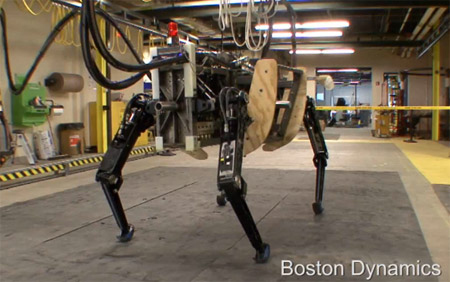
The AlphaDog Proto is a lab prototype for the Legged Squad Support System, a robot being developed by Boston Dynamics with funding from DARPA and the US Marine Corps. When fully developed the system will carry 400 lbs of payload on 20-mile missions in rough terrain. The first version of the complete robot will be completed in 2012. This video shows early results from the control development process. In this video the robot is powered remotely. AlphaDog is designed to be over 10x quieter than BigDog.


Ruuuuuuuuunnnnnnn!!!!!! BigDog Now Has a Big Brother!
Enhanced by Zemanta

Saturday, October 1, 2011

Joel Schumacher apologizes for "Batman and Robin" - YouTube


Apology accepted!

Joel Schumacher apologizes for "Batman and Robin" - YouTube
Enhanced by Zemanta

FacePalm of th Day #129 - Debunking Christianity: Is this the Best Possible World and does God have Free Will?


JohnnyP has post the following article on Debunking Christianity and there are several...problems....with it. I've annotated his post in red.

Let us assume the triple properties of the classical approach to God: that he is omniscient, omnipotent and omnibenevolent. In terms of the classic Problem of Evil argument, if there is too much evil in the world, God knows what to do about it, is powerful enough to do it, and is loving enough to want to do something about it. This argument has been around since the days of Epicurus and still remains one of the most hotly debated theological issues in modern times, causing many believers to leave the fold due to its evidential power.

This line of argumentation has never impressed me because who says that we can determine when God should deal with evil. The argument also fails to take account that if God destroyed all evil now, we would all be destroyed. If God had destroyed all evil at any time in the past, we would never exist. Instead God has a plan in mind and everything is in place to bring that plan to fruition - even evil.

19 For the creation waits in eager expectation for the children of God to be revealed. 20 For the creation was subjected to frustration, not by its own choice, but by the will of the one who subjected it, in hope 21 that[h] the creation itself will be liberated from its bondage to decay and brought into the freedom and glory of the children of God.


22 We know that the whole creation has been groaning as in the pains of childbirth right up to the present time. 23 Not only so, but we ourselves, who have the firstfruits of the Spirit, groan inwardly as we wait eagerly for our adoption to sonship, the redemption of our bodies. 24 For in this hope we were saved. But hope that is seen is no hope at all. Who hopes for what they already have? 25 But if we hope for what we do not yet have, we wait for it patiently. - Romans 8:19-25

However, logically, the theist can still defend their belief in God and the accusation that either God does not exist, or God does not possess one, two or any of those properties. They do this, more often than not, by employing the ubiquitous ‘God moves in mysterious ways’ or ‘You cannot know the mind of God’. What this equates to, is the a priori claim that God does have those three characteristics, and that, therefore, all the pain and suffering in the world is not gratuitous but part of the grander plan and vision of an all-loving, all-knowing and all-powerful Superbeing.

I really wish that when people raise this objection would really argue without the arrogance of assuming that we know just how much suffering there should be in order to get the "best possible world". We don't. We don't know know that "Best possible world is". That's like telling an engineer that the car he's designed is a failure and not knowing what the specs are! We wouldn't do judge a design (at least sane people  wouldn't) and not know what the design specs and goals are. Why would we expect the universe and reality to be different?

Although it is very difficult to logically disprove this defence, it does have some rather serious ramifications for the Christian theist. Because God is claimed as being all-loving it means that any decision that God makes, any actualisation of events and matter and so forth, must be the most loving that can be. It means that every decision made must be the most caring or loving decision that could possibly be made in terms of some criteria, or some outcome.


Again, we don't know what the criteria or outcome is so how do you judge that God is not making the most loving decision possible? Do we even know what "love" is? How would you explain what "love" is to a five year-old. My Daughter is five and she just asked me that question about half-a-week ago. How would you answer? Without God the question can't be objectively answered in any meaningful way.

Since God is omniscient, and given the possibility of Middle Knowledge or any other mechanism for divine foreknowledge, God knows every possible outcome for every actualisation of every possible world. And God, evidently, chose this one.

I reject "Middle Knowledge" because I can find no Biblical nor scientific evidence that convinces me that is how God handles time and space. I would not say that God picks a possible reality to exist. He "knows the end from the beginning" because He has determined it. I agree he knows all other possibilities but he's not bound by our will or what we will or will not do. I've posted a lot about Middle Knowledge on this blog and can read them by following this link.

First of all, the ramifications are fairly clear for God’s own free will. Since he must do what is maximally loving at all times, he cannot do otherwise. One could argue, then, that God does not have free will himself. Without the ability to act contrary to his omnibenevolence, he has only one course of action that he can possibly take, or courses of action that contain equal quantities of ‘lovingness’ (for want of a better term). A theist could argue that God could do otherwise but chooses not to.

Doing the maximally loving thing at all times is hardly limitation if you don't want to do anything otherwise. Can square want to be round? I agree that God cannot do otherwise because to do otherwise is to choose to be imperfect - equals sin. It's against God's nature and character not a limitation and is not a denial of God's free will.

This is akin to the taxman analogy. This goes as follows. A taxman assesses your business. He says you have a tax bill for $25,000. He gives you the choice of paying it or not paying it. The free choice is yours. However, by not paying it, you will go to prison (or to make the analogy more powerful, you will be sentenced to death). Thus you have a free choice where you can exercise your free will, but one choice will result in your imminent imprisonment or death. What will it be? You can argue, perhaps, that you have free will, but you can also argue that this is an effective denial of free will.

It's a bad analogy. It's more like having already been born in prison and not being able to raise bail. You are sentenced to death. The only way to be free and live is to let Jesus no just pay the price for your release but take your punishment of death as well. The problem is you are so engrossed and blind in your imprisonment you can't see how bad off you really are without being told or the truth revealed to you.

I think this is an important point:
In the same way, God could choose in a way that was not maximally loving, but he never would because it is against his all-loving nature. This is a grey area of free will. There is a debate here as to whether God does not have omnipotence, or whether omnipotence can be a potentiality. If it is a potentiality that can never be made real and existent, then does this equate to it not existing?

There is another option: God always chooses that which is maximally loving because of  who and what God is. The problem is that we don't know that the maximally loving options are or even what "love" really is in all situations. We have an idea, but we don't really know exhaustively.

However, the main point to be made here is as follows. It seems, then, that if God is to keep his omnibenevolent characteristic, then this world must be the maximally perfect and loving world that there can be. If God is perfect, then this must be his most perfect creation. A perfect God could not create something that fell short of perfection, and an all-loving God could not create something that did not fulfill the criterion of being the most-loving creation.

Johnny P neglects one major thing: Sin. You can deny sin, sure. But you can't argue against Christian theism using what we believe in order to show that it doesn't make sense and ignore sin. The Creation did not fall short of perfection before the fall. God doesn't perpetuate evil in this reality, we do. It's our rebellion that is what is wrong with the world. You cannot have love without mercy and it is this that keeps God from destroying all of us and making us wait until all those who will believe to hear the Gospel and turn to God to be revealed.

The slightly worrying outcome this is that a world where 250,000 people and millions of animals are killed in a tsunami, where anywhere between 20% and 75% of foetuses are naturally aborted (depending on the source), where cancer and malaria are rife, where a global flood killed all the population of earth bar 8 (and all the animals bar some), where forest fires kill baby deer, is a world where these events that are perhaps even necessary for it to be the most loving world.

Again do you or anyone of know what the whole plan is? Do we know what the best for us in the world is? I don't. If you think you do, then you are really dishonest. If you don't know what maximally good and perfect are, how do you know that there is no purpose for the suffering we witness? You don't.

Moreover, the Westboro Baptist Church may have some kind of twisted logic in celebrating the death of every soldier, in celebrating the outcome of pretty much anything as being the righteous judgement of an all-loving God. They realise that this judgement by God to actualise this particular world must be supremely wise and must result in the most loving world. This includes every piece of suffering and death experienced by every animal and plant in the history of the world.

Westboro Baptist Church is far from the best example of how to think logically about these issue. Is all of this due to God's judgement? Some of it? However God takes no pleasure in the death of the wicked, why should we?

Say to them, ‘As surely as I live, declares the Sovereign LORD, I take no pleasure in the death of the wicked, but rather that they turn from their ways and live. Turn! Turn from your evil ways! Why will you die, people of Israel?’ - Ezekiel 33:11

We shouldn't take pleasure in anyone dying without God and without hope. And back to Romans 8, every bit of suffering is indeed for a reason - even if we don't know what it is.

If this is where logic takes a Christian, then they can keep their God in all his maximal perfection. And while they’re at it, they can package up all the pain and suffering and send it return post to the pearly gates. Not needed here, thanks.

So Johnny P's reasons for rejecting God has to do with erroneous presuppositions about what good is and what love is and what the nature of God is. Obviously, most people would prefer to attack a strawman version of God instead of what the Bible actually say.s IF you want to throw out the God of  Middle knowledge and say that he does not exist,  more power to you! That God does not exist. Instead, how about reading the Bible and meeting the God who exists and sustains God's self with God's self.

Debunking Christianity: Is this the Best Possible World and does God have Free Will?
Enhanced by Zemanta

The Way it Was and The Way it Will Be [Comics]


 I think I've actually said the line about "video games" to my own children!


The Way it Was and The Way it Will Be [Comics]

Further Responses to "Christian" Scholar Laurence Brown by Dr James White

Last week, Dr James White began reviewing a discussion by Laurence Brown on the Islamic Apologetic' show, The Deen Show. Here is the show that Dr White is responding to.


Dr Brown is arguing that Jesus is not God and that there is no Trinity. He's wrong. You can hear the first part of the response here and the second part over here. Here is the third part of the response at this link.

Tuesday on the Dividing Line: Further Responses to "Christian" Scholar Laurence Brown
Enhanced by Zemanta

Anatomy of an Apple Rumor [Infographic]


Anatomy of an Apple Rumor [Infographic]

Fistbump of the Day: Faithful Thinkers: Evidence For vs. Proof Of

Luke Nix blogged a wonderful post in which he discussed the difference between "evidence" and "proof"! He wrote:

Not too long ago, the distinction between proof and evidence was offered to me. Evidence being a series of arguments that, if sound, point towards the truth of Christianity. Evidence has an objective sense about it. Arguments that are sound do provide evidence of their conclusion. However, a lot of the time, the conclusion offered is not exclusive.

Proof is the more subjective cousin of evidence. Proof may consist of evidence, it may not. Proof is what convinces people of the truth of a claim. Many people are convinced of the truth of things without any evidence, while others have lots of evidence. Either way, the truth of that something has been proven to them.

When a person claims that an argument "doesn't prove anything," they are typically saying that that particular argument is not persuasive to them. Unfortunately, we tend to interpret that same statement as the person saying that there is no evidence for the conclusion. I discovered this mistake when I attempted to show the logical path to the conclusion. The person wasn't looking for evidence, they were looking for something to convince them specifically.


Read the full article at the following link!

Faithful Thinkers: Evidence For vs. Proof Of
Enhanced by Zemanta

Friday, September 30, 2011

FacePalm of the Day #128: Debunking Christianity: On Making A Rational Choice About Religion

John Loftus has posted the following meandering. My annotations are  in red. 

Let's say you were shopping for the best car made. Your father brought you up as a die-hard Chevy lover but now you want to seriously find which car is the best one out there. How would you go about doing it? What are the criteria for what is to be considered the best car? There would be objective criteria but there would also be subjective person-related criteria. Are there any similarities here with choosing the best religion? Dissimilarities? Is choosing the best car analogous to how people search for the one true religion? In what ways? Which religions and sects within them would you seriously consider? Why not consider them all?

I agree that it's important to consider them all that you can. You should have  reasons why you are not Baptist, or Catholic or Muslim or Mormon or what have you. That is not enough. You should know why you have embraced the worldview you have embraced. I don't know why Loftus thinks that only Atheists thinks about such things. Grant it considering such issues does not mean that you will come up with correct answers. Loftus is a good example of that. No one can do it on their own. It takes God.

Then consider whether everyone could agree on which car is the best car made. Of course they couldn't, even with some agreed upon objective criteria. But let's say everyone who makes the wrong car choice will be cast into hell for an eternity? ;-) Sound unfair? Sure it does. Then why isn't it unfair when it comes to choosing the best religion? Have fun with this.

There is a big difference to choosing the best car and choosing to serve and follow the right God. The analogy really breaks down here.  A better analogy is choosing a Spouse. The stakes are way higher than choosing a car and it deals with relationship. You can't have a relationship with a car like a person. If the Christianity you experienced was just a relationship and you treated like a car you test drove and kicked the tires, you did it wrong. It's not what you do or what you know, it's about who you know - Jesus Christ.

Debunking Christianity: On Making A Rational Choice About Religion