Saturday, January 26, 2013

FacePalm of the Day - Debunking Christianity: Should Science Be Viewed As a Metal Detector?

Apparently John Loftus' last post on science and religion provoked enough of a response that he felt that he needed to post another in response to someone who disagreed with him.

I haven't found another blog like DC where intelligent Christians and atheists meet to debate the issues. I like it. Perhaps one of the reasons is because of comments like the one from a Keith R.:
Hi, John, I’m a long time reader and sometime commenter on DC. Of the many atheist and theist blogs that I follow I would have to say that you are the best at consistently coming up with interesting topics and arguments even though I disagree with almost everything you say.
I've heard this from others several times before. There aren't too many people out there who understand the mind of the believer and who blog on a daily basis like the writers here at DC (including Hector Avalos, Harry McCall, Jonathan Pearce, Phil Torres, and the articulate articulett). Just the same, Keith R. disagreed with my recent post, Enough of This Utter Nonsense, On Knowing the Supernatural. He wants us to think of science as a metal detector, and as such, it cannot detect anything that isn't metal. Hence, there are things that science cannot detect, supernatural things. *POOF* Therefore a trinitarian incarnational atoning resurrecting ascending and soon to be returning God exists. Get this? Neither do I.

While I would not throw Keith R out of the church for taking his position, mine is a little different. I would not say that science is incapable of telling us anything about God  I would say that science is incapable of giving us the kind of detection and evidence that Loftus thinks that he needs.

Keith (may I just use your first name?) argues that "science should be viewed as a metal detector. It does a great job of detecting metal objects just as, by analogy, science is great at studying the natural world." But it cannot detect anything else except metal, soooo, "science’s inability to detect the spiritual world because it is designed to study the physical world doesn’t mean that the spiritual world doesn’t exist or that science is to blame for not detecting it." Link.

*cough*

According to the Bible, the natural world points to God. Studying it shows us that God does exist. It is true that that you can't get the Gospel out of it, God's triunity, or the purppose for creation. That is why we have history, archaeology,  many other pieces of evidence, the Bible, and personal relationship.

I've heard a lot of analogies like these from believers. None of them show anything significant at all. What this particular analogy conjures up in our heads is the prior knowledge we have that most things in the universe are not made of metal. There is water, sand, dirt, all sorts of animals, plants, rocks, and gases. We know this. So the analogy plays with our heads precisely because we have prior knowledge that most objects in the universe are not metal. This is clearly stacking the mental deck in favor of that which Keith wants us to consider. His analogy would therefore more accurately be stated like this: If all we had was a metal detector then how can we know if non-metallic objects exist in a world where all we ever experienced are metal objects?

I'd argue that it is possible to know that the supernatural does indeed exist and those who don't experience cannot conclude that there is no God because they don't detect  God. 

So let's go back in time. The ancients agreed upon four elements in the cosmos: earth, water, air, and fire (some included Aether, the mysterious element). These elements referred to the phases of matter: earth is equivalent to solid, water is equivalent to liquid, air is equivalent to gas, and fire is equivalent to plasma. No metal is specified here. As science has progressed it has discovered 117 elements to date.

Um...excuse me. The Bronze Age is ancient times. Metal was known. And many such paradigms would consider metal to be one kind of "earth". Hasn't Loftus ever watched Avatar the Last Airbender  which is based off such conceptions.

So if Keith wants a proper analogy to science it would be an Element Detector, not just a metal detector. And what detects the elements? Our five senses, along with the many instruments scientists have produced to enhance them, beginning with the telescope and the microscope. So to put this into perspective Keith is asking if there is an element that we cannot detect with our Element Detector. Think about this, please! The only way we have for detecting elements is with our present Element Detector. If there is any other reliable way I'd like to know what it is. Faith in a private subjective experience has a proven track record of repeated failures. All we have to do is look at the difference between our reliable Element Detector compared with faith as an "element" detector seen in these two world maps.

The "Element Detector" is not just our five senses and other technological instruments. It's our perceptions and reasoning  powers - hardly reliable. The funny thing is I keep reading Loftus as saying that our minds and perceptions are flawed and easily biased  yet he loves to pretend they are good enough to conclude that there is no God.

What more can I say at this point? If there is a supernatural "element" who wants to be detected by us there is no other way but to provide our senses with objective reliable data. We cannot detect that which is undetectable. It is impossible for us to do anything different if this supernatural "element" expects us to be reasonable people.
 
By what standard doe Loftus know that he is "reasonable"? The thing Christianity posits is that without God calling us Himself, we cannot know Him. We can only know of Him.

Private subjective experiences by contrast, do not count for anything at all. Even if someone had one, he or she should doubt it as an unreliable brain fart.

It's interesting how Loftus jumps to the conclusion that something is wrong with a person if he/she experiences God but does not consider the possibility that it his faculties that have failed.

Such experiences happen during a trance-like moment of mediation, or prayer, or singing songs of worship to any and all supernatural "elements" from the beginnings of human civilization.

That's not how the Bible describes a single encounter with God. It's doesn't describe any of my  experiences or anyone I know. If this is what Loftus experienced, this might explain why he was never born again.

Just think of the trance-like state that believers would attain during the cadence-like rhythmic beating of the ancient Aztec drums as a high priest gutted a virgin on the altar, in sacrifice to Xipe Totec, so the sun would rise the next day, or the rain would come. They knew with certainty that their god existed and that he wanted them to sacrifice that virgin based on the same private subjective experiences Christians have today. Yep, the same exact ones. If this isn't what's going on in the heads of believers of all shapes and stripes, then what is?

Not the same at all. I don't have to go my own subjective experiece. God would not tell me something that would conflict with any of the messages He gave us through His Word. If my thoughts or conclusions conflict with the Bible (and that has happened), the red flag is waving. I know that I need to re-align myself with what the Word is. An Apostate is one who refuses to do that.

So it isn't the case, as Keith opines later, that his God doesn't want us to have absolute knowledge of his existence lest he force us into believing.

Many Christians take this viewpoint because they believe that God willed for humanity to choose God of our own free will without intrusive influence. While this position is not one that salvation hinges on, I don't agree. Without God we cannot choose Him. (John 6:44;Romans 8) .

The case is far far less than this. His God has not given us ANY evidence of his existence at all except for private subjective experiences and the 2nd- 3rd- 4th-handed written testimonies from ancient Christian believers who had private subjective experiences.

That is not true. We have creation. We have moral laws engraved in our minds. We have Jesus' Resurrection. We have the Bible which is extremely more reliable than Loftus likes to pretend. 

Keith simply does not think of his God as a reasonable one, for a reasonable God who wants, no demands, reasonable belief should give reasonable people what reasonable people need to believe. I am not demanding anything of God. I am a reasonable person who needs what Keith's God is not providing. I am not alone. His God doesn't even abide by the parable of the Lost Sheep. He's losing many of his sheep every day and is doing nothing objectively to keep them in the fold.

Loftus is  incorrect. No one is reasonable - at least on God's level. I want to know what makes Loftus think he is reasonable? And why does he think God owes him to provide the evidence he thinks he wants? I'd argue that if God did, it would not make a single difference in Loftus' decisions. God does abide by the Lost Sheep Parable.   To argue that God doesn't care about a single one of his sheep is to assume that there are sheep going to hell. That's not possible. God's not loosing a single sheep. John Loftus and other unbelievers should consider the possibility that maybe because they don't hear his voice is because they are not His sheep. The failure is not in God but in us. Jesus said the following:

14 “I am the good shepherd; I know my sheep and my sheep know me— 15 just as the Father knows me and I know the Father—and I lay down my life for the sheep. 16 I have other sheep that are not of this sheep pen. I must bring them also. They too will listen to my voice, and there shall be one flock and one shepherd. 17 The reason my Father loves me is that I lay down my life—only to take it up again. 18 No one takes it from me, but I lay it down of my own accord. I have authority to lay it down and authority to take it up again. This command I received from my Father.” - John 10:14-18

And Jesus also Said.

25 Jesus answered, “I did tell you, but you do not believe. The works I do in my Father’s name testify about me, 26 but you do not believe because you are not my sheep. 27 My sheep listen to my voice; I know them, and they follow me. 28 I give them eternal life, and they shall never perish; no one will snatch them out of my hand. 29 My Father, who has given them to me, is greater than all[c]; no one can snatch them out of my Father’s hand. 30 I and the Father are one.” - John 10:25-30

Debunking Christianity: Should Science Be Viewed As a Metal Detector?
Enhanced by Zemanta

High Five of the Day - He Lives: Just a thought, and I've said it before

David Heddle's blog continues to impress and inform. I really wish that people who continually get what Faith is wrong would really read and understand what it the Bible is saying Faith is instead of continually building and complaining about straw men they have imagined. I've argued much the same thing and if people will not listen to me, I hope they will listen to Dr David Heddle. He wrote:

I don't actually know what faith is. It is not simple intellectual assent--i.e., belief. The bible speaks of some who believe but are lost. Nor is it "blind." Hebrews 11 has the faith hall of fame, and lists people who did not need blind faith for they saw and spoke to god. Abraham's faith was hardly blind, with the exception that he had faith that God's promise of redemption would be fulfilled in his future. If blind faith was the ultimate virtue, Gideon (who demanded physical proof) would stand condemned--instead he shows up in Hebrews 11 as a faith hero. Faith (πίστις), I think, is closer to trust than to believe. As Grudem puts it, which works for me, it's coming to God and saying: "I got nothing."  

No, i don't think any one of us truly knows what "Faith" is. We learn and grow into it as we mature in God. This explains why Atheists constantly get this wrong.

He Lives: Just a thought, and I've said it before
Enhanced by Zemanta

Friday, January 25, 2013

FacePlant of the Day - Debunking Christianity: Enough of This Utter Nonsense, On Knowing the Supernatural

John Loftus likes to pretend that if science cannot be used to confirm something then there is no reason to there is no validity to it. He agrees that we can't trust our own perceptions, yet thinks that science is the great equalizer. Further, anyone who points out that science can't tells us everything we need to know about reality is labeled by him as a science hater. This is not true. While he claims that believers have major intellectual problems he fails repeatedly to explain how science protects him from the same problems. He also fails repeatedly to correctly explain who Jesus is and what Christians believe about Him.

A Christian commented on a recent post having to do with how science could know the supernatural:
Let's posit for a moment that the supernatural does exist. It then follows that science, which by definition focuses on the natural, would have absolutely no means to measure it or detect it. It could thus never serve as a method and no scientific protocol could ever be established to rule it out, regardless of how real the supernatural would be.
Oh my gosh, believers have just pawned us god-hating atheists now, haven't they? *Throws in the towel in defeat.* Wait, on second thought, this is utter hogwash and it should be easily seen. So here goes.


Nope. Atheism has been pawned by God through over 40 authors and a period of 1500 years.

Let's grant that science by its very nature cannot detect the supernatural, or better, a supernatural being, since that's surely what he believes. Why would it bother anyone if this is the case? I see nothing problematic about this conclusion at all. If science cannot detect a supernatural being then science cannot detect a supernatural being. It's only a problem for a particular kind supernatural being, one that wants to be detected, and/or one whom we need to detect in order to live a good life both here and later in the afterlife. Without these additional characteristics a mere supernatural being is an unnecessary hypothesis, one we can safely live without.

 So Loftus admits that if a supernatural beings is necessary to live a good life here and in an afterlife we cannot safely live without him. I can hear the objection that Loftus is talking about being able to detect such a being. The problem however is that the God of  Judaism and Christianity can be detected. More than that He says that we have no defense for concluding that He does not exist.

 18 The wrath of God is being revealed from heaven against all the godlessness and wickedness of people, who suppress the truth by their wickedness, 19 since what may be known about God is plain to them, because God has made it plain to them. 20 For since the creation of the world God’s invisible qualities—his eternal power and divine nature—have been clearly seen, being understood from what has been made, so that people are without excuse. - Romans 1:18-20

I'm aware that people trying to side-step this by claiming that this scripture is wrong because we don't know if God exists. I invite people to read Paul's letter more carefully. He's not claiming that people instinctively know about Jesus and the need to believe and confess by default.  Far from it.  The letter builds from the idea of just knowing that there is a God to how you can learn more about that God in detail. In the above passage, the argument is that we know God exists because we can know somethings about God from what has been made. Let me make it simple: we can know more about God from just looking a what God has created - through um science. This means you do not have luxury of unbelief.

So we need to additionally suppose that a supernatural being wants to be detected and/or that we need to detect her in order to live a good life both here and later in the afterlife. Well then, whose fault is it if we cannot detect her through science?

According to Romans 1, science can help us to know about God. Who is right? Loftus or God? Due to my own studies in science and engineering, I'd have have to believe that God is the one who is right. 

It wouldn't be the fault of science. It can only detect the detectable based on the standard rules of evidence-gathering. So if science cannot detect the supernatural and she wants detected then the fault for this state of affairs is laid clearly on her back. No one else is to blame.

No, the problem is how you have interpreted the evidence, not the evidence, nor science. The fault is in you.

5 Those who live according to the flesh have their minds set on what the flesh desires; but those who live in accordance with the Spirit have their minds set on what the Spirit desires. 6 The mind governed by the flesh is death, but the mind governed by the Spirit is life and peace. 7 The mind governed by the flesh is hostile to God; it does not submit to God’s law, nor can it do so. 8 Those who are in the realm of the flesh cannot please God. - Romans 8:5-8

If you are a committed atheist or have no relationship with God, Paul was talking about you. 

 In fact, it must be what she wants, even though believers have been reduced to making stupid arguments in defense of religious experience as evidence for their three-in-one incarnating atoning resurrecting God. They have been reduced to looking like fools, since William Lane Craig still has not answered my challenge regarding the so-called testimony of the inner witness of the Spirit. I don't suspect he can. I don't think any believer who accepts the inner witness of the Spirit as reliable testimony can answer my challenge. Give it a go, someone, will you?

Does anyone not get this?

Loftus, obviously doesn't get it. If one just follows Paul's argument. He starts with studying the creation - science, to consciousness and morality, and then to Jesus Christ. One who can dismiss the testimony of the Holy Spirit has never had such an experience. Given that Loftus claims to have once been a believer must have never had such confirmation which best explains his apostasy. And given that God never expects us to live on Blind faith nor on just your feelings or what you think, no Atheistic argument based on these claims work.

Let's go deeper. Let's think outside the present realities for a moment, something required when comparing any given hypotheses. The whole idea that science cannot detect the supernatural is a hindsight Christian rationalization for justifying the Christian faith due to the onslaught of modern science.

Science has never disproved the Bible.  Atheists like Loftus like to keep asserting this lie but when pressed they can't really offer up a single example. There isn't a single example. Sometimes people like to bring up macroevolution but there isn't unanimous assent to macroevolution being a fact. In fact it's still under heated debate. Sometimes people point to the order the Bible says things came into being in Genesis 1 and 2 as being in conflict with science. However not everyone agrees. Dr Hugh Ross, an Astronomer, does an excellent job in showing how this conclusion is not necessary.  

Prescientific superstitious people would never have said this, primarily because modern science had not yet arisen. Anything that could not be explained by the science of their day was considered an act of God. Their God was constantly intervening in their world, even causing the sun to rise every morning. "You want scientific evidence that God exists?," they would ask. "You can see it every single morning when the sun rises," they would answer. This was considered "scientific" evidence in the minds of believers because, as always with believers, scientific evidence is considered by them to be the lack of scientific evidence. Get it? I don't either. This is the basis for a great deal of pseudoscience, something I've written on before right here, which has gotten the 3rd highest hits at DC in seven years of Blogging.

I don't get why God is still not responsible for things that we actually understand and can predict. The more we learn through science, the more questions arise. We also know that something is holding reality together. The second law of thermodynamics tells us that everything is breaking down - tending to disorder. Yet things are still being refreshed and living things are still being born. How why? The more we look into the atom, the more smaller and smaller particles there are and the more we don't know what is holding it all together. Science is important and necessary, but it's doesn't lead us away from God.

Not only this, but if we believe the Bible then anyone who wanted scientific evidence for God would just have to sail in Noah's boat, or cross the Red Sea with Moses, or live for forty years in the wilderness on manna and be led by a pillar of smoke by day and fire by night. They could go to the circus where for an extra shekel Balaam's ass would talk, or in the booth next to it they could see Elisha's actual axe head float in a tub of water. They could follow Jesus around, or Paul, or Peter, and see blind men who were healed, and dead men who lived to tell stories about their After Death Experience (ADE vs NDE).

Yes, miracles served as empirical evidence for God. However God is still doing miracles today. Didn't Loftus ever experience a move of  God intervening in his life or someone else? I thought he said he was a Christian. If he had never experienced such why would he waste that much time as "Christian"? I'm not buying that. If I had never seen God move or intervene I would have been giving up being a Christian the first year after I was saved.

So when Christians admit science cannot detect a supernatural being what they're doing is conceding the whole argument. They're conceding science has correctly concluded that a supernatural being cannot be detected. Let. This. Point. Sink. In.

Science can't conclude that there is no God to detect because it shows evidence that there is a creator. I concede no such thing given my own education in Physics and Chemistry and that God doesn't expect me to believe Him despite the realities of science.  As a methodology for finding out about the universe science cannot be wrong, but scientists can be wrong (and have been) in the conclusions they draw.

Breathe slowly and deeply if you feel like fainting. Get some smelling salts on hand. Sit down if you must. For if science could detect a supernatural being then Christians would be crowing about it. You know it. I know it. Everyone knows it. Don't try to Billy Goat me to death with your endless "buts." I know them. I've used them myself in defense of an indefensible faith. There are no ifs ands or buts about this.

Funny it doesn't seem to stop atheists from crowing about lack of evidence while they shut their eyes and stick their fingers in their ears. 

To drive this point deeper, if there is a supernatural being who wants us to detect her then she could have either, 1) kept modern science from arising in the first place,

He's been using modern science. 

or 2) kept on providing scientific evidence in verifiable miracles in the same ways we read in the Bible.

Interesting that Loftus ignores the verifiable miracles we have today. Too bad. He should read more of Dr Gary Habermas' work.

Such a supernatural God could easily have kept modern science from arising merely by keeping any thought of scientific progress away from the minds of people who were close to attaining such a thought. See, that was easy. *Snap* You're now stupid.

Why would God do that? Instead God has put scientific progress in us. And he's been merciful enough to gift it to even to unbeliever too blind to appreciate God or acknowledge God.  Scientists like Isaac Newton credited God for their successes.

Or, much more interestingly, such a God could have created an earth as a flat disk in a much smaller universe just as we find described in the Bible, with the sun moon and stars created on the fourth day to revolve around the earth, with no amphibians so evolutionary science could not have arisen. If God had created the universe in six literal days then *BAM* along with other things modern science could never have arisen at all.

I don't know what's more pathetic - that Loftus thinks that the Bible teaches that the earth is flat  that that the solar system is geocentric or the possibility that Loftus may have thought that this when he thought that he was a Christian.

Christians, could your God have done this or not? Yes or no? Now then, please tell us all why the rise of modern science is a much greater value to your God then the loss of so many billions of people to hell. You do realize that modern science is one of the major factors reasonable people all over the world think your faith is bunk, don't you?

Yeah, that is why they are wrong. 

 Of course, that's why you reject the other religious faiths as well. Ahhhh, the good 'ole double standard days which will end soon, but we'll have to wait for my soon to be released book The Outsider Test for Faith: How to Know Which Religion Is True.


I'm really hoping that Loftus does a better job actually describing what Christians believe in this book, because so far he has not gotten it right in his blog posts. He'd have a point if he could demonstrate that the Bible is actually wrong about something.

Isn't it funny that the more science has explained the fewer and fewer miracles believers claim to have experienced, exactly in the same way that science has disconfirmed the existence of UFO's from Mars?

Explaining day and night or the seasons or how birds fly is not the same as explaining how Jesus raised Lazarus from the dead or walked on water. Don't get confused about what a "miracle" is  and isn't Science also cannot tells us the why, but it does a good job of helping us understand how.  Nothing about purpose. It's all meaningless without a designer or a creator. Science is a long way from explaining a lot of things. And what we can understand and demonstrate as true beyond a shadow of doubt points to God.

Debunking Christianity: Enough of This Utter Nonsense, On Knowing the Supernatural
Enhanced by Zemanta

ID.Plus: The Ontological Argument (question begging?)

Peter S Williams posted this really interesting video regarding the Ontological Argument for the Existence of God. I like the argument but without being drawn by God it is impossible to understand that without God there is no "being" at all.


ID.Plus: The Ontological Argument (question begging?)

Answering Muslims: Refuting Shabir Ally on the Preservation of the Bible

David Wood rebutts the arguments of the Shabir Ally against the reliability of the Bible


Answering Muslims: Refuting Shabir Ally on the Preservation of the Bible

Confident Christianity: Is The Story of Christ a Copy of the Pagan Myths?

Mary Jo Sharp recently gave a very good presentation demonstrating that Jesus is not copy of pagan myths. She didn't have the time to present every fact of evidence possible but hit the major ones concerning Osirus, Horus, Mithras, and Dionysus. She shows how different these mythological persons are from the reality of Christ. Even if you don't believe the Bible about Jesus, you can't claim that it says the same things that are said of these pagan myths.


Confident Christianity: Is The Story of Christ a Copy of the Pagan Myths?
Enhanced by Zemanta

Answering Muslims: The Preservation of the Bible and Qur'an - Debate

This was good debate. I think everyone should find out what they believe and be able to explain why they believe it. This is a good way to weigh the claims of Christianity against the claims of Islam. These claims are dependent on the reliability of the the Bible  versus the claims of the Qur'an.


Answering Muslims: The Preservation of the Bible and Qur'an - Debate
Enhanced by Zemanta

Tuesday, January 22, 2013

FacePlant of the Day - John Loftus Mischaracterize Dr. David Heddle's Response

faceplant leaving man stuck It's not often that John Lofus uses his blog at Debunking Christianity to respond to those who disagree with him directly. I just saw a blog post in which he responds to Dr David Heddle. I've been reading Heddle's blog for a while now and have thoroughly enjoyed some of the videos of presentations he has done on Physics and Theology. Some really cool stuff. I wanted to  point out Loftus' comments because he accuses Heddle of making a  strawman argument and that's not true.

Dr. David Heddle, an associate professor of physics and the Chair of the Mathematics Department at Christopher Newport University, has recently been dogging my steps. He's a Christian. As far as I know he has not read any of my books. He seems to like me better than some other critics, saying, "John Loftus is a much easier to take (I mean that as a genuine compliment) critic of Christianity (and, by leaps and bounds, a far better writer) than the detestable Richard Carrier." That's nice, I guess, even though for every person who might say this, another would say it's the exact reverse. Oh well, you can't piss off everyone after all, even though I try at times. Let's see what he thinks of me when I'm done here. I just cannot let Richard have all the glory. ;-)

From what I've seen of Heddle, I'm sure he'll continue to pray for Loftus and keep trying to point out the errors of Loftus for the benefit of Loftus and those who are deceived.  Here is a hint to Joh n Loftus: David Heddle is trying to help you. You should let him.


What brings Heddle to say "shit happens" has to do with my comment regarding last month's Sandy Hook Elementary School shooting, where I wrote:

In a godless universe shit happens without rhyme nor reason. Life is predatory from the ground up. Creatures eat one another by trapping unsuspecting victims in unusual ways, launching surprise attacks out of the blue, and hunting in packs by overpowering prey with brute force and numbers. Sometimes a creature just goes wacko for no reason at all. Humans are not exempt. Sometimes the wiring in our brains goes haywire and we snap. We too are violent and we inherited this trait from our animal predecessors. We also show care and concern to our kith and kin but we can lash out in horrific ways at what we consider an uncaring world.
Heddle actually agrees, saying I am

...operating under the misguided assumption that Christianity is a religion that teaches shit never happens.

The Bible teaches us to enjoy life, God’s bounty, and temporal happiness. It also promises, like a prescription medication: side effects may include pain, despair, suffering, lapses into grievous sin, weakness, apparent senselessness, persecution, misery, and physical death. Why atheists think that fallen man in a fallen world behaving exactly as the bible tells us is somehow a problem for Christianity is unfathomable. Shit happens. Loftus is correct that a godless world predicts as much. He is incorrect that a world with the god of the bible does not. Both hypotheses fit the data. Link.
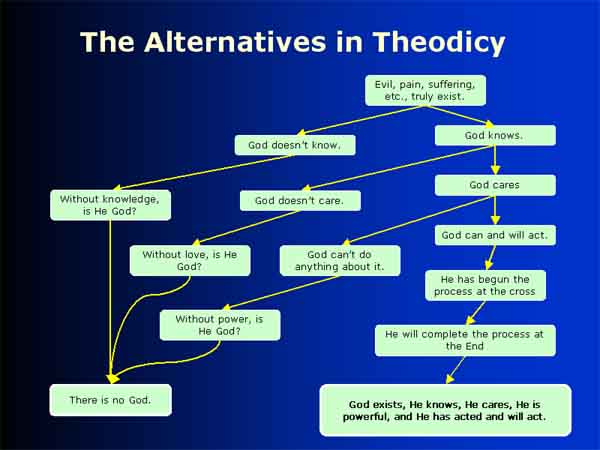
There are lots of things I could say in response. He's probably talking about gratuitous evil, that is, evil that serves no purpose at all in God's scheme of things.

Notice that Loftus does not really seem to understand Heddle's response.  Heddle is reformed. And I have not met a reformed person who thinks that there is any such thing as evil that serves no purpose in God's machinations.  

Theologians just haven't figured out whether it exists or not given their conception of God as an omnipotent and omnibenelovent being.

I totally disagree with that. The problem is not that the Bible is clear. The problem is that people do not believe what it says.  

It takes a person who has serious mental issues and a whole lot of theological gerrymandering to reconcile them. Nonetheless, the problem isn't that shit happens but so much of it happens. A whole lot of it can hit the fan and be strewn about for a few years, even killing upwards to half the world's population like the Black Death Plague. But then on Heddle's view this too fits the data.

I think the problem is that Loftus and others who raise this objection think they know how much suffering and evil should be allowed to take place. They also seem to think that all the possible evil that can happen does happen and that God does nothing to lessen suffering and restrain evil. The Bible clearly says that he does. None of Loftus' arguments address this point.  I would agree with Heddle and would extend his point and point out that sin explains the preponderance of evil and suffering of every living thing.

I'm writing a series of posts on what it takes to be a Christian apologist and Heddle committed the very first blunder, which is to "miscaricaturize your opponent's arguments to the point of failing to even try to understand them, or feigning ignorance as to what they are, and/or being willingly ignorant of them."

Loftus commits the blunder of miscaricaturizing his  "opponent's arguments to the point of failing to even try to understand them, or feigning ignorance as to what they are, and/or being willingly ignorant of them"not Heddle.

You see, it's not just that nature is red in tooth and claw, although that is a big factor. It's that an omnibenelovent God doesn't stop the most heinous of sufferings from occurring even though he could do so. [Please, if anyone comments or tries to rebut what I'm saying re-read that last sentence over and over again to get it]. Heddle is commenting on the wrong sort of problem and acting as if he answered the problem I pointed out. That's called strawmanning an argument. This is so obvious a child could see it.

Heddle did answer the point. He talked about all suffering - whether or not you think that it's gratuitous or not. No one, not even Loftus, can tell you that God never stops the worst sufferings from occurring because we would not always know.  "Omnibenevolence" does not mean that God does not allow suffering of any kind. And given our limited knowledge we are unable to really know what is best for us or anyone else. The whole point of being a Christian is recognizing and accepting that God does know. If you reject that God has the right to decide what is allowed and what is not then of course you are not only making the wrong argument, you cannot even ask the right question.

Heddle totally ignores that I had said:
In a universe where there is an all powerful, perfectly good, all knowing God this tragedy is not what we would expect to happen. There were innocent children who were brutally massacred. We would not expect that after praying the Lord's prayer to a loving heavenly father that such a deity would allow this to happen, just as we would not expect a father in that school to sit by and do nothing while the gunman killed his children.

What could a loving heavenly father have done? There are tons of things. Just have the gunman's brakes fail on the way so he would crash his car into a telephone pole and die. If God knew the man would one day kill these people then he could have killed him in a thousand unsuspecting ways like this. He had twenty years to do it. God could have snapped his omnipotent fingers causing the man to have massive amnesia such that he wouldn't know who he is, or what he was going to do with his guns that morning. God could have caused his guns to misfire if nothing else. God did nothing that a loving father would have done.

When comparing these two hypotheses the God hypothesis fails and the godless hypothesis prevails, hands down, no question, no ifs ands or buts about it.
So it's obvious Heddle is strawmanning my argument.

As human beings we have no idea what to expect. We do not know what all the parameters are or what are all the design goals in God's plan. I'm not proposing just throwing up your hands and crying "mystery". We can't even ask the right questions. I am claiming that we should agree with God. God has told us what we need to know in the Bible. God is sovereign control. And the sufferings we see now are finite and not worthy of comparison (read Romans 8 again).

From this I've devised a first of it's kind test for a delusional person:

When an intelligent person who should know better so badly strawman's an argument, it's a clear and distinct indicator that the person is delusional. In other words, the more intelligent a person is and the more easily the strawman argument can be spotted, then the more it is that what we're dealing with is a delusional person. A delusional person cannot even see what the problem is enough to answer it.

How do ya like me now Heddle? ;-)

Now, far be it from me to offer any Biblical guidance to Dr. Heddle, but his problem is not only an omnibenevolent God's inactivity at the precise moment when he should have acted, but it's also his lies.

I won't presume to speak for Heddle, but I will say that it's Loftus who is delusional. His strawman is that God does not act the way he thinks God should should have. None of us know what God's plan is or the details as what it will take to carry it out. Loftus pretends to know something he can't know and then rejects God based on that ignorance. Delusion illustrated.

For don't we read in the Holy Book of God's assurance he'll protect the innocent, the saved, and the faithful? Or, in the face of other contrary passages, is Heddle going to do a whole lot of theological gerrymandering to reconcile them?

Wow.  Most times an atheist attempts to conduct exegesis on the Bible, a faceplant is the result. Loftus attempts to list a whole bunch of scriptures that talk about how God assures his people of God's protection but he does recognize that there are scriptures that tells us that good people do suffer. So do we have a bunch of contradictions? Nope. For once, Loftus pastes relevant Bible passages but makes me wonder about his comprehension abilities. He thinks that they teach that God promises prosperity and safety at all times. 


Psalm 46

God is our refuge and strength,
an ever-present help in trouble.
2 Therefore we will not fear, though the earth give way
and the mountains fall into the heart of the sea,
3 though its waters roar and foam
and the mountains quake with their surging.

4 There is a river whose streams make glad the city of God,
the holy place where the Most High dwells.
5 God is within her, she will not fall;
God will help her at break of day.
6 Nations are in uproar, kingdoms fall;
he lifts his voice, the earth melts.

7 The Lord Almighty is with us;
the God of Jacob is our fortress.

8 Come and see what the Lord has done,
the desolations he has brought on the earth.
9 He makes wars cease
to the ends of the earth.
He breaks the bow and shatters the spear;
he burns the shields[d] with fire.
10 He says, “Be still, and know that I am God;
I will be exalted among the nations,
I will be exalted in the earth.”

11 The Lord Almighty is with us;
the God of Jacob is our fortress.

The Psalm does not tell us that there is no trouble or suffering. The promise is that God will be there for his people in the midst of all the trouble and suffering. To what purpose: God's exaltation. Notice that it's not that there will be no war or natural disasters.  The promise is deliverance not avoiding suffering.

--------------

Psalm 91
He who dwells in the shelter of the Most High will rest in the shadow of the Almighty. I will say of the LORD, "He is my refuge and my fortress, my God, in whom I trust." Surely he will save you from the fowler's snare and from the deadly pestilence. He will cover you with his feathers, and under his wings you will find refuge; his faithfulness will be your shield and rampart. You will not fear the terror of night, nor the arrow that flies by day, nor the pestilence that stalks in the darkness, nor the plague that destroys at midday. A thousand may fall at your side, ten thousand at your right hand, but it will not come near you. You will only observe with your eyes and see the punishment of the wicked. If you make the Most High your dwelling - even the LORD, who is my refuge - then no harm will befall you, no disaster will come near your tent. For he will command his angels concerning you to guard you in all your ways; they will lift you up in their hands, so that you will not strike your foot against a stone. You will tread upon the lion and the cobra; you will trample the great lion and the serpent. "Because he loves me," says the LORD, "I will rescue him; I will protect him, for he acknowledges my name. He will call upon me, and I will answer him; I will be with him in trouble, I will deliver him and honor him. With long life will I satisfy him and show him my salvation."

This Psalm does not describe life for all believers for all times. I mean to interpret scripture that way means that he assumes a high degree of gullibility. If this is the way he thought when he was a "Christian" no wonder he thinks that Christians are gullible. Does this mean that God does not protect those who  put their trust in God? Oh no. But it doesn't mean what Loftus says is correct about God not intervening in the lives of people today.  It doesa not mean that God is obligated to keep me from suffering. I trust God that no matter what happen God does what is best for me.

Deuteronomy 33 v 29:
Blessed are you, O Israel! Who is like you, a people saved by the LORD? He is your shield and helper and your glorious sword. Your enemies will cower before you, and you will trample down their high places.

I see no problem here. It's a boast in who God is and what God has promised Israel. I think this passage is horrible for showing Loftus' point. Unless you are Jewish, you can't stand on this promise.  and God's promises of safety and victory for Israel as a people are conditioned on their obedience.  Seriously bad hermeneutic, Mr Loftus. Context would help.

Psalm 27 v 1 & 5:
The LORD is my light and my salvation-whom shall I fear? The LORD is the stronghold of my life-of whom shall I be afraid? For in the day of trouble he will keep me safe in his dwelling; he will hide me in the shelter of his tabernacle and set me high upon a rock.

Again, this passage is not promising no suffering or trouble! It tells us what God is going to do when those things come and why we don't have to be afraid. 

Psalm 31v 20:
In the shelter of your presence you hide them from the intrigues of men; in your dwelling you keep them safe from accusing tongues.

Loftus seems to to think that the Bible is promising that the believer would not suffer people lying on them and making false accusations. Where does it say that? It does not! Those who trust God will be vindicated.

Psalm 32 v 7:
You are my hiding place; you will protect me from trouble and surround me with songs of deliverance.

 If there is no trouble or problems, why would we need a hiding place? Sorry this scripture also goes against Loftus' delusions.

Psalm 34 v 7-8:
The angel of the LORD encamps around those who fear him, and he delivers them. Taste and see that the LORD is good; blessed is the man who takes refuge in him.

Again the passage is not saying that you won't need deliverance but that God gives us deliverance when we need it because we will need it. 

Psalm 37 v 39-40:
The salvation of the righteous comes from the LORD; he is their stronghold in time of trouble. The LORD helps them and delivers them; he delivers them from the wicked and saves them, because they take refuge in him.

Again we can count on the Lord saving us just as much as we can that we will need saving from trouble.

Psalm 57 v 1:
Have mercy on me, O God, have mercy on me, for in you my soul takes refuge. I will take refuge in the shadow of your wings until the disaster has passed.

Again not that disaster does not come but when in God we can survive it.

Psalm 62 v 5-8:
Find rest, O my soul, in God alone; my hope comes from him. He alone is my rock and my salvation; he is my fortress, I will not be shaken. My salvation and my honor depend on God; he is my mighty rock, my refuge. Trust in him at all times, O people; pour out your hearts to him, for God is our refuge.

Amen. We are completely depended on God. Yes, Mr Loftus, with each scripture you dig yourself a whole further and further down.

Psalm 119 v 114:
You are my refuge and my shield; I have put my hope in your word.

You don't need a shield or a refuge if nothing bad is happening. No promise of no problems here either.

Psalm 121:
I lift up my eyes to the hills-where does my help come from? My help comes from the LORD, the Maker of heaven and earth. He will not let your foot slip - he who watches over you will not slumber; indeed, he who watches over Israel will neither slumber nor sleep. The LORD watches over you- the LORD is your shade at your right hand; the sun will not harm you by day, nor the moon by night. The LORD will keep you from all harm-he will watch over your life; the LORD will watch over your coming and going both now and forevermore.

Yup, still doesn't tell us what Loftus thinks Christians have to believe. Keeping me from harm does not mean that I never have problems.

Psalm 125 v 1-2:
Those who trust in the LORD are like Mount Zion, which cannot be shaken but endures forever. As the mountains surround Jerusalem, so the LORD surrounds his people both now and forevermore.

 Still more truth.

Psalm 145 v 18:
The LORD is near to all who call on him, to all who call on him in truth.

Which is why God is the best refuge and shield. 

2 Samuel 22 v 31-37:
"As for God, his way is perfect; the word of the LORD is flawless. He is a shield for all who take refuge in him. For who is God besides the LORD? And who is the Rock except our God? It is God who arms me with strength and makes my way perfect. He makes my feet like the feet of a deer; he enables me to stand on the heights. He trains my hands for battle; my arms can bend a bow of bronze. You give me your shield of victory; you stoop down to make me great. You broaden the path beneath me, so that my ankles do not turn.

Notice how the passage does not say we don't have to fight. God equips us and give us what we need so we can fight and fight the way God tells us to do.

Isaiah 12 v 2:
Surely God is my salvation; I will trust and not be afraid. The LORD, the LORD, is my strength and my song; he has become my salvation.

Yup. Still doesn't conflict with reality but does conflict with Loftus.

Isaiah 25 v 9:
In that day they will say, "Surely this is our God; we trusted in him, and he saved us. This is the LORD, we trusted in him; let us rejoice and be glad in his salvation."

This how you praise God after you have been delivered. Good reminder.

Isaiah 43 v 1-5:
But now, this is what the LORD says - he who created you, O Jacob, he who formed you, O Israel: "Fear not, for I have redeemed you; I have summoned you by name; you are mine. When you pass through the waters, I will be with you; and when you pass through the rivers, they will not sweep over you. When you walk through the fire, you will not be burned; the flames will not set you ablaze. For I am the LORD, your God, the Holy One of Israel, your Savior; I give Egypt for your ransom, Cush and Seba in your stead. Since you are precious and honored in my sight, and because I love you, I will give men in exchange for you, and people in exchange for your life. Do not be afraid, for I am with you; I will bring your children from the east and gather you from the west.

Interesting Loftus would choose this passage given that it was fulfilled. Anyone else remember the 1948 creation of the modern state of Israel or that airlifting and repatriation  of  Jews from all over the world? No?  You're welcome.

Matthew 10 v 28-31:
Do not be afraid of those who kill the body but cannot kill the soul. Rather, be afraid of the One who can destroy both soul and body in hell. Are not two sparrows sold for a penny? Yet not one of them will fall to the ground apart from the will of your Father. And even the very hairs of your head are all numbered. So don't be afraid; you are worth more than many sparrows.

These are Jesus' words. Notice that by telling us not to be afraid of those who can kill us because this is so that we can recognize that we may be killed.

1 Peter 3 v 12-13:
For the eyes of the Lord are on the righteous and his ears are attentive to their prayer, but the face of the Lord is against those who do evil. Who is going to harm you if you are eager to do good?

I think the best way to understand just how bad Loftus flubs up here is to point out the context of the passage.

8 Finally, all of you, be like-minded, be sympathetic, love one another, be compassionate and humble. 9 Do not repay evil with evil or insult with insult. On the contrary, repay evil with blessing, because to this you were called so that you may inherit a blessing. 10 For,
“Whoever would love life
    and see good days
must keep their tongue from evil
    and their lips from deceitful speech.
11 They must turn from evil and do good;
    they must seek peace and pursue it.
12 For the eyes of the Lord are on the righteous
    and his ears are attentive to their prayer,
but the face of the Lord is against those who do evil.”[a]
13 Who is going to harm you if you are eager to do good? 14 But even if you should suffer for what is right, you are blessed. “Do not fear their threats[b]; do not be frightened.”[c] 15 But in your hearts revere Christ as Lord. Always be prepared to give an answer to everyone who asks you to give the reason for the hope that you have. But do this with gentleness and respect, 16 keeping a clear conscience, so that those who speak maliciously against your good behavior in Christ may be ashamed of their slander. 17 For it is better, if it is God’s will, to suffer for doing good than for doing evil. - 1 Peter 3:8-18

Let's help Loftus out. He's confused. He completely missed Peter's point. It's not that you will not suffer for doing good but how you should act if you do. And we should not do things to bring suffering and punishment on ourselves for doing evil.

Hebrews 13 v 5-6:
Keep your lives free from the love of money and be content with what you have, because God has said, "Never will I leave you; never will I forsake you." So we say with confidence, "The Lord is my helper; I will not be afraid. What can man do to me?"

 I really like this last passage and it fits well with the way I wanna conclude this. The Bible does not say that we  do not have problems and suffering. We are stupid to think that we can tell God what is and isn't too much suffering. I'm amazed that Loftus doesn't really deal with the scriptures that tell us how to deal with suffering. The Bible is full of such passages but I will point to only two now.

18 I consider that our present sufferings are not worth comparing with the glory that will be revealed in us. 19 For the creation waits in eager expectation for the children of God to be revealed. 20 For the creation was subjected to frustration, not by its own choice, but by the will of the one who subjected it, in hope 21 that[h] the creation itself will be liberated from its bondage to decay and brought into the freedom and glory of the children of God. - Romans 8:18-21

So is there a contradiction? The best way to understand this is us the life of Job. Here was a man who was righteous and blameless and God allowed Satan to kill his family, take all he had, and to take his health. The way to deal with suffering is the way Job dealt with his suffering. He turned to God and did not loose his trust.  Here is how Job looked at it.

14 Why do I put myself in jeopardy
    and take my life in my hands?
15 Though he slay me, yet will I hope in him;
    I will surely[a] defend my ways to his face.
16 Indeed, this will turn out for my deliverance,
    for no godless person would dare come before him! - Job 13:14-16


and

23 “Oh, that my words were recorded,
    that they were written on a scroll,
24 that they were inscribed with an iron tool on[b] lead,
    or engraved in rock forever!
25 I know that my redeemer[c] lives,
    and that in the end he will stand on the earth.[d]
26 And after my skin has been destroyed,
    yet[e] in[f] my flesh I will see God;
27 I myself will see him
    with my own eyes—I, and not another.
    How my heart yearns within me! - Job 19:23-27

Debunking Christianity: Dr. David Heddle, "Shit Happens"

The Debt Limit Explained - YouTube

Want a clear and unbiased explanation of the financial crisis America is in? Well this video ain't that, but it is a good starting place to understand how the executive and legislative branches of the federal government have screwed up our finances. The video is clearly biased against congress but give it a look anyway.


The Debt Limit Explained - YouTube
Enhanced by Zemanta

Ravi Zacharias on the Problem of Evil - Apologetics 315

English: Ravi Zacharias signing books at the F...
English: Ravi Zacharias signing books at the Future of Truth conference (2004) at Moody Memorial Church in Chicago, Illinois. (Photo credit: Wikipedia)
Brian Auten posted the following quote from Dr. Ravi Zacharias. It's a gem!

"When you say there's too much evil in this world you assume there's good. When you assume there's good, you assume there's such a thing as a moral law on the basis of which to differentiate between good and evil. But if you assume a moral law, you must posit a moral Law Giver, but that's Who you're trying to disprove and not prove. Because if there's no moral Law Giver, there's no moral law. If there's no moral law, there's no good. If there's no good, there's no evil. What is your question?"

—Ravi Zacharias

In response to the objection, "There cannot be a God, because there is too much evil in this world."
Can Man Live Without God?, p. 182 [HT]


Ravi Zacharias on the Problem of Evil - Apologetics 315
Enhanced by Zemanta

Monday, January 21, 2013

I Celebrate MLK! (song for kids about Martin Luther King, Rosa Parks, segregation, etc.) - YouTube

When I told my six year-old that today was a holiday celebrating Dr Martin Luther King Jr's birthday her response was "Who's Martin Luther King?" I was shocked. How could I let that get past? So last night I found the following video on YouTube and she watched it today and loved it. More importantly she now has a starting point on knowing some basic things about such an important historical figure! Take a look.


I Celebrate MLK! (song for kids about Martin Luther King, Rosa Parks, segregation, etc.) - YouTube

Friday, January 18, 2013

FacePlant of the Day - Debunking Christianity: On Justifying the Use of Ridicule and Mockery

John Loftus has finally posted an article that I have to largely agree is true. We are truly living in an age of miracles.

Hey, I KNOW Christians don't like being mocked. I get that. So it's no surprise they would object to it by saying it doesn't cause them to change their minds, that it makes them dig their heels in deeper, and that it just makes them think less of the one doing the mocking. You would expect them to say this. The facts however are different. Ridicule and mockery have been very effective in any cultural war and they will forever be effective and necessary.

Just who does like to be mocked? I don't think anyone enjoys it. Loftus surely doesn't like being mocked. For example he doesn't like the site Debunking Loftus: Setting John Straight and apparently does not like the blog's tag line which is the title of the blog's corresponding book The Cowboy that Wasn't There.
 
Loftus is correct that ridicule and mockery are indeed effective and relevant tools for communication. However it is important that it just can't be biting or offensive or provocative. It must be true and the motives behind it must be true.

There have been some very famous satires in history. Here are four important ones:

1) Aristophanes's Greek comedy The Clouds, portrays Socrates as a buffoon and a deceiver of the young. It was the first comedy "of ideas" and was a contributing factor in the trial and death of Socrates.

2) In 1729 Jonathan Swift wrote A Modest Proposal for Preventing the Children of Poor People From Being a Burden to Their Parents or Country, and for Making Them Beneficial to the Publick, where he mocks the English mistreatment of the Irish poor (a subject dear to my heart being of Irish descent). Swift suggests the solution for the impoverished Irish was to sell their children as food to the rich.

3) In 1759 Voltaire's Candide effectively mocked Leibniz's theodicy that "all is for the best in the best of all possible worlds."

4) Thomas Taylor wrote a satire of Mary Wollstonecraft's book A Vindication of the Rights of Woman (1792). Her book was the first defense of women's rights in Western English literature. She attacked gender oppression and argued for equal educational opportunities, justice, and equality for all humanity. Taylor mocked her ideas with A Vindication of the Rights of Brutes, arguing that if women have rights, then animals also have rights, but that was preposterous to him and to his readers at the time. The irony of Taylor's satire is that he provided some of the first arguments for animal rights that are used today (by those who also condemn his sexism).

I''d like to add a fifth example. Jesus uses mockery to drive home his message also. In fact the Bible has many examples.

23 “Woe to you, teachers of the law and Pharisees, you hypocrites! You give a tenth of your spices—mint, dill and cumin. But you have neglected the more important matters of the law—justice, mercy and faithfulness. You should have practiced the latter, without neglecting the former. 24 You blind guides! You strain out a gnat but swallow a camel.
25 “Woe to you, teachers of the law and Pharisees, you hypocrites! You clean the outside of the cup and dish, but inside they are full of greed and self-indulgence. - Matthew 23:23-25
Now, does anyone think these satires convinced the people who disagreed, the ones who made the case that was being mocked by these satires? I highly doubt it. I doubt they changed any minds among the ones who thought differently, who knew Socrates personally, who considered the Irish to be garbage, who agreed with Leibniz, or thought women were second rate human beings. These people cannot be convinced by satire, so satire is not written to change their minds. It's written to marginalize them by laughing at them. It persuades people who don't yet have a settled opinion on the issue, in part by using social pressure. No one wants to be a laughingstock. No one wants to be the butt of a joke. If people are laughing at a particular view it pressures the undecided to distance themselves from it. It draws a line in the sand, so to speak. It can also silence people who think otherwise, for they won't want to speak up in a class on behalf of something most others will laugh at.

I think this underscores the motivations between  non-believers using satire and ridicule and the motivations between believers using them. When a believer uses them satire it is to literally change others' minds not to shame intractable people into silence or scare those on the fence to side with you. If you have to do that, you don't have good arguments. You are just a a mean bully. 

Isn't using laughter an informal fallacy known as Appealing to Ridicule? It sure is. Shouldn't all intelligent people denounce using an informal fallacy then? Shouldn't they instead take the moral and intellectual high ground? No, not at all. In some ways we just cannot help ourselves since some ideas seem that preposterous. When something cannot be taken seriously it deserves our laughter. We all do it, all of us. Should we hide our laughter so as not to offend? I think not. It's a way to "come out of the closet," so to speak, to let others know they will be laughed at if they espouse certain ideas with a straight face. There is power in social pressure. There is power in numbers.

 I totally agree that preposterous ideas deserve laughter. However you should be able to demonstrate why an idea or concept deserves derision. Remember at one point s heliocentric solar system was laughed at and ridicule and some people changed their minds to deny it due to peer pressure. Truth and reality should always trump what you think about the ideas you consider. Preposterous ideas does no equate to false.

Ridicule also shows people just how bad we think the case is for something. The worse we think the case is then the more our ridicule shows people what we really think of it. Laughter is an entirely appropriate response to a person who suggests women are inferior to men. That's how bad the case is for sexism. And the more studied a person is on a particular issue then more force that person's ridicule has on others. I'm ridiculed almost daily by believers who are usually ignorant of their own ignorance, so their ridicule shouldn't matter at all. By contrast, I have spent 40 years studying Christianity and my conclusion is that believers who seek to defend it are worth being laughed at. I laugh almost daily when reading something written by one of the top Christian apologists. They remind me of the story of the emperor who has no clothes on, really. I'm not kidding. Been there done that myself. Now I'm wearing clothes. I'm never going back to that nutty nudist camp for the mentally challenged who are all infected with the same virus of the mind.

Truth is Loftus does not realize how naked he is. I keep finding his understand of theology, and what the Bible says lacking of knowledge. Either Loftus mocks what he does not know or he often lies about what Christians believe and what the the Bible says. 

The use of ridicule can be justified pragmatically. It works well under the right circumstances, depending on the issue and the potential effectiveness of using it. It is best used when the arguments are there to back it up, and when more people agree against the ideas that are being ridiculed. This is what Stephen Law, Richard Carrier and I are saying about the use of ridicule, and we have earned the right to use it because we have produced the arguments. That is, because we know Christianity is a delusion, and since deluded people cannot usually be argued out of their faith because they were never argued into it in the first place, the use of persuasion techniques like ridicule are rationally justifiable. So satire, ridicule and mockery are weapons that should be in our arsenal in this important cultural war of ideas.

I've seen Law's and Carrier's arguments and they are no better that Loftus' own. At the end of the day all ll they have is satire and mockery 

Human beings may be so bad at reasoning that persuasion is all that matters. We are not like Spock of Star Trek. Not one is. Far, far, from it. If this even has some modicum degree of truth to it, and I think it does, then that alone justifies the use of mockery. Christians, for instance, are not usually reasoned into their faith. They were persuaded into it. They were persuaded to believe by the circumstances of their upbringing and/or the likability of a significant person in their lives. Based on this human propensity of ours, mockery might actually be more effective than thought, for if they were persuaded into their faith then maybe they can also be persuaded out of it.

I think Loftus is speaking from experience. If you don't know God for yourself, then you were never really in Christianity and of course you can be persuaded out of it. Your realization just lines up with reality

Science is the only antidote to this propensity of ours, and science has spoken on matters of faith. Faith is an unreliable process for gaining knowledge. Therefore the Christian faith, qua faith, is a delusion for childish people. Doubt is the adult attitude. Ridicule is both helpful and necessary. Someday in the future people will treat Christianity just like all of the other dead gods and religions are treated today. We mock them. In the future, anyone who learns about Christianity in a history book will mock it like all the other dead religions.

Here is an example Loftus attempting to use ridicule to shock Christians to give up  on God.  He says that having faith is unreliable and childish. But having to read some of his blog posts, I know that he thinks faith is believing something that is not true despite the evidence. He is front loading a lot of presuppositions and assumptions about Biblical reliability and what evidence is. This is what I mean by Loftus not making a good argument. The way he defines "faith" is not the way the Bible defines "faith".

Nothing I've said should lead anyone to think all we need is mockery. Far from it. I will continue reasoning with believers as always. It's just that mockery is effective, necessary, and justifiable in this cultural war. It's one of the weapons we need to change the religious landscape, which is my goal.

I'm amazed that Loftus thinks what he does is "reasoning".

If you meet people who think otherwise then send them here to discuss it.

So do mockery , ridicule, and satire figure into Christianity? Some say that it doesn't. But that can't be true because God uses it in the Bible. It's not immoral or wrong if you are going to do it right.  How do you know? 

13 Who is going to harm you if you are eager to do good? 14 But even if you should suffer for what is right, you are blessed. “Do not fear their threats[b]; do not be frightened.”[c] 15 But in your hearts revere Christ as Lord. Always be prepared to give an answer to everyone who asks you to give the reason for the hope that you have. But do this with gentleness and respect, 16 keeping a clear conscience, so that those who speak maliciously against your good behavior in Christ may be ashamed of their slander. 17 For it is better, if it is God’s will, to suffer for doing good than for doing evil. - 1 Peter 3:13-17

You can use ridicule and mockery and still use gentleness and respect - with God's help. Which explains why Loftus cannot do so.

Debunking Christianity: On Justifying the Use of Ridicule and Mockery
Enhanced by Zemanta