SMU Debate: Can We Trust the Text of the New Testament? Daniel B. Wallace & Bart D. Ehrman
Personal blog that will cover my personal interests. I write about Christian Theology and Apologetics, politics, culture, science, and literature.
Sunday, November 27, 2011
SMU Debate: Can We Trust the Text of the New Testament? Daniel B. Wallace & Bart D. Ehrman
I just watched the October 1st debate between Dr Daniel Wallace and Dr Bart Ehrman. If you haven't seen it use the link below to order it on DVD. It's well worth it. Ehrman has changed his tune. He used to say that we know what the autographs say due to the work critical criticism but when Wallace quoted him saying that he said that he no longer believes that (link). I've got to give him more credit than Dan "Don't quote me, Bro!" Barker (look at this link if you didn't get the reference). At least Ehrman says he changed his mind instead of trying to pretend he never said it. Here is a trailer for the October 1st Debate.
SMU Debate: Can We Trust the Text of the New Testament? Daniel B. Wallace & Bart D. Ehrman
Saturday, November 26, 2011
John Lennon - Imagine Atheism - YouTube
Mariano has done it again - A well-done commentary on Atheism!
John Lennon - Imagine Atheism - YouTube
Labels:
Atheism,
Imagine: John Lennon,
John Lennon,
Mariano Grinbank,
YouTube
“Science” Programming on Television [Comic]
I think this graphic is a little unfair because I've seen other shows than these on the History Channel and it's gotten worse - way more stuff I don't care about and attributing ancient achievements to extraterrestrials. Neither Spike TV's science/history shows or G4TV's offerings are on the list. Oh well.
“Science” Programming on Television [Comic]
[Source: PHD Comics]
“Science” Programming on Television [Comic]
Related articles
- Suck it, History Channel (amightypen.net)
- Former Oklahoman will be featured on new History Channel show (newsok.com)
- VIDEO INTERVIEW PhD movie cast and crew discuss film, tour (tech.mit.edu)
- History Channel officially becomes a subsidiary of the Obama White House (gunnyg.wordpress.com)
- Change of state (quantumdiaries.org)
The Deity of Christ/Trinity Debate with Patrick Navas on Chris Date's Theopologetics Podcast
A debate on Chris Date's Theopologetics Podcasts regarding the Deity of Christ and the Trinity between James White and Patrick Navas. It's amazing to me that this is even still a point of debate. I think the New Testament clearly spells out who Jesus is and why He is able to be the perfect sacrifice atoning for the sins of those who put their faith in Him. No mere man can do that, but a man - a kinsman redeemer - to obey God where Adam (and we) fail to obey God. I'm just glad that a capable scholar like Dr James White is used of God when th.is subject invariably comes. Of Course this is where Christianity gets attacked a lot - by Islam, Atheism, Mormonism, and any other competing ideology. Follow the link to James White's blog below to get to the links to hear the debate.
The Deity of Christ/Trinity Debate with Patrick Navas on Chris Date's Theopologetics Podcast
Related articles
- False teacher follow up (4simpsons.wordpress.com)
- The Deity of Jesus Christ (enrichedspirituallife.com)
- "God Became Man that Man Might Become God" (biblethumpingliberal.com)
- Giving Thanks For Faith! (justicemusings.wordpress.com)
- The Word and the Teachings of Jesus (thetanetworkersjourney.wordpress.com)
- The Deity of Jesus Christ: By Cooper Abrams (chaplaingary.wordpress.com)
- He is the Reason for the Season (foruntous.wordpress.com)
- Reconciliation and Representation: Doctrine of Christ (wateristhickerthanblood.wordpress.com)
Labels:
Christianity,
Christology,
Debate,
Deity of Christ,
God,
James White,
Jesus,
New Testament,
Patrick Navas,
Trinity
Friday, November 25, 2011
How Games Make Kids Smarter [Video]
Gabe Zichermann presents a talk on how video games have improved education and problem-solving in the adult world. He is the same age as I and he views video games much as I do. Very interesting.
How Games Make Kids Smarter [Video]
Related articles
- Video Games and Learning (technologies4education.wordpress.com)
- Do Video Games Make Kids Smarter? (callanrogers.wordpress.com)
- How Games Make Kids Smarter [Video] (geeksaresexy.net)
Labels:
Console,
culture,
Gabe Zichermann,
History,
Video game
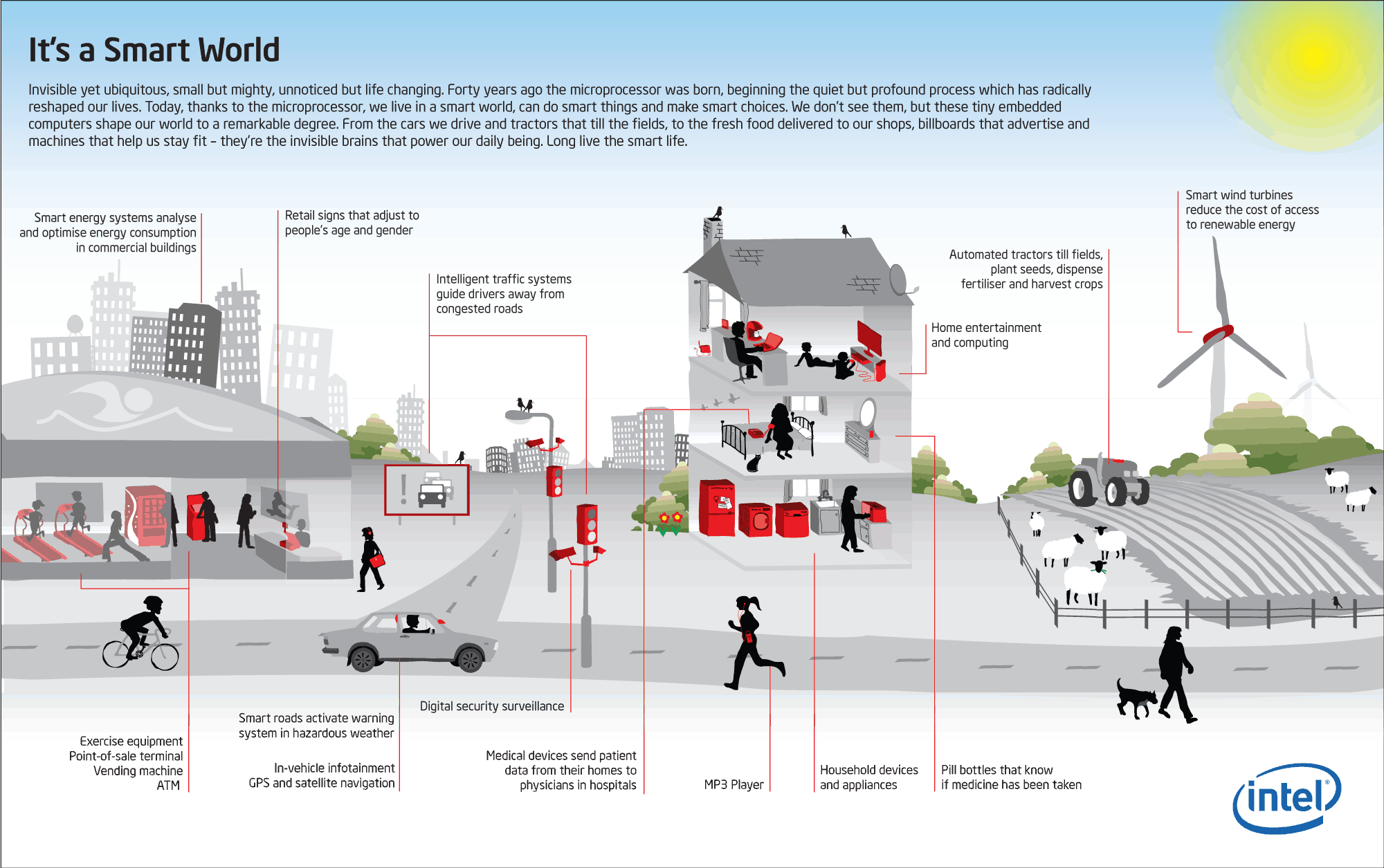
Its_a_Smart_World_infographic.png (PNG Image, 2000x1255 pixels) - Scaled (50%)
Well I'm blessed to have lived my entire life with microprocessors being used all around me all my life. This infographic will make you think.
Its_a_Smart_World_infographic.png (PNG Image, 2000x1255 pixels) - Scaled (50%)
Thursday, November 24, 2011
Interviews From San Francisco
Recently Dr Michael Licona interviewed a few scholars on camera in San Francisco. The videos are now on YouTube.
Dr Dan Wallace and Dr Paul Copan on the controversy regarding Dr Norman Giesler, Licona, and Matthew 27.
Dr Dan Wallace talked about his recent debate against Dr Bart Ehrman.
Wednesday, November 23, 2011
Bring It: Does The Bible Describe Current Times?
For this installment, Let's consider if the Bible describes the current world accurately? This comes up because Ryan Anderson disagrees with what a statement I made when I posted a quote from Dr Carl Sagan at the following link.
What had happen' was.....: Carl Sagan Quote Worth Consideration!
I had remarked about how chillingly accurate Sagan described our present day and that the Bible said the same thing. Ryan Anderson disagreed and when I said if he understood the Bible as he claims to he must know what scripture passages to which I refer. He said:
Sounds fun. Alright, let us commit. There are so many passages to choose from, but let's pick one. Just so that he understands what the challenge is let's state it clearly: Demonstrate how the following scripture referred to below does not describe the world we live in today. For example:
Let's make this really fun and open this up to everyone. Feel free suggest other Bible passages or state your own reasons that the passages chosen don't describe I world today. Go ahead. Take your best shot.
[UPDATE - 12-03-2011]
Ryan Anderson and Johnny P have both attempted to argue that 2 Timothy 3:1-9 does not apply today because these are not the "last days". Of course they both think that Paul and the other first generation Christians believed Jesus would return in their lifetimes. I fail to understand why that matters. Jesus did not say that he would return before the end of the first century, but they would have been stupid to not live like Jesus would imminently return just like Christians are stupid today if we don't. That is if we believe what we say we believe.
Notice what the Bible says in 2 Timothy 3:1.One of the arguments unbelievers rely on is the idea that God can't exist and be what Christians believe about him and their exist evil and suffering. But Johnny P has to mitigate that if he wants to argue that these days are not the last days. Are they terrible days or not? If it is, then you have to look further into Paul's argument. If it isn't, then you can't invoke the Problem of Evil against Theism.
What had happen' was.....: Carl Sagan Quote Worth Consideration!
I had remarked about how chillingly accurate Sagan described our present day and that the Bible said the same thing. Ryan Anderson disagreed and when I said if he understood the Bible as he claims to he must know what scripture passages to which I refer. He said:
I have my suspicions, but I'd like you to commit so we can dissect exactly how easy it is to read anything into loose language.
Sounds fun. Alright, let us commit. There are so many passages to choose from, but let's pick one. Just so that he understands what the challenge is let's state it clearly: Demonstrate how the following scripture referred to below does not describe the world we live in today. For example:
1 But mark this: There will be terrible times in the last days. 2 People will be lovers of themselves, lovers of money, boastful, proud, abusive, disobedient to their parents, ungrateful, unholy, 3 without love, unforgiving, slanderous, without self-control, brutal, not lovers of the good, 4 treacherous, rash, conceited, lovers of pleasure rather than lovers of God— 5 having a form of godliness but denying its power. Have nothing to do with such people.
6 They are the kind who worm their way into homes and gain control over gullible women, who are loaded down with sins and are swayed by all kinds of evil desires, 7 always learning but never able to come to a knowledge of the truth. 8 Just as Jannes and Jambres opposed Moses, so also these teachers oppose the truth. They are men of depraved minds, who, as far as the faith is concerned, are rejected. 9 But they will not get very far because, as in the case of those men, their folly will be clear to everyone. 2 Timothy 3:1-9
Let's make this really fun and open this up to everyone. Feel free suggest other Bible passages or state your own reasons that the passages chosen don't describe I world today. Go ahead. Take your best shot.
[UPDATE - 12-03-2011]
Ryan Anderson and Johnny P have both attempted to argue that 2 Timothy 3:1-9 does not apply today because these are not the "last days". Of course they both think that Paul and the other first generation Christians believed Jesus would return in their lifetimes. I fail to understand why that matters. Jesus did not say that he would return before the end of the first century, but they would have been stupid to not live like Jesus would imminently return just like Christians are stupid today if we don't. That is if we believe what we say we believe.
Notice what the Bible says in 2 Timothy 3:1.One of the arguments unbelievers rely on is the idea that God can't exist and be what Christians believe about him and their exist evil and suffering. But Johnny P has to mitigate that if he wants to argue that these days are not the last days. Are they terrible days or not? If it is, then you have to look further into Paul's argument. If it isn't, then you can't invoke the Problem of Evil against Theism.
Verses 2-5 perfectly describe the evil in the world today and it is getting worse. They describe Congress alone, let alone the rest of the world!
Verses 6-9 I think applies more to the Church than the world. The world ignores a lot of teaching instructing - the godless and otherwise. What is the most telling is how we have so many clergy teaching one things living something else.
Labels:
Bible,
Bring it,
Carl Sagan,
Moses,
Religion and Spirituality,
Ryan Anderson
Answering Muslims: Josh McDowell vs. Ahmed Deedat: Was Christ Crucified?
| Image via Wikipedia |
Answering Muslims: Josh McDowell vs. Ahmed Deedat: Was Christ Crucified?
Labels:
Ahmed Deedat,
Christ Crucified,
Christianity,
Debates,
Islam,
Jesus,
Josh McDowell,
Muslim
Answering Muslims: Kuwaiti Shaykh Yasir al-Habib Defends Temporary Marriage (Muta)
When I first heard of Muta I was shocked. It's like a sleep-with-anyone-you-want-and-not-burn-in-hell free card. Too bad I can't find any evidence that God approves. I was wondering how those who practice this justify such an obviously sinful behavior and dehumanizing women.
I'm almost sorry I asked.
Answering Muslims: Kuwaiti Shaykh Yasir al-Habib Defends Temporary Marriage (Muta)
I'm almost sorry I asked.
Answering Muslims: Kuwaiti Shaykh Yasir al-Habib Defends Temporary Marriage (Muta)
Labels:
Adultery,
David Wood,
God,
Islam,
Marriage,
Muslim,
Muta,
Prostitution
Tuesday, November 22, 2011
The Pepper Spray Cop Makes His Way into Comic Book History [Humor] - ComicsAlliance | Comic book culture, news, humor, commentary, and reviews
You may have seen the viral video of the cop pepper spraying peaceful demonstrating students who didn't seem to be breaking any law at UC Davis. Here is the video.
There has been several memes all over the internet mocking the cop was caught on video. Comics Alliance posted a few of them. This one was my favorite
Check out the others by using the following link.
The Pepper Spray Cop Makes His Way into Comic Book History [Humor] - ComicsAlliance | Comic book culture, news, humor, commentary, and reviews
There has been several memes all over the internet mocking the cop was caught on video. Comics Alliance posted a few of them. This one was my favorite
Check out the others by using the following link.
The Pepper Spray Cop Makes His Way into Comic Book History [Humor] - ComicsAlliance | Comic book culture, news, humor, commentary, and reviews
Related articles
Carl Sagan Quote Worth Consideration!
| Image via Wikipedia |
“I have a foreboding of an America in my children’s or grandchildren’s time—when the Unites States is a service and information economy; when nearly all the key manufacturing industries have slipped away to other countries; when awesome technological powers are in the hands of a very few, and no one representing the public interest can even grasp the issues; when the people have lost the ability to set their own agendas or knowledgeably question those in authority; when, clutching our crystals and nervously consulting our horoscopes, our critical faculties in decline, unable to distinguish between what feels good and what’s true, we slide, almost without noticing, back into superstition and darkness.”
— Carl Sagan, The Demon-Haunted World (via ncarinae)
Related articles
- "I have a foreboding of an America in my children's or grandchildren's time - when the United States is..." (richardjordan.tumblr.com)
Monday, November 21, 2011
Beggars All: Reformation And Apologetics: Islam: a contradiction to reason and logic and evidence
Ken has posted a great blog post about presuppostional apologetics regarding Islam. A must-read!
Beggars All: Reformation And Apologetics: Islam: a contradiction to reason and logic and evidence
Labels:
Apologetics,
Islam,
Ken,
Muslim,
Presupposition,
Presuppositional Apologetics
Sunday, November 20, 2011
Saturday, November 19, 2011
FacePlant - Epic Fail: Tisk Tisk, Johnny P Response #18a
Turns out that both Johnny P and Ryan Anderson are both not too happy with my latest response. Let's see if we can take that up several notches more, shall we? My comments will be in red. Johnny P's will be in black and Ryan Anderson's will be in purple. For the times they quote me, the quotation will be red and italicized.
What had happen' was.....: FacePlant - Epic Fail: Tisk Tisk, Johnny P Response #18
- Johnny P said...
- For pete's sake. I've read twenty odd lines, and you don't stop saying complete crap.
A lot of those first 20 lines were quoting you, Johnny P. That must of been the problem. But I thought that I was really clear about what was what I said and what you said. Go figure.
""You ought to play chess tomorrow at three" makes feck all sense unless you load a prostasis in there. That was my point. It is no different with morality unless you want to equivocate on the word 'ought'.
It makes since if someone commanded you to do it."
That is consequentialist ethics / might is right. You are being good because someone told you to. How the hell is that doing something good out of an intrinsic ought? You have no idea what you are talking about.
You still haven't explained why that's a problem, yet but you will try further along. . Oh you might try to weasel out and say you are not saying that consequentialist ethics is wrong, but you wouldn't be that dishonest would you?
Again and again. And again.
I deleted my last post by ending here, but I feel generous.
Ought you be generous? Intrinsically?
"See the trolley problem or the inquiring murderer problem.
Okay, so Johnny P is not going to meaningfully respond. Big surprise. "
If you don't even know what the trolley problem is, then you really do have no right to comment on morality. You should not need me to spell it out for you. Go and read about it. Heck, start with wiki.
I did not say that the "trolly problem" was meaningless. I'm saying that just trotting it out without a context is meaningless. Without that I have no reason to assume you know what you are talking about. By the way saying that I have no right to comment on morality is just your silly opinion and valueless according to Ryan anyway. And following is where this particular comment gets confusing. Johnny P must have had a problem copying and pasting. He said the following
"This is just shameful. WE don't habe to understand the hows and whys of God to understand that he is operating under moral consequentialism. He derives the value of his morality (value ethics etc) from the outcome. This is PATENTLY obvious.
And then my response follows with the above paragraph following it. Let me try to help the reader out by marking where the two statements are. Mine are in red and italicized.
I think we are definitely talking past one another. The value of what God does and allows is whatever God says it is and we don't have sufficient logic or understanding to judge them because we don't know what the outcome in its fullness will be. The problem you seem to have is that this makes God immoral in some way is stupid because you don't know what the outcome will be and you don't know any of the other possible outcomes. And before you try to side step this by hiding behind the idea that you are not saying God is immoral or non-existent, you have to explain just what point are you trying to make because it would follow that you should just get saved and be a Christian because you have no reason not to. This is just shameful. WE don't habe to understand the hows and whys of God to understand that he is operating under moral consequentialism. He derives the value of his morality (value ethics etc) from the outcome. This is PATENTLY obvious.
And then Johnny P just pastes what I wrote again.
I think we are definitely talking past one another. The value of what God does and allows is whatever God says it is and we don't have sufficient logic or understanding to judge them because we don't know what the outcome in its fullness will be. The problem you seem to have is that this makes God immoral in some way is stupid because you don't know what the outcome will be and you don't know any of the other possible outcomes. And before you try to side step this by hiding behind the idea that you are not saying God is immoral or non-existent, you have to explain just what point are you trying to make because it would follow that you should just get saved and be a Christian because you have no reason not to."
My goodness, that says it all. You REALLY don't understand. I am not saying God is 'immoral'. I am saying that morality is defined by consequences, and not intrinsic value. Ie objective morality is either:
1) non-existent
2) value-less
Now here is the point, I think. First he did do what I asked him not to do and claim that he's not saying that God is immoral. But let's skip that a second. The Morality in the Bible is not just defined defined by consequences. Earlier in the exchange I brought up the account of Joseph in Genesis. Johnny P probably didn't read that part given that he says my posts aren't worth reading or responding to yet he sure seems to go on responding to parts of them. Joseph's life turned out well despite all the evil dealt to him but does that make it moral that his brothers sold him into slavery and lied to their father Jacob about his death? No. Does it make it moral that Potiphar's wife tried to seduce Joseph and then lied on him saying that he tried to rape her? No. No where does the Bible try to condone these acts of evil although all of them lead to Joseph saving the known world from starvation. That is an example that belies Johnny P's argument. - November 19, 2011 1:12 PM
- Johnny P said...
- This, as I have said, and by your own admission (if you investigated your belief) is exactly what God does. He commits acts which are morally good. However, not intrinsically (the flood). so how do you define moral value if not in the objective intrinsic value? By the consequences. Hence consequentialism.
Nope. The flood was not evil. God was well within his rights to send the flood and save only those He saved.
Now the only sensible manner in which to do this is through happiness. There should then follow, and you are right in this, good debate as to what that entails as it 'can' be nebulous. However, it has the brilliant quality of being axiomatic, which makes it ideal as a motivator for morality.
Again who's happiness would you use to judge that?
All said, you've really got to understand this point, and it seems to have gone over your head like a large marquee.
Happiness is a poor measure. You still never defined what you mean by whose happiness should be in view to determined what is morally right or morally wrong.
Thus, claiming objective morality a) exists and b) is grounded by god means you have to jump through hurdles, the biggest of which is that God clearly acts on consequences.
Um,. the Bible says that God acts on His own will and purpose. Try again. - November 19, 2011 1:12 PM
- Ryan Anderson said...
- God and only God can can act as a standard to ground whether or not a personal opinion is correct
No, mmcelhaney.blogspot.com fully acts as a standard supporting my opinion that you are a complete moron.
That has nothing to do with proving that your personal opinion is correct or not. Sounds like a desperate ad hominem attack however. Congratulations.
perhaps you should delete it and try again.
I'm not surprised you couldn't understand his post, but for a guy who pretends to be an apologist and armchair philosopher, you really should have been able to. It's pretty straight forward.
The comment I thought that should be repeated was the butchered copy and pasting from Johnny P in the comment marked November 19, 2011 1:12 PM. It's above in case you are lost.
-
November 19, 2011 1:20 PM
- Johnny P said...
- "But it was Justice that is why it was right. If not than capital punishment is immoral. Why can't God be free to have mercy on whom God wants and justly punish those God chooses to punish them, in the way God chooses to punish them."
Again, proof that you don't understand the point. I couldn't care about justice etc. These are red herrings to valuing morality. You are simply not dealing with the point.
Johnny P has missed the point. You can't have "happiness" as I would define it without Justice. Without Justice and mercy, morality has no value. I can state that if you are free to state your opinion that Justice is irrelevant.
"No, as A Christian, I would argue that God was right."
Goodness. sheesh. Look, by saying he was right, you are inferring a moral ought. rather than just empty and meaningless assertion, you have to agree that God had rationality behind the rightness, otherwise it is random. How is this rightness valued? BY THE CONSEQUENCES!!! Deal with the issue, please.
You seem under the mistaken thought that I'm saying that the consequences are irrelevant. I'm not. I'm saying that we don't know God's rationality but it's not just consequences because that would mean that all the means involved in reaching those conclusion are also moral and we know that's irrational because then God wouldn't care about what we do in order to reach His consequences. Given your Biblical illiteracy you might not know this but there are many places where God allows rival nations to oppress Israel and God took credit for it because of their disobedience and immorality. Yet God punished these very nations for these offenses yet He used them to chasten Israel. No it's not just about the ends justifying the means. You keep arguing a straw god.
"Given that you are blind to the major detail that everything that God does is correct and perfect is why you are don't understand."
AAAARRRGGGGGHHHHHHH!!!! Stop being wilfully dense. It doesn't matter that I don't know God's motivations, as long as he has some (ie not random). If he is not doing it for the intrinsic value (ie it's a GREAT THING to kill loads of people and animals, woo hoo!), the value must come from the consequences of the action.
The value does not always equal the consequences. The value is whatever God says it is.
Look, to put it closer to home for you, take Jesus. Jesus' sacrifice on the cross served a greater good than the the intrinsic value of a death on a cross. This is the basis of consequentialism. consequentialism is not a good bedfellow to objective morality.
Was Jesus dying on the cross a good thing? Was it correct? Just because a good outcome expresses itself does not mean the means by which it was done is good and moral. The moral standard God has given us is objective relative to us, not God and based on who God is not what we like or what makes us happy. - November 19, 2011 1:25 PM
- Johnny P said...
- "Johnny P, you have so many people agreeing with you?"
Do you think any rational thinkers other than Ryan and myself (some kind of masochistic torture, reading your posts) come here?
Can you prove they're aren't? That's a very arrogant and insulting statement against the hundreds of people who come to my blog everyday from all over the word. If it were anyone else saying something like that I'd say is was an "argument" beneath them but it fits you perfectly. One of the reasons why my blog loads as it does is that I have several pieces of code tracking such things. You sure are clueless and ignorant.
"That doesn't seem very apparent that you have studied anything and formed a worldview, given you say you haven't declared it and left me to guess."
Again, I have made no declaration of morality. We are dealing with your morality. I am not saying mine is right, or mine is x, y, or z because that would provide a red herring for you to go off and post until the cows come home without feeling the need to defend your own account. My moral ethics can come later once we've bottomed out what YOU think. And I don't think yours is rationally held. Or at least, if you are right, it's for all the wrong reasons. (ie you don't really know how or why you are right). But you're not right anyway! :)
I've been very clear about what I say morality is and why I hold my positions. You say you can't be bothered to read my whole posts so I doubt you are even capable of understanding my arguments. I am confident that your moral ethics don't answer or have more consistency than a Biblical world view.
"So, you are or are not saying that morality is grounded? In what?"
Again, to define my morality would take, as with much philosophy, a good deal of ink. Let's look at yours first. Let's not shift the burden of proof.
So in a word, Johnny answers "No".
"If you assign a moral action the value of being 'good' or 'really good', you must also define your system of value.
You first. "
Oh my god.
You sure don't have a moral problem irreverently invoking God's title. And here I thought you said He doesn't exist.
You've actually just tried to shift the burden of proof. "The burden of proof is always on the person asserting something. Shifting the burden of proof, a special case of Argumentum ad Ignorantiam, is the fallacy of putting the burden of proof on the person who denies or questions the assertion. "
You have made several claims and assertions and have not backed up any of them.
"What no hyperlink? Are we back to that?"
If you can't copy and past a line then there is no hope for you. It's far less effort (in totality) than a hyperlink html code. Fact.
Given his botched comment earlier today, I wouldn't question my abilities if I were Johnny P. A single click is always the least effort. FACT.
In sum, the faceplant is all yours for not really understanding the philosophy of morlaity, and for committing another fine array of fallacies.
At least I can type "morality". Thanks for again illustrating what a Faceplant reads like. - November 19, 2011 2:01 PM
What had happen' was.....: FacePlant - Epic Fail: Tisk Tisk, Johnny P Response #18
Labels:
Atheism,
Consequentialism,
Ethics,
FacePlant,
God,
Johnny P,
Joseph,
Morality,
Potiphar,
Ryan Anderson,
Theodicy,
Trolley problem
FacePlant - Epic Fail: Tisk Tisk, Johnny P Response #18
Well, looks like I struck a couple of nerves. Johnny P and Ryan Anderson return...with no sign of improvement. I've decided to try to present their "arguments" in a little different format this time to show exactly who wrote what. My additional comments are in red.
- Johnny P said...
- Sweet bejesus, this is painful. Look, first of all, I really (and I mean this genuinely and non-offensively) would go away and read a book on morality, or study it to some depth because you are coming out with clanger after clanger that shows you don't really know what you are talking about.
Considering that you have yet to correctly present the Christian worldview and successfully argue against what the Bible says,. seems to me might want to actually read the Bible.
I'll ignore all the juvenile stuff about html etc.
You mean it's true?! I thought so.
Right, I have only read the first section and that was enough to make me want to cry with exasperation.
So you didn't read the response and you are going to make one of your own. Well, no surprise there.
OK:
"Again, Ryan, Johnny P and others want the freedom to decry and whine about evil and suffering but have no reason to explain why it's bad. How do you know it's bad? Why would it be wrong for someone to walk up to you, kill you, and take everything you have?"
The burden of proof is on you. YOU are the one claiming that morality is grounded in God. I have made, so far, no such indication as to my personal view on morality.
So, you too chicken to make a stand on morality and what it is? I get it. If you don't make a claim, you think you can just lob criticism without having to expose your own bankrupt ideas. Lots of fear in you. You can say whatever you want, pretend that you have not made a claim, and hide behind the charge that the burden of proof isn't on you.
Like other posts of yours, you suppose things of me which are irrelevant since you do not understand that in making a positive claim like 'morality can only be grounded in God", you are the one that has to explain the why things are bad in that context. You are doing a classic shifting of the burden of proof.
It's not irrelevant. If you disagree that morality is not grounded in God, then you must be grounded it in something. At least Ryan Anderson is honest to admit that he doesn't ground his morality in nothing more than his own opinion - as frightening as that may be. He' wrong, but as least he's consistent in his error.
"The video conceded that it was. The video ineptly argued that you can have morality without grounding it in God."
You are making claims of morality, so aside from what the video says, in order to defend those assertions that you made in your comments to the video, YOU have to show how morality is grounded.
The video conceded that Morality is grounded. Given that the post was about the video, what you want should be in another post. Which I am planning to write. I thought you understood how these things were supposed to go, Johnny P.
You also did not show how moral deontology is not valid. You have not done so. 56.3% of philosophers believe in moral deontology. given that only some 14% of philosophers are theists, that leaves a huge tranche of philosophers, who spend their lives studying this, believe in moral realism.
And you just sweep it away with a crappy assertion. Nice. You make a great philosopher. And before you deny that you are a philosopher, to which I would agree, don't go making wide-ranging and ill-though-out philosophical remarks and conclusions.
Johnny P, where have I asserted that moral realism is not true? I haven't.
"So Johnny P partly disagrees with the video and some philosophers who believe that there are moral outghts."
I believe there can be moral oughts, or oughts about morality, but they are not intrinsic. Semantically, it is incoherent.
Finally, a statement about what Johnny P really thinks he believes. However, I still see an "ought" as something that was commanded and decreed by a higher authority. If you believe you are obligated for "moral oughts" who said you were?
"You ought to play chess tomorrow at three" makes feck all sense unless you load a prostasis in there. That was my point. It is no different with morality unless you want to equivocate on the word 'ought'.
It makes since if someone commanded you to do it.
"So you mean under certain circumstances I'd ought to murder you and take all you have? You sure? When? I don't think it would ever be right under any circumstances."
See the trolley problem or the inquiring murderer problem.
Okay, so Johnny P is not going to meaningfully respond. Big surprise.
"For example, why was it wrong for terrorists to fly airliners into the World Trade Centers in 2001? They didn't think it was wrong, that is why they did it. They were wrong. What makes it correct for you to say that they ought not had done so? I'm still waiting for you or someone to ground their answer in more than your opinion because then you have to explain why your opinion is better than theirs. "
They were wrong because their God does not exist, and for many other reasons that would take much explaining (universally subjective morality based on logic and knowledge etc). If their God exists as they claim, then they have good reason to believe it is morally OK.
You are in a similar position in deriving ideas of morality from a book which you rather arbitrarily assign more charity to than any other book.
I'm not in a similar position as the Terrorist at all, if the Bible is true and the God who revealed it actually exist. You have failed to prove that and even pretend that you are not trying to say that the Bible is wrong and that there is no God. You argue against a straw god, not the God of the Bible. Nice try in finally trying to answer a question.
- November 19, 2011 4:37 AM
-
- Johnny P said...
- "We are not on God's level. He is the grounding and definition of what is and is not moral. Just because you don't always know why God has acted as He has does not make His action suspect or immoral because you do not know what all the reasons are. You might not like that. You might like to be able to hold God to a standard that you understand given that He is holding us to standard which you try to deny but agree to much of the time anyway. However, that doesn't work very well does it?"
This is just shameful. WE don't habe to understand the hows and whys of God to understand that he is operating under moral consequentialism. He derives the value of his morality (value ethics etc) from the outcome. This is PATENTLY obvious.
I think we are definitely talking past one another. The value of what God does and allows is whatever God says it is and we don't have sufficient logic or understanding to judge them because we don't know what the outcome in its fullness will be. The problem you seem to have is that this makes God immoral in some way is stupid because you don't know what the outcome will be and you don't know any of the other possible outcomes. And before you try to side step this by hiding behind the idea that you are not saying God is immoral or non-existent, you have to explain just what point are you trying to make because it would follow that you should just get saved and be a Christian because you have no reason not to.
You have even argued this in talking about the Noah's flood. Is the act of killing all humanity bar 8 and all animals bar a few morally good? On its own, no.
But it was Justice that is why it was right. If not than capital punishment is immoral. Why can't God be free to have mercy on whom God wants and justly punish those God chooses to punish them, in the way God chooses to punish them.
But a Christian would argue, given the knowledge of all the consequences, adn given a greater good to come from it, it is morally benign.
No, as A Christian, I would argue that God was right. And God would be just as right if he did the same thing today, but God has chosen to do something different.
THIS IS MORAL CONSEQUENTIALISM. I don't need to know the finer details - in fact, you claim we can't know them (we are not at God's level) - fine. However, THAT THERE ARE BENIGN CONSEQUENCES means that the value of a moral action IS NOT INTRINSIC BUT IS DERIVED FROM THE CONSEQUENCES.
Given that you are blind to the major detail that everything that God does is correct and perfect is why you are don't understand.
I'm going to leave it here. I'll read the rest of your tripe later. Please do some reading, and please understand the arguments put against you. Look, not even Marino seems to rush to your defence but seems more comfortable commenting on your 'hilarious' videos.
Johnny P, you have so many people agreeing with you? hmmm...I still hear crickets it's so quiet. Oh and why don't you make an argument that makes a substantial claim to respond to.
Anyone with a passing interest in moral philosophy (and I have studied it) will know of these issues.
That doesn't seem very apparent that you have studied anything and formed a worldview, given you say you haven't declared it and left me to guess.
It is not good enough to say THAT something is moral, but one has to say HOW it is moral. That moral value must be judged in some way. This is the job of moral philosophers. This is why utilitarianism and suchlike exist - so that morality can be quantified, grounded and understood.
So, you are or are not saying that morality is grounded? In what?
If you assign a moral action the value of being 'good' or 'really good', you must also define your system of value.
You first.
For a good article on the circularity and logical incoherence of appealing to God as the grounds to morality, see here:
http://www.freethoughtdebater.com/FDoesMoralityDepend.htm.
What no hyperlink? Are we back to that?
- November 19, 2011 4:38 AM
- Ryan Anderson said...
- I didn't say that anyone isn't entitled to your personal opinion. I'm saying that without a standard, your opinion is meaningless and no more true than any other conflicting opinion.
Simple yes or no question. In your opinion, can god only and only god act as a standard to ground personal opinions?
Ryan, that's not simple. That is not even correctly framing the question. God and only God can can act as a standard to ground whether or not a personal opinion is correct - its value and meaning - not determining whether or not you can have a personal opinion which I'm sure in many ways contradicts God.
- November 19, 2011 4:59 AM
- Ryan Anderson said...
- Oh, and sorry about your loss. This must be hard for you to take.
Not hard at all. An experiment was made that seems to agree with the CERNS results that neutrinos were observed traveling faster that the speed of light. More tests will be made and not all the of scientist involved agree that this is conclusive. So I wouldn't get all happy about proving me wrong yet. I can't blame you for being excited about proving me wrong given that you have failed so often and yet seems to be your only form of entertainment.
- November 19, 2011 5:20 AM
What had happen' was.....: FacePlant - Epic Fail: Tisk Tisk, Johnny P Response #17
Labels:
Atheism,
Ethics,
FacePlant,
God,
Johnny P,
Morality,
Neutrino,
Philosophy,
Problem of evil,
Ryan Anderson,
Theodicy
Subscribe to:
Posts (Atom)


It makes since if someone commanded you to do it."
That is consequentialist ethics / might is right. You are being good because someone told you to. How the hell is that doing something good out of an intrinsic ought? You have no idea what you are talking about.
You still haven't explained why that's a problem, yet but you will try further along. . Oh you might try to weasel out and say you are not saying that consequentialist ethics is wrong, but you wouldn't be that dishonest would you? "
This really is another example of your naivety. It makes sense if someone commands it. So if I command you to steal from Peter, would you do it? No. Not on it'd own.
Why would I not listen to you? You are not God. You didn't make me and I have no reason at all why I have to listen to you. There is no "ought".
But if the object being stolen was the cure for cancer that he was keeping hidden, then it would be morally right based on the consequences.
I'm not sure if that's moral. Stealing is stealing. The end does not always justify the means.
This is the theory behind 'Just War', too, though it is a lot more complex. Also, as with God etc, if the consequences of doing something is complicated by pain of death, or joy of heaven, then motivation for an act is again affected. You are in danger of a simple might is right here - a divine command theory issue.
So what is wrong with divine command theory? Death is nothing, other than the fact that we don't want to die. It's at most an inconvenience if there truly is a heaven and you are in Christ. The sting of death is gone....not that you won't die....but now there is no need to fear death.
"Ought you be generous? Intrinsically?"
Whici is why I gave a personal opinion - I feel generous.
I DON'T say consequentialist ethics is wrong. I argue that it is the reality of moral actions. I argue that because God shows consequentialist ethics to be the arbiter of moral value in his actions, then one of two things happens:
1) objective morality does not exist
2) objective morality exists but its value is worthless as it is ubiquitously trumped in favour of the value of the consequences.
This seems to be something you struggle to get.
Still gnawing away at that bone are we? Did you not read my examples from the Bible about how God's actions are not just valued by the good consequences?
No. No where does the Bible try to condone these acts of evil although all of them lead to Joseph saving the known world from starvation. That is an example that belies Johnny P's argument."
No no no no. This shows you just don't understand the philosophy of morality. The morality of Potiphar's actions are defined how? By the intrinsic value of the actions themselves? Or by the context leading on to the consequences.
No, Potiphar's wife's (get the story right) actions were not wrong by the context. There are no context where lying on someone about rape a good thing.
Look, to spell this out, let's refer to the Stanford Encyclopedia of Philosophy:
"Suppose that someone were to ask you whether it is good to help others in time of need. Unless you suspected some sort of trick, you would answer, “Yes, of course.” If this person were to go on to ask you why acting in this way is good, you might say that it is good to help others in time of need simply because it is good that their needs be satisfied. If you were then asked why it is good that people's needs be satisfied, you might be puzzled. You might be inclined to say, “It just is.” Or you might accept the legitimacy of the question and say that it is good that people's needs be satisfied because this brings them pleasure. But then, of course, your interlocutor could ask once again, “What's good about that?” Perhaps at this point you would answer, “It just is good that people be pleased,” and thus put an end to this line of questioning. Or perhaps you would again seek to explain the fact that it is good that people be pleased in terms of something else that you take to be good. At some point, though, you would have to put an end to the questions, not because you would have grown tired of them (though that is a distinct possibility), but because you would be forced to recognize that, if one thing derives its goodness from some other thing, which derives its goodness from yet a third thing, and so on, there must come a point at which you reach something whose goodness is not derivative in this way, something that “just is” good in its own right, something whose goodness is the source of, and thus explains, the goodness to be found in all the other things that precede it on the list. It is at this point that you will have arrived at intrinsic goodness.[10] That which is intrinsically good is nonderivatively good; it is good for its own sake. That which is not intrinsically good but extrinsically good is derivatively good; it is good, not (insofar as its extrinsic value is concerned) for its own sake, but for the sake of something else that is good and to which it is related in some way. Intrinsic value thus has a certain priority over extrinsic value. The latter is derivative from or reflective of the former and is to be explained in terms of the former. It is for this reason that philosophers have tended to focus on intrinsic value in particular."
So under what circumstances is it okay for a woman to lie on you about raping her?
By this, you should have realised the implications of the question, philosophically speaking. Why be good? In order to be good? Ie, because it has intrinsic value? This is what moral objectivists would like to argue. But it is difficult. It becomes mere assertion that 'being good' has intrinsic value. We can see that from the biblical accounts, and from everyday experience, we derive the moral value in an action from the consequences, which is usually seen in some context of happiness. This is because happiness, unlike goodness, is nonderiviative. You stop asking 'why' too early, and are satisfied with 'because it's good'. My argument is that that is not good enough. Just being good to be good is a mere tautology that I find meaningless.
There is a great thought experiment to explain this:
God comes to you and tells you there are transcendent, unconditional moral oughts.
That's because He did. And Johnny P has chosen to try to ignore God.
Just imagine that in this world all the things you ‘ought’ to do, from a moral point of view (a moral ought), happen to cause unfathomable pain, suffering and injustice and will land you up in hell where you will experience eternal torment. And just imagine that in this world, all the ‘ought nots’ happen to promote peace, health, happiness and justice and will ultimately land you in heaven where you will have eternal bliss alongside your Creator.
Imaginary for sure because that doesn't match the transcendent and unconditional moral oughts that are given to us in the Bible. Back to Johnny P's "straw god."
What course of action would you take – how would you live your life? Would you adhere to these transcendental moral oughts.
Again this thought experiment does not parallel reality at all and is based on really stupid premises because it does not match the God we see in the Bible - unless you admit that you are not arguing against the God of the Bible.
This shows that our lives are not bound by unconditional, transcendental moral oughts but by rational oughts.
That is assuming you can tell what causes unfathomable pain, suffering and injustice - infallibly and exhaustively. You can't.
Our choices and our behaviour is informed by rationalisations depending on the circumstances we wish to actualise. Whether a god exists or not, a world in which transcendental moral oughts exist would be indistinguishable from a world in which only rational oughts exist. Therefore, not only can moral oughts be seen as trivial, but they also have little practical value. It does nothing to give our moral claims a more solid foundation.
I doubt the human capacity to determine what rational oughts really are rational. I think a good example is the fact that people sin as long as they think they can get away with it and rationalize their actions.
Saying that we need transcendental, intangible unconditional moral obligations in order to have objective moral facts is the same as saying we need transcendental, intangible, medical obligations in order to have facts about medical health.
Not really. There are many things that are wrong but you would never know it unless someone told you it was wrong. For example what if you stole things and no one ever stopped you, how would you know that it was wrong?
Morality is the science of maximising social and societal wellbeing just like medicine and nutrition are the science of maximising physiological wellbeing. Moral facts, just like medical facts, exist. There are empirically moral and empirically immoral things that we can do.
You can't know medical facts without searching them out. And they are true no matter what your opinion about them are. Morality is similar in that way. If you don't know what the maximal society's well-being is, how do you determine it given that there are others in that society who will and do disagree with you? Sounds like you need an objective standard to me.
If your moral philosophy is completely divorced from real world issues of happiness and suffering, if morality has nothing to do with the pursuit of maximising wellbeing. If it truly has no stake whatsoever in actualising an ideal circumstance in this life or the next….
then what bloody use is it?
Yes, I've heard Dr Michael Shermer and Dr Samuel Harris make similar arguments. It wasn't any better then either.
I think it's because William Lane Craig is more generous that I. I mean he wins his debates without quoting the Bible and I guess he doesn't want to make it a total blow out. I use the Bible because if you are going to critique Christian ethics and Morality - which are supposed to be coming from the Bible - of course the Bible must come up.
The problem with the bible is that it does not explain its philosophy. It doesn't give you a deductive argument that tells you how morality is grounded in god and so on. It is assertion after assertion, and your biblical extracts are useless in such a debate.
Before you discuss if the Bible's philosophy is correct or not, one must understand what it says and Johnny P hasn't demonstrated that he does.
We are not discussing biblical exegesis.
If you wanna discuss what Christians believe and why, you bet we are discussing Biblical exegesis. Wow! Talk about a faceplant.
I'd be happy to discuss Matt 27 as non-factual (perhaps even poetic, as Licona would argue) etc. I love discussing biblical exegesis.
Bring it.
But it has no place in these discussions, and the sooner you realise this, the better. You would get NOWHERE in a philosophy department or philosophical essay trotting out random quote after random quote.
The historicity of Matthew 27 does not have a place here, but there are many passages that do if you are going to talk about God and why he allows what He allows and why. Without looking at that how do you expect to know what we say about God and Morality?
How does Potiphar's wife tell us whether morality is transcendental and objective. At best it can only assert something from a faux position of authority. What you need is a Christian philosopher, such as Richard Swinburne, to philosophical extricate the basic tenets, and treat them philosophically - creating syllogisms and the like. And even Swinburne gives way to consequentialism:
"It is... permissible to use someone for the good of others if on balance you are their benefacto..." (Providence and the Problem of Evil, 1998, p. 233)
Johnny P's missed the point. Not surprising. Not to contradict Dr Richard Swineburne but the Bible tells us that God meant for everything that happened to Joseph, including being enslaved, and lied on as being an attempted rapist, and falsely imprisoned, to happen. And none of those things were good. Why can't you see that?
Now if you want to get into it, Swinburne declares God is consequentialist (that he can harm people for the good of others), but is allowed to be on the basis of his authority.
I would not agree that God is a "consequentialist" but he is right God can allow people to be harmed for the good of others, but it's not just for the good of others but for their own as well - all couched in God's own foreknowledge and authority.
"Nope. The flood was not evil. God was well within his rights to send the flood and save only those He saved."
Oh good god, it's like arguing with a child. You are either being wilfully ignorant, or you really are this ignorant. How many times do I have to say? How do you quantify the flood was not evil?
God does not do evil. God sent the flood because the people were wicked and would not repent even though Noah preached to those people 120 yrs and they still didn't repent. The flood was not evil, it was justice. We are no better than they, but God has chosen to extend mercy. Better take advantage of it while you still can.
On what basis do you value the morality? Everyone else in the world values this by the consequences. If no good came from it, and it was merely destructive for the sake of being destructive - would it be good? Take it out of context. Now put it back in. God 'ought' to exact justice, start over and save those he did. It was right, no, that he did this? Or was it wrong?
If it was right, how do judge this rightness?
It was right because sin must be punished. And God can do what ever He wants whenever He wants. He made the world. It's His. Why should He not do with it as He chooses? We can't judge God anymore than the cow can judge you for killing it for food.
It really seems you haven't got a clue what you are talking about. Please, do yourself some favours and think before you write. All these people you seem to be appealing to in some kind of immature rhetorical game, can surely see that you are a moral newbie.
I have not seen anything from Johnny P that leads me to think he knows anything about God or what Christians believe about Him. To make it worse, he refuses to be corrected about where he is wrong.
You've put your fingers in the moral flame and got burnt. Go away and learn from this. read some books. Don't just assert crappy point after crappy point and then throw in a bible quote. I could throw in a Qu'ran quote. so what. Unless it has valid philosophical argumentation, it is not relevant. It does not have valid philosophical argumentation.
Says, Johnny P. YuckYuck.
"Again who's happiness would you use to judge that?"
Wahey!!
The first good question you have asked. This has merit. Once we have bottomed out whether objective morality makes sense, then we can see what the alternatives are, and whether they stand up to scrutiny.
And?
"Happiness is a poor measure. You still never defined what you mean by whose happiness should be in view to determined what is morally right or morally wrong."
Again, a good point, for which there are many answers. However, again, we need to look at objective morality first, then look at utilitarian ethics. Otherwise you will be muddying the waters and putting up smokescreens.
I'd settle for a single answer.
"Um,. the Bible says that God acts on His own will and purpose. Try again."
This is brilliant. Sooo funny. Everything you say is shocking. You say he acts on his own purpose, but don't see the purpose as having a moral dimension!!!! Either his purpose is morally benign or morally malign! In which case, where is the moral value grounded and how?
I never said that God's purposes have no moral dimension. God only does Good, however he does get good consequences out of bad means. That's clear. And without explaining how you know what "Good" is and what "Bad" is, you're wasting time.
Justice and mercy supervenes on happiness or morality itself. Why be just or merciful. these are moral actions!!! You can't derive to just or merciful and end there. These are deriviative values!
God is just and merciful. And without God we can't adequately define and understand what these mean. Many times people act as though justice and mercy are mutually exclusive. I'd be more careful if I were you. Justice is more empirical. I would not call it a moral action. If like binary code. Zero for wrong. 1 for right. If God judged us all without mercy and only justice, we are all be deserving of hell. It's nothing personal outside of the sins we have committed. Mercy is holding back the judgement we deserve. It's dependent on the qualities of the one granting the mercy, not the one who gives mercy. Johnny P might need to think more deeply about this.
This is great:
"At least I can type "morality""
Wow. What a clincher. We all make typos, I make many since I type very quickly and am usually angry with you. Sticks and eyes, Marcus. You use 'must of been' - an elementary grammatical mistake; using who's instead of whose and so on.
What a terribly juvenile way to end your thoroughly inept critique.
Guess Johnny, Can't take a joke. Oh well. I wonder if by "inept critique" he might be referring to his whole thing of saying the Bible is irrelevant but wants to talk about what Christians believe? Hmmm.
Seriously, Marcus, go and read a book on moral philosophy. Do us all a favour.
Better arguments from you, Johnny P would go a long way as well as better understanding what the Bible actually says.
I guess Ryan Anderson, didn't get the joke either. oh well. Tough room.